Problems
Filters
5 problems found
2017 Paper 1 Q4
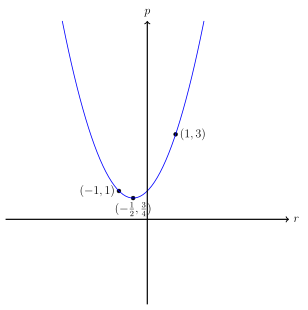
- Let \(r\) be a real number with \(\vert r \vert<1\) and let \[ S = \sum_{n=0}^\infty r^n\,. \] You may assume without proof that \(S = \displaystyle \frac{1}{1-r}\, \). Let \(p= 1 + r +r^2\). Sketch the graph of the function \(1+r+r^2\) and deduce that \(\frac{3}{4} \le p < 3\,\). Show that, if \(1 < p < 3\), then the value of \( p\) determines \(r\), and hence \(S\), uniquely. Show also that, if \(\frac{3}{4} < p < 1\), then there are two possible values of \(S\) and these values satisfy the equation \((3-p)S^2-3S+1=0\).
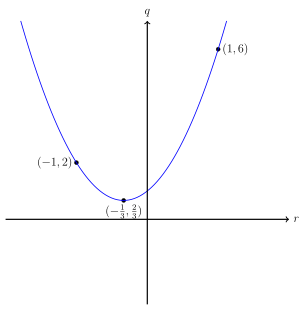
- Let \(r\) be a real number with \(\vert r \vert<1\) and let \[ T =\sum_{n=1}^\infty nr^{n-1}\,. \] You may assume without proof that \(T = \displaystyle \dfrac{1}{(1-r)^2}\,.\) Let \( q= 1+2r+3r^2\). Find the set of values of \( q\) that determine \(T\) uniquely. Find the set of values of \(q\) for which \(T\) has two possible values. Find also a quadratic equation, with coefficients depending on \( q\), that is satisfied by these two values.
Solution:
- \(\,\)
Notice that \(1+r+r^2\) ranges from \(\frac34\) to \(3\) over \((-1,1)\) therefore \(\frac34 \leq p < 3\) attaining its minimum but not its maximum. If \(p > 1\) we know we must be on the right branch and hence we can determine \(r\) and \(S\) uniquely. If \(\frac34 < p < 1\) then we must have two possible values for \(r\), satisfying \(r_i^2 + r+1 = p\) and so our two possible values for \(S_i = \frac{1}{1-r_i}\) or \(r_i = 1-\frac{1}{S_i}\) and so \begin{align*} && p &= \left ( 1 - \frac{1}{S} \right)^2 + 1 - \frac1S + 1 \\ \Rightarrow && pS^2 &= (S-1)^2 + S^2-S + S^2 \\ \Rightarrow && 0 &= (3-p)S^2 -3S + 1 \end{align*}
- \(\,\)
So \(\frac23 \leq q < 6\) and \(r\) and hence \(T\) is uniquely determined if \(2 \leq q < 6\). if \(\frac23
2007 Paper 1 Q14
The discrete random variable \(X\) has a Poisson distribution with mean \(\lambda\).
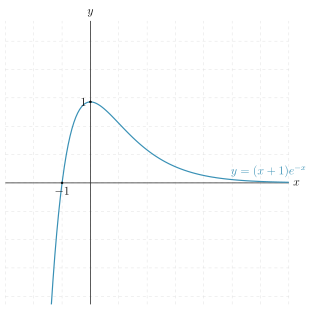
- Sketch the graph \(y=\l x+1 \r \e^{-x}\), stating the coordinates of the turning point and the points of intersection with the axes. It is known that \(\P(X \ge 2) = 1-p\), where \(p\) is a given number in the range \(0 < p <1\). Show that this information determines a unique value (which you should not attempt to find) of \(\lambda\).
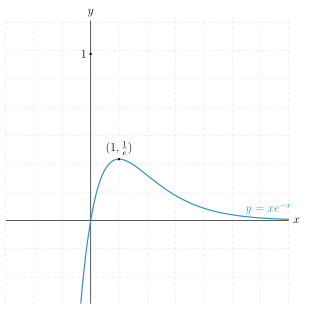
- It is known (instead) that \(\P \l X = 1 \r = q\), where \(q\) is a given number in the range \(0 < q <1\). Show that this information determines a unique value of \(\lambda\) (which you should find) for exactly one value of \(q\) (which you should also find).
- It is known (instead) that \(\P \l X = 1 \, \vert \, X \le 2 \r = r\), where \(r\) is a given number in the range \(0 < r < 1\). Show that this information determines a unique value of \(\lambda\) (which you should find) for exactly one value of \(r\) (which you should also find).
Solution: Let \(X \sim Po(\lambda)\), then
- \(\,\)
Suppose \(\mathbb{P}(X \geq 2) = 1-p\) then \(\mathbb{P}(X=0) + \mathbb{P}(X=1) = p\), ie \(e^{-\lambda} +\lambda e^{-\lambda} = p\) If \(f(x) = (1+x)e^{-x}\) we have see it is strictly decreasing on \(x \geq 0\) and takes all values from \(1\) to \(0\), therefore we can find a unique value such that \(f(\lambda) = p\) which is our desired \(\lambda\).
- Note that \(\mathbb{P}(X = 1) = \lambda e^{-\lambda}\)
Sketching \(y = xe^{-x}\) and finding it's turning point we can see that there is a unique value of \(\lambda = 1\) when \(q = \frac{1}{e}\), otherwise there is either no solution (\(p > \frac1{e}\)) or two solutions (\(0 < q > \frac1{e}\)).
- Suppose \(\mathbb{P}(X = 1 | X \leq 2) = r\), ie \begin{align*} && r &= \frac{\lambda e^{-\lambda}}{e^{-\lambda} + \lambda e^{-\lambda} + \frac12 \lambda^2 e^{-\lambda}} \\ &&&= \frac{2\lambda}{2+2\lambda+\lambda^2} \\ \Rightarrow && 0 &= r\lambda^2 + 2(r-1) \lambda + 2r\\ \Rightarrow && \Delta &= 4(r-1)^2 - 4\cdot r \cdot 2 r \\ &&&= 4((r-1)^2-2r^2) \\ &&&= 4(r-1-\sqrt{2}r)(r-1+\sqrt{2}r) \\ &&&= -4((\sqrt{2}-1)r + 1)((1+\sqrt{2})r-1) \end{align*} Therefore our quadratic in \(r\) has a unique solution if \(r = \frac{1}{1+\sqrt{2}}\). If it has a positive solution then note since \(2r > 0\) both solutions are positive, so \(\lambda\) is not unique by excluding other solutions.
2000 Paper 2 Q1
A number of the form \(1/N\), where \(N\) is an integer greater than 1, is called a unit fraction. Noting that \[ \frac1 2 =\frac13 + \frac16\\\ \mbox{ and } \frac13 = \frac14 + \frac1{12}, \] guess a general result of the form $$ \frac1N =\frac1a +\frac1b \tag{*} $$ and hence prove that any unit fraction can be expressed as the sum of two distinct unit fractions. By writing \((*)\) in the form \[ (a-N)(b-N)=N^2 \] and by considering the factors of \(N^2\), show that if \(N\) is prime, then there is only one way of expressing \(1/N\) as the sum of two distinct unit fractions. Prove similarly that any fraction of the form \(2/N\), where \(N\) is prime number greater than 2, can be expressed uniquely as the sum of two distinct unit fractions.
Solution: Notice that \(\frac{1}{N} = \frac{1}{N+1} + \frac{1}{N(N+1)}\), so any unit fraction can be expressed as the sum of two distinct unit fractions. \begin{align*} && \frac{1}N &= \frac1a + \frac1b \\ \Leftrightarrow && ab&= Nb+Na \\ \Leftrightarrow && 0 &= (a-N)(b-N)-N^2 \\ \Leftrightarrow && N^2 &= (a-N)(b-N) \end{align*} If \(N\) is prime then the only factors of \(N^2\) are \(1,N\) and \(N^2\). if \(a-N = b-N = N\) then \(a=b\) and we don't have distinct fractions. Therefore \(a-N = 1\) and \(b-N = N^2\) and we obtain the decomposition earlier (and it must be the only solution). \begin{align*} && \frac2N &= \frac1a+\frac1b \\ \Leftrightarrow && 2ab &= Nb+Na \\ \Leftrightarrow && 4ab &= 2Na+2Nb \\ \Leftrightarrow && N^2 &= (2a-N)(2b-N) \end{align*} Therefore for \(a,b\) to be distinct we must have \(2a = N+1\) and \(2b = N+N^2\) as the only possible factorisation. Both of the right hand sides are even so we can write \[ \frac{1}{N} = \frac{1}{\frac{N+1}{2}} + \frac{1}{\frac{N(N+1)}{2}} \] and this is unique
1989 Paper 2 Q7
By means of the substitution \(x^{\alpha},\) where \(\alpha\) is a suitably chosen constant, find the general solution for \(x>0\) of the differential equation \[ x\frac{\mathrm{d}^{2}y}{\mathrm{d}x^{2}}-b\frac{\mathrm{d}y}{\mathrm{d}x}+x^{2b+1}y=0, \] where \(b\) is a constant and \(b>-1\). Show that, if \(b>0\), there exist solutions which satisfy \(y\rightarrow1\) and \(\mathrm{d}y/\mathrm{d}x\rightarrow0\) as \(x\rightarrow0\), but that these conditions do not determine a unique solution. For what values of \(b\) do these conditions determine a unique solution?
Solution: Let \(z = x^\alpha, \frac{\d z}{\d x}=\alpha x^{\alpha-1} \), then \begin{align*} \frac{\d y}{\d x} &= \frac{\d y}{\d z} \frac{\d z}{\d x} \\ &= \alpha x^{\alpha-1}\frac{\d y}{\d z} \\ \\ \frac{\d^2 y}{\d x^2} &= \frac{\d }{\d x} \left ( \alpha x^{\alpha-1}\frac{\d y}{\d z} \right) \\ &= \alpha (\alpha-1)x^{\alpha-2} \frac{\d y}{\d z} + \alpha x^{\alpha-1} \frac{\d ^2 y}{\d z^2} \frac{\d z}{\d x} \\ &= \alpha(\alpha-1)x^{\alpha-2} \frac{\d y}{\d z} + \alpha^2 x^{2\alpha-2} \frac{\d ^2y}{\d z^2} \end{align*} \begin{align*} && 0 &=x\frac{\mathrm{d}^{2}y}{\mathrm{d}x^{2}}-b\frac{\mathrm{d}y}{\mathrm{d}x}+x^{2b+1}y \\ &&&= x \left ( \alpha(\alpha-1)x^{\alpha-2} \frac{\d y}{\d z} + \alpha^2 x^{2\alpha-2} \frac{\d ^2y}{\d z^2}\right) - b \left ( \alpha x^{\alpha-1}\frac{\d y}{\d z} \right) + x^{2b+1}y \\ &&&= \alpha^2 x^{2\alpha-1} \frac{\d^2 y}{\d z^2} +\left (\alpha(\alpha-1)x^{\alpha-1}-b\alpha x^{\alpha-1} \right) \frac{\d y}{\d z} + x^{2b+1} y \\ \end{align*} If we set \(\alpha = b +1\) the middle term disappears, so we get \begin{align*} && 0 &= (b+1)^2 x^{2b+1} \frac{\d^2 y}{\d z^2} + x^{2b+1} y \\ \Rightarrow && 0 &= (b+1)^2 \frac{\d^2 y}{\d z^2} + y \\ \Rightarrow && y &= A \sin \left (\frac{z}{b+1} \right) + B \cos \left (\frac{z}{b+1} \right) \\ &&&= \boxed{A \sin \left (\frac{x^{b+1}}{b+1} \right) + B \cos \left (\frac{x^{b+1}}{b+1} \right)} \\ \\ \lim_{x \to 0}: && y &\to B \\ && \frac{\d y}{\d x} &= A x^b \cos\left (\frac{x^{b+1}}{b+1} \right) - B x^b \sin\left (\frac{x^{b+1}}{b+1} \right) \\ b>0: && \frac{\d y}{\d x} &\to 0 \\ \end{align*} So there are infinitely many different solutions with \(B = 1\) and \(A\) is anything it wants to be. If \(b = 0\) \(y' \to A\) so \(A =0 \) and unique. If \(b < 0\) \(x^b \to \infty\) so we need \(A = 0\), unique. However, we also need \(y' \to 0\), so we need to check \(y' = -x^b \sin \left ( \frac{x^{b+1}}{b+1}\right) \to 0\), \begin{align*} y' &= -x^b \sin \left ( \frac{x^{b+1}}{b+1}\right) \\ &\approx -x^b \left ( \frac{x^{b+1}}{b+1}\right) \\ &= - \frac{x^{2b+1}}{b+1} \end{align*} so we need \(2b+1>0 \Rightarrow b > -\frac12\). Therefore the solution is unique on \((-\frac12,0]\)
1988 Paper 3 Q2
The real numbers \(u_{0},u_{1},u_{2},\ldots\) satisfy the difference equation \[ au_{n+2}+bu_{n+1}+cu_{n}=0\qquad(n=0,1,2,\ldots), \] where \(a,b\) and \(c\) are real numbers such that the quadratic equation \[ ax^{2}+bx+c=0 \] has two distinct real roots \(\alpha\) and \(\beta.\) Show that the above difference equation is satisfied by the numbers \(u_{n}\) defined by \[ u_{n}=A\alpha^{n}+B\beta^{n}, \] where \[ A=\frac{u_{1}-\beta u_{0}}{\alpha-\beta}\qquad\mbox{ and }\qquad B=\frac{u_{1}-\alpha u_{0}}{\beta-\alpha}. \] Show also, by induction, that these numbers provide the only solution. Find the numbers \(v_{n}\) \((n=0,1,2,\ldots)\) which satisfy \[ 8(n+2)(n+1)v_{n+2}-2(n+3)(n+1)v_{n+1}-(n+3)(n+2)v_{n}=0 \] with \(v_{0}=0\) and \(v_{1}=1.\)
Solution: First notice that \(u_n = \alpha^n\) and \(u_n = \beta^n\) both satisfy the recurrence, since: \begin{align*} && a \alpha^2 + b \alpha + c &= 0 \\ \Rightarrow && a \alpha^{n+2} + b \alpha^{n+1} + c \alpha^n &= 0 \\ \Rightarrow && a u_{n+2} + bu_{n+1} + cu_n &=0 \end{align*} Notice also that if \(u_n\) and \(v_n\) both satisfy the recurrence, then any linear combination of them will satisfy the recurrence: \begin{align*} && \begin{cases} au_{n+2} + bu_{n+1} + cu_n &= 0 \\ av_{n+2} + bv_{n+1} + cv_n &= 0 \\ \end{cases} \\ \Rightarrow && a (\lambda u_{n+2}+ \mu v_{n+2}) + b (\lambda u_{n+1}+ \mu v_{n+1}) + c (\lambda u_{n}+ \mu v_{n}) &= 0 \end{align*} by adding a linear combination of the top two equations. Therefore it suffices to check that the constants \(A\) and \(B\) are such that we match \(u_0\) and \(u_1\). \(\frac{u_1 - \beta u_0}{\alpha - \beta} + \frac{u_1 - \alpha u_0}{\beta - \alpha} = u_0\) and \(\frac{u_1 - \beta u_0}{\alpha - \beta}\alpha + \frac{u_1 - \alpha u_0}{\beta - \alpha}\beta = u_1\). So we are done. Suppose we have another sequence, then we first notice that the first and second terms must be identical to each other. Suppose the first \(k\) terms are identical, then since the \(k+1\)th term depends only on the \(k\) and \(k-1\)th terms (both of which are equal) the \(k+1\)th term is the same. Therefore, by the principle of mathematical induction, all terms are the same. First notice that if you put \(v_n = (n+1)w_n\) we have \begin{align*} && 8(n+3)(n+2)(n+1)w_{n+2} - 2(n+3)(n+2)(n+1)w_{n+1} - (n+3)(n+2)(n+1)w_n &= 0 \\ \Rightarrow && 8w_{n+2}-2w_{n+1}-w_n &= 0 \end{align*} This has characteristic equation \(8\lambda^2 - 2\lambda - 1 = 0 \Rightarrow \lambda = \frac12, -\frac14\). Therefore the general solution is \(w_n = A \l \frac12 \r^n + B \l -\frac14\r^n\) and \(v_n = (n+1)\l A \l \frac12 \r^n + B \l -\frac14\r^n \r\). When \(n = 0\) we have \(A+B = 0 \Rightarrow B =-A\). When \(n=1\) we have \(1 = 2 \l \frac{A}{2} + \frac{A}{4} \r \Rightarrow A = \frac{4}{3}\), therefore \[ v_n = \frac{4}{3}(n+1) \l \frac{1}{2^n} + \l -\frac14\r^n \r\]