Problems
Filters
4 problems found
2019 Paper 2 Q9
A particle \(P\) is projected from a point \(O\) on horizontal ground with speed \(u\) and angle of projection \(\alpha\), where \(0 < \alpha < \frac{1}{2}\pi\).
- Show that if \(\sin \alpha < \frac{2\sqrt{2}}{3}\), then the distance \(OP\) is increasing throughout the flight. Show also that if \(\sin \alpha > \frac{2\sqrt{2}}{3}\), then \(OP\) will be decreasing at some time before the particle lands.
- At the same time as \(P\) is projected, a particle \(Q\) is projected horizontally from \(O\) with speed \(v\) along the ground in the opposite direction from the trajectory of \(P\). The ground is smooth. Show that if $$2\sqrt{2}v > (\sin \alpha - 2\sqrt{2} \cos \alpha)u,$$ then \(QP\) is increasing throughout the flight of \(P\).
Solution:
- Notice that \(P = \begin{pmatrix} u \cos \alpha t\\ u \sin \alpha t - \frac12 g t^2 \end{pmatrix}\), so \begin{align*} && |OP|^2 &= u^2 \cos^2 \alpha t^2 + \left (u \sin \alpha t - \frac12 g t^2 \right)^2 \\ &&&= u^2 \cos^2 \alpha t^2 +u^2 \sin^2 \alpha t^2 - u \sin \alpha g t^3 +\frac14 g^2 t^4 \\ &&&= u^2 t^2 -u\sin \alpha g t^3 + \frac14g^2t^4 \\ && \frac{\d |OP|^2}{\d t} &= 2u^2 t - 3u \sin \alpha g t^2+g^2 t^3 \\ &&&= t \left (2u^2 - 3u \sin \alpha (gt)+(gt)^2\right) \\ && \Delta &= 9u^2 \sin^2 \alpha -4 \cdot 2u^2 \cdot 1 \\ &&&= u^2 (9\sin^2 \alpha -8) \\ \end{align*} Therefore if \(\sin \alpha < \frac{2\sqrt{2}}3\) the discriminant is negative, the quadratic factor is always positive and the distance \(|OP|\) is always increasing. Similarly, if \(\sin \alpha > \frac{2 \sqrt{2}}3\) then the derivative has a root. This means somewhere on its (possibly extended) trajectory \(OP\) is decreasing. This must be before it lands, since if it were after it 'landed' then both the \(x\) and \(y\) distances are increasing, therefore it cannot occur after it 'lands'.
- Note that \(Q = \begin{pmatrix} -v t \\0 \end{pmatrix}\) \begin{align*} && |QP|^2 &= (u \cos \alpha t+vt)^2 + \left (u \sin \alpha t - \frac12 g t^2 \right)^2 \\ &&&= u^2 \cos^2 \alpha t^2+2u\cos \alpha v t^2 + v^2 t^2 +u^2 \sin^2 \alpha t^2 - u \sin \alpha g t^3 +\frac14 g^2 t^4 \\ &&&= (u^2+2u v \cos \alpha+v^2) t^2 - u \sin \alpha g t^3 + \frac14 g^2 t^4 \\ \\ \Rightarrow && \frac{\d |QP|^2}{\d t} &= 2(u^2+u v \cos \alpha+v^2) t - 3u \sin \alpha g t^2 + g^2 t^3 \\ &&&= t \left ( 2(u^2+2u v \cos \alpha+v^2) - 3u \sin \alpha (g t) + (g t)^2\right) \\ && \Delta &= 9u^2 \sin^2 \alpha - 8(u^2+2u v \cos \alpha+v^2) \\ &&&= (9 \sin^2 \alpha -8)u^2 - 16v \cos \alpha u - 8v^2 \\ &&&= \left (( \sin \alpha-2\sqrt{2}\cos \alpha)u-2\sqrt{2} v \right) \left ( ( \sin \alpha+2\sqrt{2}\cos \alpha)u+2\sqrt{2} v \right) \end{align*} Since the second bracket is clearly positive, the first bracket must be negative (for \(\Delta < 0\) and our derivative to be positive), ie \(2\sqrt{2} v > ( \sin \alpha-2\sqrt{2}\cos \alpha)u\)
2013 Paper 1 Q9
Two particles, \(A\) and \(B\), are projected simultaneously towards each other from two points which are a distance \(d\) apart in a horizontal plane. Particle \(A\) has mass \(m\) and is projected at speed \(u\) at angle \(\alpha\) above the horizontal. Particle \(B\) has mass \(M\) and is projected at speed \(v\) at angle \(\beta\) above the horizontal. The trajectories of the two particles lie in the same vertical plane. The particles collide directly when each is at its point of greatest height above the plane. Given that both \(A\) and \(B\) return to their starting points, and that momentum is conserved in the collision, show that \[ m\cot \alpha = M \cot \beta\,. \] Show further that the collision occurs at a point which is a horizontal distance \(b\) from the point of projection of \(A\) where \[ b= \frac{Md}{m+M}\, , \] and find, in terms of \(b\) and \(\alpha\), the height above the horizontal plane at which the collision occurs.
Solution: Since \(A\) and \(B\) return to their starting points, and at their highest points there is no vertical component to their velocities, their horizontal must perfectly reverse, ie \begin{align*} && m u \cos \alpha - M v \cos \beta &= -m u \cos \alpha + M v \cos \beta \\ \Rightarrow && mu \cos \alpha &= Mv \cos \beta \end{align*} Since they reach their highest points at the same time, they must have the same initial vertical speed, ie \(u \sin \alpha = v \sin \beta\), so \begin{align*} && m v \frac{\sin \beta}{\sin \alpha} \cos \alpha &= M v \cos \beta \\ \Rightarrow && m \cot \alpha &= M \cot \beta \end{align*} The horizontal distance travelled by \(A\) & \(B\) will be: \begin{align*} && d_A &= u \cos \alpha t \\ && d_B &= v \cos \beta t \\ \Rightarrow && \frac{d_A}{d_A+d_B} &= \frac{u \cos \alpha}{u \cos \alpha + v \cos \beta} \\ &&&= \frac{\frac{M}{m}v \cos \beta}{\frac{M}{m}v \cos \beta + v \cos \beta} \\ &&&= \frac{M}{M+m} \\ \Rightarrow && d_A = b &= \frac{Md}{m+M} \end{align*} Applying \(v^2 = u^2 + 2as\) we see that \begin{align*} && 0 &= u \sin \alpha - gt \\ \Rightarrow && t &= \frac{u \sin \alpha}{g} \\ && b &=u \cos \alpha \frac{u \sin \alpha}{g} \\ \Rightarrow && u^2 &= \frac{2bg}{\sin 2 \alpha} \\ && 0 &= u^2 \sin^2 \alpha - 2g h \\ \Rightarrow && h &= \frac{u^2 \sin^2 \alpha}{2g} \\ &&&= \frac{2bg}{\sin 2 \alpha} \frac{ \sin^2 \alpha}{2g} \\ &&&= \frac12 b \tan \alpha \end{align*}
2011 Paper 3 Q9
Particles \(P\) and \(Q\) have masses \(3m\) and \(4m\), respectively. They lie on the outer curved surface of a~smooth circular cylinder of radius~\(a\) which is fixed with its axis horizontal. They are connected by a light inextensible string of length \(\frac12 \pi a\), which passes over the surface of the cylinder. The particles and the string all lie in a vertical plane perpendicular to the axis of the cylinder, and the axis intersects this plane at \(O\). Initially, the particles are in equilibrium. Equilibrium is slightly disturbed and \(Q\) begins to move downwards. Show that while the two particles are still in contact with the cylinder the angle \(\theta\) between \(OQ\) and the vertical satisfies \[ 7a\dot\theta^2 +8g \cos\theta + 6 g\sin\theta = 10g\,. \]
- Given that \(Q\) loses contact with the cylinder first, show that it does so when~\(\theta=\beta\), where \(\beta\) satisfies \[ 15\cos\beta +6\sin\beta =10. \]
- Show also that while \(P\) and \(Q\) are still in contact with the cylinder the tension in the string is $\frac {12}7 mg(\sin\theta +\cos\theta)\,$.
1994 Paper 2 Q9
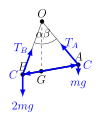
A light rod of length \(2a\) is hung from a point \(O\) by two light inextensible strings \(OA\) and \(OB\) each of length \(b\) and each fixed at \(O\). A particle of mass \(m\) is attached to the end \(A\) and a particle of mass \(2m\) is attached to the end \(B.\) Show that, in equilibrium, the angle \(\theta\) that the rod makes the horizontal satisfies the equation \[ \tan\theta=\frac{a}{3\sqrt{b^{2}-a^{2}}}. \] Express the tension in the string \(AO\) in terms of \(m,g,a\) and \(b\).
Solution: