Problems
Filters
10 problems found
2024 Paper 3 Q3
Throughout this question, consider only \(x > 0\).
- Let
\[\mathrm{g}(x) = \ln\left(1 + \frac{1}{x}\right) - \frac{x+c}{x(x+1)}\]
where \(c \geqslant 0\).
- Show that \(y = \mathrm{g}(x)\) has positive gradient for all \(x > 0\) when \(c \geqslant \frac{1}{2}\).
- Find the values of \(x\) for which \(y = \mathrm{g}(x)\) has negative gradient when \(0 \leqslant c < \frac{1}{2}\).
- It is given that, for all \(c > 0\), \(\mathrm{g}(x) \to -\infty\) as \(x \to 0\).
Sketch, for \(x > 0\), the graphs of
\[y = \mathrm{g}(x)\]
in the cases
- \(c = \frac{3}{4}\),
- \(c = \frac{1}{4}\).
- The function \(\mathrm{f}\) is defined as
\[\mathrm{f}(x) = \left(1 + \frac{1}{x}\right)^{x+c}.\]
Show that, for \(x > 0\),
- \(\mathrm{f}\) is a decreasing function when \(c \geqslant \frac{1}{2}\);
- \(\mathrm{f}\) has a turning point when \(0 < c < \frac{1}{2}\);
- \(\mathrm{f}\) is an increasing function when \(c = 0\).
2013 Paper 2 Q3
- Given that the cubic equation \(x^3+3ax^2 + 3bx +c=0\) has three distinct real roots and \(c<0\), show with the help of sketches that either exactly one of the roots is positive or all three of the roots are positive.
- Given that the equation \(x^3 +3ax^2+3bx+c=0\) has three distinct real positive roots show that \begin{equation*} a^2>b>0, \ \ \ \ a<0, \ \ \ \ c<0\,. \tag{\(*\)} \end{equation*} [Hint: Consider the turning points.]
- Given that the equation \(x^3 +3ax^2+3bx+c=0\) has three distinct real roots and that \begin{equation*} ab<0, \ \ \ \ c>0\,, \end{equation*} determine, with the help of sketches, the signs of the roots.
- Show by means of an explicit example (giving values for \(a\), \(b\) and \(c\)) that it is possible for the conditions (\(*\)) to be satisfied even though the corresponding cubic equation has only one real root.
Solution:
- First notice that this cubic has leading first term \(1\) and three real roots, so it must have the shape:
With the \(x\)-axis running somewhere between the dashed lines. Since \(c < 0\), the \(y\)-axis must meet the curve below the \(x\)-axis, ie somewhere on the blue section of this curve:
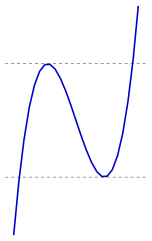 Therefore there will be either \(1\) (if it meets it in the \(\cup\) area) or \(3\) (if it meets it on the far left) positive roots.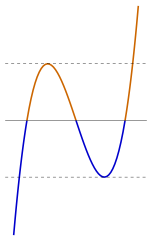
- First notice that if \(c > 0\) we cannot have three positive real roots since the function would need to pass \(0\) between \(0\) and \(-\infty\). Secondly, notice both turning points must be larger than zero, ie \begin{align*} && 0 &= 3x^2 + 6ax + 3b \\ \Leftrightarrow && 0 &= (x+a)^2 + b - a^2 \end{align*} has both roots larger than zero, (and it needs to have two roots, so \(a^2 > b\) and \(-a > 0\), ie \(a < 0\). If \(b < 0\), then just looking at \(x^2+2ax+b\) we can see that it is \(<0\) at \(0\) and one of the roots will be negative, therefore \(c < 0\), \(a^2 > b > 0\) and \(a < 0\)
- Since \(c > 0\) we can see that at least one root is negative.
ie the \(y\)-axis passes through an orange section of this curve. What now matters is where the larger turning point is. Considering \(x^2 + 2ax + b\), we notice that \(ab < 0\) means that \((x-\alpha)(x-\beta)\) we must have \((\alpha + \beta)\alpha \beta > 0\) which isn't possible if both roots are negative. Therefore the \(y\)-axis passes through the orange \(\cap\) and there are \(2\) positive real roots.
- If we take \(a = 1, b = -1, c = 1\) then we have \(x^3 + 3x^2-3x+1\). This has turning points when \(x^2+2x-1 = 0\), ie \(x = -1 \pm \sqrt{2}\) Notice that \begin{align*} && y(-1\pm \sqrt2) &= (-1 \pm \sqrt{2})^3 + 3(-1 \pm \sqrt{2})^2-3(-1 \pm \sqrt{2}) + 1 \\ &&&= (-1\pm \sqrt{2}) \cdot (3 \mp 2\sqrt2) + 3(3 \mp \sqrt2) -3(-1\pm \sqrt2) + 1 \\ &&&= (-7 \pm 5 \sqrt2) + (9 \mp 3\sqrt2) +(3 \mp 3\sqrt2) + 1 \\ &&&= 24 \mp 16\sqrt2 = 8(3 \mp 2 \sqrt2) >0 \end{align*} ie both turning points are above zero and hence only one real root
2010 Paper 2 Q7
- By considering the positions of its turning points, show that the curve with equation \[ y=x^3-3qx-q(1+q)\,, \] where \(q>0\) and \(q\ne1\), crosses the \(x\)-axis once only.
- Given that \(x\) satisfies the cubic equation \[ x^3-3qx-q(1+q)=0\,, \] and that \[ x=u+q/u\,, \] obtain a quadratic equation satisfied by \(u^3\). Hence find the real root of the cubic equation in the case \(q>0\), \(q\ne1\).
- The quadratic equation \[ t^2 -pt +q =0\, \] has roots \(\alpha \) and \(\beta\). Show that \[ \alpha^3+\beta^3 = p^3 -3qp\,. \] It is given that one of these roots is the square of the other. By considering the expression \((\alpha^2 -\beta)(\beta^2-\alpha)\), find a relationship between \(p\) and \(q\). Given further that \(q>0\), \(q\ne1\) and \(p\) is real, determine the value of \(p\) in terms of \(q\).
2008 Paper 1 Q5
The polynomial \(\p(x)\) is given by \[ \ds \p(x)= x^n +\sum\limits_{r=0}^{n-1}a_rx^r\,, \] where \(a_0\), \(a_1\), \(\ldots\) , \(a_{n-1}\) are fixed real numbers and \(n\ge1\). Let \(M\) be the greatest value of \(\big\vert \p(x) \big\vert\) for $\vert x \vert\le 1\(. Then Chebyshev's theorem states that \)M\ge 2^{1-n}$.
- Prove Chebyshev's theorem in the case \(n=1\) and verify that Chebyshev's theorem holds in the following cases:
- \( \p(x) = x^2 - \frac12\,\);
- \(\p(x) = x^3 - x \,\).
- Use Chebyshev's theorem to show that the curve $ \ y= 64x^5+25x^4-66x^3-24x^2+3x+1 \ $ has at least one turning point in the interval \(-1\le x \le 1\).
Solution:
- If \(n = 1\) the theorem is \(\max_{x \in [-1,1]} \left ( |x + a_0 |\right) \geq 1\), but clearly \(\max(1+a_0, |a_0 - 1|) \geq 1\) (taking according to the sign of \(a_0\))
- \( \p(x) = x^2 - \frac12\,\) - take \(x = 0\) then \(|p(0)| = \frac12 \geq 2^{1-2} = \frac12\)
- \(\p(x) = x^3 - x \,\). take \(x = \frac1{\sqrt{2}}\), then \(|p\left ( \frac1{\sqrt{2}}\right)| = |\frac12 \frac{1}{\sqrt{2}}-\frac{1}{\sqrt{2}}| = \frac{1}{2\sqrt{2}} > \frac14 = 2^{1-3} \)
- Consider \(p(x) = \frac{1}{64} \left ( 64x^5+25x^4-66x^3-24x^2+3x+1\right)\), then \(p\) satisfies the conditions of the theorem, therefore \(\max |p(x)| \geq 2^{1-5} = \frac1{16} = \frac{4}{64}\). However, \(p(-1) = \frac{1}{64}\) and \(p(1) = \frac{3}{64}\), so it cannot be strictly increasing or decreasing and there must be at turning point to achieve \(\frac{4}{64}\)
2008 Paper 2 Q3
- Find the coordinates of the turning points of the curve \(y=27x^3-27x^2+4\). Sketch the curve and deduce that \(x^2(1-x)\le 4/27\) for all \(x\ge0\,\). Given that each of the numbers \(a\), \(b\) and \(c\) lies between \(0\) and \(1\), prove by contradiction that at least one of the numbers \(bc(1-a)\), \(ca(1-b)\) and \(ab(1-c)\) is less than or equal to \(4/27\).
- Given that each of the numbers \(p\) and \(q\) lies between \(0\) and \(1\), prove that at least one of the numbers \(p(1-q)\) and \(q(1-p)\) is less than or equal to \(1/4\).
Solution:
- \(\,\)
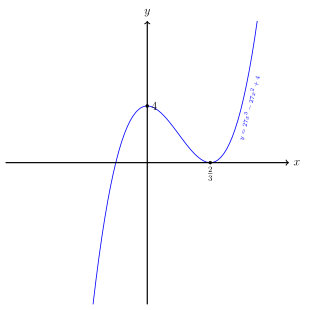
\begin{align*}
&& y & = 27x^3 - 27x^2 + 4 \\
\Rightarrow && \frac{\d y}{\d x} &= 81x^2 - 54x \\
\Rightarrow && x &= 0, \frac23 \\
\Rightarrow && (x,y) &= (0, 4), \left (\frac23, 0 \right)
\end{align*}
Since \(f(x) \geq 0\) for \(x \geq 0\) we must have \(27x^2(1-x) \leq 4 \Rightarrow x^2(1-x) \leq \frac{4}{27}\) Suppose for contradiction that \(bc(1-a) > \frac{4}{27}, ca(1-b) > \frac{4}{27}, ab(1-c) > \frac{4}{27}\) then taking the product we see \begin{align*} && \left ( \frac{4}{27} \right)^3 &< bc(1-a) \cdot ca(1-b) \cdot ab(1-c) \\ &&&= a^2(1-c) \cdot b^2(1-b) \cdot c^2(1-c) \leq \left ( \frac{4}{27}\right)^3 \end{align*} which is a contradiction.
- Notice that \(f(x) = x(1-x)\) has a turning point at \((\frac12, \frac14)\), and so \(f(x) \leq \frac14\). Suppose for contradiction that both \(p(1-q)\) and \(q(1-p)\) are larger than \(1/4\) \begin{align*} && \left ( \frac14 \right)^2 &< p(1-q) \cdot q(1-p) \\ &&&= p(1-p) \cdot q(1-q) \\ &&&\leq \left ( \frac14 \right)^2 \end{align*} which is a contradiction.
2003 Paper 3 Q5
Find the coordinates of the turning point on the curve \(y = x^2 - 2bx + c\,\). Sketch the curve in the case that the equation \(x^2 - 2bx + c=0\) has two distinct real roots. Use your sketch to determine necessary and sufficient conditions on \(b\) and \(c\) for the equation \(x^2 - 2bx + c = 0\) to have two distinct real roots. Determine necessary and sufficient conditions on \(b\) and \(c\) for this equation to have two distinct positive roots. Find the coordinates of the turning points on the curve \(y = x^3 - 3b^2x + c\) (with \(b>0\)) and hence determine necessary and sufficient conditions on \(b\) and \(c\) for the equation \(x^3 - 3b^2x + c = 0\) to have three distinct real roots. Determine necessary and sufficient conditions on \(a\,\), \(b\) and \(c\) for the equation \(\l x - a \r^3 - 3b^2 \l x - a \r + c = 0\) to have three distinct positive roots. Show that the equation \(2x^3 - 9x^2 + 7x - 1 = 0\) has three distinct positive roots.
Solution: \begin{align*} y &= x^2-2bx+c \\ &= (x-b)^2+c-b^2 \end{align*} Therefore the turning point is at \((b,c-b^2)\)


1998 Paper 3 Q7
Sketch the graph of \({\rm f}(s)={ \e}^s(s-3)+3\) for \(0\le s < \infty\). Taking \({\e\approx 2.7}\), find the smallest positive integer, \(m\), such that \({\rm f}(m) > 0\). Now let $$ {\rm b}(x) = {x^3 \over \e^{x/T} -1} \, $$ where \(T\) is a positive constant. Show that \({\rm b}(x)\) has a single turning point in \(0 < x < \infty\). By considering the behaviour for small \(x\) and for large \(x\), sketch \({\rm b}(x)\) for \(0\le x < \infty\). Let $$ \int_0^\infty {\rm b}(x)\,\d x =B, $$ which may be assumed to be finite. Show that \(B = K T^n\) where \(K\) is a constant, and \(n\) is an integer which you should determine. Given that \(\displaystyle{B \approx 2 \int_0^{Tm} {\rm b}(x) {\,\rm d }x}\), use your graph of \({\rm b}(x)\) to find a rough estimate for \(K\).
1993 Paper 1 Q7
Sketch the curve \[ \mathrm{f}(x)=x^{3}+Ax^{2}+B \] first in the case \(A>0\) and \(B>0\), and then in the case \(A<0\) and \(B>0.\) Show that the equation \[ x^{3}+ax^{2}+b=0, \] where \(a\) and \(b\) are real, will have three distinct real roots if \[ 27b^{2}+3a^{3}b<0, \] but will have fewer than three if \[ 27b^{2}+4a^{3}b<0. \]
1989 Paper 1 Q9
Sketch the graph of \(8y=x^{3}-12x\) for \(-4\leqslant x\leqslant4\), marking the coordinates of the turning points. Similarly marking the turning points, sketch the corresponding graphs in the \((X,Y)\)-plane, if \begin{alignat*}{3} \rm{(a)} & \quad & & X=\tfrac{1}{2}x, & \qquad & Y=y,\\ \rm{(b)} & & & X=x, & & Y=\tfrac{1}{2}y,\\ \rm{(c)} & & & X=\tfrac{1}{2}x+1, & & Y=y,\\ \rm{(d)} & & & X=x, & & Y=\tfrac{1}{2}y+1. \end{alignat*} Find values for \(a,b,c,d\) such that, if \(X=ax+b,\) \(Y=cy+d\), then the graph in the \((X,Y)\)-plane corresponding to \(8y=x^{3}-12x\) has turning points at \((X,Y)=(0,0)\) and \((X,Y)=(1,1)\).
Solution: \(8\frac{\d y}{\d x} = 3(x^2-4)\) so the turning points are at \((\pm 2, \mp 2)\)


1988 Paper 2 Q6
Show that the following functions are positive when \(x\) is positive:
- [ \(x-\tanh x\)
- \(x\sinh x-2\cosh x+2\)
- \(2x\cosh2x-3\sinh2x+4x\).
Solution:
- Notice that \(f(x) = x - \tanh x\) has \(f'(x) = 1-\textrm{sech}^2 x = \tanh^2 x > 0\) so \(f(x)\) is strictly increasing on \((0, \infty)\) and \(f(0) = 0\) therefore \(f(x)\) is positive for all \(x\) positive
- Let \(f(x) = x\sinh x-2\cosh x+2\) then \(f'(x) = \sinh x +x \cosh x - 2 \sinh x = x \cosh x -\sinh x = \cosh x ( x - \tanh x) > 0\) by the first part. \(f(0) = 0\) so \(f(x)\) is positive for all \(x\) positive.
- Let \(f(x) = 2x\cosh2x-3\sinh2x+4x\) then \begin{align*} f'(x) &= 2\cosh 2x +4x\sinh 2x - 6 \cosh 2x + 4 \\ &= 4( x\sinh 2x-\cosh 2x +1) \\ &= 4(x2\cosh x \sinh x -2\cosh^2x ) \\ &= 8 \cosh^2 x (x - \tanh x) \end{align*} Which is always positive when \(x\) > 0, \(f(0) = 0\) so \(f(x) > 0\) for all positive \(x\).