Problems
Filters
11 problems found
2020 Paper 2 Q4
- Given that \(a\), \(b\) and \(c\) are the lengths of the sides of a triangle, explain why \(c < a + b\), \(a < b + c\) and \(b < a + c\).
- Use a diagram to show that the converse of the result in part (i) also holds: if \(a\), \(b\) and \(c\) are positive numbers such that \(c < a + b\), \(a < b + c\) and \(b < c + a\) then it is possible to construct a triangle with sides of length \(a\), \(b\) and \(c\).
- When \(a\), \(b\) and \(c\) are the lengths of the sides of a triangle, determine in each case whether the following sets of three lengths can
- always
- sometimes but not always
- never
- Let \(\mathrm{f}\) be a function defined on the positive real numbers and such that, whenever \(x > y > 0\), \[\mathrm{f}(x) > \mathrm{f}(y) > 0 \quad \text{but} \quad \frac{\mathrm{f}(x)}{x} < \frac{\mathrm{f}(y)}{y}.\] Show that, whenever \(a\), \(b\) and \(c\) are the lengths of the sides of a triangle, then \(\mathrm{f}(a)\), \(\mathrm{f}(b)\) and \(\mathrm{f}(c)\) can also be the lengths of the sides of a triangle.
Solution:
- Not that unless a side is the largest side, it is clearly shorter than the sum of the other two sides (since it's greater than or equal to one on its own). Note also that the distance from one vertex to the other (say \(c\)) is shorter than going via the other vertex \(a+b\), therefore \(c < a+b\).
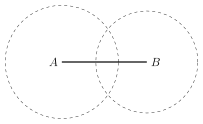
- Draw a line of the length of the largest number, say \(c\), then since \(c < a+b\) we must have circles radius \(a\) and \(b\) at the endpoints cross, and at their intersection we have a vertex of a \(c\)-\(a\)-\(b\) triangle.
- (A) always. Suppose \(c\) is the longest side, then \(c < a+b \Rightarrow c+1 < a + 1 + b+1\) so \((a+1,b+1,c+1)\) are still sides of a triangle. (B) sometimes, but not always. \((1,1,1) \to (1,1,1)\) is still a triangle, but \((10, 10, 1) \to (1, 10, \frac{1}{10})\) is not a triangle since \(10 > 1 + \frac{1}{10}\) (C) never, suppose \(a \leq b \leq c\) then the sides are \(b-a, c-b, c-a\) but \(c-a = (c-b)+(b-a)\) so the triangle inequality cannot be satisfied. (D) always - without loss of generality let \(c\) be the longest side, and since every term is homogeneous degree \(2\) we can divide through by \(c^2\) to see we have the sides \(a^2+b, b^2+a, 1+ab\) and note that \(1 + ab < a+b +ab < a+b+a^2+b^2\), also \(a^2+b < 1 + b < 1 + (a+b)b = 1 + b^2 + ab < (1+ab)+(b^2+a)\).
- Suppose \(f\) is increasing and \(\f(x)/x\) is decreasing, and suppose \(a,b,c\) are side-lengths of a triangle. Wlog \(c\) is the longest side, then note \(f(c) > f(b), f(a)\), so it suffices to prove that \(f(c) < f(a)+f(b)\) \begin{align*} \frac{f(c)}{c} < \frac{f(a)}{a}: && f(a) &> \frac{a}{c} f(c) \\ \frac{f(c)}{c} < \frac{f(b)}{b}: && f(b) &> \frac{b}{c} f(c) \\ \Rightarrow && f(a)+f(b) &> f(c) \underbrace{\left ( \frac{a+b}{c} \right)}_{>1} \\ &&&> f(c) \end{align*} as required
2019 Paper 2 Q3
For any two real numbers \(x_1\) and \(x_2\), show that $$|x_1 + x_2| \leq |x_1| + |x_2|.$$ Show further that, for any real numbers \(x_1, x_2, \ldots, x_n\), $$|x_1 + x_2 + \cdots + x_n| \leq |x_1| + |x_2| + \cdots + |x_n|.$$
- The polynomial f is defined by
$$f(x) = 1 + a_1 x + a_2 x^2 + \cdots + a_{n-1} x^{n-1} + x^n$$
where the coefficients are real and satisfy \(|a_i| \leq A\) for \(i = 1, 2, \ldots, n-1\), where \(A \geq 1\).
- If \(|x| < 1\), show that $$|f(x) - 1| \leq \frac{A|x|}{1 - |x|}.$$
- Let \(\omega\) be a real root of f, so that \(f(\omega) = 0\). In the case \(|\omega| < 1\), show that $$\frac{1}{1 + A} \leq |\omega| \leq 1 + A. \quad (*)$$
- Show further that the inequalities \((*)\) also hold if \(|\omega| \geq 1\).
- Find the integer root or roots of the quintic equation $$135x^5 - 135x^4 - 100x^3 - 91x^2 - 126x + 135 = 0.$$
Solution: Claim: \(|x_1 + x_2| \leq |x_1| + |x_2|\) Proof: Case 1: \(x_1, x_2 \geq 0\). The inequality is equivalent to \(|x_1 + x_2| = x_1 + x_2 = |x_1|+|x_2|\) so it's an equality. Case 2: \(x_1, x_2 \leq 0\). The inequality is equivalent to \(|x_1+x_2| = -x_1-x_2 = |x_1|+|x_2\), so it's also an equality in this case. Case 3: (wlog) \(|x_1| \geq |x_2| > 0\) and \(x_1x_2 < 0\) then \(|x_1+x_2| = x_1-x_2 \leq x_1 \leq |x_1|+|x_2|\) We can prove this by induction, we've already proven the base case and: \(|x_1+x_2 + \cdots + x_n| \leq |x_1 + x_2 + \cdots x_{n-1}| + |x_n| \leq |x_1| + |x_2| + \cdots + |x_n|\)
- \(\,\) \begin{align*} && |f(x) - 1| &= |a_1 x + a_2x^2 + \cdots + a_{n-1}x^{n-1} + x^n| \\ &&&\leq |a_1x| + |a_2x^2| + \cdots + |a_{n-1}x^{n-1}| + |x^n| \\ &&&\leq |a_1||x| + |a_2||x|^2 + \cdots + |a_{n-1}||x|^{n-1} + |x|^n \\ &&&\leq A|x| + A|x|^2 + \cdots + A|x|^{n-1} + |x|^n \\ &&&=A|x| \frac{1-|x|^{n-1}}{1-|x|} + |x|^n \\ &&&= \frac{A|x|-A|x|^{n}+|x|^{n+1}-|x|^n}{1-|x|} \\ &&&= \frac{A|x|-|x|^n(\underbrace{A-|x|+1}_{\geq0})}{1-|x|} \\ &&&\leq \frac{A|x|}{1-|x|} \end{align*}
- If \(f(\omega) = 0\) then \begin{align*} && 1 & \leq \frac{A|\omega|}{1-|\omega|} \\ \Leftrightarrow && 1-|\omega| &\leq A |\omega| \\ \Leftrightarrow && 1 &\leq (1+A) |\omega| \\ \Leftrightarrow && \frac{1}{1+A} &\leq |\omega| \\ \end{align*} We also know \(\omega \leq 1 < 1 + A\)
- If \(\omega\) is a root of \(f(x)\) then \(1/\omega\) is a root of \(1 + a_{n-1}x + a_{n-2}x^2 + \cdots + a_1x^{n-1}+x^n\) and so \(1/\omega\) satisfies that inequality, ie \begin{align*} && \frac{1}{1+A} && \leq &&|1/\omega| && \leq &&1 + A \\ \Leftrightarrow &&1+A && \geq&& |\omega| && \geq&& \frac{1}{1 + A} \end{align*}
- First notice that it's equivalent to: \(0 = x^5 - 1x^4 - \frac{100}{135}x^3-\frac{91}{135}x^2-\frac{126}{135} + 1\) therefore all integer roots must be between \(-2,-1\) and \(1\) and \(2\). \(1\) doesn't work. \(-1\) works. Clearly \(2\) cannot work by parity argument, therefore the only integer root is \(-1\).
2019 Paper 2 Q11
- The three integers \(n_1\), \(n_2\) and \(n_3\) satisfy \(0 < n_1 < n_2 < n_3\) and \(n_1 + n_2 > n_3\). Find the number of ways of choosing the pair of numbers \(n_1\) and \(n_2\) in the cases \(n_3 = 9\) and \(n_3 = 10\). Given that \(n_3 = 2n + 1\), where \(n\) is a positive integer, write down an expression (which you need not prove is correct) for the number of ways of choosing the pair of numbers \(n_1\) and \(n_2\). Simplify your expression. Write down and simplify the corresponding expression when \(n_3 = 2n\), where \(n\) is a positive integer.
- You have \(N\) rods, of lengths \(1, 2, 3, \ldots, N\) (one rod of each length). You take the rod of length \(N\), and choose two more rods at random from the remainder, each choice of two being equally likely. Show that, in the case \(N = 2n + 1\) where \(n\) is a positive integer, the probability that these three rods can form a triangle (of non-zero area) is $$\frac{n - 1}{2n - 1}.$$ Find the corresponding probability in the case \(N = 2n\), where \(n\) is a positive integer.
- You have \(2M + 1\) rods, of lengths \(1, 2, 3, \ldots, 2M + 1\) (one rod of each length), where \(M\) is a positive integer. You choose three at random, each choice of three being equally likely. Show that the probability that the rods can form a triangle (of non-zero area) is $$\frac{(4M + 1)(M - 1)}{2(2M + 1)(2M - 1)}.$$ Note: \(\sum_{k=1}^{K} k^2 = \frac{1}{6}K(K + 1)(2K + 1)\).
Solution:
- If \(n_3 = 9\) and we are looking for \(0 < n_1 < n_2 < n_3\) we can consider values for each \(n_2\). \begin{array}{clc|c} n_2 & \text{range} & \text{count} \\ \hline 6 & 4-5 & 2 \\ 7 & 3-6 & 4 \\ 8 & 2-7 & 6 \\ \hline & & 12 \end{array} When \(n_3 = 10\) \begin{array}{clc|c} n_2 & \text{range} & \text{count} \\ \hline 6 & 5 & 1 \\ 7 & 4-6 & 3 \\ 8 & 3-7 & 5 \\ 9 & 2-8 & 7 \\ \hline & & 16 \end{array} When \(n_3 = 2n+1\) we can have \(2 + 4 + \cdots + 2n-2 = n(n-1)\) When \(n_3 = 2n\) we can have \(1 + 3 + \cdots + 2n-3 = (n-1)^2\)
- For the 3 rods to form a triangle, it suffices for the sum of the lengths of the shorter rods to be larger than \(N\). When \(N = 2n+1\) there are \(n(n-1)\) ways this can happen, out of \(\binom{2n}{2}\) ways to choos the numbers, ie \begin{align*} && P &= \frac{n(n-1)}{\frac{2n(2n-1)}{2}} \\ &&&= \frac{n-1}{2n-1} \end{align*} When \(N = 2n\) there are \((n-1)^2\) ways this can happen, out of \(\binom{2n-1}{2}\) ways, ie \begin{align*} && P &= \frac{(n-1)^2}{\frac{(2n-1)(2n-2)}{2}} \\ &&&= \frac{n-1}{2n-1} \end{align*}
- The number of ways this can happen is: \begin{align*} C &= \sum_{k=3}^{2M+1} \# \{ \text{triangles where }k\text{ is largest} \} \\ &= \sum_{k=1}^{M} \# \{ \text{triangles where }2k+1\text{ is largest} \} +\sum_{k=1}^{M} \# \{ \text{triangles where }2k\text{ is largest} \}\\ &= \sum_{k=1}^{M} n(n-1)+\sum_{k=1}^{M} (n-1)^2\\ &= \sum_{k=1}^{M} (2n^2-3n+1)\\ &= \frac26M(M+1)(2M+1) - \frac32M(M+1) + M \\ &= \frac16 M(4M+1)(M-1) \end{align*} Therefore the probability is \begin{align*} && P &= \frac{M(4M+1)(M-1)}{6 \binom{2M+1}{3}} \\ &&&= \frac{M(4M+1)(M-1)}{(2M+1)2M(2M-1)} \\ &&&= \frac{(4M+1)(M-1)}{2(2M+1)(2M-1)} \end{align*}
2015 Paper 2 Q3
Three rods have lengths \(a\), \(b\) and \(c\), where \(a< b< c\). The three rods can be made into a triangle (possibly of zero area) if \(a+b\ge c\). Let \(T_{n}\) be the number of triangles that can be made with three rods chosen from \(n\) rods of lengths \(1\), \(2\), \(3\), \(\ldots\) , \(n\) (where \(n\ge3\)). Show that \(T_8-T_7 = 2+4+6\) and evaluate \(T_8 -T_6\). Write down expressions for \(T_{2m}-T_{2m-1}\) and \(T_{2m} - T_{2m-2}\). Prove by induction that \(T_{2m}=\frac 16 m (m-1)(4m+1)\,\), and find the corresponding result for an odd number of rods.
Solution: Every \(T_7\) triangle is valid, so we are interested in new triangles which have \(8\) has a longest side. We can have: \begin{array}{c|c|c} \text{longest} & \text{middle} & \text{shortest} \\ \hline 8 & 7 & 1-6 \\ 8 & 6 & 2-5 \\ 8 & 5 & 3-4 \end{array} which is \(6+4+2\) extra triangles. The new ones excluding all the sixes are: \begin{array}{c|c|c} \text{longest} & \text{middle} & \text{shortest} \\ \hline 8 & 7 & 1-6 \\ 8 & 6 & 2-5 \\ 8 & 5 & 3-4 \\ 7 & 6 & 1-5 \\ 7 & 5 & 2-4 \\ 7 & 4 & 3 \\ \end{array} Ie \(2+4+6 + 1 + 3+5\) \(T_{2m}-T_{2m-1} = 2 \frac{(m-1)m}{2} = m(m-1)\) and \(T_{2m}-T_{2m-2} = \frac{(2m-2)(2m-1)}{2}\) \(T_4 = 3\) (\(1,2,3\), \(1,3,4\), \(2,3,4\)) and \(\frac16 \cdot 2 \cdot 1 \cdot 9 = 3\) so the base case holds. Suppose it's true for some \(m = k\), then \begin{align*} && T_{2(k+1)} &= T_{2k} + \frac{2m(2m+1)}{2} \\ &&&= \frac{m(m-1)(4m+1)}{6} + \frac{6m(2m+1)}{6}\\ &&&= \frac{m(4m^2-3m-1+12m+6)}{6} \\ &&&= \frac{m(4m^2+9m+5)}{6}\\ &&&= \frac{m(4m+5)(m+1)}{6}\\ &&&= \frac{(m+1-1)(4(m+1)+5)(m+1)}{6}\\ \end{align*} as required, therefore it is true by induction. For odd numbers, we can see that \(T_{2m-1} = \frac{m(m-1)(4m+1)}{6} - m(m-1) = \frac{m(m-1)(4m-5)}{6}\)
2013 Paper 3 Q6
Let \(z\) and \(w\) be complex numbers. Use a diagram to show that \(\vert z-w \vert \le \vert z\vert + \vert w \vert\,.\) For any complex numbers \(z\) and \(w\), \(E\) is defined by \[ E = zw^* + z^*w +2 \vert zw \vert\,. \]
- Show that \(\vert z-w\vert^2 = \left( \vert z \vert + \vert w\vert\right)^2 -E\,\), and deduce that \(E\) is real and non-negative.
- Show that \(\vert 1-zw^*\vert^2 = \left ( 1 +\vert zw \vert \right)^2 -E\,\).
Solution:
- \(\,\) \begin{align*} && |z-w|^2 &= (z-w)(z^*-w^*) \\ &&&= zz^* - wz^*-zw^* + ww^* \\ &&&= |z|^2+|w|^2 - E + 2|zw| \\ &&&= (|z|+|w|)^2 - E \\ \Rightarrow && E &= (|z|+|w|)^2 - |z-w|^2 &\in \mathbb{R} \end{align*} and by the triangle inequality \(|z|+|w| \geq |z-w|\), so \(E \geq 0\)
- \(\,\) \begin{align*} && |1-zw^*|^2 &= (1-zw^*)(1-z^*w) \\ &&&= 1 - zw^*-z^*w + |zw|^2 \\ &&&= 1 - E + 2|zw| + |zw|^2 \\ &&&= (1+|zw|)^2 - E \end{align*} \begin{align*} && \frac{|z-w|^2}{|1-zw^*|^2} &= \frac{(|z|+|w|)^2-E}{(1+|zw|)^2-E} \\ \Leftrightarrow && (1+|zw|^2)|z-w|^2 -E|z-w|^2 &= (|z|+|w|)^2|1-zw^*|^2-E|1-zw^*|^2\\ \Leftrightarrow && (1+|zw|^2)|z-w|^2-(|z|+|w|)^2|1-zw^*|^2 &= E(|z-w|^2-|1-zw^*|^2)\\ &&&= E(|z|^2-zw^*-z^*w+|w|^2-1+zw^*+z^*w-|z|^2|w|^2) \\ &&&= E(|z|^2+|w|^2-1-|z|^2|w|^2) \\ &&&= -E(1-|z|^2)(1-|w|^2) \\ &&&\leq 0 \\ \Leftrightarrow&& (1+|zw|^2)|z-w|^2& \leq (|z|+|w|)^2|1-zw^*|^2\\ \Leftrightarrow&& \frac{|z-w|^2}{|1-zw^*|^2} &\leq \frac{(|z|+|w|)^2}{(1+|zw|)^2}\\ \Leftrightarrow && \frac{|z-w|}{|1-zw^*|} &\leq \frac{(|z|+|w|)}{(1+|zw|)}\\ \end{align*} Yes, this inequality holds if \(|z|, |w|\) are the same side of \(1\) and is reversed otherwise.
2002 Paper 3 Q8
Four complex numbers \(u_1\), \(u_2\), \(u_3\) and \(u_4\) have unit modulus, and arguments \(\theta_1\), \(\theta_2\), \(\theta_3\) and \(\theta_4\), respectively, with \(-\pi < \theta_1 < \theta_2 < \theta_3 < \theta_4 < \pi\). Show that \[ \arg \l u_1 - u_2 \r = \tfrac{1}{2} \l \theta_1 + \theta_2 -\pi \r + 2n\pi \] where \(n = 0 \hspace{4 pt} \mbox{or} \hspace{4 pt} 1\,\). Deduce that \[ \arg \l \l u_1 - u_2 \r \l u_4 - u_3 \r \r = \arg \l \l u_1 - u_4 \r \l u_3 - u_2 \r \r + 2n\pi \] for some integer \(n\). Prove that \[ | \l u_1 - u_2 \r \l u_4 - u_3 \r | + | \l u_1 - u_4 \r \l u_3 - u_2 \r | = | \l u_1 - u_3 \r \l u_4 - u_2 \r |\;. \]
1998 Paper 2 Q5
Define the modulus of a complex number \(z\) and give the geometric interpretation of \(\vert\,z_1-z_2\,\vert\) for two complex numbers \(z_1\) and \(z_2\). On the basis of this interpretation establish the inequality $$\vert\,z_1+z_2\,\vert\le \vert\,z_1\,\vert+\vert\,z_2\,\vert.$$ Use this result to prove, by induction, the corresponding inequality for \(\vert\,z_1+\cdots+z_n\,\vert\). The complex numbers \(a_1,\,a_2,\,\ldots,\,a_n\) satisfy \(|a_i|\le 3\) (\(i=1, 2, \ldots , n\)). Prove that the equation $$a_1z+a_2z^2\cdots +a_nz^n=1$$ has no solution \(z\) with \(\vert\,z\,\vert\le 1/4\).
Solution: Suppose \(z = a+ib\), where \(a,b \in \mathbb{R}\) then the modulus of \(z\), \(|z| = \sqrt{a^2+b^2}\). Noting the similarity to the Pythagorean theorem, we can say that \(|z_1 - z_2|\) is the distance between \(z_1\) and \(z_2\) in the Argand diagram. \begin{align*} |z_1 + z_2| &= |(z_1 - 0) + (0 -z_2)| \\ &\underbrace{\leq}_{\text{the direct distance is shorter than going via }0} |z_1 - 0| + |0 - z_2| \\ &= |z_1| + |-z_2| \\ &= |z_1| + |z_2| \end{align*} Claim: \(\displaystyle \vert\,z_1+\cdots+z_n\,\vert \leq \sum_{i=1}^n |z_i|\) Proof: (By Induction) Base Case: \(n = 1, 2\) have been proven. Inductive step, suppose it is true for \(n = k\), then consider \(n = k+1\), ie \begin{align*} \vert\,z_1+\cdots+z_k+z_{k+1}\,\vert &\leq \vert\,z_1+\cdots+z_k\vert + \vert z_{k+1}\,\vert \\ &\underbrace{\leq}_{\text{inductive hypothesis}} \sum_{i=1}^k |z_i| + |z_{k+1}| \\ &= \sum_{i=1}^{k+1} |z_i| \end{align*} Therefore if our hypothesis is true for \(n = k\) it is true for \(n = k+1\), and so since it is true for \(n = 1\) it is true by the principle of mathematical induction for all integers \(n \geq 1\). Suppose \(|z| \leq 1/4\), then consider: \begin{align*} \vert a_1z+a_2z^2+\cdots +a_nz^n \vert &\leq \vert a_1 z\vert + \vert a_2z^2\vert + \cdots + \vert a_n z_n\ \vert \\ &= \vert a_1\vert\vert z\vert + \vert a_2\vert\vert z^2\vert + \cdots + \vert a_n\vert\vert z^n\ \vert \\ &\leq 3\left ( |z| + |z|^2 + \cdots + |z|^n \right) \\ &\leq 3 \left ( \frac{1}{4} + \frac1{4^2} + \cdots + \frac{1}{4^n} \right) \\ &< 3 \frac{1/4}{1-1/4} \\ &= 1 \end{align*} Therefore we cannot have equality and there are no solutions.
1993 Paper 1 Q5
If \(z=x+\mathrm{i}y\) where \(x\) and \(y\) are real, define \(\left|z\right|\) in terms of \(x\) and \(y\). Show, using your definition, that if \(z_{1},z_{2}\in\mathbb{C}\) then \(\left|z_{1}z_{2}\right|=\left|z_{1}\right|\left|z_{2}\right|.\) Explain, by means of a diagram, or otherwise, why \(\left|z_{1}+z_{2}\right|\leqslant\left|z_{1}\right|+\left|z_{2}\right|.\) Suppose that \(a_{j}\in\mathbb{C}\) and \(\left|a_{j}\right|\leqslant1\) for \(j=1,2,\ldots,n.\) Show that, if \(\left|z\right|\leqslant\frac{1}{2},\) then \[ \left|a_{n}z^{n}+a_{n-1}z^{n-1}+\cdots+a_{1}z\right|<1, \] and deduce that any root \(w\) of the equation \[ a_{n}z^{n}+a_{n-1}z^{n-1}+\cdots+a_{1}z+1=0 \] must satisfy \(\left|x\right|>\frac{1}{2}.\)
1991 Paper 1 Q14
A set of \(2N+1\) rods consists of one of each length \(1,2,\ldots,2N,2N+1\), where \(N\) is an integer greater than 1. Three different rods are selected from the set. Suppose their lengths are \(a,b\) and \(c\), where \(a > b > c\). Given that \(a\) is even and fixed, show, by considering the possible values of \(b\), that the number of selections in which a triangle can then be formed from the three rods is \[ 1+3+5+\cdots+(a-3), \] where we allow only non-degenerate triangles (i.e. triangles with non-zero area). Similarly obtain the number of selections in which a triangle may be formed when \(a\) takes some fixed odd value. Write down a formula for the number of ways of forming a non-degenerate triangle and verify it for \(N=3\). Hence show that, if three rods are drawn at random without replacement, then the probability that they can form a non-degenerate triangle is \[ \frac{(N-1)(4N+1)}{2(4N^{2}-1)}. \]
Solution: Suppose we have \(a = 2k\), it is necessary (by the triangle inequality) that \(b + c > a\). So the smallest \(b\) can be is \(k+1\), and then \(c\) must be \(k\) (1 choice). Then \(b\) could be \(k+2\) and \(c\) can be \(k+1\), \(k\), \(k-1\) (3 choices). Suppose \(b = k+i\) then \(c\) can be \(k+i-1, \ldots, k-i+1\) which is \(2i-1\) choices. This works until \(b = 2k-1\) and there are \(2(k-1)-1 = 2k-3 = a-3\) choices. Therefore there are \(1 + 3 + 5 + \cdots + (a-3)\) total choices. If \(a = 2k+1\) then, \(b = k+1\) is not possible \(b = k+2\) we have \(a = k+1, k\) (2 choices) \(b = k+3\) we have \(a = k+2, k+1, k, k-1\) (4 choices) \(b = k + i\) we have \(a = k+i-1, \cdots, k-i+2\) (\(2i-2\) choices) This works until \(b = k+k\) with \(2k-2 = a-3\) choices. So \(2 + 4 + \cdots + (a-3)\) If \(a\) is even, we have \(\left ( \frac{a-2}{2} \right)^2\) If \(a\) is odd we have \(\frac{(a-3)(a-1)}{4}\) Therefore the total number is: \begin{align*} C &= \sum_{k=2}^N \left ( \frac{(2k-2)^2}{4} + \frac{(2k+1-3)(2k+1-1)}{4} \right) \\ &= \sum_{k=2}^N \left ( (k-1)^2 + (k-1)k\right) \\ &= \sum_{k=2}^N (2k^2-3k+1) \\ &= \sum_{k=1}^N (2k^2-3k+1) \\ &= \frac{N(N+1)(2N+1)}{3} - \frac{3N(N+1)}{2} + N \\ &= \frac{N((N+1)(4N+2-9)+6)}{6} \\ &= \frac{N(4N+1)(N-1)}{6} \\ \end{align*} When \(N = 3\) we have \(1, 2, \cdots, 7\) sticks, and so \(a = 4\), \(1\) option \(a = 5\), \(2\) options \(a = 6\) \(4\) options \(a = 7\) \(6\) options for a total of \(13\). \(\frac{3 \cdot 13 \cdot 2}{6} = 13\) so this is promising, There are \(\binom{2N+1}{3}\) ways to choose three sticks (in order) and of those our formula tells us how many are valid, therefore \begin{align*} && P &= \frac{ \frac{N(4N+1)(N-1)}{6} }{\frac{(2N+1)2N(2N-1)}{6}} \\ &&&= \frac{(4N+1)(N-1)}{2(4N^2-1)} \end{align*}
1990 Paper 3 Q16
- A rod of unit length is cut into pieces of length \(X\) and \(1-X\); the latter is then cut in half. The random variable \(X\) is uniformly distributed over \([0,1].\) For some values of \(X\) a triangle can be formed from the three pieces of the rod. Show that the conditional probability that, if a triangle can be formed, it will be obtuse-angled is \(3-2\sqrt{2.}\)
- The bivariate distribution of the random variables \(X\) and \(Y\) is uniform over the triangle with vertices \((1,0),(1,1)\) and \((0,1).\) A pair of values \(x,y\) is chosen at random from this distribution and a (perhaps degenerate) triangle \(ABC\) is constructed with \(BC=x\) and \(CA=y\) and \(AB=2-x-y.\) Show that the construction is always possible and that \(\angle ABC\) is obtuse if and only if \[ y>\frac{x^{2}-2x+2}{2-x}. \] Deduce that the probability that \(\angle ABC\) is obtuse is \(3-4\ln2.\)
Solution:
- The construction is possible if \(x + y > 2-x-y \Rightarrow x+y > 1\) (which is as the triangle is above the diagonal line), and \(x + (2-x-y) > y \Rightarrow 1 > y\) (true as the triangle is below the horizontal line) and \(y + (2-x-y) > x \Rightarrow 1 > x\) (true as the triangle is left of the vertical arrow). By the cosine rule: \begin{align*} && y^2 &= x^2 + (2-x-y)^2 - 2 x (2-x-y) \cos \angle ABC \\ \Rightarrow && \cos \angle ABC &= \frac{x^2+(2-x-y)^2 - y^2}{2x(2-x-y)} \\ &&&= \frac{4+2x^2-4x-4y+2xy}{2x(2-x-y)} \\ \underbrace{\Rightarrow}_{\cos \angle ABC < 0} && 0 &> 4+2x^2-4x-4y+2xy \\ \Rightarrow && 0 &> 2x^2-4x+4 - 2(x-2)y \\ \Rightarrow && y &> \frac{x^2-2x+2}{2-x} \\ &&&= -x + \frac{2}{2-x} \end{align*}
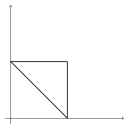 Therefore the area we want is: \begin{align*} A &= 1 - \int_0^1 \left ( -x + \frac{2}{2-x} \right)\d x \\ &= 1 - \left [-\frac12 x^2 - 2 \ln(2-x) \right]_0^1 \\ &= 1 + \frac12 -2 \ln 2 \\ &= \frac32 - 2 \ln 2 \end{align*} Therefore the relative area is: \(\frac{\frac32 - 2 \ln 2}{1/2} = 3 - 4 \ln 2\)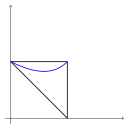
1988 Paper 1 Q7
The function \(\mathrm{f}\) is defined by \[ \mathrm{f}(x)=ax^{2}+bx+c. \] Show that \[ \mathrm{f}'(x)=\mathrm{f}(1)\left(x+\tfrac{1}{2}\right)+\mathrm{f}(-1)\left(x-\tfrac{1}{2}\right)-2\mathrm{f}(0)x. \] If \(a,b\) and \(c\) are real and such that \(\left|\mathrm{f}(x)\right|\leqslant1\) for \(\left|x\right|\leqslant1\), show that \(\left|\mathrm{f}'(x)\right|\leqslant4\) for \(\left|x\right|\leqslant1\). Find particular values of \(a,b\) and \(c\) such that, for the corresponding function \(\mathrm{f}\) of the above form \(\left|\mathrm{f}(x)\right|\leqslant1\) for all \(x\) with \(\left|x\right|\leqslant1\) and \(\mathrm{f}'(x)=4\) for some \(x\) satisfying \(\left|x\right|\leqslant1\).
Solution: Let \(f(x) = ax^2 + bx + c\) then \begin{align*} f'(x) &= 2ax + b \\ f(0) &= c \\ f(1) &= a+b+c \\ f(-1) &= a-b+c \\ f(1)+f(-1) &= 2(a+c) \\ f(1)-f(-1) &= 2b \\ f'(x) &= x(f(1)+f(-1)) + \frac12 (f(1) - f(-1)) - 2f(0)x \end{align*} as required. Since \(f'(x)\) is a straight line, the maximum value is either at \(1, -1\) or it's constant and either end suffices. \begin{align*} |f'(1)| & \leq |f(1)|\frac{3}{2} + |f(-1)| \frac12 + 2 |f(0)| \\ &\leq \frac{3}{2} + \frac12 + 2 \\ &= 4 \\ \\ |f'(-1)| & \leq |f(1)|\frac{1}{2} + |f(-1)| \frac32 + 2 |f(0)| \\ &\leq \frac{3}{2} + \frac12 + 2 \\ &= 4 \\ \end{align*} Therefore \(|f'(x)| \leq 4\). Suppose \(|f'(x)| = 4\) for some value in \(x \in [-1,1]\), then it must be either \(-1\) or \(1\). If \(f'(1) = 4\) then \(f(1) = 1, f(-1) = 1, f(0) = -1\) so \(f(x) = 1+ k(x^2-1) \Rightarrow f(x) = 1+2(x^2-1) = 2x^2 -1\). If \(f'(-1) = 4\) then \(f(1) = -1, f(-1) = -1, f(0) = 1 \Rightarrow f(x) = -2x^2 + 1\)