Problems
Filters
5 problems found
2017 Paper 1 Q7
The triangle \(ABC\) has side lengths \(\left| BC \right| = a\), \(\left| CA \right| = b\) and \(\left| AB \right| = c\). Equilateral triangles \(BXC\), \(CYA\) and \(AZB\) are erected on the sides of the triangle \(ABC\), with \(X\) on the other side of \(BC\) from \(A\), and similarly for \(Y\) and \(Z\). Points \(L\), \(M\) and \(N\) are the centres of rotational symmetry of triangles \(BXC\), \(CY\!A\) and \(AZB\) respectively.
- Show that \(| CM| = \dfrac {\ b} {\sqrt3} \,\) and write down the corresponding expression for \(| CL|\).
- Use the cosine rule to show that \[ 6 \left| LM \right|^2 = a^2+b^2+c^2 + 4\sqrt3 \, \Delta \,, \] where \(\Delta\) is the area of triangle \(ABC\). Deduce that \(LMN\) is an equilateral triangle. Show further that the areas of triangles \(LMN\) and \(ABC\) are equal if and only if \[ a^2+b^2 +c^2 = 4\sqrt3 \, \Delta \,. \]
- Show that the conditions \[ (a -b)^2 = -2ab \big( 1 -\cos(C-60^\circ)\big) \,\] and \[ a^2+b^2 +c^2 = 4\sqrt3 \, \Delta \] are equivalent. Deduce that the areas of triangles \(LMN\) and \(ABC\) are equal if and only if \(ABC\) is equilateral.
Solution:
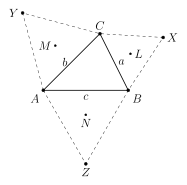
- Consider the equilateral triangle \(CYA\), notice that \(YM\) is a vertical line of symmetry, and \(\angle ACM = 30^\circ\) therefore \(\frac{AC/2}{CM} = \cos 30^\circ \Rightarrow |CM| = \frac{b}{2} \cdot \frac{2}{\sqrt{3}} = \frac{b}{\sqrt{3}}\). Similarly \(|CL| = \frac{a}{\sqrt{3}}\)
- \(\,\) \begin{align*} && |LM|^2 &= |CM|^2 + |CL|^2 - 2 \cdot |CM| \cdot |CL| \cdot \cos \angle MCL \\ &&&= \frac{b^2}{3} + \frac{a^2}{3} - 2 \frac{ab}{3} \cos \left (\angle CMA + \angle CAB + \angle BCL \right) \\ &&&= \frac13 \left (b^2 + a^2 - 2ab \cos \left ( \frac{\pi}{3} + \angle CAB \right) \right) \\ &&&= \frac13 \left (b^2 + a^2 - ab \cos \left ( \angle CAB \right) + \sqrt{3}ab \sin \angle CAB \right) \\ &&&= \frac13 \left (b^2 + a^2 - ab \cos \angle CAB + 2\sqrt{3} \Delta\right) \\ &&&= \frac13 \left (b^2 + a^2 - ab \left (\frac{a^2+b^2-c^2}{2ab} \right) + 2\sqrt{3} \Delta\right) \\ &&&= \frac13 \left ( \frac12(a^2+b^2+c^2) + 2\sqrt{3}\Delta \right) \\ \Rightarrow && 6|LM|^2 &= a^2 + b^2 + c^2 + 4\sqrt{3} \Delta \end{align*} However, nothing in our reasoning here was special about \(LM\), therefore \(LN\) and \(MN\) also equal this value, and we find that the triangle is equilateral. The area of equilateral triangle [LMN] is \(\frac{\sqrt{3}}4 |LM|^2\), ie \begin{align*} &&& \text{areas are equal} \\ \Leftrightarrow && \Delta &= \frac{\sqrt{3}}4 |LM|^2 \\ &&&= \frac{\sqrt{3}}4 \frac{a^2+b^2+c^2+4\sqrt{3}\Delta}{6} \\ &&&= \frac{\sqrt{3}}{24} (a^2+b^2+c^2) + \frac12 \Delta \\ \Leftrightarrow && \Delta &= \frac{\sqrt{3}}{12}(a^2+b^2+c^2)\\ \Leftrightarrow && 4\sqrt{3}\Delta &=a^2+b^2+c^2\\ \end{align*}
- \(\,\) \begin{align*} && (a-b)^2 &= -2ab(1 - \cos(C - 60^{\circ})) \\ \Leftrightarrow && a^2+b^2 - 2ab &=-2ab + 2ab \cos(C - 60^{\circ}) \\ \Leftrightarrow && a^2+b^2 &= ab \cos C+\sqrt{3}ab\sin C \\ \Leftrightarrow && a^2+b^2 &= ab \frac{a^2+b^2-c^2}{2ab} + 2\sqrt{3} \Delta \\ \Leftrightarrow && a^2+b^2+c^2 &= 4\sqrt{3}\Delta \end{align*} Since the LHS is non-positive, and the RHS is positive, the only way they can be equal is if they are both \(0\), ie \(a=b\) and \(C = 60^{\circ}\) ie \(ABC\) is equilateral.
2015 Paper 2 Q2
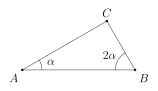
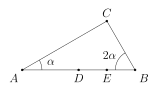
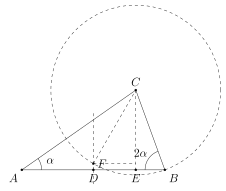
In the triangle \(ABC\), angle \(BAC = \alpha\) and angle \(CBA= 2\alpha\), where \(2\alpha\) is acute, and \(BC= x\). Show that \(AB = (3-4 \sin^2\alpha)x\). The point \(D\) is the midpoint of \(AB\) and the point \(E\) is the foot of the perpendicular from \(C\) to \(AB\). Find an expression for \(DE\) in terms of \(x\). The point \(F\) lies on the perpendicular bisector of \(AB\) and is a distance \(x\) from \(C\). The points \(F\) and \(B\) lie on the same side of the line through \(A\) and \(C\). Show that the line \(FC\) trisects the angle \(ACB\).
Solution:
2014 Paper 2 Q1
In the triangle \(ABC\), the base \(AB\) is of length 1 unit and the angles at~\(A\) and~\(B\) are \(\alpha\) and~\(\beta\) respectively, where \(0<\alpha\le\beta\). The points \(P\) and~\(Q\) lie on the sides \(AC\) and \(BC\) respectively, with \(AP=PQ=QB=x\). The line \(PQ\) makes an angle of~\(\theta\) with the line through~\(P\) parallel to~\(AB\).
- Show that \(x\cos\theta = 1- x\cos\alpha - x\cos\beta\), and obtain an expression for \(x\sin\theta\) in terms of \(x\), \(\alpha\) and~\(\beta\). Hence show that \begin{equation} \label{eq:2*} \bigl(1+2\cos(\alpha+\beta)\bigr)x^2 - 2(\cos\alpha + \cos\beta)x + 1 = 0\,. \tag{\(*\)} \end{equation} Show that \((*)\) is also satisfied if \(P\) and \(Q\) lie on \(AC\) produced and \(BC\) produced, respectively. [By definition, \(P\) lies on \(AC\) produced if \(P\) lies on the line through \(A\) and~\(C\) and the points are in the order \(A\), \(C\), \(P\)\,.]
- State the condition on \(\alpha\) and \(\beta\) for \((*)\) to be linear in \(x\). If this condition does not hold (but the condition \(0<\alpha \le \beta\) still holds), show that \((*)\) has distinct real roots.
- Find the possible values of~\(x\) in the two cases (a) \(\alpha = \beta = 45^\circ\) and (b) \(\alpha = 30^\circ\), \(\beta = 90^\circ\), and illustrate each case with a sketch.
2001 Paper 3 Q6
The plane \[ {x \over a} + {y \over b} +{z \over c} = 1 \] meets the co-ordinate axes at the points \(A\), \(B\) and \(C\,\). The point \(M\) has coordinates \(\left( \frac12 a, \frac12 b, \frac 12 c \right)\) and \(O\) is the origin. Show that \(OM\) meets the plane at the centroid \(\left( \frac13 a, \frac13 b, \frac 13 c \right)\) of triangle \(ABC\). Show also that the perpendiculars to the plane from \(O\) and from \(M\) meet the plane at the orthocentre and at the circumcentre of triangle \(ABC\) respectively. Hence prove that the centroid of a triangle lies on the line segment joining its orthocentre and circumcentre, and that it divides this line segment in the ratio \(2 : 1\,\). [The orthocentre of a triangle is the point at which the three altitudes intersect; the circumcentre of a triangle is the point equidistant from the three vertices.]
Solution: The line \(OM\) is \(\lambda \begin{pmatrix} a \\ b \\ c \end{pmatrix}\), then we need \(1 = \lambda \begin{pmatrix} a \\ b \\ c \end{pmatrix} \cdot \begin{pmatrix} \frac1{a} \\ \frac1b \\ \frac1c \end{pmatrix} = 3 \lambda \Rightarrow \lambda = \frac13\). Therefore \(OM\) meets the plane at the centroid. The orthocentre is the point \(\mathbf{h}\) such that \((\mathbf{a}-\mathbf{b}) \cdot (\mathbf{c} - \mathbf{h}) = 0 \Leftrightarrow \begin{pmatrix} a \\ -b \\ 0 \end{pmatrix} \cdot \begin{pmatrix} -p \\ -q \\ c-r \end{pmatrix} \Leftrightarrow ap-bq = 0\) \((\mathbf{b}-\mathbf{c}) \cdot (\mathbf{a} - \mathbf{h}) = 0 \Leftrightarrow \begin{pmatrix} 0 \\ b \\ -c \end{pmatrix} \cdot \begin{pmatrix} a-p \\ -q \\ -r \end{pmatrix} \Leftrightarrow bq-cr = 0\) \((\mathbf{c}-\mathbf{a}) \cdot (\mathbf{b} - \mathbf{h}) = 0 \Leftrightarrow \begin{pmatrix} -a \\ 0 \\ c \end{pmatrix} \cdot \begin{pmatrix} -p \\ b-q \\ -r \end{pmatrix} \Leftrightarrow cr-ap = 0\) ie \(ap = bq = cr\) but this is clearly on the line \(\lambda \begin{pmatrix} \frac1{a} \\ \frac1b \\ \frac1c \end{pmatrix}\) therefore the orthocentre is on the perpendicular from \(O\) \(M-A = \begin{pmatrix} -a/2 \\ b/2 \\ c/2 \end{pmatrix}\) so \(|M-A|=|M-B|=|M-C|\) Also by pythagoras the point of intersection satisfies \(|M-P|^2 + |P-A|^2 = |M-A|^2\) so \(|P-A|^2 = |P-B|^2 = |P-C|^2\), therefore \(P\) is the circumcentre. Since all these points are in the same plane and \(OGM\) is a line, we have the points are in a line. Similar triangles gives the desired ratio
1990 Paper 2 Q13
A thin non-uniform rod \(PQ\) of length \(2a\) has its centre of gravity a distance \(a+d\) from \(P\). It hangs (not vertically) in equilibrium suspended from a small smooth peg \(O\) by means of a light inextensible string of length \(2b\) which passes over the peg and is attached at its ends to \(P\) and \(Q\). Express \(OP\) and \(OQ\) in terms of \(a,b\) and \(d\). By considering the angle \(POQ\), or otherwise, show that \(d < a^{2}/b\).
Solution:
