Problems
Filters
18 problems found
2023 Paper 3 Q1
The distinct points \(P(2ap,\, ap^2)\) and \(Q(2aq,\, aq^2)\) lie on the curve \(x^2 = 4ay\), where \(a > 0\).
- Given that \[(p+q)^2 = p^2q^2 + 6pq + 5\,,\tag{\(*\)}\] show that the line through \(P\) and \(Q\) is a tangent to the circle with centre \((0,\, 3a)\) and radius \(2a\).
- Show that, for any given value of \(p\) with \(p^2 \neq 1\), there are two distinct real values of \(q\) that satisfy equation \((*)\). Let these values be \(q_1\) and \(q_2\). Find expressions, in terms of \(p\), for \(q_1 + q_2\) and \(q_1 q_2\).
- Show that, for any given value of \(p\) with \(p^2 \neq 1\), there is a triangle with one vertex at \(P\) such that all three vertices lie on the curve \(x^2 = 4ay\) and all three sides are tangents to the circle with centre \((0,\, 3a)\) and radius \(2a\).
2022 Paper 2 Q5
- Given that \(a > b > c > 0\) are constants, and that \(x\), \(y\), \(z\) are non-negative variables, show that \[ax + by + cz \leqslant a(x + y + z).\]
- Find \(\Delta\) in terms of \(a\), \(b\), \(c\), \(x\), \(y\) and \(z\).
- Find both the minimum value of the sum of the perpendicular distances from \(P\) to the three sides of the triangle and the values of \(x\), \(y\) and \(z\) which give this minimum sum, expressing your answers in terms of some or all of \(a\), \(b\), \(c\) and \(\Delta\).
- Show that, for all real \(a\), \(b\), \(c\), \(x\), \(y\) and \(z\), \[(a^2+b^2+c^2)(x^2+y^2+z^2) = (bx-ay)^2 + (cy-bz)^2 + (az-cx)^2 + (ax+by+cz)^2.\]
- Find both the minimum value of the sum of the squares of the perpendicular distances from \(P\) to the three sides of the triangle and the values of \(x\), \(y\) and \(z\) which give this minimum sum, expressing your answers in terms of some or all of \(a\), \(b\), \(c\) and \(\Delta\).
- Find both the maximum value of the sum of the squares of the perpendicular distances from \(P\) to the three sides of the triangle and the values of \(x\), \(y\) and \(z\) which give this maximum sum, expressing your answers in terms of some or all of \(a\), \(b\), \(c\) and \(\Delta\).
2019 Paper 1 Q1
A straight line passes through the fixed point \((1 , k)\) and has gradient \(- \tan \theta\), where \(k > 0\) and \(0 < \theta < \frac{1}{2}\pi\). Find, in terms of \(\theta\) and \(k\), the coordinates of the points \(X\) and \(Y\) where the line meets the \(x\)-axis and the \(y\)-axis respectively.
- Find an expression for the area \(A\) of triangle \(OXY\) in terms of \(k\) and \(\theta\). (The point \(O\) is the origin.) You are given that, as \(\theta\) varies, \(A\) has a minimum value. Find an expression in terms of \(k\) for this minimum value.
- Show that the length \(L\) of the perimeter of triangle \(OXY\) is given by $$L = 1 + \tan \theta + \sec \theta + k(1 + \cot \theta + \cosec \theta).$$ You are given that, as \(\theta\) varies, \(L\) has a minimum value. Show that this minimum value occurs when \(\theta = \alpha\) where $$\frac{1 - \cos \alpha}{1 - \sin \alpha} = k.$$ Find and simplify an expression for the minimum value of \(L\) in terms of \(\alpha\).
Solution: \(y = (-\tan \theta)(x-1)+k\) so when \(x = 0\), \(y = k + \tan \theta\), so \(Y = (0, k+\tan \theta)\). When \(y = 0\), \(x = 1 + \frac{k}{\tan \theta}\)
- \(A = \frac12 (k+\tan \theta)\left ( 1 + \frac{k}{\tan \theta} \right) = k + \frac12 \left (\tan \theta + \frac{k^2}{\tan \theta} \right)\) Notice that \(x + \frac{k^2}{x} \geq 2 k\) by AM-GM, so the minimum is \(k + \frac12 \cdot 2k = 2k\)
- \(\,\) \begin{align*} L &= k + \tan \theta + 1 + k \cot \theta + \sqrt{(k + \tan \theta)^2 + \left (1 + \frac{k}{\tan \theta} \right)^2} \\ &= k + \tan \theta + 1 + k \cot \theta + \sqrt{k^2 + 2 k \tan \theta +\tan^2 \theta + 1 + 2k \cot \theta + k^2\cot^2 \theta} \\ &= k + \tan \theta + 1 + k \cot \theta + \sqrt{\sec^2 \theta+ 2k \sec\theta\cosec \theta + k^2\cosec^2 \theta} \\ &= k + \tan \theta + 1 + k \cot \theta +\sec \theta + k\cosec \theta\\ &= 1 + \tan \theta + \sec \theta + k (1 + \cot \theta + \cosec \theta) \end{align*} \begin{align*} && \frac{\d L}{\d \theta} &= \sec^2 \theta + \tan \theta \sec \theta + k(-\cosec^2 \theta - \cot \theta \cosec \theta ) \\ \Rightarrow && 0 &=\sec^2 \alpha+ \tan \theta \sec \alpha+ k(-\cosec^2 \alpha- \cot \alpha\cosec \alpha) \\ \Rightarrow && k &= \frac{\sec^2 \alpha+ \tan \alpha\sec \alpha}{\cosec^2 \alpha+ \cot \alpha\cosec \alpha} \\ &&&= \frac{\sin^2 \alpha(1 + \sin \alpha)}{\cos^2 \alpha (1+ \cos \alpha)} \\ &&&= \frac{(1-\cos^2 \alpha)(1 + \sin \alpha)}{(1-\sin^2 \alpha )(1+ \cos \alpha)} \\ &&&= \frac{1-\cos \alpha}{1-\sin \alpha} \\ \Rightarrow && L &= 1 + \tan \alpha + \sec \alpha + \frac{1-\cos \alpha}{1-\sin \alpha} \left (1 + \cot \alpha + \cosec \alpha \right) \\ &&&= \frac{1+\tan \alpha + \sec \alpha -\sin \alpha-\sin \alpha \tan \alpha-\tan \alpha}{1-\sin \alpha} + \\ &&&\quad \quad \frac{1+\cot \alpha + \cosec \alpha-\cos \alpha-\cos \alpha \cot \alpha -\cot \alpha}{1-\sin \alpha} \\ &&&= \frac{2+\sec \alpha(1-\sin^2 \alpha)-\sin \alpha + \cosec \alpha(1-\cos^2 \alpha)-\cos \alpha}{1-\sin \alpha} \\ &&&= \frac{2+\cos\alpha-\sin \alpha + \sin\alpha-\cos \alpha}{1-\sin \alpha} \\ &&&= \frac{2}{1-\sin \alpha} \end{align*}
2018 Paper 2 Q7
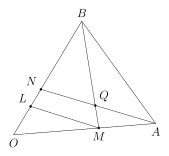
The points \(O\), \(A\) and \(B\) are the vertices of an acute-angled triangle. The points \(M\) and \(N\) lie on the sides \(OA\) and \(OB\) respectively, and the lines \(AN\) and \(BM\) intersect at \(Q\). The position vector of \(A\) with respect to \(O\) is \(\bf a\), and the position vectors of the other points are labelled similarly. Given that \(\vert MQ \vert = \mu \vert QB\vert \), and that \(\vert NQ \vert = \nu \vert QA\vert \), where \(\mu\) and \(\nu\) are positive and \(\mu \nu <1\), show that \[ {\bf m} = \frac {(1+\mu)\nu}{1+\nu} \, {\bf a} \,. \] The point \(L\) lies on the side \(OB\), and \(\vert OL \vert = \lambda \vert OB \vert \,\). Given that \(ML\) is parallel to \(AN\), express \(\lambda\) in terms of \(\mu\) and \(\nu\). What is the geometrical significance of the condition \(\mu\nu<1\,\)?
Solution:
2017 Paper 2 Q8
All vectors in this question lie in the same plane. The vertices of the non-right-angled triangle \(ABC\) have position vectors \(\bf a\), \(\bf b\) and \(\bf c\), respectively. The non-zero vectors \(\bf u\) and \(\bf v\) are perpendicular to \(BC\) and \(CA\), respectively. Write down the vector equation of the line through \(A\) perpendicular to \(BC\), in terms of \(\bf u\), \(\bf a\) and a parameter \(\lambda \). The line through \(A\) perpendicular to \(BC\) intersects the line through \(B\) perpendicular to \(CA\) at \(P\). Find the position vector of \(P\) in terms of \(\bf a\), \(\bf b\), \(\bf c\) and \(\bf u\). Hence show that the line \(CP\) is perpendicular to the line \(AB\).
Solution: The line through \(A\) perpendicular to \(BC\) is \(\mathbf{a} + \lambda\mathbf{u}\). The line through \(B\) perpendicular to \(CA\) is \(\mathbf{b} + \mu \mathbf{v}\). They intersect when \(\mathbf{a} + \lambda\mathbf{u} = \mathbf{b} + \mu \mathbf{v}\). Since \(\mathbf{v}\) is perpendicular to \(CA\), we must have \begin{align*} && \mathbf{a} + \lambda\mathbf{u} &= \mathbf{b} + \mu \mathbf{v} \\ \Rightarrow && \mathbf{a}\cdot(\mathbf{c}-\mathbf{a}) + \lambda\mathbf{u}\cdot(\mathbf{c}-\mathbf{a}) &= \mathbf{b}\cdot(\mathbf{c}-\mathbf{a}) + \mu \mathbf{v}\cdot(\mathbf{c}-\mathbf{a}) \\ \\ \Rightarrow && \lambda &= \frac{\mathbf{b}\cdot(\mathbf{c}-\mathbf{a}) -\mathbf{a}\cdot(\mathbf{c}-\mathbf{a})}{\mathbf{u}\cdot(\mathbf{c}-\mathbf{a})} \\ &&&= \frac{(\mathbf{b}-\mathbf{a})\cdot(\mathbf{c}-\mathbf{a})}{\mathbf{u} \cdot(\mathbf{c}-\mathbf{a})} \end{align*} Therefore the point is \(\mathbf{a} + \frac{(\mathbf{b}-\mathbf{a})\cdot(\mathbf{c}-\mathbf{a})}{\mathbf{u} \cdot(\mathbf{c}-\mathbf{a})} \mathbf{u}\). The line \(CP\) is \(\mathbf{c} + \nu \left (\mathbf{p} - \mathbf{c} \right)\), to check this is perpendicular with \(AB\) we should dot \(\mathbf{p}-\mathbf{c}\) with \(\mathbf{a}-\mathbf{b}\), ie \begin{align*} && (\mathbf{p}-\mathbf{c}) \cdot (\mathbf{a}-\mathbf{b}) &= \left ( \mathbf{a} + \frac{(\mathbf{b}-\mathbf{a})\cdot(\mathbf{c}-\mathbf{a})}{\mathbf{u} \cdot(\mathbf{c}-\mathbf{a})} \mathbf{u} - \mathbf{c}\right) \cdot ( \mathbf{a}-\mathbf{b}) \\ &&&= \left ( \mathbf{a}- \mathbf{c} + \frac{(\mathbf{b}-\mathbf{a})\cdot(\mathbf{c}-\mathbf{a})}{\mathbf{u} \cdot(\mathbf{c}-\mathbf{a})} \mathbf{u} \right) \cdot ( \mathbf{a}-\mathbf{c}+(\mathbf{c}-\mathbf{b})) \\ &&&= (\mathbf{a}-\mathbf{c})\cdot(\mathbf{a}-\mathbf{c}) + \frac{(\mathbf{b}-\mathbf{a})\cdot(\mathbf{c}-\mathbf{a})}{\mathbf{u} \cdot(\mathbf{c}-\mathbf{a})}\mathbf{u} \cdot (\mathbf{a}-\mathbf{c}) + \\ &&&\quad (\mathbf{a}-\mathbf{c})\cdot(\mathbf{c}-\mathbf{b}) + \lambda \underbrace{\mathbf{u} \cdot (\mathbf{c}-\mathbf{b})}_{=0} \\ &&&=(\mathbf{a}-\mathbf{c})\cdot(\mathbf{a}-\mathbf{c}) -(\mathbf{b}-\mathbf{a})\cdot(\mathbf{c}-\mathbf{a})+ (\mathbf{a}-\mathbf{c})\cdot(\mathbf{c}-\mathbf{b}) \\ &&&= (\mathbf{a}-\mathbf{c})\cdot(\mathbf{a}-\mathbf{c}+\mathbf{b}-\mathbf{a}+\mathbf{c}-\mathbf{b}) \\ &&&= 0 \end{align*} as required.
2014 Paper 1 Q7
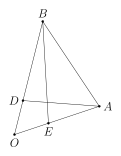
In the triangle \(OAB\), the point \(D\) divides the side \(BO\) in the ratio \(r:1\) (so that \(BD = rDO\)), and the point \(E\) divides the side \(OA\) in the ratio \(s:1\) (so that \(OE =s EA\)), where \(r\) and \(s\) are both positive.
- The lines \(AD\) and \(BE\) intersect at \(G\). Show that \[ \mathbf{g}= \frac{rs}{1+r+rs} \, \mathbf{a} + \frac 1 {1+r+rs} \, \mathbf{b} \,, \] where \(\mathbf{a}, \mathbf{b}\) and \(\mathbf{g}\) are the position vectors with respect to \(O\) of \(A\), \(B\) and \(G\), respectively.
- The line through \(G\) and \(O\) meets \(AB\) at \(F\). Given that \(F\) divides \(AB\) in the ratio \(t:1\), find an expression for \(t\) in terms of \(r\) and \(s\).
Solution:
2009 Paper 1 Q4
The sides of a triangle have lengths \(p-q\), \(p\) and \(p+q\), where \(p>q> 0\,\). The largest and smallest angles of the triangle are \(\alpha\) and \(\beta\), respectively. Show by means of the cosine rule that \[ 4(1-\cos\alpha)(1-\cos\beta) = \cos\alpha + \cos\beta \,. \] In the case \(\alpha = 2\beta\), show that \(\cos\beta=\frac34\) and hence find the ratio of the lengths of the sides of the triangle.
Solution: The largest angle will be opposite the side with length \(p+q\). Similarly the smallest angle will be opposite the side with length \(p-q\). The cosine rule tells us that: \begin{align*} && (p+q)^2 &= p^2 + (p-q)^2 - 2p(p-q) \cos \alpha \\ && 0 &= p(p-4q-2(p-q)\cos \alpha)\\ && 0 &= p(1-2\cos \alpha) + q(2\cos \alpha - 4)\\ \Rightarrow && \frac{p}{q} & = \frac{4-2 \cos \alpha}{1-2 \cos \alpha} \\ && (p-q)^2 &= p^2 + (p+q)^2 - 2p(p+q) \cos \beta \\ && 0 &= p(p+4q-2(p+q) \cos \beta) \\ && 0 &= p(1-2\cos \beta)+q(4-2\cos \beta) \\ \Rightarrow && \frac{p}{q} &= \frac{2\cos \beta - 4}{1-2\cos \beta} \\ \Rightarrow && \frac{4-2 \cos \alpha}{1-2 \cos \alpha} &= \frac{2\cos \beta - 4}{1-2\cos \beta} \\ \Rightarrow && (2-\cos \alpha)(1-2\cos \beta) &= (\cos \beta - 2)(1 - 2 \cos \alpha) \\ \Rightarrow && 2 - \cos \alpha -4\cos \beta+2\cos \alpha \cos \beta &= \cos \beta - 2-2\cos \alpha \cos \beta + 4 \cos \alpha \\ \Rightarrow && 4-4\cos \alpha - 4\cos \beta+4\cos \alpha\cos \beta &= \cos \alpha + \cos \beta \\ \Rightarrow && 4(1-\cos \alpha)(1-\cos \beta) &= \cos \alpha + \cos \beta \end{align*} If \(\alpha = 2 \beta\), and let \(c = \cos \beta\) \begin{align*} && 4 (1- \cos 2 \beta)(1-\cos \beta) &= \cos 2 \beta + \cos \beta \\ \Rightarrow && 4(1-(2c^2-1))(1-c) &= 2c^2-1+c\\ \Rightarrow && 8(1+c)(1-c)^2 &= (2c-1)(c+1) \\ \Rightarrow && 0 &= (c+1)(8(1-c)^2-(2c-1)) \\ &&&= (c+1)(8c^2-18c+9) \\ &&&= (c+1)(4c-3)(2c-3) \\ \end{align*} Therefore \(c = -1, \frac32, \frac34\). Clearly \(\cos \beta \neq -1, \frac32\), since they are not valid angles in a triangle (or valid values of \(\cos \beta\)). \(\frac{p}{q} = \frac{2 \cdot \frac34-4 }{1 - 2\cdot \frac34} = \frac{3-8}{2-3} = 5\) so \(4:5:6\)
2009 Paper 1 Q8
- The equation of the circle \(C\) is \[ (x-2t)^2 +(y-t)^2 =t^2, \] where \(t\) is a positive number. Show that \(C\) touches the line \(y=0\,\). Let \(\alpha\) be the acute angle between the \(x\)-axis and the line joining the origin to the centre of \(C\). Show that \(\tan2\alpha=\frac43\) and deduce that \(C\) touches the line \(3y=4x\,\).
- Find the equation of the incircle of the triangle formed by the lines \(y=0\), \(3y=4x\) and \(4y+3x=15\,\). Note: The incircle of a triangle is the circle, lying totally inside the triangle, that touches all three sides.
Solution:
- This is a circle centre \((2t,t)\) with radius \(t\). Therefore it is exactly \(t\) away from the line \(y = 0\) so just touches that line. Not that \(\tan \alpha = \frac{t}{2t} = \frac12\) so \(\tan 2\alpha = \frac{2\tan \alpha}{1-\tan^2\alpha} = \frac{1}{1-\frac14} = \frac43\). Therefore the line \(y = \frac43x\) or \(3y = 4x\) is tangent to \(C\).
- Note that \(3y=4x\) and \(4y+3x=15\) are perpendicular, so this is a right-angled triangle with incenter \((2t,t)\) for some \(t\) and hypotenuse \(15\) We can find the third coordinate when \(3y-4x = 0\) and \(4y+3x = 15\) meet, ie \((\frac{9}{5}, \frac{12}5)\) The incentre lies on the bisector of the right angle at this point, which is the line through \((\frac{9}{5}, \frac{12}5)\) and \((\frac{15}{2}, 0)\), so \begin{align*} && \frac{2t-\frac{12}{5}}{t - \frac{9}{5}} &= \frac{-\frac{12}{5}}{\frac{15}2-\frac95} \\ \Rightarrow && \frac{10t-12}{5t-9} &= \frac{-24}{57} = -\frac{8}{19} \\ \Rightarrow && 190t - 12 \cdot 19 &= -40t + 72 \\ \Rightarrow && t &= 2 \end{align*} Therefore the center is \((4, 2)\) and the equation is \((x-4)^2+(y-2)^2=2^2\)
2007 Paper 2 Q8
The points \(B\) and \(C\) have position vectors \(\mathbf{b}\) and \(\mathbf{c}\), respectively, relative to the origin \(A\), and \(A\), \(B\) and \(C\) are not collinear.
- The point \(X\) has position vector \(s \mathbf{b}+t\mathbf{c}\). Describe the locus of \(X\) when \(s+t=1\).
- The point \(P\) has position vector \(\beta \mathbf{b}+\gamma\mathbf{c}\), where \(\beta\) and \(\gamma\) are non-zero, and \(\beta+\gamma\ne1\). The line \(AP\) cuts the line \(BC\) at \(D\). Show that \(BD:DC=\gamma:\beta\).
- The line \(BP\) cuts the line \(CA\) at \(E\), and the line \(CP\) cuts the line \(AB\) at \(F\). Show that \[ \frac{AF}{FB} \times \frac{BD}{DC} \times \frac{CE}{EA}=1\,. \]
Solution:
- \(X\) lies on the line including \(B\) and \(C\).
- points on the line \(AP\) have the form \(\lambda(\beta \mathbf{b}+\gamma\mathbf{c})\), and the point \(D\) will be the point where \(\lambda\beta + \lambda \gamma = 1\). \begin{align*} && \frac{|BD|}{|DC|} &= \frac{|\mathbf{b} -\lambda(\beta \mathbf{b}+\gamma\mathbf{c})| }{|\lambda(\beta \mathbf{b}+\gamma\mathbf{c})- \mathbf{c}|} \\ &&&= \frac{|(1-\lambda \beta)\mathbf{b} - \lambda \gamma \mathbf{c}|}{|\lambda \beta \mathbf{b}+(\lambda \gamma -1)\mathbf{c}|}\\ &&&= \frac{|\lambda \gamma\mathbf{b} - \lambda \gamma \mathbf{c}|}{|\lambda \beta \mathbf{b}-(\lambda \beta)\mathbf{c}|} \\ &&&= \frac{\gamma}{\beta} \end{align*}
- The line \(BP\) is \(\mathbf{b} + \mu(\beta \mathbf{b}+\gamma\mathbf{c})\) and will meet \(CA\) when \(1+\mu\beta = 0\), ie \(\mu = -\frac{1}{\beta}\), therefore \(E\) is \(-\frac{\gamma}{\beta}\mathbf{c}\), and so \(\frac{|CE|}{|EA|} = \frac{1+\gamma/\beta}{\gamma/\beta} = \frac{\beta+\gamma}{\gamma}\). Similarly, \(F\) is \(-\frac{\beta}{\gamma}\mathbf{b}\) and \(\frac{|AF|}{|FB|} = \frac{\beta/\gamma}{1+\frac{\beta}{\gamma}} = \frac{\beta}{\gamma+\beta}\), and so \[\frac{AF}{FB} \times \frac{BD}{DC} \times \frac{CE}{EA} = \frac{\beta}{\gamma+\beta} \frac{\gamma}{\beta} \frac{\beta+\gamma}{\gamma} = 1 \]
2004 Paper 1 Q6
The three points \(A\), \(B\) and \(C\) have coordinates \(\l p_1 \, , \; q_1 \r\), \(\l p_2 \, , \; q_2 \r\) and \(\l p_3 \, , \; q_3 \r\,\), respectively. Find the point of intersection of the line joining \(A\) to the midpoint of \(BC\), and the line joining~\(B\) to the midpoint of \(AC\). Verify that this point lies on the line joining \(C\) to the midpoint of~\(AB\). The point \(H\) has coordinates \(\l p_1 + p_2 + p_3 \, , \; q_1 + q_2 + q_3 \r\,\). Show that if the line \(AH\) intersects the line \(BC\) at right angles, then \(p_2^2 + q_2^2 = p_3^2 + q_3^2\,\), and write down a similar result if the line \(BH\) intersects the line \(AC\) at right angles. Deduce that if \(AH\) is perpendicular to \(BC\) and also \(BH\) is perpendicular to \(AC\), then \(CH\) is perpendicular to \(AB\).
2001 Paper 1 Q1
The points \(A\), \(B\) and \(C\) lie on the sides of a square of side 1 cm and no two points lie on the same side. Show that the length of at least one side of the triangle \(ABC\) must be less than or equal to \((\sqrt6 -\sqrt2)\) cm.
2000 Paper 2 Q3
The lengths of the sides \(BC\), \(CA\), \(AB\) of the triangle \(ABC\) are denoted by \(a\), \(b\), \(c\), respectively. Given that $$ b = 8+{\epsilon}_1, \, c=3+{\epsilon}_2,\, A=\tfrac{1}{3}\pi + {\epsilon}_3, $$ where \({\epsilon}_1\), \({\epsilon}_2\), and \( {\epsilon}_3\) are small, show that \(a \approx 7 + {\eta}\), where ${\eta}= {\left(13 \, {{\epsilon}_1}-2\,{\epsilon}_2 + 24{\sqrt 3} \;{{\epsilon}_3}\right)}/14$. Given now that $$ {\vert {\epsilon}_1} \vert \le 2 \times 10^{-3}, \ \ \ {\vert {\epsilon}_2} \vert \le 4\cdot 9\times 10^{-2}, \ \ \ {\vert {\epsilon}_3} \vert \le \sqrt3 \times 10^{-3}, $$ find the range of possible values of \({\eta}\).
Solution: The cosine rule states that: \(a^2 = b^2 + c^2 - 2bc \cos (A)\) Therefore \begin{align*} a^2 &= (8 + \epsilon_1)^2 + (3 + \epsilon_2)^2 - 2(8 + \epsilon_1) (3 + \epsilon_2)\cos \l \frac{\pi}{3} + \epsilon_3 \r \\ &\approx 64 + 16\epsilon_1 + 9 + 6\epsilon_2- 2(24 + 3\epsilon_1+8\epsilon_2) \cos \l \frac{\pi}{3} + \epsilon_3 \r \\ &= 73 + 16\epsilon_1+ 6\epsilon_2 - 2(24 + 3\epsilon_1+8\epsilon_2) \l \cos \l \frac{\pi}{3} \r \cos \epsilon_3 - \sin \l \frac{\pi}{3} \r \sin \epsilon_3 \r \\ &\approx 73 + 16\epsilon_1+ 6\epsilon_2 - (24 + 3 \epsilon_1+8\epsilon_2) + 24\sqrt{3}\epsilon_3 \\ &= 49 + 13 \epsilon_1 - 2\epsilon_2+24\sqrt{3}\epsilon_3 \\ &= 7^2 + 2 \cdot 7 \cdot \frac{13 \epsilon_1 - 2\epsilon_2+24\sqrt{3}\epsilon_3}{14} \\ &\approx \l 7 + \frac{13 \epsilon_1 - 2\epsilon_2+24\sqrt{3}\epsilon_3}{14} \r^2 \end{align*} In this approximation, we are ignoring all terms of order \(2\), and using the approximations \(\cos \varepsilon \approx 1, \sin \varepsilon \approx \varepsilon\) Therefore \(a \approx 7 + \frac{ 13 \epsilon_1 - 2\epsilon_2+24\sqrt{3}\epsilon_3}{14}\). \(\eta\) is maximised if \(\epsilon_1, \epsilon_3\) are and \(\epsilon_2\) is minimized, ie: \begin{align*} \eta &\leq \frac{13 \cdot 2 \cdot 10^{-3} - 2 \cdot 4.9 \cdot 10^{-2} + 24 \sqrt{3} \cdot \sqrt{3} \cdot 10^{-3}}{14} \\ &= 10^{-3} \cdot \frac{26 - 98 + 74}{14} \\ &= 10^{-3} \cdot \frac{1}{7}\end{align*} Similarly, it is maximised when signs are reversed, ie: \(| \eta | \leq 10^{-3} \cdot \frac{1}{7}\)
1998 Paper 2 Q8
Points \(\mathbf{A},\mathbf{B},\mathbf{C}\) in three dimensions have coordinate vectors \(\mathbf{a},\mathbf{b},\mathbf{c}\), respectively. Show that the lines joining the vertices of the triangle \(ABC\) to the mid-points of the opposite sides meet at a point \(R\). \(P\) is a point which is {\bf not} in the plane \(ABC\). Lines are drawn through the mid-points of \(BC\), \(CA\) and \(AB\) parallel to \(PA\), \(PB\) and \(PC\) respectively. Write down the vector equations of the lines and show by inspection that these lines meet at a common point \(Q\). Prove further that the line \(PQ\) meets the plane \(ABC\) at \(R\).
1995 Paper 1 Q7
Let \(A,B,C\) be three non-collinear points in the plane. Explain briefly why it is possible to choose an origin equidistant from the three points. Let \(O\) be such an origin, let \(G\) be the centroid of the triangle \(ABC,\) let \(Q\) be a point such that \(\overrightarrow{GQ}=2\overrightarrow{OG},\) and let \(N\) be the midpoint of \(OQ.\)
- Show that \(\overrightarrow{AQ}\) is perpendicular to \(\overrightarrow{BC}\) and deduce that the three altitudes of \(\triangle ABC\) are concurrent.
- Show that the midpoints of \(AQ,BQ\) and \(CQ\), and the midpoints of the sides of \(\triangle ABC\) are all equidistant from \(N\).
1995 Paper 2 Q7
The diagram shows a circle, of radius \(r\) and centre \(I\), touching the three sides of a triangle \(ABC\). We write \(a\) for the length of \(BC\) and \(\alpha\) for the angle \(\angle BAC\) and so on. Let \(s=\frac{1}{2}\left(a+b+c\right)\) and let \(\triangle\) be the area of the triangle.

- By considering the area of the triangles \(AIB,\) \(BIC\) and \(CIA\), or otherwise, show that \(\Delta=rs\).
- By using the formula \(\Delta=\frac{1}{2}bc\sin\alpha\), show that \[ \Delta^{2}=\tfrac{1}{16}[4b^{2}c^{2}-\left(2bc\cos\alpha\right)^{2}]. \] Now use the formula \(a^{2}=b^{2}+c^{2}-2bc\cos\alpha\) to show that \[ \Delta^{2}=\tfrac{1}{16}[(a^{2}-\left(b-c\right)^{2})(\left(b+c\right)^{2}-a^{2})] \] and deduce that \[ \Delta=\sqrt{s\left(s-a\right)\left(s-b\right)\left(s-c\right)}. \]
- A hole in the shape of the triangle \(ABC\) is cut in the top of a level table. A sphere of radius \(R\) rests in the hole. Find the height of the centre of the sphere above the level of the table top, expressing your answer in terms of \(a,b,c,s\) and \(R\).
Solution:
- \([AIB] = \frac12br\), \([BIC] = \frac12ar\), \([CIA] = \frac12 rc\), therefore \(\Delta = [AIB] +[BIC] + [CIA] = \frac12r(a+b+c) = sr\)
- \(\,\) \begin{align*} && \Delta &= \frac12 bc \sin \alpha \\ \Rightarrow && \Delta^2 &= \frac14 b^2c^2 \sin^2 \alpha \\ &&&= \frac14 \left (b^2c^2 - b^2c^2\cos^2 \alpha \right) \\ &&&= \frac1{16} \left (4b^2c^2 - (2bc\cos \alpha )^2\right) \\ \\ \Rightarrow && \Delta^2 &= \frac1{16} \left (4b^2c^2 - (b^2+c^2-a^2 )^2\right) \\ &&&= \frac1{16} (2bc-b^2-c^2+a^2)(2bc+b^2+c^2-a^2) \\ &&&= \frac{1}{16}(a^2-(b-c)^2)((b+c)^2-a^2) \\ &&&= \frac1{16}(a-b+c)(a+b-c)(b+c-a)(b+c+a) \\ &&&= (s - b)(s-c)(s-a)s \\ \Rightarrow && \Delta &= \sqrt{s(s-a)(s-b)(s-c)} \end{align*}
- We have the setting like this,
so \begin{align*} && h & = \sqrt{R^2-r^2} \\ &&&= \sqrt{R^2-\frac{\Delta^2}{s^2}} \\ &&&= \sqrt{R^2 - \frac{(s-a)(s-b)(s-c)}{s}} \end{align*}
