Problems

Filters
Clear Filters

5 problems found

2003 Paper 2 Q4
D: 1600.0 B: 1484.0

The line \(y=d\,\), where \(d>0\,\), intersects the circle \(x^2+y^2=R^2\) at \(G\) and \(H\). Show that the area of the minor segment \(GH\) is equal to \begin{equation} R^2\arccos \left({d \over R}\right) -d\sqrt{R^2 - d^2}\;. \tag {\(*\)} \end{equation} In the following cases, the given line intersects the given circle. Determine how, in each case, the expression \((*)\) should be modified to give the area of the minor segment.

  1. Line: \(y=c\,\); \ \ \ circle: \((x-a)^2+(y-b)^2=R^2\,\).
  2. Line: \(y=mx+c\, \); \ \ \ circle: \(x^2+y^2=R^2\,\).
  3. Line: \(y=mx+c\,\); \ \ \ circle: \((x-a)^2+(y-b)^2=R^2\,\).

2003 Paper 3 Q5
D: 1700.0 B: 1500.0

Find the coordinates of the turning point on the curve \(y = x^2 - 2bx + c\,\). Sketch the curve in the case that the equation \(x^2 - 2bx + c=0\) has two distinct real roots. Use your sketch to determine necessary and sufficient conditions on \(b\) and \(c\) for the equation \(x^2 - 2bx + c = 0\) to have two distinct real roots. Determine necessary and sufficient conditions on \(b\) and \(c\) for this equation to have two distinct positive roots. Find the coordinates of the turning points on the curve \(y = x^3 - 3b^2x + c\) (with \(b>0\)) and hence determine necessary and sufficient conditions on \(b\) and \(c\) for the equation \(x^3 - 3b^2x + c = 0\) to have three distinct real roots. Determine necessary and sufficient conditions on \(a\,\), \(b\) and \(c\) for the equation \(\l x - a \r^3 - 3b^2 \l x - a \r + c = 0\) to have three distinct positive roots. Show that the equation \(2x^3 - 9x^2 + 7x - 1 = 0\) has three distinct positive roots.


Solution: \begin{align*} y &= x^2-2bx+c \\ &= (x-b)^2+c-b^2 \end{align*} Therefore the turning point is at \((b,c-b^2)\)

TikZ diagram
Therefore there will be two distinct roots if \(c -b^2 < 0 \Rightarrow c < b^2\). For the equation to have two distinct positive roots it needs to have two distinct roots (ie the condition above) and \(y(0) = c\) needs to be positive, ie \(c > 0\). Therefore the curve has two distinct positive roots if \(0 < c < b^2\). The turning points on \(y = x^3-3b^2x+c\) will have \(0 = y' = 3x^2-3b^2 \Rightarrow x = \pm b\) Therefore for the cubic to have three distinct real root we must have a root between the turning points, \(y(-b) > 0 > y(b)\) \(b^3-3b^3+c = c-2b^3 < 0\) \((-b)^3+3b^3+c = c+2b^3 > 0\) ie \(-2b^3 < c < 2b^3\). The equation \(\l x - a \r^3 - 3b^2 \l x - a \r + c = 0\) will have 3 distinct roots if \(-2b^3 < c < 2b^3\), they will all be positive if the \(y(0) < 0\) and \(a+b > 0\) (ie the first turning point is in the first quadrant, ie \(-a^3+3b^2a+c < 0, a+b>0\). \begin{align*} 2x^3 - 9x^2 + 7x - 1 &= 2(x^3-\frac92x^2+\frac72 x-\frac12) \\ &= 2((x-\frac{3}{2})^3-\frac{27}{4}x+\frac{27}{8}+\frac72x-\frac12) \\ &= 2((x-\frac{3}{2})^3-\frac{13}{4}x+\frac{23}{8}) \\ &= 2((x-\frac{3}{2})^3-\frac{13}{4}(x-\frac{3}{2})-\frac{39}{8}+\frac{23}{8}) \\ &= 2((x-\frac{3}{2})^3-\frac{13}{4}(x-\frac{3}{2})-2) \\ \end{align*} Therefore in our notation \(a = \frac32, b = \sqrt{13/12}, c = 2\). Clearly \(a+b > 0\), so we need to check \(|c| < 2b^3\) which is clearly true as \(b > 1\). Finally we need to check \(y(0) = -1\), so all conditions are satisfied and there are 3 distinct roots.
TikZ diagram

1999 Paper 1 Q4
D: 1500.0 B: 1484.0

Sketch the following subsets of the \(x\)-\(y\) plane:

  1. \(|x|+|y|\le 1\) ;
  2. \(|x-1|+|y-1|\le 1 \) ;
  3. \(|x-1|-|y+1|\le 1 \) ;
  4. \(|x|\, |y-2|\le 1\) .


Solution:

  1. TikZ diagram
  2. TikZ diagram
  3. TikZ diagram
  4. TikZ diagram

1989 Paper 1 Q9
D: 1516.0 B: 1500.1

Sketch the graph of \(8y=x^{3}-12x\) for \(-4\leqslant x\leqslant4\), marking the coordinates of the turning points. Similarly marking the turning points, sketch the corresponding graphs in the \((X,Y)\)-plane, if \begin{alignat*}{3} \rm{(a)} & \quad & & X=\tfrac{1}{2}x, & \qquad & Y=y,\\ \rm{(b)} & & & X=x, & & Y=\tfrac{1}{2}y,\\ \rm{(c)} & & & X=\tfrac{1}{2}x+1, & & Y=y,\\ \rm{(d)} & & & X=x, & & Y=\tfrac{1}{2}y+1. \end{alignat*} Find values for \(a,b,c,d\) such that, if \(X=ax+b,\) \(Y=cy+d\), then the graph in the \((X,Y)\)-plane corresponding to \(8y=x^{3}-12x\) has turning points at \((X,Y)=(0,0)\) and \((X,Y)=(1,1)\).


Solution: \(8\frac{\d y}{\d x} = 3(x^2-4)\) so the turning points are at \((\pm 2, \mp 2)\)

TikZ diagram
TikZ diagram
TikZ diagram
TikZ diagram
TikZ diagram
We need either \begin{align*} && \begin{cases} -2a+b &= 0 \\ 2c+d &= 0 \\ 2a+b &= 1 \\ -2c+d &= 1 \end{cases} && \text{ or } && \begin{cases} -2a+b &= 1 \\ 2c+d &= 1 \\ 2a+b &= 0 \\ -2c+d &= 0 \end{cases} \\ \Rightarrow && \begin{cases} -2a+b &= 0 \\ 2a+b &= 1 \\ 2c+d &= 0 \\ -2c+d &= 1 \end{cases} && \text{ or } && \begin{cases} -2a+b &= 1 \\ 2a+b &= 0 \\ 2c+d &= 1 \\ -2c+d &= 0 \end{cases}\\ \Rightarrow && \begin{cases} (a,b) = (\frac14,\frac12) \\ (c,d) = (-\frac14, \frac12)\end{cases} && \text{ or } && \begin{cases} (a,b) = (-\frac14,\frac12) \\ (c,d) = (\frac14, \frac12)\end{cases} \end{align*} So either \(X = \frac14 x + \frac12, Y = -\frac14 y + \frac12\) or \(X = -\frac14x + \frac12, Y = \frac14y + \frac12\)

1988 Paper 1 Q6
D: 1500.0 B: 1516.0

The complex numbers \(z_{1},z_{2},\ldots,z_{6}\) are represented by six distinct points \(P_{1},P_{2},\ldots,P_{6}\) in the Argand diagram. Express the following statements in terms of complex numbers:

  1. \(\overrightarrow{P_{1}P_{2}}=\overrightarrow{P_{5}P_{4}}\) and \(\overrightarrow{P_{2}P_{3}}=\overrightarrow{P_{6}P_{5}}\,\);
  2. \(\overrightarrow{P_{2}P_{4}}\) is perpendicular to \(\overrightarrow{P_{3}P_{6}}\,\).
If \((i)\) holds, show that \(\overrightarrow{P_{3}P_{4}}=\overrightarrow{P_{1}P_{6}}\,\). Suppose that the statements \((i)\) and \((ii)\) both hold, and that \(z_{1}=0,\) \(z_{2}=1,\) \(z_{3}=z,\) \(z_{5}=\mathrm{i}\) and \(z_{6}=w.\) Determine the conditions which \(\mathrm{Re}(z)\) and \(\mathrm{Re}(w)\) must satisfy in order that \(P_{1}P_{2}P_{3}P_{4}P_{5}P_{6}\) should form a convex hexagon. Find the distance between \(P_{3}\) and \(P_{6}\) when \(\tan(\angle P_{3}P_{2}P_{6})=-2/3.\)


Solution:

  1. \(\overrightarrow{P_{1}P_{2}}=\overrightarrow{P_{5}P_{4}}\) is equivalent to \(z_2 - z_1 = z_4 - z_5\). \(\overrightarrow{P_{2}P_{3}}=\overrightarrow{P_{6}P_{5}}\) is equivalent to \(z_3-z_2 = z_5 - z_6\).
  2. \(\overrightarrow{P_{2}P_{4}}\) is perpendicular to \(\overrightarrow{P_{3}P_{6}}\,\) is equivalent to \(\frac{z_4 - z_2}{z_6-z_3} \in i\mathbb{R}\)
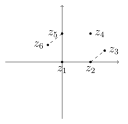
If \(z_2 - z_1 =z_4 - z_5\) and \(z_3-z_2 = z_5 - z_6\) then adding we get \(z_3 - z_1 = z_4 - z_6\) or \(z_4 - z_3 = z_6-z_1\), which is equivalent to \(\overrightarrow{P_{3}P_{4}}=\overrightarrow{P_{1}P_{6}}\,\).
TikZ diagram
\(\textrm{Re}(z) > 1, \textrm{Re}(w) < 0, \textrm{Re}(z) +\textrm{Re}(w)=1\). (We only need one of the first two constraints, since the other is implied by the former). Since \(\overrightarrow{P_{2}P_{4}}\) is perpendicular to \(\overrightarrow{P_{3}P_{6}}\,\) we must have that \(\textrm{Im}(z) = \textrm{Im}(w)\). Combined with the vector logic we must have that \(\textrm{Im}(z) = \frac12\). Let \(z = a + \frac12i\) and \(w = (1-a) + \frac12i\). Since \(w - 1 = k(3-2i)(z-1)\) (the angle constraint) we must have that: \begin{align*} &&-a+\frac12i &= k(3-2i)((a-1) \frac12i) \\ &&&= k( 3 a - 2+(\frac72 - 2 a)i) \\ \Rightarrow && \frac{3a-2}{-a} &= \frac{\frac72-2a}{\frac12} \\ \Rightarrow && 3a-2&= 4a^2-7a \\ \Rightarrow && 0 &= 4a^2-10a+2 \\ \Rightarrow && a &= \frac{5 \pm \sqrt{17}}{4} \end{align*} Since \(a > 1, a = \frac{5 +\sqrt{17}}{4}\) and the distance is: \begin{align*} \left | z - w \right | &= | a+\frac12i - ((1-a) +\frac12i ) | \\ &= |2a-1| \\ &= \frac{5+\sqrt{17}}{2}-1 \\ &= \frac{3+\sqrt{17}}{2} \end{align*}