Problems
Filters
9 problems found
2025 Paper 3 Q5
Three points, \(A\), \(B\) and \(C\), lie in a horizontal plane, but are not collinear. The point \(O\) lies above the plane. Let \(\overrightarrow{OA} = \mathbf{a}\), \(\overrightarrow{OB} = \mathbf{b}\) and \(\overrightarrow{OC} = \mathbf{c}\). \(P\) is a point with \(\overrightarrow{OP} = \alpha\mathbf{a} + \beta\mathbf{b} + \gamma\mathbf{c}\), where \(\alpha\), \(\beta\) and \(\gamma\) are all positive and \(\alpha + \beta + \gamma < 1\). Let \(k = 1 - (\alpha + \beta + \gamma)\).
- The point \(L\) is on \(OA\), the point \(X\) is on \(BC\) and \(LX\) passes through \(P\). Determine \(\overrightarrow{OX}\) in terms of \(\beta\), \(\gamma\), \(\mathbf{b}\) and \(\mathbf{c}\) and show that \(\overrightarrow{OL} = \frac{\alpha}{k+\alpha}\mathbf{a}\).
- Let \(M\) and \(Y\) be the unique pair of points on \(OB\) and \(CA\) respectively such that \(MY\) passes through \(P\), and let \(N\) and \(Z\) be the unique pair of points on \(OC\) and \(AB\) respectively such that \(NZ\) passes through \(P\). Show that the plane \(LMN\) is also horizontal if and only if \(OP\) intersects plane \(ABC\) at the point \(G\), where \(\overrightarrow{OG} = \frac{1}{3}(\mathbf{a} + \mathbf{b} + \mathbf{c})\). Where do points \(X\), \(Y\) and \(Z\) lie in this case?
- State what the condition \(\alpha + \beta + \gamma < 1\) tells you about the position of \(P\) relative to the tetrahedron \(OABC\).
2023 Paper 2 Q8
A tetrahedron is called isosceles if each pair of edges which do not share a vertex have equal length.
- Prove that a tetrahedron is isosceles if and only if all four faces have the same perimeter.
- By considering the lengths of \(OA\) and \(BC\), show that \[2\mathbf{b}.\mathbf{c} = |\mathbf{b}|^2 + |\mathbf{c}|^2 - |\mathbf{a}|^2.\] Show that \[\mathbf{a}.(\mathbf{b}+\mathbf{c}) = |\mathbf{a}|^2.\]
- Let \(G\) be the centroid of the tetrahedron, defined by \(\overrightarrow{OG} = \frac{1}{4}(\mathbf{a}+\mathbf{b}+\mathbf{c})\). Show that \(G\) is equidistant from all four vertices of the tetrahedron.
- By considering the length of the vector \(\mathbf{a}-\mathbf{b}-\mathbf{c}\), or otherwise, show that, in an isosceles tetrahedron, none of the angles between pairs of edges which share a vertex can be obtuse. Can any of them be right angles?
2013 Paper 3 Q11
An equilateral triangle, comprising three light rods each of length \(\sqrt3a\), has a particle of mass \(m\) attached to each of its vertices. The triangle is suspended horizontally from a point vertically above its centre by three identical springs, so that the springs and rods form a tetrahedron. Each spring has natural length \(a\) and modulus of elasticity \(kmg\), and is light. Show that when the springs make an angle \(\theta\) with the horizontal the tension in each spring is \[ \frac{ kmg(1-\cos\theta)}{\cos\theta}\,. \] Given that the triangle is in equilibrium when \(\theta = \frac16 \pi\), show that \(k=4\sqrt3 +6\). The triangle is released from rest from the position at which \(\theta=\frac13\pi\). Show that when it passes through the equilibrium position its speed \(V\) satisfies \[ V^2 = \frac{4ag}3(6+\sqrt3)\,. \]
2012 Paper 3 Q12
- A point \(P\) lies in an equilateral triangle \(ABC\) of height 1. The perpendicular distances from \(P\) to the sides \(AB\), \(BC\) and \(CA\) are \(x_1\), \(x_2\) and \(x_3\), respectively. By considering the areas of triangles with one vertex at \(P\), show that \(x_1+x_2+x_3=1\). Suppose now that \(P\) is placed at random in the equilateral triangle (so that the probability of it lying in any given region of the triangle is proportional to the area of that region). The perpendicular distances from \(P\) to the sides \(AB\), \(BC\) and \(CA\) are random variables \(X_1\), \(X_2\) and \(X_3\), respectively. In the case \(X_1= \min(X_1,X_2,X_3)\), give a sketch showing the region of the triangle in which \(P\) lies. Let \(X= \min(X_1,X_2,X_3)\). Show that the probability density function for \(X\) is given by \[ \f(x) = \begin{cases} 6(1-3x) & 0 \le x \le \frac13\,, \\ 0 & \text{otherwise}\,. \end{cases} \] Find the expected value of \(X\).
- A point is chosen at random in a regular tetrahedron of height 1. Find the expected value of the distance from the point to the closest face. \newline [The volume of a tetrahedron is \(\frac13 \times \text{area of base}\times\text{height}\) and its centroid is a distance \(\frac14\times \text{height}\) from the base.]
2010 Paper 2 Q6
Each edge of the tetrahedron \(ABCD\) has unit length. The face \(ABC\) is horizontal, and \(P\) is the point in \(ABC\) that is vertically below \(D\).
- Find the length of \(PD\).
- Show that the cosine of the angle between adjacent faces of the tetrahedron is \(1/3\).
- Find the radius of the largest sphere that can fit inside the tetrahedron.
Solution:
- \(D\) must be above the centre (of any kind) of the equilateral triangle \(ABC\). Therefore it is a distance \(\frac23 \frac{\sqrt{3}}2 = \frac{\sqrt{3}}3\) from \(A\). \(D\) is \(1\) from \(A\), therefore by Pythagoras \(PD = \sqrt{1-\frac13} = \sqrt{\frac23}\)
- We can place \(D\) at \(\langle 0,0,\sqrt{\frac23}\rangle\) and \(A'\) (the midpoint of \(BC\)) at \(\langle-\frac{\sqrt{3}}{6},0,0 \rangle\) and we find: \begin{align*} && \cos \theta &= \frac{(\mathbf{a}'-\mathbf{d})\cdot \mathbf{a}'}{|\mathbf{a}'-\mathbf{d}|| \mathbf{a}'|} \\ &&&= \frac{|\mathbf{a}'|}{|\mathbf{a}'-\mathbf{d}|} \\ &&&= \frac{\frac{\sqrt{3}}{6}}{\sqrt{\frac23+\frac{3}{36}}} = \frac13 \end{align*}
- We have And therefore we must have \(\tan \frac{\cos^{-1} \frac13}{2} = \frac{r}{\frac{\sqrt{3}}{6}}\) therefore \begin{align*} && r &= \frac{\sqrt{3}}{6} \tan \left (\frac{\cos^{-1} \frac13}{2} \right) \\ &&&= \frac{\sqrt{3}}6 \sqrt{\frac{1-\cos(\cos^{-1}\frac13)}{1+\cos(\cos^{-1}\frac13)}} \\ &&&= \frac{\sqrt{3}}6 \sqrt{\frac{\frac23}{\frac43}} \\ &&&= \frac{\sqrt{6}}{12} \end{align*}

2006 Paper 1 Q8
{\it Note that the volume of a tetrahedron is equal to \(\frac1 3\) \(\times\) the area of the base \(\times\) the height.} The points \(O\), \(A\), \(B\) and \(C\) have coordinates \((0,0,0)\), \((a,0,0)\), \((0,b,0)\) and \((0,0,c)\), respectively, where \(a\), \(b\) and \(c\) are positive.
- Find, in terms of \(a\), \(b\) and \(c\), the volume of the tetrahedron \(OABC\).
- Let angle \(ACB = \theta\). Show that \[ \cos\theta = \frac {c^2} { { \sqrt{\vphantom{ \dot b} (a^2+c^2)(b^2+c^2)} } ^{\vphantom A} \ } \] and find, in terms of \(a\), \(b\) and \(c\), the area of triangle \(ABC\). % is %\(\displaystyle \tfrac12 \sqrt{ \vphantom{\dot A } a^2b^2 +b^2c^2 + c^2 a^2 \;} \;\).
1998 Paper 3 Q12
The mountain villages \(A,B,C\) and \(D\) lie at the vertices of a tetrahedron, and each pair of villages is joined by a road. After a snowfall the probability that any road is blocked is \(p\), and is independent of the conditions of any other road. The probability that, after a snowfall, it is possible to travel from any village to any other village by some route is \(P\). Show that $$ P =1- p^2(6p^3-12p^2+3p+4). $$ %In the case \(p={1\over 3}\) show that this probability is \({208 \over 243}\).
1992 Paper 3 Q5
The tetrahedron \(ABCD\) has \(A\) at the point \((0,4,-2)\). It is symmetrical about the plane \(y+z=2,\) which passes through \(A\) and \(D\). The mid-point of \(BC\) is \(N\). The centre, \(Y\), of the sphere \(ABCD\) is at the point \((3,-2,4)\) and lies on \(AN\) such that \(\overrightarrow{AY}=3\overrightarrow{YN}.\) Show that \(BN=6\sqrt{2}\) and find the coordinates of \(B\) and \(C\). The angle \(AYD\) is \(\cos^{-1}\frac{1}{3}.\) Find the coordinates of \(D\). [There are two alternative answers for each point.]
Solution: Since \(B\) and \(C\) are reflections of each other in the plane \(y+z=2\) (since that's what it means to be symmetrical), we must have that \(N\) also lies on the plane \(y+z=2\). Since \(\overrightarrow{AY}=3\overrightarrow{YN}.\) we must have \(\overrightarrow{AN}=\overrightarrow{AY}+\overrightarrow{YN} = \frac43\overrightarrow{AY} = \frac43\begin{pmatrix} 3\\-6\\6\end{pmatrix} = \begin{pmatrix} 4\\-8\\8\end{pmatrix}\) and \(N\) is the point \((4,-4,6)\) (which fortunately is on our plane as expected). \(Y\) is the point \((3,-2,4)\) \(|\overrightarrow{AY}| = \sqrt{3^2+(-6)^2+6^2} = 3\sqrt{1+4+4} = 9\)

1989 Paper 1 Q12
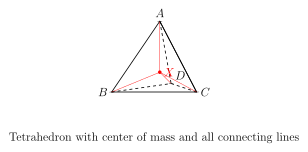
A regular tetrahedron \(ABCD\) of mass \(M\) is made of 6 identical uniform rigid rods, each of length \(2a.\) Four light elastic strings \(XA,XB,XC\) and \(XD\), each of natural length \(a\) and modulus of elasticity \(\lambda,\) are fastened together at \(X\), the other end of each string being attached to the corresponding vertex. Given that \(X\) lies at the centre of mass of the tetrahedron, find the tension in each string. The tetrahedron is at rest on a smooth horizontal table, with \(B,C\) and \(D\) touching the table, and the ends of the strings at \(X\) attached to a point \(O\) fixed in space. Initially the centre of mass of the tetrahedron coincides with \(O.\) Suddenly the string \(XA\) breaks, and the tetrahedron as a result rises vertically off the table. If the maximum height subsequently attained is such that \(BCD\) is level with the fixed point \(O,\) show that (to 2 significant figures) \[ \frac{Mg}{\lambda}=0.098. \]
Solution: