Problems
Filters
4 problems found
2019 Paper 3 Q2
The definition of the derivative \(f'\) of a (differentiable) function f is $$f'(x) = \lim_{h\to 0} \frac{f(x + h) - f(x)}{h}. \quad (*)$$
- The function f has derivative \(f'\) and satisfies $$f(x + y) = f(x)f(y)$$ for all \(x\) and \(y\), and \(f'(0) = k\) where \(k \neq 0\). Show that \(f(0) = 1\). Using \((*)\), show that \(f'(x) = kf(x)\) and find \(f(x)\) in terms of \(x\) and \(k\).
- The function g has derivative \(g'\) and satisfies $$g(x + y) = \frac{g(x) + g(y)}{1 + g(x)g(y)}$$ for all \(x\) and \(y\), \(|g(x)| < 1\) for all \(x\), and \(g'(0) = k\) where \(k \neq 0\). Find \(g'(x)\) in terms of \(g(x)\) and \(k\), and hence find \(g(x)\) in terms of \(x\) and \(k\).
Solution:
- \(\,\) \begin{align*} && f(0+x) &= f(0)f(x) \\ \Rightarrow && f(0) &= 0, 1\\ &&\text{since }f'(0) \neq 0 & \text{ there is some non-zero } f(x) \\ \Rightarrow && f(0) &= 1 \end{align*} \begin{align*} && f'(x) &= \lim_{h\to 0} \frac{f(x+h)-f(x)}{h} \\ &&&= \lim_{h\to 0} \frac{f(x)f(h)-f(x)}{h} \\ &&&= f(x) \cdot \lim_{h\to 0} \frac{f(h)-1}{h} \\ &&&= f(x) \cdot \lim_{h\to 0} \frac{f(0+h)-f(0)}{h} \\ &&&= f(x) \cdot f'(0) \\ &&&= kf(x) \end{align*} Since \(f'(x) = kf(x)\) we must have \(\frac{f'(x)}{f(x)} = k \Rightarrow \ln f(x) = kx + c \Rightarrow f(x) = Ae^{kx}\) but \(f(0) = 1\) so \(f(x) = e^{kx}\)
- Consider \begin{align*} && g(0+0) &= \frac{g(0)+g(0)}{1+(g(0))^2} \\ \Rightarrow && g(0)(1+(g(0))^2)&= 2g(0) \\ \Rightarrow && 0 &= g(0)\left (1- (g(0))^2 \right) \\ \Rightarrow && g(0) &= -1, 0, 1 \\ \Rightarrow && g(0) &= 0 \tag{\(|g(0)| < 1\)} \end{align*} \begin{align*} && g'(x) &=\lim_{h\to 0} \frac{g(x+h)-g(x)}{h} \\ &&&= \lim_{h\to 0} \frac{\frac{g(x)+g(h)}{1+g(x)g(h)}-g(x)}{h} \\ &&&= \lim_{h\to 0} \frac{g(x)+g(h)-g(x)(1+g(x)g(h))}{h(1+g(x)g(h))} \\ &&&= \lim_{h\to 0} \frac{g(h)-g(x)(g(x)g(h))}{h(1+g(x)g(h))} \\ &&&= (1-(g(x))^2) \cdot \lim_{h \to 0} \frac{1}{1+g(x)g(h)} \cdot \lim_{h \to 0} \frac{g(h)}{h} \\ &&&= (1-(g(x))^2) \cdot \frac{1}{1+g(x)\cdot 0} \cdot \lim_{h \to 0} \frac{g(h) - g(0)}{h} \\ &&&= (1-(g(x))^2) \cdot g'(0)\\ &&&= k (1-(g(x))^2) \\ \end{align*} Let \(y = g(x)\) so \begin{align*} && y' &= k(1-y^2) \\ \Rightarrow && kx &= \int \frac{1}{1-y^2} \d y \\ \Rightarrow &&&= \int \frac12\left ( \frac{1}{1-y} + \frac{1}{1+y} \right) \d y \\ &&&= \frac12\ln \left ( \frac{1+y}{1-y} \right) + C \\ x = 0, y = 0: && 0 &= \ln 1 + C \\ \Rightarrow && C &= 0 \\ \Rightarrow && \frac{1+y}{1-y} &= e^{2kx} \\ \Rightarrow && 1+y &= e^{2kx} - e^{2kx}y \\ \Rightarrow && y &= \frac{e^{2kx}-1}{e^{2kx}+1} \\ &&&= \tanh kx \end{align*}
2016 Paper 3 Q6
Show, by finding \(R\) and \(\gamma\), that \(A \sinh x + B\cosh x \) can be written in the form \(R\cosh (x+\gamma)\) if \(B>A>0\). Determine the corresponding forms in the other cases that arise, for \(A>0\), according to the value of \(B\). Two curves have equations \(y = \textrm{sech} x\) and \(y = a\tanh x + b\,\), where \(a>0\).
- In the case \(b>a\), show that if the curves intersect then the \(x\)-coordinates of the points of intersection can be written in the form \[ \pm\textrm{arcosh} \left( \frac 1 {\sqrt{b^2-a^2}}\right) - {\rm artanh \,} \frac a b .\]
- Find the corresponding result in the case \(a>b>0\,\).
- Find necessary and sufficient conditions on \(a\) and \(b\) for the curves to intersect at two distinct points.
- Find necessary and sufficient conditions on \(a\) and \(b\) for the curves to touch and, given that they touch, express the \(y\)-coordinate of the point of contact in terms of \(a\).
Solution: \begin{align*} && R\cosh(x + \gamma) &=R \cosh x \cosh \gamma + R \sinh x \sinh \gamma \\ \Rightarrow && R \cosh \gamma &= B \\ && R \sinh \gamma &= A \\ \Rightarrow && R^2 &= B^2 - A^2 \\ \Rightarrow && \tanh \gamma &= \frac{A}{B} \\ \end{align*} Therefore it is possible, by writing \(R = \sqrt{B^2-A^2}\) and \(\gamma = \textrm{artanh} \left ( \frac{A}{B} \right)\). This works as long as \(|B| > A > 0\). Supposing \(A >|B| \), try \(S \sinh (x + \delta) = S \sinh x \cosh \delta +S \cosh x \sinh \delta\) \begin{align*} && S \cosh \delta &= A \\ && -S \sinh \delta &= B \\ \Rightarrow && S^2 &= A^2 - B^2 \\ \Rightarrow && \tanh \delta &= \frac{B}{A} \\ \end{align*} Therefore in this case we can write \(\sqrt{A^2-B^2} \sinh \left (x + \tanh^{-1} \left ( \frac{B}{A} \right) \right)\) If \(A = \pm B > 0\) we can we have \(A \sinh x + B \cosh x = \pm Ae^{\pm x}\)
- Suppose \(y \cosh x = 1\) and \(y \cosh x = a \sinh x +b \cosh x\) so \begin{align*} && 1 & = a \sinh x + b \cosh x \\ &&&= \sqrt{b^2-a^2} \cosh(x + \textrm{artanh} \frac{a}{b} ) \\ \Rightarrow && x + \textrm{artanh} \frac{a}{b} &= \pm \textrm{arcosh} \left ( \frac{1}{\sqrt{b^2-a^2}} \right) \\ \Rightarrow && x &= \pm \textrm{arcosh} \left ( \frac{1}{\sqrt{b^2-a^2}} \right) -\textrm{artanh} \frac{a}{b} \end{align*}
- If \( a > b > 0\) we have \begin{align*} && 1 & = \sqrt{a^2-b^2} \sinh \left ( x - \textrm{artanh} \frac{b}{a} \right) \\ \Rightarrow && x &= \textrm{arsinh} \left ( \frac{1}{\sqrt{a^2-b^2}} \right) + \textrm{artanh} \left ( \frac{b}{a} \right) \end{align*}
- To intersect at distinct points we must have \(b > a\) and \(\textrm{arcosh} \left ( \frac{1}{\sqrt{b^2-a^2}} \right) \neq 0\) which is always true.
- For the curves to touch, we need them to intersect and have matching derivatives, ie \begin{align*} && -\tanh x \cdot \textrm{sech}x &= a\textrm{sech}^2 x \\ \Rightarrow && 0 &= \textrm{sech}^2 x (a + \sinh x) \\ \Rightarrow && x &= -\textrm{arsinh} \, a\\ \Rightarrow && \sinh x &= - a\\ \Rightarrow &&\cosh x &= \sqrt{1 + a^2} \\ \end{align*} So if the curves touch, we must have \(1 = -a^2+b\sqrt{1+a^2} \Rightarrow b = \sqrt{1+a^2}\) and since this does work it is a necessary and sufficient condition. We will also have the \(y\) coordinate is \(\frac{1}{\sqrt{1+a^2}}\)
2008 Paper 3 Q4
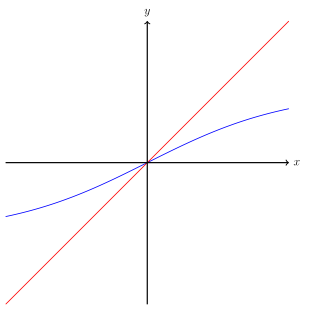
- Show, with the aid of a sketch, that \(y> \tanh (y/2)\) for \(y>0\) and deduce that \begin{equation} \textrm{arcosh} x > \dfrac{x-1}{\sqrt{x^2-1}} \text{ for } x>1. \tag{\(*\)} \end{equation}
- By integrating \((*)\), show that $\textrm{arcosh} x > 2 \dfrac{{x-1}}{\sqrt{x^2-1}} \( for \)x>1$.
- Show that $\textrm{arcosh} x >3 \dfrac{\sqrt{x^2-1}}{{x+2}} \( for \)x>1$.
Solution:
- If \(y = \textrm{arcosh} x \), then \(\tanh\textrm{arcosh} x/2 = \sqrt{\frac{\cosh \textrm{arcosh} x-1}{\cosh \textrm{arcosh} x+1}} = \sqrt{\frac{x-1}{x+1}} = \frac{x-1}{\sqrt{x^2-1}}\)
- \begin{align*} \int \textrm{arcosh} x \d x &= \left [x \textrm{arcosh} x \right] - \int \frac{x}{\sqrt{x^2-1}} \d x \\ &= x \textrm{arcosh} x - \sqrt{x^2-1}+C \\ \int \frac{x-1}{\sqrt{x^2-1}} &= \sqrt{x^2-1} - \textrm{arcosh} x +C \end{align*} Therefore \begin{align*} && \int_1^x \textrm{arcosh} t \d t &> \int_1^x \frac{t-1}{\sqrt{t^2-1}} \d t \\ \Rightarrow && x \textrm{arcosh} x - \sqrt{x^2-1} - 0 &> \sqrt{x^2-1} - \textrm{arcosh} x - 0 \\ \Rightarrow && (x+1) \textrm{arcosh} x &> 2\sqrt{x^2-1} \\ \Rightarrow && \textrm{arcosh} x & > 2\frac{\sqrt{x^2-1}}{x+1} \\ &&&= 2 \frac{\sqrt{x-1}}{\sqrt{x+1}} \\ &&&= 2 \frac{x-1}{\sqrt{x^2-1}} \end{align*}
- Integrating both sides again, \begin{align*} && \int_1^x \textrm{arcosh} t \d t &> 2 \int_1^x \frac{t-1}{\sqrt{t^2-1}} \d t \\ \Rightarrow && x \textrm{arcosh} x - \sqrt{x^2-1} &> 2\left (\sqrt{x^2-1} - \textrm{arcosh}x \right) \\ \Rightarrow && (x+2)\textrm{arcosh} x &> 3 \sqrt{x^2-1} \\ \Rightarrow && \textrm{arcosh} x &> 3 \frac{\sqrt{x^2-1}}{x+2} \end{align*}
1991 Paper 3 Q6
The transformation \(T\) from \(\binom{x}{y}\) to \(\binom{x'}{y'}\) in two-dimensional space is given by \[ \begin{pmatrix}x'\\ y' \end{pmatrix}=\begin{pmatrix}\cosh u & \sinh u\\ \sinh u & \cosh u \end{pmatrix}\begin{pmatrix}x\\ y \end{pmatrix}, \] where \(u\) is a positive real constant. Show that the curve with equation \(x^{2}-y^{2}=1\) is transformed into itself. Find the equations of two straight lines through the origin which transform into themselves. A line, not necessary through the origin, which has gradient \(\tanh v\) transforms under \(T\) into a line with gradient \(\tanh v'\). Show that \(v'=v+u\). The lines \(\ell_{1}\) and \(\ell_{2}\) with gradients \(\tanh v_{1}\) and \(\tanh v_{2}\) transform under \(T\) into lines with gradients \(\tanh v_{1}'\) and \(\tanh v_{2}'\) respectively. Find the relation satisfied by \(v_{1}\) and \(v_{2}\) that is the necessary and sufficient for \(\ell_{1}\) and \(\ell_{2}\) to intersect at the same angle as their transforms. In the case when \(\ell_{1}\) and \(\ell_{2}\) meet at the origin, illustrate in a diagram the relation between \(\ell_{1}\), \(\ell_{2}\) and their transforms.