Problems
Filters
3 problems found
2013 Paper 1 Q11
\(\,\)
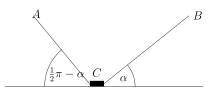
- In the case \(W> T\sin(\alpha+\beta)\), show that the block will remain at rest provided \[ W\sin\lambda \ge T\cos(\alpha+\beta- \lambda)\,, \] where \(\lambda\) is the acute angle such that \(\tan\lambda = \mu\).
- In the case \(W=T\tan\phi\), where \(2\phi =\alpha+\beta\), show that the block will start to move in a direction that makes an angle \(\phi\) with the horizontal.
Solution:
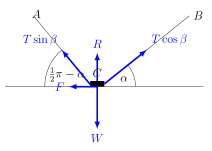
- Assuming the block is at rest we must have: \begin{align*} \text{N2}(\uparrow): && 0 &= T \sin \beta\cos \alpha + T \cos \beta \sin \alpha +R -W \\ \Rightarrow && W &> T \sin \beta\cos \alpha + T \cos \beta \sin \alpha \\ &&&= T\sin(\alpha+\beta) \\ \Rightarrow && R &= W-T\sin(\alpha+\beta)\\ \\ \text{N2}(\rightarrow): && 0 &= T \cos \beta \cos \alpha - T \sin \beta \sin \alpha - F \\ \Rightarrow && T \cos(\alpha+\beta) &= F \\ &&&\leq \mu (W-T\sin(\alpha+\beta)) \\ \Rightarrow && W \sin \lambda &\geq T \cos (\alpha+\beta)\cos \lambda +T \sin (\alpha+\beta) \sin \lambda \\ &&&= T\cos(\alpha+\beta-\lambda) \end{align*}
- If \(W = T\tan \phi\) where \(2\phi = \alpha + \beta\) then \begin{align*} \text{N2}(\uparrow): && ma_y &= T\sin(\alpha+\beta) - W \\ &&&= T \sin(\alpha+\beta) - T \tan \left ( \frac{\alpha+\beta}{2} \right ) \\ &&&= T \tan \left ( \frac{\alpha+\beta}{2} \right ) \left ( 2 \cos^2 \left ( \frac{\alpha+\beta}{2} \right ) -1\right) \\ &&&= T \tan \phi \cos \left ( \alpha+\beta\right ) \tag{notice this is positive so \(R=F=0\)} \\ \text{N2}(\rightarrow): && ma_x &= T \cos(\alpha+\beta) \\ \Rightarrow && \frac{a_y}{a_x} &= \tan \phi \end{align*} Therefore we are accelerating at an angle \(\phi\) to the horizontal
2011 Paper 3 Q11
A thin uniform circular disc of radius \(a\) and mass \(m\) is held in equilibrium in a horizontal plane a distance \(b\) below a horizontal ceiling, where \(b>2a\). It is held in this way by \(n\) light inextensible vertical strings, each of length \(b\); one end of each string is attached to the edge of the disc and the other end is attached to a point on the ceiling. The strings are equally spaced around the edge of the disc. One of the strings is attached to the point \(P\) on the disc which has coordinates \((a,0,-b)\) with respect to cartesian axes with origin on the ceiling directly above the centre of the disc. The disc is then rotated through an angle \(\theta\) (where \(\theta<\pi\)) about its vertical axis of symmetry and held at rest by a couple acting in the plane of the disc. Show that the string attached to~\(P\) now makes an angle \(\phi\) with the vertical, where \[ b\sin\phi = 2a \sin\tfrac12 \theta\,. \] Show further that the magnitude of the couple is \[ \frac {mga^2\sin\theta}{\sqrt{b^2-4a^2\sin^2 \frac12\theta \ } \ }\,. \] The disc is now released from rest. Show that its angular speed, \(\omega\), when the strings are vertical is given by \[ \frac{a^2\omega^2}{4g} = b-\sqrt{b^2 - 4a^2\sin^2 \tfrac12\theta \;}\,. \]
1994 Paper 2 Q9
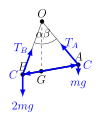
A light rod of length \(2a\) is hung from a point \(O\) by two light inextensible strings \(OA\) and \(OB\) each of length \(b\) and each fixed at \(O\). A particle of mass \(m\) is attached to the end \(A\) and a particle of mass \(2m\) is attached to the end \(B.\) Show that, in equilibrium, the angle \(\theta\) that the rod makes the horizontal satisfies the equation \[ \tan\theta=\frac{a}{3\sqrt{b^{2}-a^{2}}}. \] Express the tension in the string \(AO\) in terms of \(m,g,a\) and \(b\).
Solution: