Problems
Filters
70 problems found
2025 Paper 2 Q12
Let \(X\) be a Poisson random variable with mean \(\lambda\) and let \(p_r = P(X = r)\), for \(r = 0, 1, 2, \ldots\). Neither \(\lambda\) nor \(\lambda + \frac{1}{2} + \sqrt{\lambda + \frac{1}{4}}\) is an integer.
- Show, by considering the sequence \(d_r \equiv p_r - p_{r-1}\) for \(r = 1, 2, \ldots\), that there is a unique integer \(m\) such that \(P(X = r) \leq P(X = m)\) for all \(r = 0, 1, 2, \ldots\), and that \[\lambda - 1 < m < \lambda.\]
- Show that the minimum value of \(d_r\) occurs at \(r = k\), where \(k\) is such that \[k < \lambda + \frac{1}{2} + \sqrt{\lambda + \frac{1}{4}} < k + 1.\]
- Show that the condition for the maximum value of \(d_r\) to occur at \(r = 1\) is \[1 < \lambda < 2 + \sqrt{2}.\]
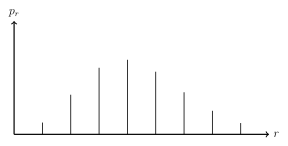
- In the case \(\lambda = 3.36\), sketch a graph of \(p_r\) against \(r\) for \(r = 0, 1, 2, \ldots, 6, 7\).
Solution:
- Suppose \(d_r = p_r - p_{r-1}\) then \begin{align*} d_r &= p_r - p_{r-1} \\ &= \mathbb{P}(X = r) - \mathbb{P}(X = r-1) \\ &= e^{-\lambda} \left ( \frac{\lambda^r}{r!} - \frac{\lambda^{r-1}}{(r-1)!} \right) \\ &= e^{-\lambda} \frac{\lambda^{r-1}}{(r-1)!} \left ( \frac{\lambda}{r} - 1\right) \end{align*} Therefore \(d_r > 0 \Leftrightarrow \lambda > r\)ie, \(p_r\) is increasing while \(r < \lambda\) and reaches a (unique) maximum when \(r = \lfloor \lambda \rfloor\).
- Let \(dd_r = d_r - d_{r-1}\), so: \begin{align*} dd_r &= d_r - d_{r-1} \\ &= p_r - 2p_{r-1} + p_{r-2} \\ &= e^{-\lambda} \frac{\lambda^{r-2}}{r!} \left ( \lambda^2 - 2 \lambda r + r(r-1)\right ) \end{align*} Therefore \(dd_r < 0 \Leftrightarrow \lambda^2 - 2\lambda r +r(r-1) < 0 \Leftrightarrow r^2 -(1+2\lambda)r + \lambda^2 < 0\), but this has roots \(r = \frac{(1+2\lambda) \pm \sqrt{(1+2\lambda)^2-4\lambda^2}}{2} = \lambda + \frac12 \pm \sqrt{\lambda + \frac14}\). Therefore \(d_r\) is decreasing when \(r \in \left (\lambda + \frac12 -\sqrt{\lambda + \frac14},\lambda + \frac12 + \sqrt{\lambda + \frac14} \right)\), therefore the possible minimums are \(d_1\) and \(d_k\) where \(k < \lambda + \frac{1}{2} + \sqrt{\lambda + \frac{1}{4}} < k + 1\). \(d_1 = e^{-\lambda}(\lambda - 1)\), \(d_k = e^{-\lambda} \frac{\lambda^{k-1}}{(k-1)!}(\frac{\lambda}{k}-1)\)
- If the maximum value of \(d_r\) is \(r = 1\) then \(d_r\) must be decreasing, ie considering \(dd_2\) we have \(\lambda^2 -4\lambda + 2< 0 \Leftrightarrow 2 - \sqrt{2} < \lambda < 2 + \sqrt{2}\). It must also be the case that it doesn't get beaten as \(\lambda \to \infty\). In this case \(d_r \to 0\), so we need \(d_1 > 0\), ie \(\lambda > 1\). Therefore \(1 < \lambda < 2 + \sqrt{2}\)
2025 Paper 3 Q2
Let \(f(x) = 7 - 2|x|\). A sequence \(u_0, u_1, u_2, \ldots\) is defined by \(u_0 = a\) and \(u_n = f(u_{n-1})\) for \(n > 0\).
- Sketch, on the same axes, the graphs with equations \(y = f(x)\) and \(y = f(f(x))\).
- Find all solutions of the equation \(f(f(x)) = x\).
- Find the values of \(a\) for which the sequence \(u_0, u_1, u_2, \ldots\) has period 2.
- Show that, if \(a = \frac{28}{5}\), then the sequence \(u_2, u_3, u_4, \ldots\) has period 2, but neither \(u_0\) or \(u_1\) is equal to either of \(u_2\) or \(u_3\).
- Sketch, on the same axes, the graphs with equations \(y = f(x)\) and \(y = f(f(f(x)))\).
- Consider the sequence \(u_0, u_1, u_2, \ldots\) in the cases \(a = 1\) and \(a = -\tfrac79\). Hence find all the solutions of the equation \(f(f(f(x))) = x\).
- Find a value of \(a\) such that the sequence \(u_3, u_4, u_5, \ldots\) has period 3, but where none of \(u_0, u_1\) or \(u_2\) is equal to any of \(u_3, u_4\) or \(u_5\).
Solution:

- If \(a = 1\) then \(u_1 = f(a) = 7-2 = 5\), \(u_2 = f(5) = -3\), \(u_3 = f(-3) = 7-6 = 1\). Therefore it must be the case that \(f(f(f(x))) = x\) for \(x = 1, 5, -3\). Similarly, if \(a = -\tfrac79\) then \(u_1 = f(-\tfrac79) = \tfrac{49}{9}\), \(u_2 = f(\tfrac{49}{9}) = -\tfrac{35}{9}\) and \(u_3 = f(-\tfrac{35}{9}) = -\tfrac79\). Therefore we must also have roots \(x = -\tfrac79, \tfrac{49}{9}, -\tfrac{35}9\). We also have the roots \(x = -7, \tfrac73\) from the first part so we have found all \(8\) roots.
- We need \(f(f(f(x))) = 1\) but \(f(f(x)) \neq -3, f(x) \neq 5, x \neq 1\). Suppose \(f(y) = 1 \Rightarrow 7-2|y| = 1 \Rightarrow y = \pm 3\). So \(y = 3\), ie \(f(f(x)) = 3\). Suppose \(f(z) = 3 \Rightarrow 7-2|z| = 3 \Rightarrow z = \pm 2\). Finally we need \(f(x) = \pm 2\), so say \(7-2|x| = 2 \Rightarrow x = \tfrac52\), so we have the sequence \(\tfrac52, 2, 3, 1, 5, -3, 1, \cdots\)as required.
2019 Paper 2 Q5
The sequence \(u_0, u_1, \ldots\) is said to be a constant sequence if \(u_n = u_{n+1}\) for \(n = 0, 1, 2, \ldots\). The sequence is said to be a sequence of period 2 if \(u_n = u_{n+2}\) for \(n = 0, 1, 2, \ldots\) and the sequence is not constant.
- A sequence of real numbers is defined by \(u_0 = a\) and \(u_{n+1} = f(u_n)\) for \(n = 0, 1, 2, \ldots\), where $$f(x) = p + (x - p)x,$$ and \(p\) is a given real number. Find the values of \(a\) for which the sequence is constant. Show that the sequence has period 2 for some value of \(a\) if and only if \(p > 3\) or \(p < -1\).
- A sequence of real numbers is defined by \(u_0 = a\) and \(u_{n+1} = f(u_n)\) for \(n = 0, 1, 2, \ldots\), where $$f(x) = q + (x - p)x,$$ and \(p\) and \(q\) are given real numbers. Show that there is no value of \(a\) for which the sequence is constant if and only if \(f(x) > x\) for all \(x\). Deduce that, if there is no value of \(a\) for which the sequence is constant, then there is no value of \(a\) for which the sequence has period 2. Is it true that, if there is no value of \(a\) for which the sequence has period 2, then there is no value of \(a\) for which the sequence is constant?
Solution:
- If \(f(a) = a\) then the sequence is constant, ie \(a = p+a^2-pa \Rightarrow 0 = (a-p)(a-1)\). Therefore \(a = 1, p\) If there sequence has period \(2\) then there must be a solution to \(f(f(x)) = x\), ie \begin{align*} && x &= p+(f(x)-p)f(x) \\ &&&= p+(p+(x-p)x-p)(p+(x-p)x) \\ &&&= p + (x-p)x(p+(x-p)x) \\ &&&= p+(x^2-px)(x^2-px+p) \\ \Rightarrow && 0 &= x^4-2px^3+(p+p^2)x^2-(p^2+1)x+p \\ &&&= (x-1)(x-p)(x^2-(p-1)x+1) \end{align*} The first two roots (\(x = 1, p\)) are constant sequences, so we need the second quadratic to have a root, ie \((p-1)^2-4 \geq 0 \Rightarrow p \geq 3 , p \leq -1\). We also need this root not to be \(1\) or \(p\), ie \(1-(p-1)+1 = 3-p \neq 0\) and \(p^2-(p-1)p + 1 = 1+p \neq 0\) so \(p \neq -1, 3\). Therefore \(p > 3\) or \(p < -1\).
- There exists a constant sequence iff there is a solution to \(f(x) = x\), ie \begin{align*} && x &= f(x) \\ &&&= q + (x-p)x \\ \Leftrightarrow && 0 &= x^2-(p+1)x + q \tag{has a solution} \\ \end{align*} But if it doesn't have a solution, clearly the RHS is always larger, and if it does have a solution then there is some point where the inequality doesn't hold. Suppose \(f(x) > x\) for all \(x\) then \(f(f(x)) > f(x) > x\) therefore there is no value where \(f(f(x)) = x\) which is required for any sequence of period 2. No, consider \(p = q = 0\) so \(f(x) = x^2\) then there cannot be a period \(2\) sequence by the first part, but also clearly \(u_n = 1\) is a valid constant sequence.
2018 Paper 3 Q2
The sequence of functions \(y_0\), \(y_1\), \(y_2\), \(\ldots\,\) is defined by \(y_0=1\) and, for \(n\ge1\,\), \[ y_n = (-1)^n \frac {1}{z} \, \frac{\d^{n} z}{\d x^n} \,, \] where \(z= \e^{-x^2}\!\).
- Show that \(\dfrac{\d y_n}{\hspace{-4.7pt}\d x} = 2x y_n -y_{n+1}\,\) for \(n\ge1\,\).
- Prove by induction that, for \(n\ge1\,\), \[ y_{n+1} = 2x y_n -2ny_{n-1} \,. \] Deduce that, for \(n\ge1\,\), \[ y_{n+1}^2 - {y}_n {y}_{n+2} = 2n (y_n^2 - y_{n-1}y_{n+1}) + 2 y_n^2 \,. \]
- Hence show that $y_{n}^2 - y^2_{n-1} y^2_{n+1} > 0\( for \)n \ge 1$.
Solution:
- \begin{align*} \frac{\d y_n}{\d x} &= \frac{\d}{\d x} \l (-1)^n e^{x^2} \frac{\d^n}{\d x^{n}} \l e^{-x^2}\r \r \\ &= (-1)^n 2xe^{x^2} \frac{\d^n}{\d x^{n}} \l e^{-x^2}\r + (-1)^n e^{x^2} \frac{\d^{n+1}}{\d x^{n+1}} \l e^{-x^2}\r \\ &= 2xy_n - (-1)^{n+1} e^{x^2} \frac{\d^{n+1}}{\d x^{n+1}} \l e^{-x^2}\r \\ &= 2xy_n - y_{n+1} \end{align*}
- \(y_0 = 1\), \(y_1 = (-1) e^{x^2} \cdot (-2x) \cdot e^{-x^2} = 2x\), \(y_2 = e^{x^2} \frac{\d^2}{\d x^2} \l e^{-x^2}\r = e^{x^2} \frac{\d }{\d x}\l -2xe^{-x^2} \r = e^{x^2} \l -2e^{-x^2}+4x^2e^{-x^2}\r = 4x^2-2\). Therefore \(2xy_1 - 2y_0 = 2x \cdot 2x - 2\cdot1 = 4x^2-2 = y_2\) so our statement is true for \(n=1\). Assume the statement is true for \(n=k\), then \begin{align*} && y_{k+1} &= 2xy_k - 2ky_{k-1} \\ \frac{\d }{\d x}: && \frac{\d y_{k+1}}{\d x} &= 2\frac{\d}{\d x}\l xy_k \r - 2k\frac{\d y_{k-1}}{\d x} \\ \Rightarrow && 2xy_{k+1}-y_{k+2} &= 2y_k+2x \l 2xy_k-y_{k+1}\r - 2k \l 2xy_{k-1}-y_k \r \\ \Rightarrow && y_{k+2} &=2y_k+ 4x \cdot y_{k+1}-(4x^2+2k)y_k+2x \cdot 2k y_{k-1} \\ &&&= 4x \cdot y_{k+1}-(4x^2+2(k+1))y_k+2x \l2xy_k - y_{k+1} \r \\ &&&= 2x \cdot y_{k+1} -2(k+1)y_k \end{align*} Therefore since our statement is true for \(n=1\) and if it is true for \(n=k\) it is true for \(n=k=1\), therefore by the principle of mathematical induction it is true for all \(n \geq 1\). Since \(2x = \frac{y_{n+1}+2ny_{n-1}}{y_n}\) for all \(n\), we must have \begin{align*} && \frac{y_{n+1}+2ny_{n-1}}{y_n} &= \frac{y_{n+2}+2(n+1)y_{n}}{y_{n+1}} \\ \Leftrightarrow && y_{n+1}^2+2ny_{n-1}y_{n+1} &= y_ny_{n+2}+2ny_n^2+2y_n^2 \\ \Leftrightarrow && y_{n+1}^2-y_ny_{n+2} &= 2n(y_n^2-y_{n-1}y_{n+1})+2y_n^2 \end{align*}
- Consider the functions \(f_n(x) = y_{n}^2-y_{n-1}y_{n+1}\) then clearly \(f_{n+1} = 2nf_{n} + 2y_n^2 \geq f_{n}\) so to prove \(f_n(x) > 0\) for \(n \geq 1\) it suffices to prove it for \(n = 1\). But \(f_1 = y_1^2 - y_0y_{2} = (2x)^2-(4x^2-2) = 2 > 0\) so we are done.
2018 Paper 3 Q5
The real numbers \(a_1\), \(a_2\), \(a_3\), \(\ldots\) are all positive. For each positive integer \(n\), \(A_n\) and \(G_n\) are defined by \[ A_n = \frac{a_1+a_2 + \cdots + a_n}n \ \ \ \ \ \text{and } \ \ \ \ \ G_n = \big( a_1a_2\cdots a_n\big) ^{1/n} \,. \]
- Show that, for any given positive integer \(k\), \[ (k+1) ( A_{k+1} - G_{k+1}) \ge k (A_k-G_k) \] if and only if \[\lambda^{k+1}_k -(k+1)\lambda_{{k}} +k \ge 0\,, \] where \( \lambda_{{k}} = \left(\dfrac{a_{k+1}}{G_{k}}\right)^{\frac1 {k+1}}\,\).
- Let \[ \f(x)=x^{k+1} -(k+1)x +k \,, \] where \(x > 0\) and \(k\) is a positive integer. Show that \(\f(x)\ge0\) and that \(\f(x)=0\) if and only if \(x = 1\,\).
- Deduce that:
- \(A_n \ge G_n\) for all \(n\); \\
- if \(A_n=G_n\) for some \(n\), then \(a_1=a_2 = \cdots = a_n\,\).
Solution:
- \begin{align*} && (k+1) (A_{k+1} - G_{k+1}) & \geq k(A_k - G_k) \\ \Leftrightarrow && \sum_{i=1}^{k+1} a_i - (k+1)G_{k+1} &\geq \sum_{i=1}^k a_i - kG_k \\ \Leftrightarrow && a_{k+1} -(k+1)G_k^{k/(k+1)}a_{k+1}^{1/(k+1)} & \geq - k G_k \\ \Leftrightarrow && a_{k+1} -(k+1)G_k^{k/(k+1)}a_{k+1}^{1/(k+1)} + k G_k& \geq 0\\ \Leftrightarrow && \frac{a_{k+1}}{G_k} -(k+1)G_k^{k/(k+1)-1}a_{k+1}^{1/(k+1)} + k & \geq 0\\ \Leftrightarrow && \lambda_k^{k+1} -(k+1)\lambda_k+ k & \geq 0\\ \end{align*} as required.
- \begin{align*} && f'(x) &= (k+1)x^k - (k+1) \\ &&&= (k+1)(x^k-1) \end{align*} Therefore \(f(x)\) is strictly decreasing on \((0,1)\) and strictly increasing on \((1,\infty)\) and so the minimum will be \(f(1) = 1 - (k+1) + k = 0\), so \(f(x) \geq 0\) with equality only at \(x = 1\).
- We can proceed by induction to show since the inequality holds for \(n=1\) and since if it holds for \(n=k\) it will hold for \(n=k+1\) as \(A_{k+1}-G_{k+1}\) must have the same sign as \(A_k - G_k\).
- The only way for equality to hold is if \(\lambda_k = 1\) for \(k = 1, \cdots n\), ie \(a_{k+1} = G_k\), but this means \(a_2 = a_1, a_3 = a_1\) etc. Therefore all values are equal.
2017 Paper 1 Q8
Two sequences are defined by \(a_1 = 1\) and \(b_1 = 2\) and, for \(n \ge 1\), \begin{equation*} \begin{split} a_{n+1} & = a_n+ 2b_n \,, \\ b_{n+1} & = 2a_n + 5b_n \,. \end{split} \end{equation*} Prove by induction that, for all \(n \ge 1\), \[ a_n^2+2a_nb_n - b_n^2 = 1 \,. \tag{\(*\)}\]
- Let \(c_n = \dfrac{a_n}{b_n}\). Show that \(b_n \ge 2 \times 5^{n-1}\) and use \((*)\) to show that \[ c_n \to \sqrt 2 -1 \text{ as } n\to\infty\,. \]
- Show also that \(c_n > \sqrt2 -1\) and hence that \(\dfrac2 {c_n+1} < \sqrt2 < c_n+1\). Deduce that \(\dfrac{140}{99}< \sqrt{2} < \dfrac{99}{70 }\,\).
Solution: Claim \(a_n^2+2a_nb_n - b_n^2 = 1\) for all \(n \geq 1\) Proof: (By induction) Base case: (\(n = 1\)). When \(n = 1\) we have \(a_1^2 + 2a_1 b_1-b_1^2 = 1^2+2\cdot1\cdot2-2^2 = 1\) as required. (Inductive step). Now we assume our result is true for some \(n =k\), ie \(a_k^2+2a_kb_k - b_k^2 = 1\), now consider \(n = k+1\) \begin{align*} && a_{k+1}^2+2a_{k+1}b_{k+1} - b_{k+1}^2 &= (a_k+2b_k)^2+2(a_k+2b_k)(2a_k+5b_k) - (2a_k+5b_k)^2 \\ &&&= a_k^2+4a_kb_k+4b_k^2 +4a_k^2+18a_kb_k+20b_k^2 - 4a_k^2-20a_kb_k-25b_k^2 \\ &&&= (1+4-4)a_k^2+(4+18-20)a_kb_k +(4+20-25)b_k^2 \\ &&&= a_k^2+2a_kb_k -b_k^2 = 1 \end{align*} Therefore since our statement is true for \(n = 1\) and when it is true for \(n=k\) it is true for \(n=k+1\) by the POMI it is true for \(n \geq 1\)
- Notice that \(b_{n+1} \geq 5 b_n\) and therefore \(b_n \geq 5^{n-1} b_1 = 2\cdot 5^{n-1}\), so \begin{align*} && 1 &= a_n^2+2a_nb_n - b_n^2\\ \Rightarrow && \frac1{b_n^2} &= c_n^2 + 2c_n - 1 \\ \to && 0 &= c_n^2 + 2c_n - 1 \quad \text{ as } n\to \infty \\ \end{align*} This has roots \(c = -1 \pm \sqrt{2}\), and since \(c_n > 0\) it must tend to the positive value, ie \(c_n \to \sqrt{2}-1\)
- Notice that \(c_n^2 + 2c_n - 1 > 0\) so either \(c_n > \sqrt{2}-1\) or \(c_n < -1-\sqrt{2}\), but again, since \(c_n > 0\) we must have \(c_n > \sqrt{2}-1\). Therefore \(\sqrt{2} < c_n + 1\) and \(1+c_n > \sqrt{2} \Rightarrow \frac{1}{1+c_n} < \frac{\sqrt{2}}2 \Rightarrow \frac{2}{1+c_n} < \sqrt{2}\) \begin{array}{c|c|c} n & a_n & b_n \\ \hline 1 & 1 & 2 \\ 2 & 5 & 12 \\ 3 & 29 & 70 \end{array} Therefore \(c_3 = \frac{29}{70}\) and so \(\frac{2}{1 + \frac{29}{70}} = \frac{140}{99} < \sqrt{2} < \frac{29}{70} + 1 = \frac{99}{70}\)
2017 Paper 1 Q13
I have a sliced loaf which initially contains \(n\) slices of bread. Each time I finish setting a STEP question, I make myself a snack: either toast, using one slice of bread; or a sandwich, using two slices of bread. I make toast with probability \(p\) and I make a sandwich with probability \(q\), where \(p+q=1\), unless there is only one slice left in which case I must, of course, make toast. Let \(s_r\) (\(1 \le r \le n\)) be the probability that the \(r\)th slice of bread is the second of two slices used to make a sandwich and let \(t_r\) (\(1 \le r \le n\)) be the probability that the \(r\)th slice of bread is used to make toast. What is the value of \(s_1\)? Explain why the following equations hold: \begin{align*} \phantom{\hspace{2cm} (2\le r \le n-1)} t_r &= (s_{r-1}+ t_{r-1})\,p \hspace{2cm} (2\le r \le n-1)\,; \\ \phantom{\hspace{1.53cm} (2\le r \le n) } s_r &= 1- (s_{r-1} + t_{r-1}) \hspace{1.53cm} ( 2\le r \le n )\,. \end{align*} Hence, or otherwise, show that \(s_{r} = q(1-s_{r-1})\) for \(2\le r\le n-1\). Show further that \[ \phantom{\hspace{2.7cm} (1\le r\le n)\,,} s_r = \frac{q+(-q)^r}{1+q} \hspace{2.7cm} (1\le r\le n-1)\,, \, \hspace{0.14cm} \] and find the corresponding expression for \(t_r\). Find also expressions for \(s_n\) and \(t_n\) in terms of \(q\).
Solution: The \(1\)st slice of bread can only be the first slice in a sandwich or a slice of toast. Therefore \(s_1 = 0\) \begin{align*} && t_r &= \underbrace{s_{r-1}}_{r-1\text{th is the end of a sandwich}} \cdot \underbrace{p}_{\text{and we make toast}} + \underbrace{t_{r-1}}_{r-1\text{th is toast}} \cdot \underbrace{p}_{\text{and we make toast}} \\ &&&= (s_{r-1}+t_{r-1})p \\ \\ && s_r &= 1-\mathbb{P}(\text{previous slice is not the first of a sandwich}) \\ &&&= 1-(s_{r-1} + t_{r-1}) \\ \\ \Rightarrow && s_r &= 1 - \frac{t_r}{p} \\ \Rightarrow && t_r &= p - ps_r \\ \Rightarrow && s_r &= 1 - s_{r-1} - (p-ps_{r-1}) \\ &&&= 1 -p -(1-p)s_{r-1} \\ &&&= q(1-s_{r-1}) \end{align*} Therefore since \(s_r + qs_{r-1} = q\) we should look for a solution of the form \(s_r = A(-q)^r + B\). The particular solution will have \((1+q)B = q \Rightarrow B = \frac{q}{1+q}\), the initial condition will have \(s_1 = \frac{q}{1+q} +A(-q) = 0 \Rightarrow q = \frac{1}{1+q}\), so we must have \begin{align*} && s_r &= \frac{q+(-q)^r}{1+q}\\ \Rightarrow && t_r &= p(1-s_r) \\ &&&= p \frac{1+q-q-(-q)^r}{1+q} \\ &&&= \frac{(1-q)(1-(-q)^r)}{1+q} \\ && s_n &= 1-\frac{q+(-q)^{n-1}}{1+q} - \frac{p(1-(-q)^{n-1})}{1+q} \\ &&&= 1-\frac{1+(1-p)(-q)^{n-1}}{1+q}\\ &&&= 1-\frac{1-(-q)^n}{1+q}\\ &&&= \frac{q+(-q)^n}{1+q}\\ && t_n &=1-s_n \\ &&&=\frac{1-(-q)^n}{1+q} \end{align*}
2017 Paper 2 Q2
The sequence of numbers \(x_0\), \(x_1\), \(x_2\), \(\ldots\) satisfies \[ x_{n+1} = \frac{ax_n-1}{x_n+b} \,. \] (You may assume that \(a\), \(b\) and \(x_0\) are such that \(x_n+b\ne0\,\).) Find an expression for \(x_{n+2}\) in terms of \(a\), \(b\) and \(x_n\).
- Show that \(a+b=0\) is a necessary condition for the sequence to be periodic with period 2. Note: The sequence is said to be periodic with period \(k\) if \(x_{n+k} = x_n\) for all \(n\), and there is no integer \(m\) with \(0 < m < k\) such that \(x_{n+m} = x_n\) for all \(n\).
- Find necessary and sufficient conditions for the sequence to have period 4.
Solution: \begin{align*} x_{n+2} &= \frac{ax_{n+1}-1}{x_{n+1}+b} \\ &= \frac{a \frac{ax_n - 1}{x_n+b}-1}{\frac{ax_n - 1}{x_n+b}+b} \\ &= \frac{a(ax_n-1)-(x_n+b)}{ax_n-1+b(x_n+b)} \\ &= \frac{(a^2-1)x_n-(a+b)}{(a+b)x_n+b^2-1} \end{align*}
- If \(x_{n+2} = x_n\) then \begin{align*} && x_n &= \frac{(a^2-1)x_n-(a+b)}{(a+b)x_n+b^2-1} \\ \Rightarrow && 0 &=(a+b)x_n^2+(b^2-a^2)x_n+(a+b) \\ &&&= (a+b)(x_n^2+(a-b)x_n + 1) \end{align*} If \(x_{n+1} = x_n\) then \(x_n^2+(a-b)x_n + 1\) and since our sequence has period \(2\) rather than \(1\) it must be the case this is non-zero. Therefore \(a+b =0\).
- \begin{align*} x_{n+4} &= \frac{(a^2-1)x_{n+2}-(a+b)}{(a+b)x_{n+2}+b^2-1} \\ &= \frac{(a^2-1)\frac{(a^2-1)x_{n}-(a+b)}{(a+b)x_{n}+b^2-1} -(a+b)}{(a+b)\frac{(a^2-1)x_{n}-(a+b)}{(a+b)x_{n}+b^2-1} +b^2-1} \\ &= \frac{((a^2-1)^2-(a+b)^2)x_n -(a^2+b^2-2)(a+b)}{(a^2+b^2-2)(a+b)x_n + (b^2-1)^2-(a+b)^2} \end{align*} If \(x_{n+4} = x_n\) then \begin{align*} x_n &=\frac{((a^2-1)^2-(a+b)^2)x_n -(a^2+b^2-2)(a+b)}{(a^2+b^2-2)(a+b)x_n + (b^2-1)^2-(a+b)^2} \\ 0 &= (a^2+b^2-2)(a+b)x_n^2 + \l (b^2-1)^2-(a^2-1)^2 \r x_n+(a^2+b^2-2)(a+b) \\ &= (a^2+b^2-2)(a+b)x_n^2+(b^2-a^2)(a^2+b^2-2)x_n + (a^2+b^2-2)(a+b) \\ &= (a^2+b^2-2)(a+b)(x_n^2+(b-a)x_n + 1) \end{align*} Since we do not want \(x_n\) to be periodic with period \(1\) we must have the quadratic in \(x_n\) \(\neq 0\). If \(a+b = 0\) then \(x_n\) is periodic with period \(2\) since \(x_{n+2} = \frac{(a^2-1)x_n}{((-a)^2-1)} = x_n\). Therefore it is necessary that \(a^2+b^2-2 = 0\). If \(a^2+b^2-2= 0\) then \begin{align*} x_{n+4} &= \frac{((a^2-1)^2-(a+b)^2)x_n}{(b^2-1)^2-(a+b)^2} \\ &=\frac{((a^2-1)^2-(a+b)^2)x_n}{((2-a^2)-1)^2-(a+b)^2} \\ &=\frac{((a^2-1)^2-(a+b)^2)x_n}{((1-a^2)^2-(a+b)^2} \\ &= x_n \end{align*} Therefore it is sufficient too. So our conditions are \(a+b \neq 0, \, \, x_n^2+(a-b)x_n + 1 \neq 0\) and \(a^2+b^2-2 = 0\)
2017 Paper 2 Q6
Let \[ S_n = \sum_{r=1}^n \frac 1 {\sqrt r \ } \,, \] where \(n\) is a positive integer.
- Prove by induction that \[ S_n \le 2\sqrt n -1\, . \]
- Show that \((4k+1)\sqrt{k+1} > (4k+3)\sqrt k\,\) for \(k\ge0\,\). Determine the smallest number \(C\) such that \[ S_n \ge 2\sqrt n + \frac 1 {2\sqrt n} -C \,.\]
Solution:
- Claim: \(S_n \leq 2\sqrt{n} -1\). Proof: (By induction) (Base case: \(n = 1\)). \(\frac{1}{\sqrt{1}} \leq 1 = 2 \cdot \sqrt1 - 1\). Therefore the base case is true. (Inductive step): Suppose our result is true for \(n = k\). Then consider \(n = k+1\). \begin{align*} && \sum_{r=1}^{k+1} \frac{1}{\sqrt{r}} &=\sum_{r=1}^{k} \frac{1}{\sqrt{r}} + \frac{1}{\sqrt{k+1}} \\ &&&\leq 2\sqrt{k} - 1 + \frac{1}{\sqrt{k+1}} \\ &&&= \frac{2 \sqrt{k}\sqrt{k+1}+1}{\sqrt{k+1}} - 1 \\ &&&\underbrace{\leq}_{AM-GM} \frac{(k+k+1)+1}{\sqrt{k+1}} - 1 \\ &&&=\frac{2(k+1)}{\sqrt{k+1}} - 1 \\ &&&= 2\sqrt{k+1}-1 \end{align*} Therefore, since if our statement is true for \(n = k\), it is also true for \(n = k+1\). By the principle of mathematical induction we can say that it is true for all \(n \geq 1, n \in \mathbb{Z}\)
- Claim: \((4k+1)\sqrt{k+1} > (4k+3)\sqrt k\,\) for \(k\ge0\,\) Proof: \begin{align*} && (4k+1)\sqrt{k+1} &> (4k+3)\sqrt k \\ \Leftrightarrow && (4k+1)^2(k+1) &> (4k+3)^2k \\ \Leftrightarrow && (16k^2+8k+1)(k+1) &> (16k^2 + 24k+9)k \\ \Leftrightarrow && 16 k^3 + 24 k^2 + 9 k +1&> 16k^3 + 24k^2+9k \end{align*} But this last inequality is clearly true, hence our original inequality is true. Suppose \(S_n \geq 2\sqrt{n} + \frac{1}{2 \sqrt{n}} - C\), then adding \(\frac{1}{\sqrt{n+1}}\) to both sides we have: \begin{align*} S_{n+1} &\geq 2\sqrt{n} + \frac{1}{2 \sqrt{n}} - C + \frac{1}{\sqrt{n+1}} \\ &= 2\sqrt{n+1} + \frac{1}{2\sqrt{n+1}} - C + \frac{1}{2\sqrt{n+1}} +\frac{1}{2 \sqrt{n}} +2(\sqrt{n} - \sqrt{n+1})\\ &= 2\sqrt{n+1} + \frac{1}{2\sqrt{n+1}} - C + \frac{1}{2\sqrt{n+1}} +\frac{1}{2 \sqrt{n}} -\frac{2}{\sqrt{n+1} + \sqrt{n}}\\ \end{align*} Therefore as long as the inequality is satisfied for \(n=1\), ie \(1 \geq 2\sqrt{1} + \frac{1}{2 \sqrt{1}} - C = \frac52 - C \Rightarrow C \geq \frac32\)
2017 Paper 3 Q1
- Prove that, for any positive integers \(n\) and \(r\), \[ \frac{1}{^{n+r}\C_{r+1}} =\frac{r+1}{r} \left(\frac{1}{^{n+r-1}\C_{r}}-\frac{1}{^{n+r}\C_{r}}\right). \] Hence determine \[ \sum_{n=1}^{\infty}{\frac{1}{^{n+r}\C_{r+1}}} \,, \] and deduce that \ \(\displaystyle \sum_{n=2}^\infty \frac 1 {^{n+2}\C_3} = \frac12\,\).
- Show that, for \(n \ge 3\,\), \[ \frac{3!}{n^3} < \frac{1}{^{n+1}\C_{3}} \ \ \ \ \ \text{and} \ \ \ \ \ \frac{20}{^{n+1}\C_3} - \frac{1}{^{n+2}\C_{5}} < \frac{5!}{n^3} \,. \] By summing these inequalities for \(n \ge 3\,\), show that \[ \frac{115}{96} < \sum_{n=1}^{\infty}{\frac{1}{n^3}} < \frac{116}{96} \, . \]
Solution: \begin{align*} \frac{r+1}{r} \left(\frac{1}{^{n+r-1}\C_{r}}-\frac{1}{^{n+r}\C_{r}}\right) &= \frac{r+1}{r} \l \frac{r!(n-1)!}{(n+r-1)!} - \frac{r!n!}{(n+r)!} \r \\ &= \frac{(r+1)!(n-1)!}{r(n+r-1)!} \l 1 - \frac{n}{n+r} \r \\ &= \frac{(r+1)!(n-1)!}{r(n+r-1)!} \frac{r}{n+r} \\ &= \frac{(r+1)!n!}{(n+r)!} \\ &= \frac{1}{^{n+r}\C_{r+1}} \end{align*} \begin{align*} \sum_{n=1}^{\infty}{\frac{1}{^{n+r}\C_{r+1}}} &= \sum_{n=1}^{\infty} \l \frac{r+1}{r} \left(\frac{1}{^{n+r-1}\C_{r}}-\frac{1}{^{n+r}\C_{r}}\right) \r \\ &= \frac{r+1}{r} \sum_{n=1}^{\infty} \l \frac{1}{^{n+r-1}\C_{r}}-\frac{1}{^{n+r}\C_{r}} \r \\ &= \frac{r+1}{r} \lim_{N \to \infty} \sum_{n=1}^{N} \l \frac{1}{^{n+r-1}\C_{r}}-\frac{1}{^{n+r}\C_{r}} \r \\ &= \frac{r+1}{r} \lim_{N \to \infty} \l \frac{1}{^{1+r-1}\C_{r}} - \frac{1}{^{N+r}\C_{r}}\r \\ &= \frac{r+1}{r} \frac{1}{^{1+r-1}\C_{r}} \tag{since \(\frac{1}{^{N+r}\C_{r}} \to 0\)} \\ &= \frac{r+1}{r} \end{align*} When \(r = 2\), we have: \begin{align*} && \frac{3}{2} &= \sum_{n=1}^{\infty}{\frac{1}{^{n+2}\C_{3}}} \\ && &=\frac{1}{^{1+2}\C_{3}} + \sum_{n=2}^{\infty}{\frac{1}{^{n+2}\C_{3}}} \\ && &= 1 + \sum_{n=2}^{\infty}{\frac{1}{^{n+2}\C_{3}}} \\ \Rightarrow && \sum_{n=2}^{\infty}{\frac{1}{^{n+2}\C_{3}}} &= \frac12 \end{align*} \begin{align*} \frac{1}{^{n+1}\C_{3}} &= \frac{3!}{(n+1)n(n-1)} \\ &= \frac{3!}{n^3-n} \\ &> \frac{3!}{n^3} \end{align*} \begin{align*} \frac{20}{^{n+1}\C_3} - \frac{1}{^{n+2}\C_{5}} &= \frac{5!}{(n+1)n(n-1)} - \frac{5!}{(n+2)(n+1)n(n-1)(n-2)} \\ &= \frac{5!}{n^3} \frac{n^2}{n^2-1}\l 1- \frac{1}{n^2-4} \r \\ &= \frac{5!}{n^3} \frac{n^2}{n^2-1}\l \frac{n^2-5}{n^2-4} \r \\ &= \frac{5!}{n^3} \frac{n^2(n^2-5)}{(n^2-1)(n^2-4)} \\ &< \frac{5!}{n^3} \end{align*} Since \(k(k-5) < (k-1)(k-4) \Leftrightarrow 0 < 4\), this only makes sense if \(n \geq 3\) \begin{align*} &&\frac{3!}{n^3} &< \frac{1}{^{n+1}\C_{3}} \tag{if \(n \geq 3\)} \\ \Rightarrow &&\sum_{n=3}^\infty \frac{3!}{n^3} &< \sum_{n=3}^\infty \frac{1}{^{n+1}\C_{3}} \\ \Rightarrow && \frac{6}{1^3} + \frac{6}{2^3} + \sum_{n=3}^\infty \frac{3!}{n^3} &< \frac{6}{1^3} + \frac{6}{2^3} + \sum_{n=3}^\infty \frac{1}{^{n+1}\C_{3}} \\ \Rightarrow && \sum_{n=1}^\infty \frac{3!}{n^3} &< 6 + \frac{3}{4} + \sum_{n=2}^\infty \frac{1}{^{n+2}\C_{2+1}} \\ \Rightarrow && \sum_{n=1}^\infty \frac{3!}{n^3} &< 6 + \frac{3}{4} + \frac{1}{2} = \frac{29}{4} \\ \Rightarrow && \sum_{n=1}^\infty \frac{1}{n^3} &< \frac{29}{24} = \frac{116}{96} \\ \end{align*} \begin{align*} && \frac{20}{^{n+1}\C_3} - \frac{1}{^{n+2}\C_{5}} &< \frac{5!}{n^3} \\ \Rightarrow && \sum_{n=3}^\infty \l \frac{20}{^{n+1}\C_3} - \frac{1}{^{n+2}\C_{5}} \r &< \sum_{n=3}^\infty \frac{5!}{n^3} \\ \Rightarrow && \frac{120}{1^3} + \frac{120}{2^3} + \sum_{n=3}^\infty \frac{20}{^{n+1}\C_3} - \sum_{n=3}^\infty \frac{1}{^{n+2}\C_{5}} &< \frac{120}{1^3} + \frac{120}{2^3} + \sum_{n=3}^\infty \frac{5!}{n^3} \\ \Rightarrow && \frac{120}{1^3} + \frac{120}{2^3} + \sum_{n=2}^\infty \frac{20}{^{n+2}\C_{2+1}} - \sum_{n=1}^\infty \frac{1}{^{n+4}\C_{4+1}} &< \frac{120}{1^3} + \frac{120}{2^3} + \sum_{n=3}^\infty \frac{5!}{n^3} \\ \Rightarrow && \frac{120}{1^3} + \frac{120}{2^3} + \frac{20}{2} - \frac{4+1}{4} &< \sum_{n=1}^\infty \frac{5!}{n^3} \\ \Rightarrow && \frac{115}{96} &< \sum_{n=1}^\infty \frac{1}{n^3} \\ \end{align*}
2017 Paper 3 Q8
Prove that, for any numbers \(a_1, a_2, \ldots\,,\) and \(b_1, b_2, \ldots\,,\) and for \(n\ge1\), \[ \sum_{m=1}^n a_m(b_{m+1} -b_m) = a_{n+1}b_{n+1} -a_1b_1 -\sum_{m=1}^n b_{m+1}(a_{m+1} -a_m) \,. \]
- By setting \(b_m = \sin mx\), show that \[ \sum_{m=1}^n \cos (m+\tfrac12)x = \tfrac12 \big(\sin (n+1)x - \sin x \big) \cosec \tfrac12 x \,. \] Note: $\sin A - \sin B = \displaystyle 2 \cos \big( \tfrac{{\displaystyle A+B\vphantom{_1}}} {\displaystyle 2\vphantom{^1}} \big)\, \sin\big( \tfrac{{\displaystyle A-B\vphantom{_1}}}{\displaystyle 2\vphantom{^1}} \big)\, $.
- Show that \[ \sum_{m=1}^n m\sin mx = \big (p \sin(n+1)x +q \sin nx\big) \cosec^2 \tfrac12 x \,, \] where \(p\) and \(q\) are to be determined in terms of \(n\). Note: \(2\sin A \sin B = \cos (A-B) - \cos (A+B)\,\); Note: \(2\cos A \sin B = \sin (A+B) - \sin (A-B)\,\).
Solution: \begin{align*} \sum_{m=1}^n a_m(b_{m+1} -b_m) +\sum_{m=1}^n b_{m+1}(a_{m+1} -a_m) &= \sum_{m=1}^n \left (a_{m+1}b_{m+1}-a_mb_m \right) \\ &= a_{n+1}b_{n+1} - a_1b_1 \end{align*} And the result follows.
- Let \(b_m = \sin m x \), \(a_m = \cosec \frac{x}{2}\), so \begin{align*} && \sum_{m=1}^n \cosec \frac{x}{2} \left (\sin (m+1)x - \sin mx \right) &= \sum_{m=1}^n \cosec \frac{x}{2} 2 \cos \left ( \frac{2m+1}{2}x \right) \sin \left ( \frac{(m+1)-m}{2}x \right) \\ &&&=2 \sum_{m=1}^n\cos \left ( (m + \tfrac12)x \right)\\ \\ \Rightarrow && \sum_{m=1}^n\cos \left ( (m + \tfrac12)x \right) &= \tfrac12 \cosec \tfrac{x}{2}\left ( \sin(n+1)x - \sin x \right) \end{align*}
- \(\,\) \begin{align*} && b_{m+1}-b_m &= \sin m x \sin \tfrac12 x \\ &&&= \frac12 \left ( \cos (m-\tfrac12)x - \cos (m+\tfrac12)x \right)\\ \Rightarrow && b_m &= -\tfrac12 \cos (m - \tfrac12)x\\ && a_m &= m \\ \Rightarrow && \sum_{m=1}^n m \sin m x \sin \tfrac12 x &= (n+1) b_{n+1} - 1 \cdot b_1 - \sum_{m=1}^n b_{m+1} \cdot 1 \\ &&&= -(n+1) \tfrac12\cos(n+1-\tfrac12)x+\tfrac12\cos(\tfrac12x) + \tfrac12\sum_{m=1}^n \cos(m+\tfrac12)x \\ &&&= -(n+1) \tfrac12\cos(n+1-\tfrac12)x+\tfrac12\cos(\tfrac12x) + \tfrac14 \cosec \tfrac{x}{2}\left ( \sin(n+1)x - \sin x \right) \\ &&&= -(n+1) \tfrac12\cos(n+1-\tfrac12)x+ \tfrac14 \cosec \tfrac{x}{2}\sin(n+1)x \\ &&&= \tfrac12\cosec\tfrac{x}2 \left (\tfrac12 \sin (n+1)x-(n+1)\cos(n+\tfrac12)x\sin\tfrac12x \right) \\ &&&= \tfrac12\cosec\tfrac{x}2 \left (\tfrac12 \sin (n+1)x-(n+1)\tfrac12 \left ( \sin (n+1)x - \sin nx \right) \right) \\ &&&= \tfrac14 \cosec \tfrac{x}{2} \left ( -n \sin (n+1)x +(n+1) \sin n x \right) \end{align*} Therefore \(p = -\frac{n}4, q = \frac{n+1}{4}\)
2016 Paper 1 Q8
Given an infinite sequence of numbers \(u_0\), \(u_1\), \(u_2\), \(\ldots\,\), we define the generating function, \(\f\), for the sequence by \[ \f(x) = u_0 + u_1x +u_2 x^2 +u_3 x^3 + \cdots \,. \] Issues of convergence can be ignored in this question.
- Using the binomial series, show that the sequence given by \(u_n=n\,\) has generating function \(x(1-x)^{-2}\), and find the sequence that has generating function \(x(1-x)^{-3}\). Hence, or otherwise, find the generating function for the sequence \(u_n =n^2\). You should simplify your answer.
- \(\bf (a)\) The sequence \(u_0\), \(u_1\), \(u_2\), \(\ldots\,\) is determined by \(u_{n} = ku_{n-1}\) (\(n\ge1\)), where \(k\) is independent of \(n\), and \(u_0=a\). By summing the identity \(u_{n}x^n \equiv ku_{n-1}x^n\), or otherwise, show that the generating function, f, satisfies \[ \f(x) = a + kx \f(x) \] Write down an expression for \(\f(x)\).
- \(\bf (b)\) The sequence \(u_0, u_1, u_2, \ldots\,\) is determined by \(u_{n} = u_{n-1}+ u_{n-2}\) (\(n\ge2\)) and \(u_0=0\), \(u_1=1\). Obtain the generating function.
Solution:
- \(\,\) \begin{align*} && x(1-x)^{-2} &= x \left (1 + (-2)(-x) + \frac{(-2)(-3)}{2!}x^2 + \cdots + \frac{(-2)(-3)\cdots(-2-(k-1))}{k!} (-x)^k + \cdots \right) \\ &&&= x(1 + 2x + 3x^2 + \cdots + \frac{(-2)(-3)\cdots(-(k+1))}{k!}(-1)^k x^k + \cdots ) \\ &&&= x+2x^2 + 3x^3 + \cdots + (k+1)x^{k+1} + \cdots \\ \Rightarrow && u_n &= n \end{align*} \begin{align*} && x(1-x)^{-3} &= x \left (1 + 3x + 6x^2 + \cdots + \frac{(-3)(-4)\cdots(-k-2)}{k!}(-x)^k + \cdots \right) \\ &&&= x \left (1 + 3x + 6x^2 + \cdots + \frac{(k+2)(k+1)}{2}x^k + \cdots \right) \\ &&&= x + 3x^2 + 6x^3 + \cdots + \binom{k+2}{2}x^{k+1} + \cdots \\ && u_n &= \binom{n+1}{2} = \frac{n^2+n}{2} \\ \\ \Rightarrow && 2x(1-x)^{-3} - x(1-x)^{-2} &= (1-x)^{-3}(2x-x(1-x)) \\ &&&= (1-x)^{-3}(x+x^2) \end{align*}
- \(u_n = ku_{n-1} \Rightarrow u_nx^n = ku_{n-1}x^n\) so \begin{align*} && \sum_{n=1}^\infty u_n x^n &= \sum_{n=1}^\infty k u_{n-1}x^n \\ && \sum_{n=0}^\infty u_n x^n - a &= x\sum_{n=0}^\infty k u_{n}x^n \\ \Rightarrow && f(x)-a &= kx f(x) \\ \Rightarrow && f(x) &= a + kxf(x) \\ \Rightarrow && f(x) &= \frac{a}{1-kx} \end{align*}
- Suppose \(\displaystyle f(x) = \sum_{n=0}^\infty u_n x^n\) so \begin{align*} && x^n u_n &= x^n u_{n-1} + x^n u_{n-2} \\ \Rightarrow && \sum_{n=2}^\infty x^n u_n &= \sum_{n=2}^\infty x^n u_{n-1} + \sum_{n=2}^\infty x^n u_{n-2} \\ && \sum_{n=0}^\infty x^n u_n - u_0 - u_1 x &= \left ( \sum_{n=0}^\infty x^{n+1} u_{n} -xu_0 \right) + \sum_{n=0}^\infty x^{n+2} u_{n} \\ && f(x) - x &= xf(x) +x^2f(x) \\ \Rightarrow && f(x) &= \frac{x}{1-x-x^2} \end{align*}
2016 Paper 2 Q8
Evaluate the integral \[ \hphantom{ \ \ \ \ \ \ \ \ \ (m> \tfrac12)\,.} \int_{m-\frac12} ^\infty \frac 1{x^2}\, \d x { \ \ \ \ \ \ \ \ \ (m > \tfrac12)\,.} \] Show by means of a sketch that \[ \sum_{r=m}^n \frac 1 {r^2} \approx \int_{m-\frac12}^{n+\frac12} \frac1 {x^2} \, \d x \,, \tag{\(*\)} \] where \(m\) and \(n\) are positive integers with \(m < n\).
- You are given that the infinite series \(\displaystyle \sum_{r=1}^\infty \frac 1 {r^2}\) converges to a value denoted by \(E\). Use \((*)\) to obtain the following approximations for \(E\): \[ E\approx 2\,; \ \ \ \ E\approx \frac53\,; \ \ \ \ E\approx \frac{33}{20} \,.\]
- Show that, when \(r\) is large, the error in approximating \(\dfrac 1{r^2}\) by \(\displaystyle \int_{r-\frac12}^{r+\frac12} \frac 1 {x^2} \, \d x\) is approximately \(\dfrac 1{4r^4}\,\). Given that \(E \approx 1.645\), show that \(\displaystyle \sum_{r=1}^\infty \frac1{r^4} \approx 1.08\, \).
Solution: \begin{align*} && \int_{m-\frac12}^\infty \frac{1}{x^2} \d x &= \lim_{K \to \infty} \left [ -x^{-1} \right]_{m-\frac12}^K \\ &&&= \frac{1}{m-\frac12} - \lim_{K \to \infty }\frac{1}K \\ &&&= \frac{1}{m-\frac12} \end{align*}

- \(\,\) \begin{align*} E &\approx \int_{1-\frac12}^\infty \frac1{x^2} \d x = \frac{1}{1-\frac12} = 2 \\ E &\approx 1 + \int_{2-\frac12}^\infty \frac1{x^2} \d x= 1 + \frac{1}{2 - \frac12} = \frac53 \\ E &\approx 1 +\frac14 + \int_{3-\frac12}^\infty \frac1{x^2} \d x= \frac54 + \frac{1}{3-\frac12} \\ &= \frac54+\frac{2}{5} = \frac{33}{20} \end{align*}
- The error is \begin{align*} && \epsilon &= \int_{r-\frac12}^{r+\frac12} \frac 1 {x^2} \, \d x - \frac1{r^2} \\ &&&= \frac{1}{r-\frac12} - \frac{1}{r + \frac12} - \frac1{r^2} \\ &&&= \frac{1}{r^2 - \frac14} - \frac1{r^2} \\ &&&= \frac{\frac14}{r^2(r^2-\frac14)} \\ &&&\approx \frac{1}{4r^4} \end{align*} Therefore \begin{align*} && \sum_{n=1}^\infty \frac1{r^4} &\approx 4 \left ( 1 +\frac14 + \int_{3-\frac12}^\infty \frac1{x^2} \d x-\sum_{r=1}^\infty \frac{1}{r^2} \right) + 1 + \frac{1}{2^4}\\ &&&= 4 \left ( \frac{33}{20}-1.645 \right) + 1 + \frac{1}{2^4} \\ &&&= 4 \left ( 1.65-1.645 \right) + 1 + \frac{1}{2^4} \\ &&&= 1.0825 \approx 1.08 \end{align*}
2016 Paper 3 Q4
- By considering \(\displaystyle \frac1{1+ x^r} - \frac1{1+ x^{r +1}}\) for \(\vert x \vert \ne 1\), simplify \[ \sum_{r=1}^N \frac{x^r}{(1+x^r)(1+x^{r+1})} \] Show that, for \(\vert x \vert <1\), \[ \sum_{r=1}^\infty \frac{x^r}{(1+x^r)(1+x^{r+1})} = \frac x {1-x^2} \]
- Deduce that \[ \sum_{r=1}^\infty \textrm{sech}(ry)\textrm{sech}((r + 1)y) = 2\e^{-y} \textrm{cosech}(2 y) \] for \(y > 0\). Hence simplify \[ \sum_{r=-\infty}^\infty \textrm{sech}(ry) \textrm{sech}((r + 1)y) \] for \(y>0\).
Solution:
- \(\,\) \begin{align*} && \frac{1}{1+x^r} - \frac{1}{1+x^{r+1}} &= \frac{1+x^{r+1}-1-x^r}{(1+x^r)(1+x^{r+1})} \\ &&&= \frac{x^r(x-1)}{(1+x^r)(1+x^{r+1})} \\ \\ && \sum_{r=1}^N \frac{x^r}{(1+x^r)(1+x^{r+1})} &= \sum_{r=1}^N \frac{1}{x-1} \left ( \frac{1}{1+x^r} - \frac{1}{1+x^{r+1}}\right) \\ &&&= \frac{1}{x-1} \Bigg ( \frac{1}{1+x} + \cdots \\ &&& \qquad \qquad \quad - \frac{1}{1+x^2} + \frac{1}{1+x^2} + \cdots \\ &&& \qquad \qquad \quad - \frac{1}{1+x^3} + \frac{1}{1+x^3} + \cdots \\ &&& \qquad \qquad \quad - \cdots \\ &&& \qquad \qquad \quad - \frac{1}{1+x^{N+1}} \Bigg ) \\ &&&= \frac{1}{x-1} \left (\frac{1}{1+x} - \frac{1}{1+x^{N+1}} \right) \\ \\ && \sum_{r=1}^{\infty} \frac{x^r}{(1+x^r)(1+x^{r+1})} &= \lim_{N\to \infty} \frac{1}{x-1} \left (\frac{1}{1+x} - \frac{1}{1+x^{N+1}} \right) \\ &&&= \frac{1}{x-1} \left ( \frac{1}{1+x} - 1\right) \\ &&&= \frac{1}{x-1} \left ( \frac{-x}{1+x} \right) \\ &&&= \frac{x}{1-x^2} \end{align*}
- \(\,\) \begin{align*} && \sum_{r=1}^\infty \textrm{sech}(ry)\textrm{sech}((r + 1)y) &= \sum_{r=1}^\infty \frac{4}{(e^{ry}+e^{-ry})(e^{(r+1)y}+e^{-(r+1)y})} \\ &&&=\sum_{r=1}^\infty \frac{4e^{-(2r+1)y}}{(1+e^{-2ry})(1+e^{-2(r+1)y})} \\ x = e^{-2y}: &&&= \frac{4e^{-y}e^{-2y}}{1-e^{-4y}} \\ &&&= \frac{4e^{-y}e^{-2y}}{e^{-2y}(e^{2y}-e^{-2y})} \\ &&&=2e^{-y}\textrm{cosech}(2y) \end{align*} \begin{align*} && \sum_{r=-\infty}^\infty \textrm{sech}(ry) \textrm{sech}((r + 1)y) &= \sum_{r=1}^\infty \textrm{sech}(ry) \textrm{sech}((r + 1)y) + \sum_{r=-\infty}^0 \textrm{sech}(ry) \textrm{sech}((r + 1)y) \\ &&&= 2e^{-y}\textrm{cosech}(2y) + \sum_{r=0}^\infty \textrm{sech}(-ry) \textrm{sech}(-(r-1)y) \\ &&&= 2e^{-y}\textrm{cosech}(2y) + \sum_{r=0}^\infty \textrm{sech}((r-1)y) \textrm{sech}(ry) \\ &&&= 4e^{-y}\textrm{cosech}(2y) + \textrm{sech}(y) + \textrm{sech}(-y) \\ &&&= 4e^{-y}\textrm{cosech}(2y)+2\textrm{sech}(y) \\ &&&= 4e^{-y} \frac12 \textrm{sech}(y) \textrm{cosech}(y) + 2 \textrm{sech}(y) \\ &&&= 2\textrm{sech}(y) \left ( e^{-y} \textrm{cosech}(y)+1 \right) \\ &&&= 2\textrm{sech}(y) \left ( \frac{2}{e^{2y}-1} + 1 \right) \\ &&&= 2\textrm{sech}(y) \left ( \frac{e^{2y}+1}{e^{2y}-1} \right) \\ &&&= 2 \textrm{cosech}(y) \end{align*}
2015 Paper 2 Q12
Four players \(A\), \(B\), \(C\) and \(D\) play a coin-tossing game with a fair coin. Each player chooses a sequence of heads and tails, as follows: Player A: HHT; Player B: THH; Player C: TTH; Player D: HTT. The coin is then tossed until one of these sequences occurs, in which case the corresponding player is the winner.
- Show that, if only \(A\) and \(B\) play, then \(A\) has a probability of \(\frac14\) of winning.
- If all four players play together, find the probabilities of each one winning.
- Only \(B\) and \(C\) play. What is the probability of \(C\) winning if the first two tosses are TT? Let the probabilities of \(C\) winning if the first two tosses are HT, TH and HH be \(p\), \(q\) and \(r\), respectively. Show that \(p=\frac12 +\frac12q\). Find the probability that \(C\) wins.
Solution:
- The only way \(A\) can win is if the sequence starts HH, if it does not start like this, then the only way HHT can appear is after a sequence of THH...H, but then THH has already appeared and \(B\) has won. Therefore the probability is \(\frac14\)
- If HH appears before TT then either \(A\) or \(B\) will win. If HH appears first, then \(A\) has a \(\frac14\) probability of winning. So \(A\): \(\frac18\), \(B:\), \(\frac38\), \(C:\), \(\frac18\), \(D: \frac38\)
- If the first two tosses are TT then \(C\) will win. If the first two tosses are HT, then either the next toss is T and \(C\) wins, or the next toss is H, and it's as if we started TH. ie \(p = \frac12 + \frac12 q\). If the first two tosses are TH, then either the next toss is H and \(C\) losses or the next toss is T and it's like starting HT. So \(q = \frac12 p\). Therefore \(p = \frac12 + \frac14p \Rightarrow p = \frac13\) If the first two tosses are HH, then eventually a T appears, and it's the same as starting HT. Therefore the probability \(C\) wins is: \(\frac14 + \frac14 \cdot \frac13 + \frac14 \cdot \frac16 + \frac14 \cdot \frac13 = \frac{11}{24}\)