Problems
Filters
29 problems found
2019 Paper 1 Q5
- The four points \(P\), \(Q\), \(R\) and \(S\) are the vertices of a plane quadrilateral. What is the geometrical shape of \(PQRS\) if \(\vec{PQ} = \vec{SR}\)? What is the geometrical shape of \(PQRS\) if \(\vec{PQ} = \vec{SR}\) and \(|\vec{PQ}| = |\vec{PS}|\)?
- A cube with edges of unit length has opposite vertices at \((0,0,0)\) and \((1,1,1)\). The points
$$P(p,0,0), \quad Q(1,q,0), \quad R(r,1,1) \quad \text{and} \quad S(0,s,1)$$
lie on edges of the cube. Given that the four points lie in the same plane, show that
$$rq = (1-s)(1-p).$$
- Show that \(\vec{PQ} = \vec{SR}\) if and only if the centroid of the quadrilateral \(PQRS\) is at the centre of the cube. Note: the centroid of the quadrilateral \(PQRS\) is the point with position vector $$\frac{1}{4}(\vec{OP} + \vec{OQ} + \vec{OR} + \vec{OS}),$$ where \(O\) is the origin.
- Given that \(\vec{PQ} = \vec{SR}\) and \(|\vec{PQ}| = |\vec{PS}|\), express \(q\), \(r\) and \(s\) in terms of \(p\). Show that $$\cos PQR = \frac{4p-1}{5-4p+8p^2}.$$ Write down the values of \(p\), \(q\), \(r\) and \(s\) if \(PQRS\) is a square, and show that the length of each side of this square is greater than \(\frac{21}{20}\).
Solution:
- If \(\vec{PQ} = \vec{SR}\) we have a parallelogram. \(\vec{PQ} = \vec{SR}\) and \(|\vec{PQ}| = |\vec{PS}|\) then we have a rhombus.
- If the four points lie in a plane then
\((\vec{RS} \times \vec{RP}) \cdot \vec{RQ} =0\), so
\begin{align*}
&& 0 &=\left ( \begin{pmatrix}-r\\ s-1 \\ 0 \end{pmatrix} \times \begin{pmatrix}p-r\\ -1 \\ -1 \end{pmatrix}\right) \cdot \begin{pmatrix}1-r\\ q-1 \\ -1 \end{pmatrix} \\
&& &= \begin{pmatrix}1-s \\ -r \\r+(p-r)(1-s) \end{pmatrix} \cdot \begin{pmatrix}1-r\\ q-1 \\ -1 \end{pmatrix} \\
&&&= (1-s)(1-r)-r(q-1)-r-(p-r)(1-s) \\
&&&=(1-s)(1-r-p+r)-rq \\
\Rightarrow && rq &= (1-s)(1-p)
\end{align*}
- \(\,\) \begin{align*} && \vec{PQ} &= \vec{SR} \\ \Leftrightarrow && \begin{pmatrix}1-p\\q \\ 0 \end{pmatrix} &= \begin{pmatrix}r\\1-s \\ 0 \end{pmatrix} \\ \Leftrightarrow && 1-p = r & \quad ; \quad q = 1-s\\ \Leftrightarrow && 1= r+p & \quad ; \quad 1 = q+s\\ \end{align*} The centroid is \(\frac14 (p+1+r, q+s+1, 2)\) which is clearly \(\frac12(1,1,1)\) iff those equations are true.
- \(\,\) \begin{align*} && |\vec{PQ}| &= |\vec{PS}| \\ \Leftrightarrow && (1-p)^2+q^2+ 0^2 &= p^2+s^2+1)\\ \Leftrightarrow && 1-2p+p^2+q^2 &= p^2 + s^2 + 1 \\ \Leftrightarrow && -2p+q^2 &= s^2 \end{align*} From the previous equations we have \(r = 1-p\), and \(-2p+(1-s)^2 = s^2 \Rightarrow -2p + 1 -2s = 0 \Rightarrow s = \frac12 - p\) and \(q = \frac12 + p\) \begin{align*} && \cos PQR &= \frac{\vec{QP}\cdot \vec{QR}}{|\vec{QP}||\vec{QR}|} \\ &&&= \frac{ \begin{pmatrix}p-1\\ -q \\ 0 \end{pmatrix} \cdot \begin{pmatrix}r-1\\ 1-q \\ 1 \end{pmatrix}}{\sqrt{(p-1)^2+q^2}\sqrt{(r-1)^2+(1-q)^2+1^2}} \\ &&&= \frac{ \begin{pmatrix}p-1\\ -\frac12-p \\ 0 \end{pmatrix} \cdot \begin{pmatrix}-p\\ \frac12-p \\ 1 \end{pmatrix}}{\sqrt{(p-1)^2+(-\frac12-p)^2}\sqrt{p^2+(\frac12-p)^2+1^2}} \\ &&&= \frac{ p-p^2-\frac14+p^2}{\sqrt{p^2-2p+1+\frac14+p+p^2}\sqrt{p^2+\frac14-p+p^2+1}} \\ &&&= \frac{4p-1}{\sqrt{8p^2-4p+5}\sqrt{8p^2-4p+5}}\\ &&&= \frac{4p-1}{8p^2-4p+5}\\ \end{align*} For \(PQRS\) to be a square \(\cos PQR = 0\), ie \(p = \frac14\) and so \((p,q,r,s) = (\frac14, \frac34, \frac34, \frac14)\) and \(|PQ| = \sqrt{(1-p)^2+q^2} = \sqrt{\left ( \frac34 \right)^2 + \left ( \frac34 \right)^2 } = \frac{3\sqrt{2}}4\), notice that \(\left ( \frac{21}{20} \right)^2 = \frac{441}{400} < \frac{9}{8}\) (\(441 < 450\)) therefore the sides are at least as long as \(\frac{21}{20}\)
2019 Paper 2 Q7
- The points \(A\), \(B\) and \(C\) have position vectors \(\mathbf{a}\), \(\mathbf{b}\) and \(\mathbf{c}\), respectively. Each of these vectors is a unit vector (so \(\mathbf{a} \cdot \mathbf{a} = 1\), for example) and $$\mathbf{a} + \mathbf{b} + \mathbf{c} = \mathbf{0}.$$ Show that \(\mathbf{a} \cdot \mathbf{b} = -\frac{1}{2}\). What can be said about the triangle ABC? You should justify your answer.
- The four distinct points \(A_i\) (\(i = 1, 2, 3, 4\)) have unit position vectors \(\mathbf{a}_i\) and
$$\sum_{i=1}^{4} \mathbf{a}_i = \mathbf{0}.$$
Show that \(\mathbf{a}_1 \cdot \mathbf{a}_2 = \mathbf{a}_3 \cdot \mathbf{a}_4\).
- Given that the four points lie in a plane, determine the shape of the quadrilateral with vertices \(A_1\), \(A_2\), \(A_3\) and \(A_4\).
- Given instead that the four points are the vertices of a regular tetrahedron, find the length of the sides of this tetrahedron.
Solution:
- Given \(\mathbf{a} + \mathbf{b} + \mathbf{c} = \mathbf{0}\), we can form the following results: \begin{align*} && \begin{cases} \mathbf{a} \cdot (\mathbf{a} + \mathbf{b} + \mathbf{c}) &= 0 \\ \mathbf{b} \cdot (\mathbf{a} + \mathbf{b} + \mathbf{c}) &= 0 \\ \mathbf{c} \cdot (\mathbf{a} + \mathbf{b} + \mathbf{c}) &= 0 \\ \end{cases} \\ \Rightarrow && \begin{cases} \mathbf{a} \cdot \mathbf{a} + \mathbf{a} \cdot\mathbf{b} + \mathbf{a} \cdot\mathbf{c} &= 0 \\ \mathbf{b} \cdot \mathbf{a} + \mathbf{b} \cdot \mathbf{b} + \mathbf{b} \cdot \mathbf{c} &= 0 \\ \mathbf{c} \cdot \mathbf{a} + \mathbf{c} \cdot \mathbf{b} + \mathbf{c} \cdot \mathbf{c} &= 0 \\ \end{cases} \\ \Rightarrow && \begin{cases} \mathbf{a} \cdot\mathbf{b} + \mathbf{a} \cdot\mathbf{c} &= -1 \\ \mathbf{a} \cdot \mathbf{b} + \mathbf{b} \cdot \mathbf{c} &= -1 \\ \mathbf{a} \cdot \mathbf{c} + \mathbf{b} \cdot \mathbf{c} &= -1 \\ \end{cases} \\ \Rightarrow && \begin{cases} \mathbf{a} \cdot\mathbf{b} + \mathbf{a} \cdot\mathbf{c} &= -1 \\ \mathbf{a} \cdot \mathbf{b} + \mathbf{b} \cdot \mathbf{c} &= -1 \\ \mathbf{a} \cdot \mathbf{c} + \mathbf{b} \cdot \mathbf{c} &= -1 \\ \mathbf{a} \cdot \mathbf{b} +\mathbf{a} \cdot \mathbf{c} + \mathbf{b} \cdot \mathbf{c} &= -\frac12 \\ \end{cases} \\ \Rightarrow && \begin{cases} \mathbf{a} \cdot \mathbf{b} = -\frac12 \\ \mathbf{a} \cdot \mathbf{c} = -\frac12 \\ \mathbf{b} \cdot \mathbf{c} = -\frac12 \\ \end{cases} \end{align*} The triangle must be equilateral since the angles between each vertex are the same.
- We have \(\displaystyle \sum_{i=1}^{4} \mathbf{a}_i = \mathbf{0}\) so \(\displaystyle \mathbf{a}_i \cdot \sum_{i=1}^{4} \mathbf{a}_i = 0\) or for each \(i\), \(\displaystyle \sum_{j \neq i} \mathbf{a}_i \cdot \mathbf{a}_j = -1\).
\begin{align*}
&& \begin{cases}
\mathbf{a}_1 \cdot \mathbf{a}_2 + \mathbf{a}_1 \cdot \mathbf{a}_3 + \mathbf{a}_1 \cdot \mathbf{a}_4 = -1 \\
\mathbf{a}_1 \cdot \mathbf{a}_2 + \mathbf{a}_2 \cdot \mathbf{a}_3 + \mathbf{a}_2 \cdot \mathbf{a}_4 = -1 \\
\mathbf{a}_1 \cdot \mathbf{a}_3 + \mathbf{a}_2 \cdot \mathbf{a}_3 + \mathbf{a}_3 \cdot \mathbf{a}_4 = -1 \\
\mathbf{a}_2 \cdot \mathbf{a}_4 + \mathbf{a}_2 \cdot \mathbf{a}_4 + \mathbf{a}_3 \cdot \mathbf{a}_4 = -1 \\
\end{cases} \\
&& \text{adding the first two, subtracting the last two} \\
\Rightarrow && \begin{cases}
\mathbf{a}_1 \cdot \mathbf{a}_2 +\cancel{\mathbf{a}_1 \cdot \mathbf{a}_3} + \cancel{\mathbf{a}_1 \cdot \mathbf{a}_4} = -1 \\
\mathbf{a}_1 \cdot \mathbf{a}_2 + \cancel{\mathbf{a}_2 \cdot \mathbf{a}_3} + \cancel{\mathbf{a}_2 \cdot \mathbf{a}_4} = -1 \\
\cancel{\mathbf{a}_1 \cdot \mathbf{a}_3} + \cancel{\mathbf{a}_2 \cdot \mathbf{a}_3} + \mathbf{a}_3 \cdot \mathbf{a}_4 = -1 \\
\cancel{\mathbf{a}_1 \cdot \mathbf{a}_4} + \cancel{\mathbf{a}_2 \cdot \mathbf{a}_4} + \mathbf{a}_3 \cdot \mathbf{a}_4 = -1 \\
\end{cases} \\
\Rightarrow && 2 (\mathbf{a}_1 \cdot \mathbf{a}_2) - 2(\mathbf{a}_3 \cdot \mathbf{a}_4) = 0
\end{align*}
Rather than adding the first two and last two, we could have done any pair, resulting in the relations:
\begin{align*}
\mathbf{a}_1 \cdot \mathbf{a}_2 &= \mathbf{a}_3 \cdot \mathbf{a}_4 \\
\mathbf{a}_1 \cdot \mathbf{a}_3 &= \mathbf{a}_2 \cdot \mathbf{a}_4 \\
\mathbf{a}_1 \cdot \mathbf{a}_4 &= \mathbf{a}_2 \cdot \mathbf{a}_3
\end{align*}
- The shape must be a parallelogram (from the angle requirement, but also cyclic quadrilateral (since all vectors are unit length), therefore it must be a rectangle
- Given it's a regular tetrahedron, \(\mathbf{a}_i \cdot \mathbf{a}_j\) must be the same for all \(i \neq j\), ie \(-\frac13\). We are interested in \(|\mathbf{a}_i - \mathbf{a}_j|\) so consider, \begin{align*} |\mathbf{a}_i - \mathbf{a}_j|^2 &= (\mathbf{a}_i - \mathbf{a}_j) \cdot (\mathbf{a}_i - \mathbf{a}_j) \\ &= \mathbf{a}_i \cdot \mathbf{a}_i - 2 \mathbf{a}_i \cdot \mathbf{a}_j + \mathbf{a}_j \cdot \mathbf{a}_j \\ &= 1 - \frac23 + 1 \\ &= \frac43 \end{align*} Therefore the unit side lengths are \(\frac{2}{\sqrt{3}}\)
2019 Paper 3 Q8
A pyramid has a horizontal rectangular base \(ABCD\) and its vertex \(V\) is vertically above the centre of the base. The acute angle between the face \(AVB\) and the base is \(\alpha\), the acute angle between the face \(BVC\) and the base is \(\beta\) and the obtuse angle between the faces \(AVB\) and \(BVC\) is \(\pi - \theta\).
- The edges \(AB\) and \(BC\) are parallel to the unit vectors \(\mathbf{i}\) and \(\mathbf{j}\), respectively, and the unit vector \(\mathbf{k}\) is vertical. Find a unit vector that is perpendicular to the face \(AVB\). Show that $$\cos \theta = \cos \alpha \cos \beta.$$
- The edge \(BV\) makes an angle \(\phi\) with the base. Show that $$\cot^2 \phi = \cot^2 \alpha + \cot^2 \beta.$$ Show also that $$\cos^2 \phi = \frac{\cos^2 \alpha + \cos^2 \beta - 2 \cos^2 \theta}{1 - \cos^2 \theta} \geq \frac{2 \cos \theta - 2 \cos^2 \theta}{1 - \cos^2 \theta}$$ and deduce that \(\phi < \theta\).
Solution:
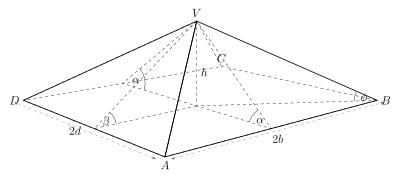
- Let \(A = (0,0,0)\) and then \(B = 22b \mathbf{i}, D = 2d\mathbf{j}, C = 2b\mathbf{i}+2d\mathbf{j}\) and \(V = b \mathbf{i} + d\mathbf{j} + h\mathbf{k}\) We also have \begin{align*} && \tan \alpha &= \frac{h}{d}\\ && \tan \beta &= \frac{d}{b} \\ && \vec{AV} \times \vec{VB} &= \begin{pmatrix} b \\ d \\ h \end{pmatrix} \times \begin{pmatrix} -b \\ d \\ h \end{pmatrix} \\ &&&= \begin{pmatrix} 0 \\ -2bh \\ 2db \end{pmatrix} \\ &&&= 2b \begin{pmatrix} 0 \\ -d \tan \alpha \\ d \end{pmatrix} \\ &&&= k \begin{pmatrix} 0 \\ - \sin \alpha \\ \cos \alpha \end{pmatrix} \end{align*} similarly for the vector perpendicular to the other face it must be \(\begin{pmatrix}-\sin \beta \\ 0 \\ \cos \beta \end{pmatrix}\) Looking at the angle between these perpendicular (to find the angles between the faces we see: \begin{align*} \begin{pmatrix} 0 \\ - \sin \alpha \\ \cos \alpha \end{pmatrix} \cdot \begin{pmatrix}-\sin \beta \\ 0 \\ \cos \beta \end{pmatrix} &= \cos \alpha \cos \beta \end{align*} But this is also \(\pi -\) the angle between the planes, ie \(\cos \theta = \cos \alpha \cos \beta\)
- \(\,\) \begin{align*} && \cot^2 \phi &= \frac{b^2+d^2}{h^2} \\ && \cot^2 \alpha &= \frac{d^2}{h^2} \\ && \cot^2 \beta &= \frac{b^2}{h^2} \\ \Rightarrow && cot^2 \phi &= \cot^2 \beta+\cot^2 \alpha \end{align*} \begin{align*} && \cos^2 \phi &= \frac{b^2+d^2}{b^2+d^2+h^2} \\ && \cos^2 \alpha &= \frac{d^2}{d^2+h^2} \\ && \cos^2 \beta &= \frac{b^2}{b^2+h^2} \\ && \frac{\cos^2 \alpha + \cos^2 \beta - 2 \cos^2 \theta}{1-\cos^2 \theta} &= \frac{\frac{d^2}{d^2+h^2}+\frac{b^2}{b^2+h^2}-2\cdot \frac{d^2}{d^2+h^2} \cdot \frac{b^2}{b^2+h^2}}{1 - \frac{d^2}{d^2+h^2} \cdot\frac{b^2}{b^2+h^2}} \\ &&&= \frac{d^2(b^2+h^2)+b^2(d^2+h^2)-2d^2b^2}{(d^2+h^2)(b^2+h^2)-d^2b^2} \\ &&&= \frac{h^2(b^2+d^2)}{h^2(b^2+d^2+h^2)} \\ &&&= \frac{b^2+d^2}{b^2+d^2+h^2} \\ &&&= \cos^2\phi \end{align*} Also notice that \begin{align*} && \cos^2 \alpha + \cos^2 \beta &\underbrace{\geq}_{AM-GM} 2 \cos \alpha \cos \beta \\ &&&= 2 \cos \theta \\ \Rightarrow && \frac{\cos^2 \alpha + \cos^2 \beta - 2 \cos^2 \theta}{1-\cos^2 \theta} &\geq \frac{2 \cos \theta - 2\cos^2 \theta}{1-\cos^2 \theta} \\ &&&= \frac{2\cos \theta}{1+\cos \theta} = \cos \theta \frac{2}{1+\cos \theta} \\ &&&> \cos^2 \theta \\ \Rightarrow && \phi &< \theta \end{align*}
2017 Paper 2 Q8
All vectors in this question lie in the same plane. The vertices of the non-right-angled triangle \(ABC\) have position vectors \(\bf a\), \(\bf b\) and \(\bf c\), respectively. The non-zero vectors \(\bf u\) and \(\bf v\) are perpendicular to \(BC\) and \(CA\), respectively. Write down the vector equation of the line through \(A\) perpendicular to \(BC\), in terms of \(\bf u\), \(\bf a\) and a parameter \(\lambda \). The line through \(A\) perpendicular to \(BC\) intersects the line through \(B\) perpendicular to \(CA\) at \(P\). Find the position vector of \(P\) in terms of \(\bf a\), \(\bf b\), \(\bf c\) and \(\bf u\). Hence show that the line \(CP\) is perpendicular to the line \(AB\).
Solution: The line through \(A\) perpendicular to \(BC\) is \(\mathbf{a} + \lambda\mathbf{u}\). The line through \(B\) perpendicular to \(CA\) is \(\mathbf{b} + \mu \mathbf{v}\). They intersect when \(\mathbf{a} + \lambda\mathbf{u} = \mathbf{b} + \mu \mathbf{v}\). Since \(\mathbf{v}\) is perpendicular to \(CA\), we must have \begin{align*} && \mathbf{a} + \lambda\mathbf{u} &= \mathbf{b} + \mu \mathbf{v} \\ \Rightarrow && \mathbf{a}\cdot(\mathbf{c}-\mathbf{a}) + \lambda\mathbf{u}\cdot(\mathbf{c}-\mathbf{a}) &= \mathbf{b}\cdot(\mathbf{c}-\mathbf{a}) + \mu \mathbf{v}\cdot(\mathbf{c}-\mathbf{a}) \\ \\ \Rightarrow && \lambda &= \frac{\mathbf{b}\cdot(\mathbf{c}-\mathbf{a}) -\mathbf{a}\cdot(\mathbf{c}-\mathbf{a})}{\mathbf{u}\cdot(\mathbf{c}-\mathbf{a})} \\ &&&= \frac{(\mathbf{b}-\mathbf{a})\cdot(\mathbf{c}-\mathbf{a})}{\mathbf{u} \cdot(\mathbf{c}-\mathbf{a})} \end{align*} Therefore the point is \(\mathbf{a} + \frac{(\mathbf{b}-\mathbf{a})\cdot(\mathbf{c}-\mathbf{a})}{\mathbf{u} \cdot(\mathbf{c}-\mathbf{a})} \mathbf{u}\). The line \(CP\) is \(\mathbf{c} + \nu \left (\mathbf{p} - \mathbf{c} \right)\), to check this is perpendicular with \(AB\) we should dot \(\mathbf{p}-\mathbf{c}\) with \(\mathbf{a}-\mathbf{b}\), ie \begin{align*} && (\mathbf{p}-\mathbf{c}) \cdot (\mathbf{a}-\mathbf{b}) &= \left ( \mathbf{a} + \frac{(\mathbf{b}-\mathbf{a})\cdot(\mathbf{c}-\mathbf{a})}{\mathbf{u} \cdot(\mathbf{c}-\mathbf{a})} \mathbf{u} - \mathbf{c}\right) \cdot ( \mathbf{a}-\mathbf{b}) \\ &&&= \left ( \mathbf{a}- \mathbf{c} + \frac{(\mathbf{b}-\mathbf{a})\cdot(\mathbf{c}-\mathbf{a})}{\mathbf{u} \cdot(\mathbf{c}-\mathbf{a})} \mathbf{u} \right) \cdot ( \mathbf{a}-\mathbf{c}+(\mathbf{c}-\mathbf{b})) \\ &&&= (\mathbf{a}-\mathbf{c})\cdot(\mathbf{a}-\mathbf{c}) + \frac{(\mathbf{b}-\mathbf{a})\cdot(\mathbf{c}-\mathbf{a})}{\mathbf{u} \cdot(\mathbf{c}-\mathbf{a})}\mathbf{u} \cdot (\mathbf{a}-\mathbf{c}) + \\ &&&\quad (\mathbf{a}-\mathbf{c})\cdot(\mathbf{c}-\mathbf{b}) + \lambda \underbrace{\mathbf{u} \cdot (\mathbf{c}-\mathbf{b})}_{=0} \\ &&&=(\mathbf{a}-\mathbf{c})\cdot(\mathbf{a}-\mathbf{c}) -(\mathbf{b}-\mathbf{a})\cdot(\mathbf{c}-\mathbf{a})+ (\mathbf{a}-\mathbf{c})\cdot(\mathbf{c}-\mathbf{b}) \\ &&&= (\mathbf{a}-\mathbf{c})\cdot(\mathbf{a}-\mathbf{c}+\mathbf{b}-\mathbf{a}+\mathbf{c}-\mathbf{b}) \\ &&&= 0 \end{align*} as required.
2013 Paper 3 Q3
The four vertices \(P_i\) (\(i= 1, 2, 3, 4\)) of a regular tetrahedron lie on the surface of a sphere with centre at \(O\) and of radius 1. The position vector of \(P_i\) with respect to \(O\) is \({\bf p}_i\) (\(i= 1, 2, 3, 4\)). Use the fact that \({\bf p}_1+ {\bf p}_2+{\bf p}_3+{\bf p}_4={\bf 0}\,\) to show that \({\bf p}_i \,.\, {\bf p}_j =-\frac13\,\) for \(i\ne j\). Let \(X\) be any point on the surface of the sphere, and let \(XP_i\) denote the length of the line joining \(X\) and \(P_i\) (\(i= 1, 2, 3, 4\)).
- By writing \((XP_i) ^2\) as \(({\bf p}_i- {\bf x)}\,.\,({\bf p}_i- {\bf x})\), where \({\bf x}\) is the position vector of \(X\) with respect to \(O\), show that \[ \sum_{i=1}^4(XP_i) ^2 =8\,. \]
- Given that \(P_1\) has coordinates \((0,0,1)\) and that the coordinates of \(P_2\) are of the form \((a,0,b)\), where \(a > 0\), show that \(a=2\sqrt2/3\) and \(b=-1/3\), and find the coordinates of \(P_3\) and \(P_4\).
- Show that \[ \sum_{i=1}^4 (XP_i)^4 = 4 \sum_{i=1}^4 (1- {\bf x}\,.\,{\bf p}_i)^2\,. \] By letting the coordinates of \(X\) be \( (x,y,z)\), show further that \(\sum\limits_{i=1}^4 (XP_i)^4\) is independent of the position of \(X\).
Solution: Note that \({\bf p}_i \cdot {\bf p}_i = 1\) and \({\bf p}_i \cdot {\bf p}_j\) are all equal when \(i \neq j\) by symmetry and commutativity. \begin{align*} && 0 &= {\bf p}_i \cdot \left ( {\bf p}_1+ {\bf p}_2+{\bf p}_3+{\bf p}_4 \right) \\ &&&= 1 + \sum_{j \neq i} {\bf p}_i \cdot {\bf p}_j \\ &&&= 1 + 3 {\bf p}_i \cdot {\bf p}_j \\ \Rightarrow && {\bf p}_i \cdot {\bf p}_j &= -\frac13 \end{align*}
- \(\,\) \begin{align*} && (XP_i)^2 &= ({\bf p}_i- {\bf x)}\,.\,({\bf p}_i- {\bf x}) \\ &&&= {\bf p}_i \cdot {\bf p}_i - 2 {\bf p}_i \cdot {\bf x} + {\bf x} \cdot {\bf x} \\ &&&= 2 - 2 {\bf p}_i \cdot {\bf x} \\ \Rightarrow && \sum_i (XP_i)^2 &= \sum_i \left (2 - 2 {\bf p}_i \cdot {\bf x} \right) \\ &&&= 8 - 2 \sum_i {\bf p}_i \cdot {\bf x} \\ &&&= 8 - 2 \left ( {\bf p}_1+ {\bf p}_2+{\bf p}_3+{\bf p}_4 \right) \cdot {\bf x} \\ &&&= 8 \end{align*}
- Notice we have \(1 = \left \|\begin{pmatrix} a \\0 \\b \end{pmatrix} \right \|= a^2 + b^2\) and \(-\frac13 = \begin{pmatrix} a \\0 \\b \end{pmatrix} \cdot \begin{pmatrix} 0 \\0 \\ 1 \end{pmatrix} = b\). So \(b = -1/3\) and \(a = \sqrt{1-b^2} = 2\sqrt{2}/3\). Suppose another of the vertices has coordinates \((u,v,w)\) we must have \begin{align*} && 1 &= u^2+v^2+w^2 \\ && -\frac13&=w \\ && -\frac13 &= \frac{2\sqrt{2}}3 u +\frac19 \\ \Rightarrow && u &= -\frac{\sqrt2}3 \\ \Rightarrow && 1 &= \frac19 + \frac29 + v^2 \\ \Rightarrow && v &= \pm \sqrt{\frac{2}{3}} \end{align*} So \(P_3, P_4 = (-\frac{\sqrt2}3, \pm \frac{\sqrt{6}}3, -\frac13)\)
- \(\,\) \begin{align*} && \sum_{i=1}^4 (XP_i)^4 &= \sum_i \left (2 - 2 {\bf p}_i \cdot {\bf x} \right)^2 \\ &&&= 4 \sum_i \left (1 - {\bf p}_i \cdot {\bf x} \right)^2 \\ &&&= 4 \sum_i (1 - 2{\bf p}_i \cdot {\bf x} + ({\bf p}_i \cdot {\bf x})^2) \\ &&&= 16 + 4\sum_i ({\bf p}_i \cdot {\bf x})^2 \\ &&&=16+ 4\left ( z^2+\left (\frac{2\sqrt{2}}3x-\frac13z \right)^2 +\left (-\frac{\sqrt{2}}3x-\frac{\sqrt{6}}3y-\frac13z \right)^2 +\left (-\frac{\sqrt{2}}3x+\frac{\sqrt{6}}3y-\frac13z \right)^2 \right) \\ &&&= 16+4 \left ( \frac43z^2 + \left (\frac89 + \frac29+\frac29 \right)x^2+\left (\frac69 + \frac69 \right)y^2 + 0xz + 0yz + 0zx \right) \\ &&&= 16+ 4\cdot\frac43(x^2+y^2+z^2) \\ &&&=16+\frac{16}{3}=\frac{64}{3} \end{align*}
2011 Paper 1 Q4
The distinct points \(P\) and \(Q\), with coordinates \((ap^2,2ap)\) and \((aq^2,2aq)\) respectively, lie on the curve \(y^2=4ax\). The tangents to the curve at \(P\) and \(Q\) meet at the point \(T\). Show that \(T\) has coordinates \(\big(apq, a(p+q)\big)\). You may assume that \(p\ne0\) and \(q\ne0\). The point \(F\) has coordinates \((a,0)\) and \(\phi\) is the angle \(TFP\). Show that \[ \cos\phi = \frac{pq+1}{\sqrt{(p^2+1)(q^2+1)}\ } \] and deduce that the line \(FT\) bisects the angle \(PFQ\).
Solution: The tangent at \((at^2, 2at)\) can be found \begin{align*} && \frac{\d y}{\d x} &= \frac{\dot{y}}{\dot{x}} \\ &&&= \frac{2a}{2at} = \frac1t \\ \Rightarrow && \frac{y-2at}{x-at^2} &= \frac1t \\ \Rightarrow && ty -x &= at^2 \\ \\ PT: && py - x &= ap^2 \\ QT: && qy - x &= aq^2 \\ \Rightarrow && (p-q)y &= a(p^2-q^2) \\ \Rightarrow && y &= a(p+q) \\ && x &= aq(p+q) - aq^2 \\ &&&= apq \end{align*} By the cosine rule: \begin{align*} && TP^2 &= FT^2 + FP^2 - 2 \cdot FT \cdot FP \cdot \cos \phi \\ && (apq - ap^2)^2 + (a(p+q)-2ap)^2 &= (a-apq)^2+(a(p+q))^2 + \\ &&&\quad + (a-ap^2) + (2ap)^2 - 2 \cdot FT \cdot FP \cdot \cos \phi \\ \Rightarrow && a^2p^2(q-p)^2 + a^2(q-p)^2 &= a^2(1-pq)^2+a^2(p+q)^2 + \\ &&&\quad + a^2(1-p^2)^2+4a^2p^2 - 2 \cdot FT \cdot FP \cdot \cos \phi \\ && a^2(p^2+1)(q-p)^2 &= a^2(1+p^2)(1+q^2) + a^2(1+p^2)^2 + \\ &&&\quad - 2 \cdot a^2(1+p^2)\sqrt{(1+p^2)(1+q^2)} \cos \phi \\ \Rightarrow && \cos \phi &= \frac{a^2(1+p^2)(2+q^2+p^2-(q-p)^2)}{2 a^2 (1+p^2)\sqrt{(1+p^2)(1+q^2)}} \\ &&&= \frac{1+pq}{\sqrt{(1+p^2)(1+q^2)}} \end{align*} As required. Notice that by symmetry, \(\cos \angle TFQ = \frac{1+qp}{\sqrt{(1+q^2)(1+p^2)}} = \cos \phi\). Therefore they have the same angle and \(FT\) bisects \(PFQ\)
2011 Paper 2 Q5
The points \(A\) and \(B\) have position vectors \(\bf a \) and \(\bf b\) with respect to an origin \(O\), and \(O\), \(A\)~and~\(B\) are non-collinear. The point \(C\), with position vector \(\bf c\), is the reflection of \(B\) in the line through \(O\) and \(A\). Show that \(\bf c\) can be written in the form \[ \bf c = \lambda \bf a -\bf b \] where \(\displaystyle \lambda = \frac{2\,{\bf a .b}}{{\bf a.a}}\). The point \(D\), with position vector \(\bf d\), is the reflection of \(C\) in the line through \(O\) and \(B\). Show that \(\bf d\) can be written in the form \[ \bf d = \mu\bf b - \lambda \bf a \] for some scalar \(\mu\) to be determined. Given that \(A\), \(B\) and \(D\) are collinear, find the relationship between \(\lambda\) and \(\mu\). In the case \(\lambda = -\frac12\), determine the cosine of \(\angle AOB\) and describe the relative positions of \(A\), \(B\) and \(D\).
2010 Paper 1 Q10
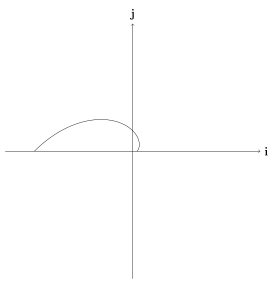
A particle \(P\) moves so that, at time \(t\), its displacement \( \bf r \) from a fixed origin is given by \[ {\bf r} =\left( \e^{t}\cos t \right) {\bf i}+ \left(\e^t \sin t\right) {\bf j}\,.\] Show that the velocity of the particle always makes an angle of \(\frac{\pi}{4}\) with the particle's displacement, and that the acceleration of the particle is always perpendicular to its displacement. Sketch the path of the particle for \(0\le t \le \pi\). A second particle \(Q\) moves on the same path, passing through each point on the path a fixed time \(T\) after \(P\) does. Show that the distance between \(P\) and \(Q\) is proportional to \(\e^{t}\).
Solution: \begin{align*} && {\bf r} &=\left( \e^{t}\cos t \right) {\bf i}+ \left(\e^t \sin t\right) {\bf j} \\ \Rightarrow && \dot{\bf r} &= \left( \e^{t}\cos t -\e^t \sin t\right) {\bf i}+ \left(\e^t \sin t+\e^t \cos t\right) {\bf j} \\ \Rightarrow && \mathbf{r}\cdot\dot{ \mathbf{r}} &= e^{2t}(\cos^2 t - \sin t \cos t) + e^{2t}(\sin^2 t+ \sin t \cos t) \\ &&&= e^{2t} (\cos^2 t + \sin ^2 t)\\ &&&= e^{2t} \\ \\ && | {\bf r}| &= e^{t} \\ && |{\bf \dot{r}}| &= e^t \sqrt{(\cos t - \sin t)^2 + (\sin t + \cos t)^2} \\ &&&= e^t \sqrt{2 \cos^2 t + 2 \sin^2 t} \\ &&&= \sqrt{2} e^t \\ \\ \Rightarrow && \frac{\mathbf{r}\cdot\dot{ \mathbf{r}}}{ |{\bf {r}}| |{\bf \dot{r}}|} &= \frac{e^{2t}}{\sqrt{2}e^te^t} \\ &&&= \frac{1}{\sqrt{2}} \end{align*} Therefore the angle between the velocity and displacement is \(\frac{\pi}{4}\). \begin{align*} && \ddot{\bf{r}} &= \left( \e^{t}(\cos t - \sin t) - \e^t (\sin t + \cos t)\right) {\bf i}+ \left(\e^t (\sin t + \cos t) + \e^t(\cos t - \sin t)\right) {\bf j} \\ &&&= \left ( -2\e^{t} \sin t \right) {\bf i}+ \left ( 2\e^{t} \cos t \right) {\bf j} \\ \Rightarrow && {\bf r} \cdot \ddot{\bf{r}} &= 2e^{2t} \left ( -\sin t \cos t + \sin t \cos t \right) \\ &&&= 0 \end{align*} Therefore the acceleration is perpendicular.
2010 Paper 2 Q5
The points \(A\) and \(B\) have position vectors \(\bf i +j+k\) and \(5{\bf i} - {\bf j} -{\bf k}\), respectively, relative to the origin \(O\). Find \(\cos2\alpha\), where \(2\alpha\) is the angle \(\angle AOB\).
- The line \(L _1\) has equation \({\bf r} =\lambda(m{\bf i}+n {\bf j} + p{\bf k})\). Given that \(L _1\) is inclined equally to \(OA\) and to \(OB\), determine a relationship between \(m\), \(n\) and~\(p\). Find also values of \(m\), \(n\) and~\(p\) for which \(L _1\) is the angle bisector of \(\angle AOB\).
- The line \(L _2\) has equation \({\bf r} =\mu(u{\bf i}+v {\bf j} + w{\bf k})\). Given that \( L _2\) is inclined at an angle \(\alpha\) to \(OA\), where \(2\alpha = \angle AOB\), determine a relationship between \(u\), \(v\) and \(w\). Hence describe the surface with Cartesian equation \(x^2+y^2+z^2 =2(yz+zx+xy)\).
2008 Paper 2 Q8
The points \(A\) and \(B\) have position vectors \(\bf a\) and \(\bf b\), respectively, relative to the origin \(O\). The points \(A\), \(B\) and \(O\) are not collinear. The point \(P\) lies on \(AB\) between \(A\) and \(B\) such that \[ AP : PB = (1-\lambda):\lambda\,. \] Write down the position vector of \(P\) in terms of \(\bf a\), \(\bf b\) and \(\lambda\). Given that \(OP\) bisects \(\angle AOB\), determine \(\lambda\) in terms of \(a\) and \(b\), where \(a=\vert \bf a\vert\) and $b=\vert \mathbf{b}\vert\(. The point \)Q\( also lies on \)AB\( between \)A\( and \)B\(, and is such that \)AP=BQ$. Prove that $$OQ^2-OP^2=(b-a)^2\,.$$
Solution:

2007 Paper 1 Q5
Note: a regular octahedron is a polyhedron with eight faces each of which is an equilateral triangle.
- Show that the angle between any two faces of a regular octahedron is \(\arccos \left( -{\frac1 3} \right)\).
- Find the ratio of the volume of a regular octahedron to the volume of the cube whose vertices are the centres of the faces of the octahedron.
Solution:
- Suppose the vertices are \((\pm1, 0,0), (0,\pm1,0), (0,0,\pm1)\), then clearly this is an octahedron. We can measure the angle between the faces, by looking at vectors in the same plane and also in two of the faces: \(\langle \frac12, \frac12, - 1\rangle\) and \(\langle \frac12, \frac12, 1\rangle\), then by considering the dot product: \begin{align*} && \cos \theta &= \frac{\frac14+\frac14-1}{\frac14+\frac14+1} \\ &&&= \frac{-2}{6} = -\frac13 \end{align*}
- The volume of our octahedron is \(2 \cdot \frac13 \cdot \underbrace{\sqrt{2}^2}_{\text{base}} \cdot \underbrace{1}_{\text{height}} = \frac43\). The centre of two touching faces are \(\langle \frac13, \frac13, \frac13 \rangle\) and \(\langle \frac13, \frac13, -\frac13 \rangle\) and so the length of the side of the cube is \(\frac23\) and so the volume of the cube is \(\frac8{27}\). Therefore the ratio is \(\frac{2}{9}\)
2006 Paper 2 Q6
By considering a suitable scalar product, prove that \[ (ax+by+cz)^2 \le (a^2+b^2+c^2)(x^2+y^2+z^2) \] for any real numbers \(a\), \(b\), \(c\), \(x\), \(y\) and \(z\). Deduce a necessary and sufficient condition on \(a\), \(b\), \(c\), \(x\), \(y\) and \(z\) for the following equation to hold: \[ (ax+by+cz)^2 = (a^2+b^2+c^2)(x^2+y^2+z^2) \,. \]
- Show that \((x+2y+2z)^2 \le 9(x^2+y^2+z^2)\) for all real numbers \(x\), \(y\) and \(z\).
- Find real numbers \(p\), \(q\) and \(r\) that satisfy both \[ p^2+4q^2+9r^2 = 729 \text{ and } 8p+8q+3r = 243\,. \]
Solution: Consider \(\begin{pmatrix} a \\ b \\ c \end{pmatrix}\), \(\begin{pmatrix} x \\ y \\ z \end{pmatrix}\), then we know that \begin{align*} && \begin{pmatrix} a \\ b \\ c \end{pmatrix} \cdot \begin{pmatrix} x \\ y \\ z \end{pmatrix} &= \sqrt{a^2+b^2+c^2} \sqrt{x^2+y^2+z^2} \cos \theta \\ \Rightarrow && (ax+by+cz)^2 &= (a^2+b^2+c^2)(x^2+y^2+z^2) \cos^2 \theta \\ &&&\leq (a^2+b^2+c^2)(x^2+y^2+z^2) \end{align*} For equality to hold, we must have that the vectors are parallel, ie \(\begin{pmatrix} a \\ b \\ c \end{pmatrix} = \lambda \begin{pmatrix} x \\ y \\ z \end{pmatrix}\)
- By applying our inequality from the first part with \(a=1, b = 2, c=2\) we have \((x+2y+2z)^2 \leq (1+2^2+2^2)(x^2+y^2+z^2) = 9(x^2+y^2+z^2)\)
- Since \begin{align*} && (p^2+(2q)^2+(3r)^2)\left (8^2 +4^2+1^2 \right) &\geq (8p+8q+3r)^2 \\ \Leftrightarrow && 729 \cdot 81 &\geq 243^2 \\ &&3^6 \cdot 3^4 &\geq 3^{10} \end{align*} Therefore we must be in the equality case, ie \(p = 8\lambda, 2q = 4\lambda, 3r = \lambda\) as well as \(64\lambda + 16\lambda +\lambda = 243 \Rightarrow 81\lambda = 243 \Rightarrow \lambda = 3\) so we have \[ (p,q,r) = \left (24, 6, 1 \right) \]
2004 Paper 2 Q6
The vectors \({\bf a}\) and \({\bf b}\) lie in the plane \(\Pi\,\). Given that \(\vert {\bf a} \vert= 1\) and \({\bf a}.{\bf b} = 3,\) find, in terms of \({\bf a}\) and \({\bf b}\,\), a vector \({\bf p}\) parallel to \({\bf a}\) and a vector \({\bf q}\) perpendicular to \({\bf a}\,\), both lying in the plane \(\Pi\,\), such that $${\bf p}+{\bf q}={\bf a}+{\bf b}\;.$$ The vector \({\bf c}\) is not parallel to the plane \(\Pi\) and is such that \({\bf a}.{\bf c} = -2\) and \({\bf b}.{\bf c} = 2\,\). Given that \(\vert {\bf b} \vert = 5\,\), find, in terms of \({\bf a}, {\bf b}\) and \({\bf c},\) vectors \({\bf P}\), \({\bf Q}\) and \({\bf R}\) such that \({\bf P}\) and \({\bf Q}\) are parallel to \({\bf p}\) and \({\bf q},\) respectively, \({\bf R}\) is perpendicular to the plane \(\Pi\) and $${\bf P} + {\bf Q} + {\bf R} = {\bf a}+{\bf b}+{\bf c}\;.$$
Solution: Suppose \({\bf p} = \lambda {\bf a}\) and \({\bf p} + {\bf q} = {\bf a} + {\bf b}\) then \begin{align*} {\bf a} \cdot : && {\bf a} \cdot {\bf p} + {\bf a} \cdot {\bf p} &= {\bf a} \cdot {\bf a} + {\bf a} \cdot {\bf b} \\ && \lambda + 0 &= 1 + 3 = 4 \\ \Rightarrow && \mathbf{p} &= 4 \mathbf{a} \\ && \mathbf{q} &= \mathbf{b} - 3\mathbf{a} \\ \\ && \mathbf{P} &= 4p\mathbf{a} \\ && \mathbf{Q} &= q\mathbf{b} - 3q\mathbf{a} \\ \\ \mathbf{a} \cdot : && \mathbf{a} \cdot \mathbf{P} + \mathbf{a} \cdot \mathbf{Q} + \mathbf{a} \cdot \mathbf{R} &= \mathbf{a} \cdot \mathbf{a} + \mathbf{a} \cdot \mathbf{b} + \mathbf{a} \cdot \mathbf{c} \\ && 4p &= 1+3-2 \\ \Rightarrow && p &= \tfrac12 \\ \\ && {\bf P} + {\bf Q} + {\bf R} &= {\bf a}+{\bf b}+{\bf c} \\ \mathbf{b} \cdot : && \mathbf{b} \cdot \mathbf{P} + \mathbf{b} \cdot \mathbf{Q} + \mathbf{b} \cdot \mathbf{R} &= \mathbf{b} \cdot \mathbf{a} + \mathbf{b} \cdot \mathbf{b} + \mathbf{b} \cdot \mathbf{c} \\ && 12p + 25q - 9q &= 3+25+2 \\ && 6+16q &= 30 \\ \Rightarrow && q &= \tfrac{3}{2}\\ && \\ && \mathbf{P} &= 2\mathbf{a} \\ && \mathbf{Q} &= \tfrac32 \mathbf{b} - \tfrac92 \mathbf{a} \\ && \mathbf{R} &= \tfrac72\mathbf{a} -\tfrac12 \mathbf{b} + \mathbf{c} \end{align*}
2002 Paper 2 Q7
In 3-dimensional space, the lines \(m_1\) and \(m_2\) pass through the origin and have directions \(\bf i + j\) and \(\bf i +k \), respectively. Find the directions of the two lines \(m_3\) and \(m_4\) that pass through the origin and make angles of \(\pi/4\) with both \(m_1\) and \(m_2\). Find also the cosine of the acute angle between \(m_3\) and \(m_4\). The points \(A\) and \(B\) lie on \(m_1\) and \(m_2\) respectively, and are each at distance \(\lambda \surd2\) units from~\(O\). The points \(P\) and \(Q\) lie on \(m_3\) and \(m_4\) respectively, and are each at distance \(1\) unit from~\(O\). If all the coordinates (with respect to axes \(\bf i\), \(\bf j\) and \(\bf k\)) of \(A\), \(B\), \(P\) and \(Q\) are non-negative, prove that:
- there are only two values of \(\lambda\) for which \(AQ\) is perpendicular to \(BP\,\);
- there are no non-zero values of \(\lambda\) for which \(AQ\) and \(BP\) intersect.
2001 Paper 2 Q3
The cuboid \(ABCDEFGH\) is such \(AE\), \(BF\), \(CG\), \(DH\) are perpendicular to the opposite faces \(ABCD\) and \(EFGH\), and \(AB =2, BC=1, AE={\lambda}\). Show that if \(\alpha\) is the acute angle between the diagonals \(AG\) and \(BH\) then $$\cos {\alpha} = |\frac {3-{\lambda}^2} {5+{\lambda}^2} |$$ Let \(R\) be the ratio of the volume of the cuboid to its surface area. Show that \(R<\frac{1}{3}\) for all possible values of \(\lambda\). Prove that, if \(R\ge \frac{1}{4}\), then \(\alpha \le \arccos \frac{1}{9}\).
Solution:
