Problems
Filters
18 problems found
2024 Paper 2 Q3
The unit circle is the circle with radius 1 and centre the origin, \(O\). \(N\) and \(P\) are distinct points on the unit circle. \(N\) has coordinates \((-1, 0)\), and \(P\) has coordinates \((\cos\theta, \sin\theta)\), where \(-\pi < \theta < \pi\). The line \(NP\) intersects the \(y\)-axis at \(Q\), which has coordinates \((0, q)\).
- Show that \(q = \tan\frac{1}{2}\theta\).
- In this part, \(q \neq 1\).
- Let \(\mathrm{f}_1(q) = \dfrac{1+q}{1-q}\). Show that \(\mathrm{f}_1(q) = \tan\frac{1}{2}\!\left(\theta + \frac{1}{2}\pi\right)\).
- Let \(Q_1\) be the point with coordinates \((0, \mathrm{f}_1(q))\) and \(P_1\) be the point of intersection (other than \(N\)) of the line \(NQ_1\) and the unit circle. Describe geometrically the relationship between \(P\) and \(P_1\).
- \(P_2\) is the image of \(P\) under an anti-clockwise rotation about \(O\) through angle \(\frac{1}{3}\pi\). The line \(NP_2\) intersects the \(y\)-axis at the point \(Q_2\) with co-ordinates \((0, \mathrm{f}_2(q))\). Find \(\mathrm{f}_2(q)\) in terms of \(q\), for \(q \neq \sqrt{3}\).
- In this part, \(q \neq -1\). Let \(\mathrm{f}_3(q) = \dfrac{1-q}{1+q}\), let \(Q_3\) be the point with coordinates \((0, \mathrm{f}_3(q))\) and let \(P_3\) be the point of intersection (other than \(N\)) of the line \(NQ_3\) and the unit circle. Describe geometrically the relationship between \(P\) and \(P_3\).
- In this part, \(0 < q < 1\). Let \(\mathrm{f}_4(q) = \mathrm{f}_2^{-1}\!\Big(\mathrm{f}_3\!\big(\mathrm{f}_2(q)\big)\Big)\), let \(Q_4\) be the point with coordinates \((0, \mathrm{f}_4(q))\) and let \(P_4\) be the point of intersection (other than \(N\)) of the line \(NQ_4\) and the unit circle. Describe geometrically the relationship between \(P\) and \(P_4\).
Solution:
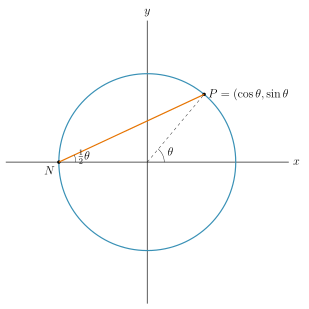
- \(\,\) \begin{align*} && \frac{y-0}{x-(-1)} &= \frac{\sin \theta }{\cos \theta + 1} \\ \Rightarrow && y_0 &= \frac{\sin \theta}{\cos \theta + 1} \\ &&&= \frac{\frac{2t}{1+t^2}}{\frac{1-t^2}{1+t^2}+1} \\ &&&= t = \tan \tfrac{\theta}{2} \end{align*} Alternatively, it is straightforward to see from the angles.
- \(f_1(q) = \frac{1+q}{1-q}\) so \begin{align*} && f_1(\tan\tfrac12\theta) &= \frac{1+\tan\tfrac12\theta}{1-\tan\tfrac12\theta} \\ &&&= \frac{\cos \tfrac12 \theta + \sin \tfrac12 \theta}{\cos \tfrac12 \theta - \sin \tfrac12 \theta} \\ &&&= \frac{\sin(\tfrac14 \pi + \tfrac12 \theta)}{\cos(\tfrac14 \pi + \tfrac12 \theta)} \\ &&&= \tan \tfrac12(\theta + \tfrac{\pi}{2}) \end{align*}
- \(Q_1\) is the point \((0, f_1(q))\) so \(P_1\) will be the point \((\cos (\theta + \tfrac{\pi}{2}), \sin (\theta + \tfrac{\pi}{2}))\) which is a rotation anticlockwise by \(\frac{\pi}{2}\)
- \(P_2 = (\cos(\theta + \tfrac{\pi}{3}), \sin( \theta + \tfrac{\pi}{3})\) and so \(f_2(q) = \tan (\tfrac12(\theta + \tfrac{\pi}{3}))\) so \begin{align*} && f_2(q) &= \tan (\tfrac12(\theta + \tfrac{\pi}{3})) \\ &&&= \frac{q + \tan \frac{\pi}{3}}{1 - \tan \frac{\pi}{3} \cdot q} \\ &&&= \frac{q + \frac{1}{\sqrt3}}{1 - \frac{q}{\sqrt{3}}} \\ &&&= \frac{\sqrt3 q + 1}{\sqrt3-q} \end{align*}
- Since \(q \to -q\) reflects \((0,q)\) in the \(x\)-axis, \(f_3(q) = f_1(-q)\) so \(P_3\) is the reflection of \(P_1\) so it's rotation by \(\frac{\pi}{2}\) followed by reflection in the \(x\)-axis, which is reflection in \(y=x\). [ie \(\theta \to -\theta + \frac{\pi}{2} \to \frac{\pi}{2}-\theta\)]
- We are rotating by \(\frac{\pi}{3}\) then reflecting in \(y=x\) and then rotating by \(-\frac{\pi}{3}\), ie \(\theta \to \theta + \frac{\pi}{3} \to \frac{\pi}{6}-\theta \to -\theta -\frac{\pi}{6} \)
2022 Paper 3 Q7
Let \(\mathbf{n}\) be a vector of unit length in three dimensions. For each vector \(\mathbf{r}\), \(\mathrm{f}(\mathbf{r})\) is defined by \[ \mathrm{f}(\mathbf{r}) = \mathbf{n} \times \mathbf{r}\,. \]
- Given that \[ \mathbf{n} = \begin{pmatrix} a \\ b \\ c \end{pmatrix} \quad \text{and} \quad \mathbf{r} = \begin{pmatrix} x \\ y \\ z \end{pmatrix}, \] show that the \(x\)-component of \(\mathrm{f}(\mathrm{f}(\mathbf{r}))\) is \(-x(b^2+c^2)+aby+acz\). Show further that \[ \mathrm{f}(\mathrm{f}(\mathbf{r})) = (\mathbf{n}.\mathbf{r})\mathbf{n} - \mathbf{r}\,. \] Explain, by means of a diagram, how \(\mathrm{f}(\mathrm{f}(\mathbf{r}))\) is related to \(\mathbf{n}\) and \(\mathbf{r}\).
- Let \(R\) be the point with position vector \(\mathbf{r}\) and \(P\) be the point with position vector \(\mathrm{g}(\mathbf{r})\), where \(\mathrm{g}\) is defined by \[ \mathrm{g}(\mathbf{s}) = \mathbf{s} + \sin\theta\,\mathrm{f}(\mathbf{s}) + (1-\cos\theta)\,\mathrm{f}(\mathrm{f}(\mathbf{s}))\,. \] By considering \(\mathrm{g}(\mathbf{n})\) and \(\mathrm{g}(\mathbf{r})\) when \(\mathbf{r}\) is perpendicular to \(\mathbf{n}\), state, with justification, the geometric transformation which maps \(R\) onto \(P\).
- Let \(R\) be the point with position vector \(\mathbf{r}\) and \(Q\) be the point with position vector \(\mathrm{h}(\mathbf{r})\), where \(\mathrm{h}\) is defined by \[ \mathrm{h}(\mathbf{s}) = -\mathbf{s} - 2\,\mathrm{f}(\mathrm{f}(\mathbf{s}))\,. \] State, with justification, the geometric transformation which maps \(R\) onto \(Q\).
2020 Paper 3 Q3
Given distinct points \(A\) and \(B\) in the complex plane, the point \(G_{AB}\) is defined to be the centroid of the triangle \(ABK\), where the point \(K\) is the image of \(B\) under rotation about \(A\) through a clockwise angle of \(\frac{1}{3}\pi\). Note: if the points \(P\), \(Q\) and \(R\) are represented in the complex plane by \(p\), \(q\) and \(r\), the centroid of triangle \(PQR\) is defined to be the point represented by \(\frac{1}{3}(p+q+r)\).
- If \(A\), \(B\) and \(G_{AB}\) are represented in the complex plane by \(a\), \(b\) and \(g_{ab}\), show that \[ g_{ab} = \frac{1}{\sqrt{3}}(\omega a + \omega^* b), \] where \(\omega = \mathrm{e}^{\frac{\mathrm{i}\pi}{6}}\).
- The quadrilateral \(Q_1\) has vertices \(A\), \(B\), \(C\) and \(D\), in that order, and the quadrilateral \(Q_2\) has vertices \(G_{AB}\), \(G_{BC}\), \(G_{CD}\) and \(G_{DA}\), in that order. Using the result in part (i), show that \(Q_1\) is a parallelogram if and only if \(Q_2\) is a parallelogram.
- The triangle \(T_1\) has vertices \(A\), \(B\) and \(C\) and the triangle \(T_2\) has vertices \(G_{AB}\), \(G_{BC}\) and \(G_{CA}\). Using the result in part (i), show that \(T_2\) is always an equilateral triangle.
Solution:
- Note that the vector \(\overrightarrow{AB}\) is \(b-a\), and if we rotate this by \(\frac13\pi\) we get \(e^{-i\pi/3}(b-a)\) after rotating it. Therefore the point \(K\) is represented by \(a + e^{-i\pi/3}(b-a)\) and so \(G_{AB}\) is \begin{align*} && g_{ab} &= \tfrac13(a + b + a + e^{-i\pi/3}(b-a)) \\ &&&= \tfrac13((1+ e^{-i\pi/3})b+(2-e^{-i\pi/3})a)\\ &&&= \tfrac13((1+\tfrac12 - \tfrac{\sqrt3}{2}i)b + ((2-\tfrac12+\tfrac{\sqrt3}{2}i)a) \\ &&&= \tfrac13((\tfrac32 - \tfrac{\sqrt3}{2}i)b + ((\tfrac32+\tfrac{\sqrt3}{2}i)a) \\ &&&= \tfrac1{\sqrt3}((\tfrac{\sqrt3}2 - \tfrac{1}{2}i)b + ((\tfrac{\sqrt3}2+\tfrac{1}{2}i)a) \\ &&&= \frac{1}{\sqrt3}(\omega^* b + \omega a) \end{align*}
- First note that \(Q_1\) is a parallelogram iff \(c - a = (b-a) + (d-a)\) ie \(a + c = b+d\) (indeed this is true for all quadrilaterals), so. \begin{align*} && Q_1 &\text{ is a parallelogram} \\ \Longleftrightarrow && a + b &= c + d \\ \Longleftrightarrow && \frac{1}{\sqrt{3}}(\omega - \omega^*)(a + c) &= \frac{1}{\sqrt{3}}(\omega -\omega^*)(b + d) \\ \Longleftrightarrow && \frac{1}{\sqrt{3}}(\omega a + \omega^*b)+\frac{1}{\sqrt{3}}(\omega c + \omega^*d) &=\frac{1}{\sqrt{3}}(\omega b + \omega^*c)+\frac{1}{\sqrt{3}}(\omega d + \omega^*a) \\ \Longleftrightarrow && g_{ab}+g_{cd} &=g_{bc}+g_{da} \\ \Longleftrightarrow && Q_2 &\text{ is a parallelogram} \\ \end{align*}
- We consider \(\frac{g_{ab}-g_{bc}}{g_{ca}-g_{bc}}\) so \begin{align*} && \frac{g_{ab}-g_{bc}}{g_{ca}-g_{bc}} &= \frac{(\omega a + \omega^*b)-(\omega b + \omega^* c)}{(\omega c + \omega^*a)-(\omega b + \omega^* c)} \\ &&&= \frac{\omega a- \omega^* c -(\omega- \omega^*)b }{\omega^*a-\omega b -(\omega^* -\omega )c} \\ &&&= \frac{\omega^2 a- c -(\omega^2- 1)b }{a-\omega^2 b -(1 -\omega^2 )c} \\ &&&=\omega^2\frac{ a- \omega^4 c -(1- \omega^4)b }{a-\omega^2 b -(1 -\omega^2 )c} \\ &&&=\omega^2\frac{ a- (1-\omega^2) c -\omega^2b }{a-\omega^2 b -(1 -\omega^2 )c} \\ &&&= \omega^2 \end{align*} Therefore the triangle is equilateral.
2020 Paper 3 Q4
The plane \(\Pi\) has equation \(\mathbf{r} \cdot \mathbf{n} = 0\) where \(\mathbf{n}\) is a unit vector. Let \(P\) be a point with position vector \(\mathbf{x}\) which does not lie on the plane \(\Pi\). Show that the point \(Q\) with position vector \(\mathbf{x} - (\mathbf{x} \cdot \mathbf{n})\mathbf{n}\) lies on \(\Pi\) and that \(PQ\) is perpendicular to \(\Pi\).
- Let transformation \(T\) be a reflection in the plane \(ax+by+cz=0\), where \(a^2+b^2+c^2=1\). Show that the image of \(\mathbf{i} = \begin{pmatrix} 1 \\ 0 \\ 0 \end{pmatrix}\) under \(T\) is \(\begin{pmatrix} b^2+c^2-a^2 \\ -2ab \\ -2ac \end{pmatrix}\), and find the images of \(\mathbf{j}\) and \(\mathbf{k}\) under \(T\). Write down the matrix \(\mathbf{M}\) which represents transformation \(T\).
- The matrix \[ \begin{pmatrix} 0.64 & 0.48 & 0.6 \\ 0.48 & 0.36 & -0.8 \\ 0.6 & -0.8 & 0 \end{pmatrix} \] represents a reflection in a plane. Find the cartesian equation of the plane.
- The matrix \(\mathbf{N}\) represents a rotation through angle \(\pi\) about the line through the origin parallel to \(\begin{pmatrix} a \\ b \\ c \end{pmatrix}\), where \(a^2+b^2+c^2=1\). Find the matrix \(\mathbf{N}\).
- Identify the single transformation which is represented by the matrix \(\mathbf{NM}\).
2017 Paper 3 Q2
The transformation \(R\) in the complex plane is a rotation (anticlockwise) by an angle \(\theta\) about the point represented by the complex number \(a\). The transformation \(S\) in the complex plane is a rotation (anticlockwise) by an angle \(\phi\) about the point represented by the complex number \(b\).
- The point \(P\) is represented by the complex number~\(z\). Show that the image of \(P\) under \(R\) is represented by \[ \e^{{\mathrm i} \theta}z + a(1-\e^{{\rm i} \theta})\,. \]
- Show that the transformation \(SR\) (equivalent to \(R\) followed by \(S\)) is a rotation about the point represented by \(c\), where \[ %\textstyle c\,\sin \tfrac12 (\theta+\phi) = a\,\e^{ {\mathrm i}\phi/2}\sin \tfrac12\theta + b\,\e^{-{\mathrm i} \theta/2}\sin \tfrac12 \phi \,, \] provided \(\theta+\phi \ne 2n\pi\) for any integer \(n\). What is the transformation \(SR\) if \(\theta +\phi = 2\pi\)?
- Under what circumstances is \(RS =SR\)?
Solution:
- We can map \(a \mapsto 0\), rotate the whole plane, then shift the plane back to \(a\), so \(z \mapsto (z-a) \mapsto e^{i \theta}(z-a) \mapsto a + e^{i \theta}(z-a) = e^{i \theta}z + a(1 - e^{i\theta})\)
- \(z \mapsto e^{i \theta}z + a(1 - e^{i\theta}) \mapsto e^{i \phi} \l e^{i \theta}z + a(1 - e^{i\theta}) \r + b(1 - e^{i \phi})\) \begin{align*} e^{i \phi} \l e^{i \theta}z + a(1 - e^{i\theta}) \r + b(1 - e^{i \phi}) &= e^{i(\phi + \theta)}z + ae^{i\phi} - ae^{i (\theta + \phi)} + b(1 - e^{i \phi}) \\ \end{align*} Therefore this is rotation by angle \(\phi + \theta\) and about \begin{align*} \frac{ae^{i\phi} - ae^{i (\theta + \phi)} + b(1 - e^{i \phi})}{1 - e^{i(\phi + \theta)}} &= \frac{e^{-i\frac{(\phi + \theta)}{2}} \l ae^{i\phi} - ae^{i (\theta + \phi)} + b(1 - e^{i \phi}) \r}{e^{-i\frac{(\phi + \theta)}{2}} - e^{i\frac{(\phi + \theta)}2}} \\ &= \frac{\l ae^{i\frac{\phi-\theta}{2}} - ae^{i \frac{(\theta + \phi)}{2}} + b(e^{-i\frac{(\phi + \theta)}{2}} -e^{i\frac{(\phi - \theta)}{2}}) \r}{e^{-i\frac{(\phi + \theta)}{2}} - e^{i\frac{(\phi + \theta)}2}} \\ &= \frac{ae^{i\frac{\phi}{2}} 2i\sin(\frac{\theta}{2}) + be^{-i\frac{\theta}{2}}2i\sin\frac{\phi}{2} }{2i \sin(\frac{\phi + \theta}2)} \\ \end{align*} as required. If \(\phi + \theta = 2\pi\), then \(z \mapsto z + (b-a)(1 - e^{i\phi})\) which is a translation.
- If \(\phi + \theta \neq 2 \pi\) then \(RS = ST\) if \begin{align*} && a\,\e^{ {\mathrm i}\phi/2}\sin \tfrac12\theta + b\,\e^{-{\mathrm i} \theta/2}\sin \tfrac12 \phi &= b\,\e^{ {\mathrm i}\theta/2}\sin \tfrac12\phi + a\,\e^{-{\mathrm i} \phi/2}\sin \tfrac12 \theta \\ && a\,(\e^{ {\mathrm i}\phi/2}-\e^{-{\mathrm i}\phi/2})\sin \tfrac12\theta + b\,(\e^{-{\mathrm i} \theta/2}-\e^{+{\mathrm i} \theta/2})\sin \tfrac12 \phi &= 0 \\ && a \sin \frac{\phi}{2} \sin \frac{\theta}{2}-b \sin \frac{\theta}{2} \sin \frac{\phi}{2} &= 0 \\ \Leftrightarrow && a = b \text{ or } \sin \frac{\theta}{2} = 0 \text{ or } \sin \frac{\phi}{2} = 0 \\ \Leftrightarrow && a = b \text{ or } \theta = 0 \text{ or } \phi = 0 \\ \end{align*} If \(\phi + \theta \neq 2 \pi\) then \(RS = ST\) if \(b = a\) or \(e^{i\phi} = e^{i \theta}\) ie rotation through the same angle.
2014 Paper 3 Q5
A quadrilateral drawn in the complex plane has vertices \(A\), \(B\), \(C\) and \(D\), labelled anticlockwise. These vertices are represented, respectively, by the complex numbers \(a\), \(b\), \(c\) and \(d\). Show that \(ABCD\) is a parallelogram (defined as a quadrilateral in which opposite sides are parallel and equal in length) if and only if \(a+c =b+d\,\). Show further that, in this case, \(ABCD\) is a square if and only if \({\rm i}(a-c)=b-d\). Let \(PQRS\) be a quadrilateral in the complex plane, with vertices labelled anticlockwise, the internal angles of which are all less than \(180^\circ\). Squares with centres \(X\), \(Y\), \(Z\) and \(T\) are constructed externally to the quadrilateral on the sides \(PQ\), \(QR\), \(RS\) and \(SP\), respectively.
- If \(P\) and \(Q\) are represented by the complex numbers \(p\) and \(q\), respectively, show that \(X\) can be represented by \[ \tfrac 12 \big( p(1+{\rm i} ) + q (1-{\rm i})\big) \,. \]
- Show that \(XY\!ZT\) is a square if and only if \(PQRS\) is a parallelogram.
Solution: The vector representing the side \(AB\) is \(b - a\) and the vector representing the side \(DC\) is \(c - d\). \(ABCD\) is a parallelogram if and only if these opposite sides are parallel and equal in length, which is given by \(b - a = c - d\), or equivalently \(a + c = b + d\). Similarly, if \(a + c = b + d\), then \(c - b = d - a\), so the side \(BC\) is parallel and equal in length to the side \(AD\). Thus, \(a + c = b + d\) is the necessary and sufficient condition for \(ABCD\) to be a parallelogram. In a parallelogram, the shape is a square if and only if the diagonals are equal in length and perpendicular to each other. The diagonals are represented by the vectors \(c - a\) and \(d - b\). For these to be equal in length and perpendicular, one must be a \(90^\circ\) rotation of the other. Since \(A, B, C, D\) are labeled anticlockwise, a \(90^\circ\) anticlockwise rotation of the vector \(\vec{AC}\) (which is \(c-a\)) would point in the direction of \(\vec{DB}\) (which is \(b-d\) if we consider the relative orientation). Specifically: \(i(c - a) = d - b \implies -i(a - c) = d - b \implies i(a - c) = b - d\). Thus, \(ABCD\) is a square if and only if \(i(a - c) = b - d\).
- The midpoint of the side \(PQ\) is \(\frac{1}{2}(p + q)\). To find the centre \(X\) of the square built externally on \(PQ\), we start at the midpoint and move a distance equal to half the side length in a direction perpendicular to \(PQ\). Since \(P, Q, R, S\) are anticlockwise, the outward direction is a \(90^\circ\) clockwise rotation of the vector \(\vec{PQ}\). A clockwise rotation of \(90^\circ\) corresponds to multiplication by \(-i\). \[ x = \frac{p+q}{2} + (-i)\left(\frac{q-p}{2}\right) = \frac{p + q - iq + ip}{2} = \frac{1}{2} \big( p(1+i) + q(1-i) \big) \]
- From part (i), we have the representations for the centres: \begin{align*} x &= \tfrac{1}{2}(p(1+i) + q(1-i)) \\ y &= \tfrac{1}{2}(q(1+i) + r(1-i)) \\ z &= \tfrac{1}{2}(r(1+i) + s(1-i)) \\ t &= \tfrac{1}{2}(s(1+i) + p(1-i)) \end{align*} As shown in the first part of the problem, \(XYZT\) is a square if and only if: (1) \(x+z = y+t\) (it is a parallelogram) (2) \(i(x-z) = y-t\) (it is a square) First, examine condition (1): \begin{align*} x+z - (y+t) &= \tfrac{1}{2} \big[ (p+r)(1+i) + (q+s)(1-i) - (q+s)(1+i) - (r+p)(1-i) \big] \\ &= \tfrac{1}{2} \big[ (p+r)(1+i - (1-i)) - (q+s)(1+i - (1-i)) \big] \\ &= \tfrac{1}{2} \big[ (p+r)(2i) - (q+s)(2i) \big] \\ &= i(p+r - (q+s)) \end{align*} Thus, \(x+z = y+t\) if and only if \(p+r = q+s\), which is the condition that \(PQRS\) is a parallelogram. Next, examine condition (2): \begin{align*} i(x-z) &= \tfrac{1}{2} i \big[ p(1+i) + q(1-i) - r(1+i) - s(1-i) \big] \\ &= \tfrac{1}{2} \big[ p(i-1) + q(i+1) - r(i-1) - s(i+1) \big] \\ y-t &= \tfrac{1}{2} \big[ q(1+i) + r(1-i) - s(1+i) - p(1-i) \big] \\ \text{So, } i(x-z) - (y-t) &= \tfrac{1}{2} \big[ p(i-1 + 1-i) + q(i+1 - 1-i) + r(-i+1 - 1+i) + s(-i-1 + 1+i) \big] \\ &= 0 \end{align*} Since \(i(x-z) = y-t\) is an identity (always true for any \(PQRS\)), \(XYZT\) is a square if and only if it is a parallelogram. As established above, this occurs if and only if \(PQRS\) is a parallelogram.
2008 Paper 1 Q7
The point \(P\) has coordinates \((x,y)\) with respect to the origin \(O\). By writing \(x=r\cos\theta\) and \(y=r\sin\theta\), or otherwise, show that, if the line \(OP\) is rotated by \(60^\circ\) clockwise about \(O\), the new \(y\)-coordinate of \(P\) is \(\frac12(y-\sqrt3\,x)\). What is the new \(y\)-coordinate in the case of an anti-clockwise rotation by \(60^\circ\,\)? An equilateral triangle \(OBC\) has vertices at \(O\), \((1,0)\) and \((\frac12,\frac12 \sqrt3)\), respectively. The point \(P\) has coordinates \((x,y)\). The perpendicular distance from \(P\) to the line through \(C\) and \(O\) is \(h_1\); the perpendicular distance from \(P\) to the line through \(O\) and \(B\) is \(h_2\); and the perpendicular distance from \(P\) to the line through \(B\) and \(C\) is \(h_3\). Show that \(h_1=\frac12 \big\vert y-\sqrt3\,x\big\vert\) and find expressions for \(h_2\) and \(h_3\). Show that \(h_1+h_2+h_3=\frac12 \sqrt3\) if and only if \(P\) lies on or in the triangle \(OBC\).
2008 Paper 3 Q7
The points \(A\), \(B\) and \(C\) in the Argand diagram are the vertices of an equilateral triangle described anticlockwise. Show that the complex numbers \(a\), \(b\) and \(c\) representing \(A\), \(B\) and \(C\) satisfy \[2c= (a+b) +\mathrm{i}\sqrt3(b-a).\] Find a similar relation in the case that \(A\), \(B\) and \(C\) are the vertices of an equilateral triangle described clockwise.
- The quadrilateral \(DEFG\) lies in the Argand diagram. Show that points \(P\), \(Q\), \(R\) and \(S\) can be chosen so that \(PDE\), \(QEF\), \(RFG\) and \(SGD\) are equilateral triangles and \(PQRS\) is a parallelogram.
- The triangle \(LMN\) lies in the Argand diagram. Show that the centroids \(U\), \(V\) and \(W\) of the equilateral triangles drawn externally on the sides of \(LMN\) are the vertices of an equilateral triangle. \noindent [{\bf Note:} The {\em centroid} of a triangle with vertices represented by the complex numbers \(x\),~\(y\) and~\(z\) is the point represented by \(\frac13(x+y+z)\,\).]
2003 Paper 2 Q4
The line \(y=d\,\), where \(d>0\,\), intersects the circle \(x^2+y^2=R^2\) at \(G\) and \(H\). Show that the area of the minor segment \(GH\) is equal to \begin{equation} R^2\arccos \left({d \over R}\right) -d\sqrt{R^2 - d^2}\;. \tag {\(*\)} \end{equation} In the following cases, the given line intersects the given circle. Determine how, in each case, the expression \((*)\) should be modified to give the area of the minor segment.
- Line: \(y=c\,\); \ \ \ circle: \((x-a)^2+(y-b)^2=R^2\,\).
- Line: \(y=mx+c\, \); \ \ \ circle: \(x^2+y^2=R^2\,\).
- Line: \(y=mx+c\,\); \ \ \ circle: \((x-a)^2+(y-b)^2=R^2\,\).
2001 Paper 2 Q7
In an Argand diagram, \(O\) is the origin and \(P\) is the point \(2+0\mathrm{i}\). The points \(Q\), \(R\) and \(S\) are such that the lengths \(OP\), \(PQ\), \(QR\) and \(RS\) are all equal, and the angles \(OPQ\), \(PQR\) and \(QRS\) are all equal to \({5{\pi}}/6\), so that the points \(O\), \(P\), \(Q\), \(R\) and \(S\) are five vertices of a regular 12-sided polygon lying in the upper half of the Argand diagram. Show that \(Q\) is the point \(2 + \sqrt 3 + \mathrm{i}\) and find \(S\). The point \(C\) is the centre of the circle that passes through the points \(O\), \(P\) and \(Q\). Show that, if the polygon is rotated anticlockwise about \(O\) until \(C\) first lies on the real axis, the new position of \(S\) is $$ - \tfrac{1}{2} (3\sqrt 2+ \sqrt6)(\sqrt3-\mathrm{i})\;. $$
2000 Paper 3 Q3
Given that \(\alpha = \e^{\mathrm{i} \pi/3}\) , prove that \(1 + \alpha^2 = \alpha\). A triangle in the Argand plane has vertices \(A\), \(B\), and \(C\) represented by the complex numbers \(p\), \(q\alpha^2\) and \(- r\alpha\) respectively, where \(p\), \(q\) and \(r\) are positive real numbers. Sketch the triangle~\(ABC\). Three equilateral triangles \(ABL\), \(BCM\) and \(CAN\) (each lettered clockwise) are erected on sides \(AB\), \(BC\) and \(CA\) respectively. Show that the complex number representing \(N\) is \mbox{\(( 1 - \alpha) p- \alpha^2 r\)} and find similar expressions for the complex numbers representing \(L\) and \(M\). Show that lines \(LC\), \(MA\) and \(NB\) all meet at the origin, and that these three line segments have the common length \(p+q+r\).
2000 Paper 3 Q11
A thin beam is fixed at a height \(2a\) above a horizontal plane. A uniform straight rod \(ACB\) of length \(9a\) and mass \(m\) is supported by the beam at \(C\). Initially, the rod is held so that it is horizontal and perpendicular to the beam. The distance \(AC\) is \(3a\), and the coefficient of friction between the beam and the rod is \(\mu\). The rod is now released. Find the minimum value of \(\mu\) for which \(B\) strikes the horizontal plane before slipping takes place at \(C\).
1998 Paper 1 Q5
- In the Argand diagram, the points \(Q\) and \(A\) represent the complex numbers \(4+6i\) and \(10+2i\). If \(A\), \(B\), \(C\), \(D\), \(E\), \(F\) are the vertices, taken in clockwise order, of a regular hexagon (regular six-sided polygon) with centre \(Q\), find the complex number which represents \(B\).
- Let \(a\), \(b\) and \(c\) be real numbers. Find a condition of the form \(Aa+Bb+Cc=0\), where \(A\), \(B\) and \(C\) are integers, which ensures that \[\frac{a}{1+i}+\frac{b}{1+2i}+\frac{c}{1+3i}\] is real.
Solution:
- We are looking for \((10+2i) - (4+6i) = 6 - 4i\) rotated by \(\frac{\pi}{3}\) and then added to \(4+6i\), which is \begin{align*} (6-4i)(\cos \frac{\pi}{3} + i \sin \frac{\pi}{3}) &= (6-4i)\left(\tfrac12 +\tfrac{\sqrt{3}}2i\right) \\ &= 3+2\sqrt{3} + (3\sqrt{3}-2)i \end{align*}

- \begin{align*} &&& \frac{a}{1+i}+\frac{b}{1+2i}+\frac{c}{1+3i} &\in \mathbb{R} \\ \Longleftrightarrow && \frac{a}{1+i}+\frac{b}{1+2i}+\frac{c}{1+3i} &= \frac{a}{1-i}+\frac{b}{1-2i}+\frac{c}{1-3i} \\ && 0 &= a\left ( \frac{1}{1+i} - \frac{1}{1-i} \right)+ b\left ( \frac{1}{1+2i} - \frac{1}{1-2i} \right)+ c\left ( \frac{1}{1+3i} - \frac{1}{1-3i} \right) \\ &&&= a\left ( \frac{(1-i)-(1+i)}{1^2+1^2} \right) + b\left ( \frac{(1-2i)-(1+2i)}{1^2+2^2} \right) + c\left ( \frac{(1-3i)-(1+3i)}{1^2+3^2} \right) \\ &&&= -\frac{2i}{2}a-\frac{4i}{5}b-\frac{-6i}{10}c \\ \Longleftrightarrow && 0 &= a+\tfrac45b+\tfrac35c \end{align*}
1998 Paper 3 Q5
The exponential of a square matrix \({\bf A}\) is defined to be $$ \exp ({\bf A}) = \sum_{r=0}^\infty {1\over r!} {\bf A}^r \,, $$ where \({\bf A}^0={\bf I}\) and \(\bf I\) is the identity matrix. Let $$ {\bf M}=\left(\begin{array}{cc} 0 & -1 \\ 1 & \phantom{-} 0 \end{array} \right) \,. $$ Show that \({\bf M}^2=-{\bf I}\) and hence express \(\exp({\theta {\bf M}})\) as a single \(2\times 2\) matrix, where \(\theta\) is a real number. Explain the geometrical significance of \(\exp({\theta {\bf M}})\). Let $$ {\bf N}=\left(\begin{array}{rr} 0 & 1 \\ 0 & 0 \end{array}\right) \,. $$ Express similarly \(\exp({s{\bf N}})\), where \(s\) is a real number, and explain the geometrical significance of \(\exp({s{\bf N}})\). For which values of \(\theta\) does $$ \exp({s{\bf N}})\; \exp({\theta {\bf M}})\, = \, \exp({\theta {\bf M}})\;\exp({s{\bf N}}) $$ for all \(s\)? Interpret this fact geometrically.
Solution: \begin{align*} \mathbf{M}^2 &= \begin{pmatrix} 0 & - 1 \\ 1 & 0 \end{pmatrix}^2 \\ &= \begin{pmatrix} 0 \cdot 0 + (-1) \cdot 1 & 0 \cdot (-1) + (-1) \cdot 0 \\ 1 \cdot 0 + 0 \cdot 1 & 1 \cdot (-1) + 0 \cdot 0 \end{pmatrix} \\ &= \begin{pmatrix} -1 & 0 \\ 0 & -1\end{pmatrix} \\ &= - \mathbf{I} \end{align*} \begin{align*} \exp(\theta \mathbf{M}) &= \sum_{r=0}^\infty \frac1{r!} (\theta \mathbf{M})^r \\ &= \sum_{r=0}^\infty \frac{1}{r!} \theta^r \mathbf{M}^r \\ &= \cos \theta \mathbf{I} + \sin \theta \mathbf{M} \\ &= \begin{pmatrix} \cos \theta & -\sin \theta \\ \sin \theta & \cos \theta \end{pmatrix} \end{align*} This is a rotation of \(\theta\) degrees about the origin. \begin{align*} && \mathbf{N}^2 &= \begin{pmatrix} 0 & 1 \\ 0 & 0 \end{pmatrix}^2 \\ && &= \begin{pmatrix} 0 & 0 \\ 0 & 0 \end{pmatrix} \\ \Rightarrow && \exp(s\mathbf{N}) &= \sum_{r=0}^\infty \frac{1}{r!} (s\mathbf{N})^r \\ &&&= \mathbf{I} + s \mathbf{N} \\ &&&= \begin{pmatrix} 1 &s \\ 0 & 1 \end{pmatrix} \end{align*} This is a shear, leaving the \(y\)-axis invariant, sending \((1,1)\) to \((1+s, 1)\). Suppose those matrices commute, for all \(s\), ie \begin{align*} && \begin{pmatrix} 1 &s \\ 0 & 1 \end{pmatrix}\begin{pmatrix} \cos \theta & -\sin \theta \\ \sin \theta & \cos \theta \end{pmatrix} &= \begin{pmatrix} \cos \theta & -\sin \theta \\ \sin \theta & \cos \theta \end{pmatrix}\begin{pmatrix} 1 &s \\ 0 & 1 \end{pmatrix} \\ \Rightarrow && \begin{pmatrix} \cos \theta - s \sin \theta & -\sin \theta + s \cos \theta \\ \sin \theta & \cos \theta \end{pmatrix} &= \begin{pmatrix} \cos \theta & s \cos \theta - \sin \theta \\ \sin \theta & s \sin \theta + \cos \theta \end{pmatrix} \\ \Rightarrow && \sin \theta &= 0 \\ \Rightarrow && \theta &=n \pi, n \in \mathbb{Z} \end{align*} Clearly it doesn't matter when we do nothing. If we are rotating by \(\pi\) then it also doesn't matter which order we do it in as the stretch happens in both directions equally.
1994 Paper 3 Q6
The four points \(A,B,C,D\) in the Argand diagram (complex plane) correspond to the complex numbers \(a,b,c,d\) respectively. The point \(P_{1}\) is mapped to \(P_{2}\) by rotating about \(A\) through \(\pi/2\) radians. Then \(P_{2}\) is mapped to \(P_{3}\) by rotating about \(B\) through \(\pi/2\) radians, \(P_{3}\) is mapped to \(P_{4}\) by rotating about \(C\) through \(\pi/2\) radians and \(P_{4}\) is mapped to \(P_{5}\) by rotating about \(D\) through \(\pi/2\) radians, each rotation being in the positive sense. If \(z_{i}\) is the complex number corresponding to \(P_{i},\) find \(z_{5}\) in terms of \(a,b,c,d\) and \(z_{1}.\) Show that \(P_{5}\) will coincide with \(P_{1},\) irrespective of the choice of the latter if, and only if \[a-c=\mathrm{i}(b-d)\] and interpret this condition geometrically. The points \(A,B\) and \(C\) are now chosen to be distinct points on the unit circle and the angle of rotation is changed to \(\theta,\) where \(\theta\neq0,\) on each occasion. Find the necessary and sufficient condition on \(\theta\) and the points \(A,B\) and \(C\) for \(P_{4}\) always to coincide with \(P_{1}.\)