Problems
Filters
48 problems found
2025 Paper 2 Q2
- Show that if the complex number \(z\) satisfies the equation \[z^2 + |z + b| = a,\] where \(a\) and \(b\) are real numbers, then \(z\) must be either purely real or purely imaginary.
- Show that the equation \[z^2 + \left|z + \frac{5}{2}\right| = \frac{7}{2}\] has no purely imaginary roots.
- Show that the equation \[z^2 + \left|z + \frac{7}{2}\right| = \frac{5}{2}\] has no purely real roots.
- Show that, when \(\frac{1}{2} < b < \frac{3}{4}\), the equation \[z^2 + |z + b| = \frac{1}{2}\] will have at least one purely imaginary root and at least one purely real root.
- Solve the equation \[z^3 + |z + 2|^2 = 4.\]
Solution:
- Suppose \(z^2 + |z + b| = a\), then \(z^2 = a- |z + b| \in \mathbb{R}\), since \(a \in \mathbb{R}\). Since the square root of a real number is either purely real or purely imaginary, \(z\) is purely real or purely imaginary.
- Suppose \(z = it\) for some \(t \in \mathbb{R}\), then \begin{align*} && \frac72 &= -t^2 +\sqrt{t^2 + \frac{25}{4}} \\ \Rightarrow && \left ( \frac72 + t^2\right)^2 &= t^2 + \frac{25}{4} \\ \Rightarrow && t^4 + 7t^2 + \frac{49}{4} &= t^2 + \frac{25}{4} \\ \Rightarrow && t^4 + 6t^2 + 6 &= 0 \end{align*} but since \(\Delta = 6^2 - 4 \cdot 1 \cdot 6 < 0\) there are no real solutions.
- Suppose \(z = t\) for some \(t \in \mathbb{R}\), then either \(t^2 + t + \frac72 = \frac52 \Rightarrow t^2 + t + 1 = 0\) (no solutions) or \(t^2 - t - \frac72 = \frac52 \Rightarrow t^2 - t - 6 = (t-3)(t+2) = 0\). When \(t = 3\) then we must take the positive part for \(|z + \frac72|\) so this cannot work. When \(t = -2\) we also have \(\frac72-2 > 0\) so we are still taking the positive part. Hence no solutions
- Suppose \(\frac{1}{2} < b < \frac{3}{4}\), the equation then consider \(z^2 + |z + b| = \frac{1}{2}\). Case 1: \(z = t \in \mathbb{R}\), then we have two cases: Case 1a: \(z+b > 0\). \(z^2 + z + b = \frac12 \Rightarrow z = \frac{-1 \pm \sqrt{1-4b+2}}{2}\) which clearly is a valid real number an \(z + b > 0\). Case 1b: \(z+b < 0\) \(z^2 - z - b = \frac12 \Rightarrow z = \frac{1 \pm \sqrt{1+4b-2}}{2}\)
- Let \(\omega\) be a (primitive) cube root of unity. \begin{align*} && z^3 &= 4 - |z+2|^2 \\ \Rightarrow && z &\in \mathbb{R} \cup \omega \mathbb{R} \cup \omega^2 \mathbb{R} \end{align*} Case 1:
2025 Paper 3 Q6
- Let \(a\), \(b\) and \(c\) be three non-zero complex numbers with the properties \(a + b + c = 0\) and \(a^2 + b^2 + c^2 = 0\). Show that \(a\), \(b\) and \(c\) cannot all be real. Show further that \(a\), \(b\) and \(c\) all have the same modulus.
- Show that it is not possible to find three non-zero complex numbers \(a\), \(b\) and \(c\) with the properties \(a + b + c = 0\) and \(a^3 + b^3 + c^3 = 0\).
- Show that if any four non-zero complex numbers \(a\), \(b\), \(c\) and \(d\) have the properties \(a + b + c + d = 0\) and \(a^3 + b^3 + c^3 + d^3 = 0\), then at least two of them must have the same modulus.
- Show, by taking \(c = 1\), \(d = -2\) and \(e = 3\) that it is possible to find five real numbers \(a\), \(b\), \(c\), \(d\) and \(e\) with distinct magnitudes and with the properties \(a + b + c + d + e = 0\) and \(a^3 + b^3 + c^3 + d^3 + e^3 = 0\).
Solution:
- If \(a,b,c\) were all real then \(a^2+b^2+c^2 = 0 \Rightarrow a,b,c = 0\) but they are non-zero. Therefore they cannot all be real. Since \((a+b+c)^2 = 0\) we must have \(ab+bc+ca = 0\). Therefore \(a,b,c\) must satisfy \(x^3 -abc = 0 \Rightarrow\) they all have the same modulus, since they are all cube roots of the same number.
- Notice that \(a^3+b^3+c^3 - 3abc = (a+b+c)(a^2+b^2+c^2 - ab-bc-ca) \Rightarrow abc = 0\) but therefore they cannot all be non-zero.
- Suppose \(a+b+c+d = 0\) then note that \(\displaystyle a^2+b^2+c^2+d^2 = (a+b+c+d)^2 - 2\sum_{sym} ab\) and \(\displaystyle a^3+b^3+c^3+d^3 = (a+b+c+d)^3 - 3(a+b+c+d)(ab+ac+ad+bc+bd+cd) + 3(abc+abd+acd+bcd) \Rightarrow abc+abd+acd+bcd = 0\). Therefore \(a,b,c,d\) are roots of a polynomial of the form \(x^4 -kx^2 + l = 0\), but this means they must come in pairs with the same modulus.
- Suppose \(c = 1, d = -2, e = 3\) so \(c+d+e = 2\) and \(c^3 + d^3 + e^3 = 1 - 8 + 27 = 20\), so we need to find \(a,b\) satisfying \(a+b = -2, a^2+b^2 = -20\), ie \(4 = (a+b)^2 = -20 + 2ab \Rightarrow ab = 12\), so we need the roots of \(x^2 +2x + 12= 0\) which clearly have different modulus.
2023 Paper 3 Q3
- Show that, if \(a\) and \(b\) are complex numbers, with \(b \neq 0\), and \(s\) is a positive real number, then the points in the Argand diagram representing the complex numbers \(a + sbi\), \(a - sbi\) and \(a + b\) form an isosceles triangle. Given three points which form an isosceles triangle in the Argand diagram, explain with the aid of a diagram how to determine the values of \(a\), \(b\) and \(s\) so that the vertices of the triangle represent complex numbers \(a + sbi\), \(a - sbi\) and \(a + b\).
- Show that, if the roots of the equation \(z^3 + pz + q = 0\), where \(p\) and \(q\) are complex numbers, are represented in the Argand diagram by the vertices of an isosceles triangle, then there is a non-zero real number \(s\) such that \[\frac{p^3}{q^2} = \frac{27(3s^2 - 1)^3}{4(9s^2 + 1)^2}\,.\]
- Sketch the graph \(y = \dfrac{(3x-1)^3}{(9x+1)^2}\), identifying any stationary points.
- Show that if the roots of the equation \(z^3 + pz + q = 0\) are represented in the Argand diagram by the vertices of an isosceles triangle then \(\dfrac{p^3}{q^2}\) is a real number and \(\dfrac{p^3}{q^2} > -\dfrac{27}{4}\).
2022 Paper 2 Q7
Let \(\mathrm{h}(z) = nz^6 + z^5 + z + n\), where \(z\) is a complex number and \(n \geqslant 2\) is an integer.
- Let \(w\) be a root of the equation \(\mathrm{h}(z) = 0\).
- Show that \(|w^5| = \sqrt{\dfrac{\mathrm{f}(w)}{\mathrm{g}(w)}}\), where \[\mathrm{f}(z) = n^2 + 2n\operatorname{Re}(z) + |z|^2 \quad \text{and} \quad \mathrm{g}(z) = n^2|z|^2 + 2n\operatorname{Re}(z) + 1.\]
- By considering \(\mathrm{f}(w) - \mathrm{g}(w)\), prove by contradiction that \(|w| \geqslant 1\).
- Show that \(|w| = 1\).
- It is given that the equation \(\mathrm{h}(z) = 0\) has six distinct roots, none of which is purely real.
- Show that \(\mathrm{h}(z)\) can be written in the form \[\mathrm{h}(z) = n(z^2 - a_1 z + 1)(z^2 - a_2 z + 1)(z^2 - a_3 z + 1),\] where \(a_1\), \(a_2\) and \(a_3\) are real constants.
- Find \(a_1 + a_2 + a_3\) in terms of \(n\).
- By considering the coefficient of \(z^3\) in \(\mathrm{h}(z)\), find \(a_1 a_2 a_3\) in terms of \(n\).
- How many of the six roots of the equation \(\mathrm{h}(z) = 0\) have a negative real part? Justify your answer.
2022 Paper 3 Q1
Let \(C_1\) be the curve given by the parametric equations \[ x = ct\,, \quad y = \frac{c}{t}\,, \] where \(c > 0\) and \(t \neq 0\), and let \(C_2\) be the circle \[ (x-a)^2 + (y-b)^2 = r^2\,. \] \(C_1\) and \(C_2\) intersect at the four points \(P_i\) (\(i = 1,2,3,4\)), and the corresponding values of the parameter \(t\) at these points are \(t_i\).
- Show that \(t_i\) are the roots of the equation \[ c^2 t^4 - 2act^3 + (a^2 + b^2 - r^2)t^2 - 2bct + c^2 = 0\,. \qquad (*) \]
- Show that \[ \sum_{i=1}^{4} t_i^2 = \frac{2}{c^2}(a^2 - b^2 + r^2) \] and find a similar expression for \(\displaystyle\sum_{i=1}^{4} \frac{1}{t_i^2}\).
- Hence show that \(\displaystyle\sum_{i=1}^{4} OP_i^2 = 4r^2\), where \(OP_i\) denotes the distance of the point \(P_i\) from the origin.
- Suppose that the curves \(C_1\) and \(C_2\) touch at two distinct points. By considering the product of the roots of \((*)\), or otherwise, show that the centre of circle \(C_2\) must lie on either the line \(y = x\) or \(y = -x\).
Solution:
- Suppose \((ct, c/t)\) is on \(C_2\) then \begin{align*} && r^2 &= \left ( ct - a \right)^2 + \left ( \frac{c}{t} - b \right)^2 \\ &&&= c^2t^2 - 2cta + a^2 + \frac{c^2}{t^2} - \frac{2cb}{t} + b^2 \\ \Rightarrow && 0 &= c^2t^4 - 2act^3 + (a^2+b^2-r^2)t^2 - 2bct + c^2 \end{align*}
- Notice that \(\displaystyle \sum t_i = \frac{2a}{c}\) and \(\displaystyle \sum t_it_j = \frac{a^2+b^2-r^2}{c^2}\) so \begin{align*} && \sum t_i^2 &= \left ( \sum t_i \right)^2 - 2 \sum t_it_j \\ &&&= \frac{4a^2}{c^2} - \frac{2a^2+2b^2-2r^2}{c^2} \\ &&&= \frac{2}{c^2} \left (a^2 - b^2 + r^2 \right) \end{align*} Note that \(\frac{1}{t}\) are roots of the \(c^2 - 2act + (a^2+b^2-r^2)t^2 - 2bct^3 + c^2t^4 = 0\) which is the same equation but with \(a \leftrightarrow b\) so \(\displaystyle \sum \frac{1}{t_i^2} = \frac{2}{c^2} (b^2 - a^2 + r^2)\)
- Therefore \begin{align*} && \sum_{i=1}^4 OP_i^2 &= \sum_{i=1}^4 \left (c^2t_i^2 + \frac{c^2}{t_i^2} \right) \\ &&&= 2(a^2-b^2+r^2) + 2(b^2-a^2+r^2) \\ &&&= 4r^2 \end{align*}
- If they touch at two distinct points it must be the case that \(t_1 = t_2\) and \(t_3 = t_4\). We must also have \(t_1t_2t_3t_4 = t_1^2t_3^2 = 1\) so \(t_1t_3 = \pm 1\). Therefore our points are \((ct_1, \frac{c}{t_1})\) and \(\pm(\frac{c}{t_1}, ct_1)\) but these are reflections in \(y = \pm x\). But if these two points are reflections of one another the line of reflection is the perpendicular bisector, which must run through the centre of the circle.
2020 Paper 2 Q8
In this question, \(\mathrm{f}(x)\) is a quartic polynomial where the coefficient of \(x^4\) is equal to \(1\), and which has four real roots, \(0\), \(a\), \(b\) and \(c\), where \(0 < a < b < c\). \(\mathrm{F}(x)\) is defined by \(\mathrm{F}(x) = \displaystyle\int_0^x \mathrm{f}(t)\,\mathrm{d}t\). The area enclosed by the curve \(y = \mathrm{f}(x)\) and the \(x\)-axis between \(0\) and \(a\) is equal to that between \(b\) and \(c\), and half that between \(a\) and \(b\).
- Sketch the curve \(y = \mathrm{F}(x)\), showing the \(x\) co-ordinates of its turning points. Explain why \(\mathrm{F}(x)\) must have the form \(\mathrm{F}(x) = \frac{1}{5}x^2(x-c)^2(x-h)\), where \(0 < h < c\). Find, in factorised form, an expression for \(\mathrm{F}(x) + \mathrm{F}(c-x)\) in terms of \(c\), \(h\) and \(x\).
- If \(0 \leqslant x \leqslant c\), explain why \(\mathrm{F}(b) + \mathrm{F}(x) \geqslant 0\) and why \(\mathrm{F}(b) + \mathrm{F}(x) > 0\) if \(x \neq a\). Hence show that \(c - b = a\) or \(c > 2h\). By considering also \(\mathrm{F}(a) + \mathrm{F}(x)\), show that \(c = a + b\) and that \(c = 2h\).
- Find an expression for \(\mathrm{f}(x)\) in terms of \(c\) and \(x\) only. Show that the points of inflection on \(y = \mathrm{f}(x)\) lie on the \(x\)-axis.
2019 Paper 2 Q3
For any two real numbers \(x_1\) and \(x_2\), show that $$|x_1 + x_2| \leq |x_1| + |x_2|.$$ Show further that, for any real numbers \(x_1, x_2, \ldots, x_n\), $$|x_1 + x_2 + \cdots + x_n| \leq |x_1| + |x_2| + \cdots + |x_n|.$$
- The polynomial f is defined by
$$f(x) = 1 + a_1 x + a_2 x^2 + \cdots + a_{n-1} x^{n-1} + x^n$$
where the coefficients are real and satisfy \(|a_i| \leq A\) for \(i = 1, 2, \ldots, n-1\), where \(A \geq 1\).
- If \(|x| < 1\), show that $$|f(x) - 1| \leq \frac{A|x|}{1 - |x|}.$$
- Let \(\omega\) be a real root of f, so that \(f(\omega) = 0\). In the case \(|\omega| < 1\), show that $$\frac{1}{1 + A} \leq |\omega| \leq 1 + A. \quad (*)$$
- Show further that the inequalities \((*)\) also hold if \(|\omega| \geq 1\).
- Find the integer root or roots of the quintic equation $$135x^5 - 135x^4 - 100x^3 - 91x^2 - 126x + 135 = 0.$$
Solution: Claim: \(|x_1 + x_2| \leq |x_1| + |x_2|\) Proof: Case 1: \(x_1, x_2 \geq 0\). The inequality is equivalent to \(|x_1 + x_2| = x_1 + x_2 = |x_1|+|x_2|\) so it's an equality. Case 2: \(x_1, x_2 \leq 0\). The inequality is equivalent to \(|x_1+x_2| = -x_1-x_2 = |x_1|+|x_2\), so it's also an equality in this case. Case 3: (wlog) \(|x_1| \geq |x_2| > 0\) and \(x_1x_2 < 0\) then \(|x_1+x_2| = x_1-x_2 \leq x_1 \leq |x_1|+|x_2|\) We can prove this by induction, we've already proven the base case and: \(|x_1+x_2 + \cdots + x_n| \leq |x_1 + x_2 + \cdots x_{n-1}| + |x_n| \leq |x_1| + |x_2| + \cdots + |x_n|\)
- \(\,\) \begin{align*} && |f(x) - 1| &= |a_1 x + a_2x^2 + \cdots + a_{n-1}x^{n-1} + x^n| \\ &&&\leq |a_1x| + |a_2x^2| + \cdots + |a_{n-1}x^{n-1}| + |x^n| \\ &&&\leq |a_1||x| + |a_2||x|^2 + \cdots + |a_{n-1}||x|^{n-1} + |x|^n \\ &&&\leq A|x| + A|x|^2 + \cdots + A|x|^{n-1} + |x|^n \\ &&&=A|x| \frac{1-|x|^{n-1}}{1-|x|} + |x|^n \\ &&&= \frac{A|x|-A|x|^{n}+|x|^{n+1}-|x|^n}{1-|x|} \\ &&&= \frac{A|x|-|x|^n(\underbrace{A-|x|+1}_{\geq0})}{1-|x|} \\ &&&\leq \frac{A|x|}{1-|x|} \end{align*}
- If \(f(\omega) = 0\) then \begin{align*} && 1 & \leq \frac{A|\omega|}{1-|\omega|} \\ \Leftrightarrow && 1-|\omega| &\leq A |\omega| \\ \Leftrightarrow && 1 &\leq (1+A) |\omega| \\ \Leftrightarrow && \frac{1}{1+A} &\leq |\omega| \\ \end{align*} We also know \(\omega \leq 1 < 1 + A\)
- If \(\omega\) is a root of \(f(x)\) then \(1/\omega\) is a root of \(1 + a_{n-1}x + a_{n-2}x^2 + \cdots + a_1x^{n-1}+x^n\) and so \(1/\omega\) satisfies that inequality, ie \begin{align*} && \frac{1}{1+A} && \leq &&|1/\omega| && \leq &&1 + A \\ \Leftrightarrow &&1+A && \geq&& |\omega| && \geq&& \frac{1}{1 + A} \end{align*}
- First notice that it's equivalent to: \(0 = x^5 - 1x^4 - \frac{100}{135}x^3-\frac{91}{135}x^2-\frac{126}{135} + 1\) therefore all integer roots must be between \(-2,-1\) and \(1\) and \(2\). \(1\) doesn't work. \(-1\) works. Clearly \(2\) cannot work by parity argument, therefore the only integer root is \(-1\).
2019 Paper 3 Q4
The \(n\)th degree polynomial P\((x)\) is said to be reflexive if:
- P\((x)\) is of the form \(x^n - a_1x^{n-1} + a_2x^{n-2} - \cdots + (-1)^na_n\) where \(n \geq 1\);
- \(a_1, a_2, \ldots, a_n\) are real;
- the \(n\) (not necessarily distinct) roots of the equation P\((x) = 0\) are \(a_1, a_2, \ldots, a_n\).
- Find all reflexive polynomials of degree less than or equal to 3.
- For a reflexive polynomial with \(n > 3\), show that $$2a_2 = -a_2^2 - a_3^2 - \cdots - a_n^2.$$ Deduce that, if all the coefficients of a reflexive polynomial of degree \(n\) are integers and \(a_n \neq 0\), then \(n \leq 3\).
- Determine all reflexive polynomials with integer coefficients.
Solution:
- Suppose \(n = 1\), then all polynomials are reflexive (since \(x - a_1\) has the root \(a_1\). Suppose \(n = 2\), then we want \begin{align*} && x^2-a_1x+a_2 &= (x-a_1)(x-a_2) \\ &&&= x^2-(a_1+a_2)x+a_1a_2 \\ \Rightarrow && a_2 &= 0 \\ \end{align*} So all polynomials of the form \(x^2-a_1x\) work and no others. Suppose \(n = 3\) then we want \begin{align*} && x^3-a_1x^2+a_2x-a_3 &= (x-a_1)(x-a_2)(x-a_3) \\ &&&= x^3-(a_1+a_2+a_3)x+(a_1a_2+a_1a_3+a_2a_3)x-a_1a_2a_3 \\ \Rightarrow && a_2+a_3 &= 0 \\ && a_2a_3 &= a_2 \\ \Rightarrow && -a_2^2 &= a_2 \\ \Rightarrow && a_2 &= 0, -1 \\ && -a_1a_2^2 &= -a_2 \\ \Rightarrow && a_2 &= 0, a_2 = 1/a_1 \end{align*} So we need either \(x^3-a_1x\) or \((x+1)^2(x-1) = x^3+x^2-x-1\)
- Suppose \(n > 3\) then \begin{align*} && \sum a_i^2 &= \left (\sum a_i \right)^2 - 2 \sum_{i < j} a_i a_j \\ && &= a_1^2 - 2a_2 \\ \Rightarrow && 2a_2 &= a_1^2 - \sum a_i^2 \\ &&&= -a_2^2 - a_3^2 - \cdots - a_n^2 \end{align*} So \((a_2+1)^2 = 1-a_3^2 -\cdots -a_n^2\) so if \(a_n > 0\) (or any other \(a_i, i > 2\) for that matter) then we must have \(a_n = \pm 1, a_{3}, \ldots a_{n-1} = 0\), but if \(a_n = \pm 1\) \(x = 0\) is not a root. Therefore we must have \(a_0\) and \(a_i = 0\) for all \(i > 3\)
- The only reflexive polynomials therefore must be \(x^n - kx^{n-1}\) and \(x^{n+3}+x^{n+2}-x^{n+1}-x^n\)
2018 Paper 1 Q7
- In the cubic equation \(x^3-3pqx+pq(p+q)=0\,\), where \(p\) and \(q\) are distinct real numbers, use the substitution \[ x=\frac{pz+q}{z+1} \] to show that the equation reduces to \(az^3+b = 0\,\), where \(a\) and \(b\) are to be expressed in terms of \(p\) and \(q\).
- Show further that the equation \(x^3 - 3cx + d = 0\,\), where \(c\) and \(d\) are non-zero real numbers, can be written in the form \(x^3-3pqx+pq(p+q)=0\,\), where \(p\) and \(q\) are distinct real numbers, provided \(d^2 > 4c^3\,\).
- Find the real root of the cubic equation \(x^3+6x-2=0\,\).
- Find the roots of the equation \(x^3 - 3p^2x +2p^3=0\,\), and hence show how the equation \(x^3 - 3cx + d = 0\) can be solved in the case \(d^2 = 4c^3\,\).
Solution:
- Let \(x = \frac{pz+q}{z+1}\) then \begin{align*} && 0 &= x^3-3pqx+pq(p+q) \\ &&&= \left ( \frac{pz+q}{z+1} \right)^3 - 3pq \left ( \frac{pz+q}{z+1} \right) + pq(p+q) \\ &&&= \frac{(pz+q)^3-3pq(pz+q)(z+1)^2+pq(p+q)(z+1)^3}{(z+1)^3} \\ &&&= \frac{1}{(z+1)^3} \Big ((p^3+pq(p+q)-3p^2q)z^3 + (3p^2q-6p^2q+3pq^2+3p^2q+3pq^2)z^2 + \\ &&&\qquad \qquad\quad\quad +(3pq^2-3p^2q-6pq^2+3p^2q+3qp^2)z+(q^3-3pq^2+p^2q+pq^2) \Big ) \\ &&&= \frac{(p^3+pq^2-2p^2q)z^3+(q^3+p^2q-2pq^2)}{(z+1)^3} \\ \Rightarrow && 0 &= (p^3+pq^2-2p^2q)z^3+(q^3+p^2q-2pq^2) \\ &&&= p(p-q)^2z^3 + q(p-q)^2 \\ \Rightarrow && 0 &= pz^3 + q \end{align*}
- We would like to find \(pq = c\) and \(pq(p+q) = d\), so \(p\) and \(q\) are roots of the quadratic \(x^2-\frac{d}{c}x + c = 0\), which has distinct real roots if \(\Delta = \frac{d^2}{c^2}-4c > 0 \Rightarrow d^2>4c^3\)
- Note that \(c = -2, d = -2\) so \begin{align*} && 0 &= x^3+6x-2 \\ \text{consider} && 0 &= X^2-X-2 \\ && &= (X+1)(X-2) \\ \Rightarrow && p = -1, &q = 2\\ \Rightarrow && 0 &= x^3-3\cdot 2 \cdot(-1) x + 2\cdot(-1) \cdot(-2+1) \\ \Rightarrow && 0 &= -z^3+2 \\ \Rightarrow && z &= \sqrt[3]{2} \\ \Rightarrow && \frac{-z+2}{z+1} &= \sqrt[3]{2} \\ \Rightarrow && -z+2 &= \sqrt[3]{2} z + \sqrt[3]{2} \\ \Rightarrow && z &= \frac{2-\sqrt[3]{2}}{\sqrt[3]{2}+1} \end{align*}
- \(\,\) \begin{align*} && 0 &= x^3 - 3p^2x + 2p^3 \\ &&&= (x-p)(x^2+px-2p^2) \\ &&&=(x-p)^2(x+2p)\\ \Rightarrow && x &= p, p, -2p \end{align*} Therefore if we have a repeated root to our associated quadratic we can find a cubic of the form \(x^3-3p^2x+2p^3\), but we know this has roots we can find.
2018 Paper 2 Q1
Show that, if \(k\) is a root of the quartic equation \[ x^4 + ax^3 + bx^2 + ax + 1 = 0\,, \tag{\(*\)} \] then \(k^{-1}\) is a root. You are now given that \(a\) and \(b\) in \((*)\) are both real and are such that the roots are all real.
- Write down all the values of \(a\) and \(b\) for which \((*)\) has only one distinct root.
- Given that \((*)\) has exactly three distinct roots, show that either \(b=2a-2\) or \(b=-2a-2\,\).
- Solve \((*)\) in the case \(b= 2 a -2\,\), giving your solutions in terms of \(a\).
Solution: Let \(f(x) = x^4 + ax^3 + bx^2 + ax + 1\), and suppose \(f(k) = 0\). Since \(f(0) = 1\), \(k \neq 0\), therefore we can talk about \(k^{-1}\). \begin{align*} && f(k^{-1}) &= k^{-4} + ak^{-3} + bk^{-2} + ak^{-1} + 1 \\ &&&= k^{-4}(1 + ak + bk^2 + ak^3 + k^4) \\ &&&= k^{-4}(k^4+ak^3+bk^2+ak+1) \\ &&&= k^{-4}f(k) = 0 \end{align*} Therefore \(k^{-1}\) is also a root of \(f\)
- If \(f\) has only on distinct root, we must have \(f(x) = (x+k)^4\) therefore \(k = k^{-1} \Rightarrow k^2 = 1 \Rightarrow k = \pm1\), or \(a = 4, b = 6\) or \(a = -4, b = 6\)
- If \(f\) has exactly three distinct roots then one of the roots must be a repeated \(1\) or \(-1\), ie \(0 = f(1) = 1 + a + b + a + 1 = 2 + b +2a \Rightarrow b = -2a-2\) or \(0 = f(-1) = 1 -a + b -a + 1 \Rightarrow b = 2a - 2\)
- If \(b = 2a-2\), we have \begin{align*} && f(x) &= 1 + ax + (2a-2)x^2 + ax^3 + x^4 \\ &&&= (x^2+2x+1)(1+(a-2)x+x^2) \\ \Rightarrow && x &= \frac{2-a \pm \sqrt{(a-2)^2 - 4}}{2} \\ &&&= \frac{2-a \pm \sqrt{a^2-4a}}{2} \end{align*}
2018 Paper 3 Q1
- The function \(\f\) is given by \[ \f(\beta)=\beta - \frac 1 \beta - \frac 1 {\beta^2} \ \ \ \ \ \ \ \ (\beta\ne0) \,. \] Find the stationary point of the curve \(y=\f(\beta)\,\) and sketch the curve. Sketch also the curve \(y=\g(\beta)\,\), where \[ \g(\beta) = \beta + \frac 3 \beta - \frac 1 {\beta^2} \ \ \ \ \ \ \ \ (\beta\ne0)\,. \]
- Let \(u\) and \(v\) be the roots of the equation \[ x^2 +\alpha x +\beta = 0 \,, \] where \(\beta\ne0\,\). Obtain expressions in terms of \(\alpha\) and \(\beta\) for \(\displaystyle u+v + \frac 1 {uv}\) and \( \displaystyle \frac 1 u + \frac 1 v + uv\,\).
- Given that \(\displaystyle u+v + \frac 1 {uv} = -1\,\), and that \(u\) and \(v\) are real, show that \(\displaystyle \frac 1 u+ \frac 1 v + {uv} \le -1\;\).
- Given instead that \(\displaystyle u+v + \frac 1 {uv} = 3 \;\), and that \(u\) and \(v\) are real, find the greatest value of \(\displaystyle \frac 1 u+ \frac 1v + {uv}\,\).
Solution:
- \begin{align*}
&& f(\beta) &= \beta - \frac1{\beta}-\frac1{\beta^2} \\
\Rightarrow && f'(\beta) &= 1 +\frac{1}{\beta^2}+\frac{2}{\beta^3} \\
\Rightarrow && 0 &= f'(\beta) \\
&&&= 1 + \frac1{\beta^2} + \frac{2}{\beta^3} \\
\Rightarrow && 0 &= \beta^3 + \beta + 2 \\
&&&= (\beta+1)(\beta^2-\beta+2)
\end{align*}
Therefore the only stationary point is at \(\beta = -1, f(-1) = -1\)
\begin{align*} && g(\beta) &= \beta + \frac3{\beta}-\frac1{\beta^2} \\ \Rightarrow && g'(\beta) &= 1 -\frac{3}{\beta^2}+\frac{2}{\beta^3} \\ \Rightarrow && 0 &= f'(\beta) \\ &&&= 1 - \frac3{\beta^2} + \frac{2}{\beta^3} \\ \Rightarrow && 0 &= \beta^3 - 3\beta + 2 \\ &&&= (\beta-1)^2(\beta+2) \end{align*} Therefore there are stationary points at \(\beta=1,f(1) = 3, \beta=-2, f(-2) = \frac14\)
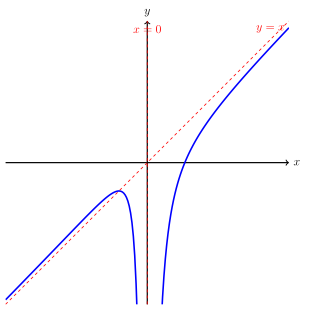
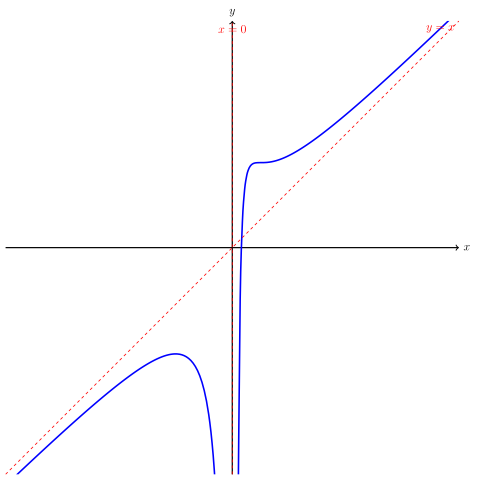
- Let \(u,v\) be the roots of \(x^2 + \alpha x + \beta = 0\), then since \((x-u)(x-v) = 0\) we must have \(\alpha = -(u+v), \beta = uv\). Therefore: \begin{align*} && u+v +\frac{1}{uv} &= -\alpha + \frac{1}{\beta} \\ && \frac1u+\frac1v + uv &= \frac{u+v}{uv} + uv \\ &&&= -\frac{\alpha}{\beta} + \beta \end{align*} Given \(u+v + \frac 1 {uv} = -1\), ie \(-\alpha + \frac{1}{\beta} = -1\). Since the roots are real, we must also have that \(\alpha^2 - 4\beta \geq 0\), so \begin{align*} && -\alpha + \frac1\beta &= -1 \\ \Rightarrow && \alpha &= 1 +\frac1\beta \\ \Rightarrow && -\frac{\alpha}{\beta}+\beta &= -\frac{1}{\beta} \l1+\frac1{\beta}\r + \beta \\ &&&=\beta - \frac{1}{\beta}-\frac{1}{\beta^2} \end{align*} So we want to maximise \(f(\beta)\) subject to \(\alpha ^2 - 4\beta \geq 0\) \begin{align*} && 0 &\leq \alpha^2 -4 \beta \\ &&&= \l 1 + \frac1{\beta} \r^2 - 4\beta \\ &&&= 1+ \frac2{\beta} + \frac1{\beta^2} - 4\beta \\ \Leftrightarrow && 0 &\leq -4\beta^3+\beta^2 + 2\beta + 1 \\ &&&=-(\beta-1)(4\beta^2+3\beta+1)\\ \Leftrightarrow && \beta &\leq 1 \end{align*} But we know \(f(\beta) \leq -1\) on \((-\infty,1]\) so we're done.
- Given that \(-\alpha + \frac{1}{\beta} = 3\) we have \begin{align*} && -\alpha + \frac1\beta &= 3 \\ \Rightarrow && \alpha &= -3 +\frac1\beta \\ \Rightarrow && -\frac{\alpha}{\beta}+\beta &= -\frac{1}{\beta} \l-3+\frac1{\beta}\r + \beta \\ &&&=\beta + \frac{3}{\beta}-\frac{1}{\beta^2} \end{align*} which we want to maximise, subject to: \begin{align*} && 0 &\leq \alpha^2 -4 \beta \\ &&&= \l -3 + \frac1{\beta} \r^2 - 4\beta \\ &&&= 9- \frac6{\beta} + \frac1{\beta^2} - 4\beta \\ \Leftrightarrow && 0 &\leq -4\beta^3+9\beta^2 - 6\beta + 1 \\ &&&=-(\beta-1)^2(4\beta-1)\\ \Leftrightarrow && \beta &\leq \frac14 \end{align*} Therefore the maximum will either be \(f(-2) = \frac14\) or \(f(\frac14) = -\frac{15}4\). Therefore the maximum is \(\frac14\)
2018 Paper 3 Q7
- Use De Moivre's theorem to show that, if \(\sin\theta\ne0\)\,, then \[ \frac{ \left(\cot \theta + \rm{i}\right)^{2n+1} -\left(\cot \theta - \rm{i}\right)^{2n+1}}{2\rm{i}} = \frac{\sin \left(2n+1\right)\theta} {\sin^{2n+1}\theta} \,, \] for any positive integer \(n\). Deduce that the solutions of the equation \[ \binom{2n+1}{1}x^{n}-\binom{2n+1}{3}x^{n-1} +\cdots + \left(-1\right)^{n}=0 \] are \[x=\cot^{2}\left(\frac{m\pi}{2n+1}\right) \] where \( m=1\), \(2\), \(\ldots\) , \(n\,\).
- Hence show that \[ \sum_{m=1}^n \cot^{2}\left(\frac{m\pi}{2n+1}\right) =\frac{n\left(2n-1\right)}{3}. \]
- Given that \(0<\sin \theta <\theta <\tan \theta\) for \(0 < \theta < \frac{1}{2}\pi\), show that \[ \cot^{2}\theta<\frac{1}{\theta^{2}}<1+\cot^{2}\theta. \] Hence show that \[ \sum^\infty_{m=1} \frac{1}{m^2}= \frac{\pi^2}{6}\,.\]
Solution:
- \begin{align*} \frac{\left(\cot \theta + i\right)^{2n+1} -\left(\cot \theta - i\right)^{2n+1}}{2i} &= \frac{1}{\sin^{2n+1} \theta}\frac{\left(\cos \theta + i \sin \theta \right)^{2n+1} -\left(\cos\theta - i\sin \theta\right)^{2n+1}}{2i} \\ &= \frac{1}{\sin^{2n+1} \theta} \frac{e^{i(2n+1) \theta} - e^{-i(2n+1) \theta} }{2i} \\ &=\frac{\sin (2n+1) \theta}{\sin^{2n+1} \theta} \end{align*} Notice that: \begin{align*} (\cot \theta + i)^{2n+1} - (\cot \theta - i)^{2n+1} &= \sum_{k=0}^{2n+1} \binom{2n+1}{k}(i)^k \cdot \cot^{2n+1-k} \theta - \sum_{k=0}^{2n+1} \binom{2n+1}{k}(-i)^k \cdot \cot^{2n+1-k} \theta \\ &= \sum_{k=0}^{2n+1} \binom{2n+1}{k} \l i^k - (-i)^k \r \cdot \cot^{2n+1-k} \theta \\ &= \sum_{l=0}^{n} \binom{2n+1}{2l+1} \l i^{2l+1} - (-i)^{2l+1} \r \cdot \cot^{2n+1-(2l+1)} \theta \\ &= \sum_{l=0}^{n} \binom{2n+1}{2l+1} 2i \cdot \cot^{2(n-l)} \theta \\ &= 2i\sum_{l=0}^{n} \binom{2n+1}{2l+1} \cot^{2(n-l)} \theta \\ \end{align*} Therefore if \(\theta\) satisfies \(\frac{\sin (2n+1) \theta}{\sin^{2n+1} \theta} = 0\) then \(z = \cot^2 \theta\) satisfies the equation. But \(\theta = \frac{m \pi}{2n+1}, m = 1, 2, \ldots, n\) are \(n\) distinct all the roots must be \(\cot^2 \frac{m \pi}{2n+1}\).
- Notice that the sum of the roots will be \(\displaystyle \frac{\binom{2n+1}{3}}{\binom{2n+1}{1}} = \frac{(2n+1)\cdot 2n \cdot (2n-1)}{3! \cdot (2n+1)} = \frac{n \cdot (2n-1)}{3}\) and so \[ \sum_{m=1}^n \cot^{2}\left(\frac{m\pi}{2n+1}\right) =\frac{n\left(2n-1\right)}{3}. \]
- For \(0 < \theta < \frac{1}{2}\pi\), \begin{align*} && 0 < \sin \theta < \theta < \tan \theta \\ \Leftrightarrow && 0 < \cot \theta < \frac{1}{\theta} < \frac{1}{\sin \theta} \\ \Leftrightarrow && 0 < \cot^2 \theta < \frac{1}{\theta^2} < \cosec^2 \theta = 1 + \cot^2 \theta\\ \end{align*} Therefore \begin{align*} && \sum_{n=1}^N \cot^2 \frac{n \pi}{2N+1} < \sum_{n=1}^N \frac{(2N+1)^2}{n^2 \pi^2} < N + \sum_{n=1}^N \cot^2 \frac{n \pi}{2N+1} \\ \Rightarrow && \frac{1}{(2N+1)^2} \frac{N(2N-1)}{3} < \sum_{n=1}^N \frac{1}{n^2 \pi^2} < \frac{1}{(2N+1)^2} \l \frac{N(2N-1)}{3} + 1 \r \\ \Rightarrow && \lim_{N \to \infty}\frac{1}{(2N+1)^2} \frac{N(2N-1)}{3} < \lim_{N \to \infty}\sum_{n=1}^N \frac{1}{n^2 \pi^2} < \lim_{N \to \infty}\frac{1}{(2N+1)^2} \l \frac{N(2N-1)}{3} + 1 \r \\ \Rightarrow && \frac{1}{6} \leq \lim_{N \to \infty}\sum_{n=1}^N \frac{1}{n^2 \pi^2} \leq \frac16 \\ \Rightarrow && \sum_{n=1}^N \frac{1}{n^2} = \frac{\pi^2}{6} \end{align*}
2017 Paper 1 Q4
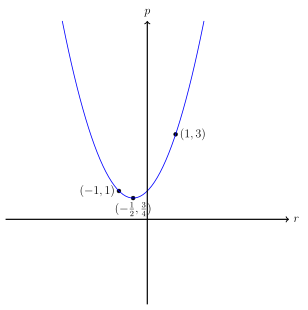
- Let \(r\) be a real number with \(\vert r \vert<1\) and let \[ S = \sum_{n=0}^\infty r^n\,. \] You may assume without proof that \(S = \displaystyle \frac{1}{1-r}\, \). Let \(p= 1 + r +r^2\). Sketch the graph of the function \(1+r+r^2\) and deduce that \(\frac{3}{4} \le p < 3\,\). Show that, if \(1 < p < 3\), then the value of \( p\) determines \(r\), and hence \(S\), uniquely. Show also that, if \(\frac{3}{4} < p < 1\), then there are two possible values of \(S\) and these values satisfy the equation \((3-p)S^2-3S+1=0\).
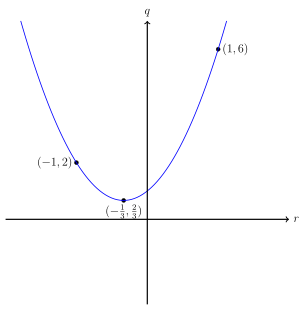
- Let \(r\) be a real number with \(\vert r \vert<1\) and let \[ T =\sum_{n=1}^\infty nr^{n-1}\,. \] You may assume without proof that \(T = \displaystyle \dfrac{1}{(1-r)^2}\,.\) Let \( q= 1+2r+3r^2\). Find the set of values of \( q\) that determine \(T\) uniquely. Find the set of values of \(q\) for which \(T\) has two possible values. Find also a quadratic equation, with coefficients depending on \( q\), that is satisfied by these two values.
Solution:
- \(\,\)
Notice that \(1+r+r^2\) ranges from \(\frac34\) to \(3\) over \((-1,1)\) therefore \(\frac34 \leq p < 3\) attaining its minimum but not its maximum. If \(p > 1\) we know we must be on the right branch and hence we can determine \(r\) and \(S\) uniquely. If \(\frac34 < p < 1\) then we must have two possible values for \(r\), satisfying \(r_i^2 + r+1 = p\) and so our two possible values for \(S_i = \frac{1}{1-r_i}\) or \(r_i = 1-\frac{1}{S_i}\) and so \begin{align*} && p &= \left ( 1 - \frac{1}{S} \right)^2 + 1 - \frac1S + 1 \\ \Rightarrow && pS^2 &= (S-1)^2 + S^2-S + S^2 \\ \Rightarrow && 0 &= (3-p)S^2 -3S + 1 \end{align*}
- \(\,\)
So \(\frac23 \leq q < 6\) and \(r\) and hence \(T\) is uniquely determined if \(2 \leq q < 6\). if \(\frac23
2017 Paper 3 Q3
Let \(\alpha\), \(\beta\), \(\gamma\) and \(\delta\) be the roots of the quartic equation \[ x^4 +px^3 +qx^2 +r x +s =0 \,. \] You are given that, for any such equation, \(\,\alpha \beta + \gamma\delta\,\), \(\alpha\gamma+\beta\delta\,\) and \(\,\alpha \delta + \beta\gamma\,\) satisfy a cubic equation of the form \[ y^3+Ay^2+ (pr-4s)y+ (4qs-p^2s -r^2) =0 \,. \] Determine \(A\). Now consider the quartic equation given by \(p=0\,\), \(q= 3\,\), \(r=-6\,\) and \(s=10\,\).
- Find the value of \(\alpha\beta + \gamma \delta\), given that it is the largest root of the corresponding cubic equation.
- Hence, using the values of \(q\) and \(s\), find the value of \((\alpha +\beta)(\gamma+\delta)\,\) and the value of \(\alpha\beta\) given that \(\alpha\beta >\gamma\delta\,\).
- Using these results, and the values of \(p\) and \(r\), solve the quartic equation.
Solution: \begin{align*} A &= -(\alpha \beta + \gamma\delta + \alpha\gamma+\beta\delta+\alpha \delta + \beta\gamma) \\ &= -q \end{align*}
- The corresponding cubic equation is: \begin{align*} && 0 &= y^3 - 3y^2-40y+(120-36) \\ &&&= y^3 -3y^2 - 40y + 84 \\ &&&= (y-7)(y-2)(y+6) \end{align*} Therefore \(\alpha\beta + \gamma \delta = 7\)
- \begin{align*}(\alpha+\beta)(\gamma+\delta) &= \alpha \gamma + \alpha \delta + \beta \gamma + \beta \delta \\ &= 3 -(\alpha\beta + \gamma\delta) \\ &=3-7 = -4 \end{align*} Let \(\alpha\beta\) and \(\gamma\delta\) be the roots of a quadratic; then the quadratic will be \(t^2-7t+10 = 0 \Rightarrow t = 2,5\) so \(\alpha\beta = 5\)
- \(\alpha\beta = 5, \gamma\delta = 2\) Consider the quadratic with roots \(\alpha+\beta\) and \(\gamma+\delta\), then \(t^2-4 = 0 \Rightarrow t = \pm 2\). Suppose \(\alpha+\beta = 2, \gamma+\delta=-2\) then \(\alpha, \beta = 1 \pm 2i, \gamma,\delta = -1 \pm i\) \(\alpha \beta \gamma + \beta\gamma\delta + \gamma\delta\alpha + \delta\alpha\beta = 5\gamma + 2\beta + 2\alpha + 5\delta = -6 \neq 6\) Suppose \(\alpha+\beta = -2, \gamma+\delta=2\) then \(\alpha, \beta = -1 \pm 2i, \gamma,\delta = 1 \pm i\) \(\alpha \beta \gamma + \beta\gamma\delta + \gamma\delta\alpha + \delta\alpha\beta = 5\gamma + 2\beta + 2\alpha + 5\delta = 6\), therefore these are there roots. (In some order): \(1 \pm i, -1 \pm 2i\)
2016 Paper 2 Q3
For each non-negative integer \(n\), the polynomial \(\f_n\) is defined by \[ \f_n(x) = 1 + x + \frac{x^2}{2!} + \frac {x^3}{3!} + \cdots + \frac{x^n}{n!} \]
- Show that \(\f'_{n}(x) = \f_{n-1}(x)\,\) (for \(n\ge1\)).
- Show that, if \(a\) is a real root of the equation \[\f_n(x)=0\,,\tag{\(*\)}\] then \(a<0\).
- Let \(a\) and \(b\) be distinct real roots of \((*)\), for \(n\ge2\). Show that \(\f_n'(a)\, \f_n'(b)>0\,\) and use a sketch to deduce that \(\f_n(c)=0\) for some number \(c\) between \(a\) and \(b\). Deduce that \((*)\) has at most one real root. How many real roots does \((*)\) have if \(n\) is odd? How many real roots does \((*)\) have if \(n\) is even?
Solution:
- \(\,\) \begin{align*} && f'_n(x) &= 0 + 1 + \frac{2x}{2!} + \frac{3x^2}{3!} + \cdots + \frac{nx^{n-1}}{n!} \\ &&&= 1 + x + \frac{x^2}{2!} + \frac{x^3}{3!} + \cdots + \frac{x^{n-1}}{(n-1)!} \\ &&&= f_{n-1}(x) \end{align*}
- Claim: \(f_n(x) > 0\) for all \(x > 0\) Proof: (By induction) Base case: (\(n = 1\)) \(f_1(x) = 1 + x > 1\) therefore \(f_1(x) > 0\) Suppose it's true for \(n = k\), then consider \(f_{k+1}\), if we differentiate it, we find it is increasing on \((0, \infty)\) by our inductive hypothesis. But then \(f_{k+1}(0) = 1 > 0\). Therefore \(f_{k+1}(x) > 0\) as well. Therefore by the principle of mathematical induction we are done. Since \(f_n(x) > 0\) for non-negative \(x\), if \(a\) is a root it must be negative.
- Suppose \(f_n(a) = f_n(b) = 0\) then \(f'_n(a) = -\frac{a^n}{n!}\) and \(f'_n(b) = -\frac{b^n}{n!}\), but then \(f_n'(a) f_n'(b) = \frac{(-a)^n(-b)^n}{(n!)^2} > 0\) since \(a < 0, b < 0\). \(_n'(a) f_n'(b)\) is positive, the two gradients must have the same sign (and not be zero). Therefore if they are both increasing, at some point the curve must cross the axis in between. Therefore there is some root \(c\) between \(a\) and \(b\). But then there is also a root between \(c\) and \(a\) and \(c\) and \(b\), and very quickly we find more than \(n\) roots which is not possivel. Therefore there must be at most \(1\) root. If \(n\) is odd there must be exactly one root, since \(f_n\) changes sign as \(x \to -\infty\) vs \(x = 0\). If \(n\) is even then there can't be any roots, since if it crossed the \(x\)-axis there would be two roots (not possible) and it cannot touch the axis, since \(f'_n(a) \neq 0\) unless \(a = 0\), and we know \(a < 0\)