Problems
Filters
7 problems found
2021 Paper 2 Q2
In this question, the numbers \(a\), \(b\) and \(c\) may be complex.
- Let \(p\), \(q\) and \(r\) be real numbers. Given that there are numbers \(a\) and \(b\) such that \[ a + b = p, \quad a^2 + b^2 = q \quad \text{and} \quad a^3 + b^3 = r, \qquad (*) \] show that \(3pq - p^3 = 2r\).
- Conversely, you are given that the real numbers \(p\), \(q\) and \(r\) satisfy \(3pq - p^3 = 2r\). By considering the equation \(2x^2 - 2px + (p^2 - q) = 0\), show that there exist numbers \(a\) and \(b\) such that the three equations \((*)\) hold.
- Let \(s\), \(t\), \(u\) and \(v\) be real numbers. Given that there are distinct numbers \(a\), \(b\) and \(c\) such that \[ a + b + c = s, \quad a^2 + b^2 + c^2 = t, \quad a^3 + b^3 + c^3 = u \quad \text{and} \quad abc = v, \] show, using part~(i), that \(c\) is a root of the equation \[ 6x^3 - 6sx^2 + 3(s^2 - t)x + 3st - s^3 - 2u = 0 \] and write down the other two roots. Deduce that \(s^3 - 3st + 2u = 6v\).
- Find numbers \(a\), \(b\) and \(c\) such that \[ a + b + c = 3, \quad a^2 + b^2 + c^2 = 1, \quad a^3 + b^3 + c^3 = -3 \quad \text{and} \quad abc = 2, \qquad (**) \] and verify that your solution satisfies the four equations \((**)\).
2010 Paper 1 Q13
The number of texts that George receives on his mobile phone can be modelled by a Poisson random variable with mean \(\lambda\) texts per hour. Given that the probability George waits between 1 and 2 hours in the morning before he receives his first text is \(p\), show that \[ p\e^{2\lambda}-\e^{\lambda}+1=0. \] Given that \(4p<1\), show that there are two positive values of \(\lambda\) that satisfy this equation. The number of texts that Mildred receives on each of her two mobile phones can be modelled by independent Poisson random variables with different means \(\lambda_{1}\) and \(\lambda_{2}\) texts per hour. Given that, for each phone, the probability that Mildred waits between 1 and 2 hours in the morning before she receives her first text is also \(p\), find an expression for \(\lambda_{1}+\lambda_{2}\) in terms of \(p\). Find the probability, in terms of \(p\), that she waits between 1 and 2 hours in the morning to receive her first text.
Solution: Let \(X_t\) be the number of texts he recieves before \(t\) hours. So \(X_t \sim P(t\lambda)\) \begin{align*} &&\mathbb{P}(X_1 = 0 \, \cap \, X_2 > 0) &= e^{-\lambda} \cdot \left ( 1-e^{-\lambda}\right) = p \\ \Rightarrow && e^{2\lambda}p &= e^{\lambda} - 1 \\ \Rightarrow && 0 &= pe^{2\lambda}-e^{\lambda} + 1 \\ \Rightarrow && e^{\lambda} &= \frac{1 \pm \sqrt{1-4p}}{2p} \end{align*} Which clearly has two positive roots if \(4p < 1\). We need to show both roots are \(>1\). So considering the smaller one we are looking at: \begin{align*} && \frac{1-\sqrt{1-4p}}{2p} & > 1 \\ \Leftrightarrow && 1-\sqrt{1-4p} &> 2p \\ \Leftrightarrow && 1-2p&> \sqrt{1-4p} \\ \Leftrightarrow && (1-2p)^2&> 1-4p \\ \Leftrightarrow && 1-4p+4p^2&> 1-4p \\ \end{align*} which is clearly true. We must have \(e^{\lambda_1}\cdot e^{\lambda_2} = \frac{1}{p}\), so \(\lambda_1 + \lambda_2 = -\ln p\) by considering the product of the roots in our quadratic. (Vieta). Therefore the probability she waits between 1 and 2 hours in the morning is \(e^{-(\lambda_1 + \lambda_2)} \cdot ( 1- e^{-(\lambda_1+\lambda_2)}) = p \cdot (1-p)\)
2006 Paper 1 Q7
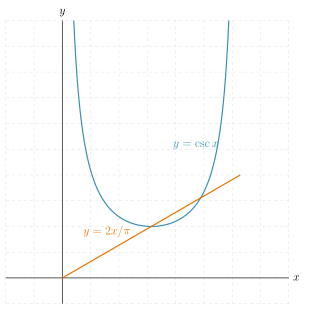
- Sketch on the same axes the functions \({\rm cosec}\, x\) and \(2x/ \pi\), for \(0 < x < \pi\,\). Deduce that the equation \(x\sin x = \pi/2 \) has exactly two roots in the interval \(0 < x < \pi\,\). Show that \[ \displaystyle \int_{\pi/2}^{\pi} \left \vert x\sin x - \frac{\pi} { 2} \right \vert \; \mathrm{d}x = 2\sin\alpha +\frac{3\pi^2} 4 - \alpha \pi -\pi -2\alpha \cos\alpha -1 \] where \(\alpha\) is the larger of the roots referred to above.
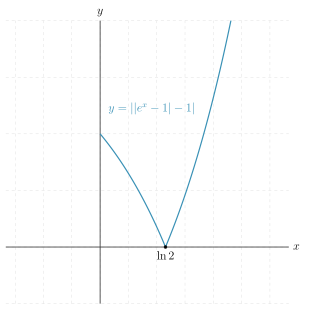
- Show that the region bounded by the positive \(x\)-axis, the \(y\)-axis and the curve \[y = \Bigl| \vert \e^x - 1 \vert - 1 \Bigr|\] has area \(\ln 4-1\).
Solution:
- \(\,\)
Notice that they are equal at \(1\) when \(x = \pi/2\), but this is a local minimum for \(\csc x\) whereas \(2x/\pi\) is increasing so there is a second intersection. Notice that \(\csc x = \frac{2x}{\pi} \Leftrightarrow x \sin x = \frac{\pi}{2}\) therefore our intersections are also the roots of \(x \sin x = \frac{\pi}{2}\) and the larger one is greater than \(\pi/2\) \begin{align*} && I &= \int_{\pi/2}^{\pi} \Bigl| x \sin x - \frac{\pi}{2} \Bigr| \d x \\ &&&= \int_{\pi/2}^{\alpha} \left ( x \sin x - \frac{\pi}{2} \right )\d x +\int_{\alpha}^{\pi} \left ( \frac{\pi}{2} -x \sin x \right) \d x \\ &&&= \left ( \pi - 2\alpha + \frac{\pi}{2}\right) \frac{\pi}{2} + \int_{\pi/2}^{\alpha} x \sin x\d x -\int_{\alpha}^{\pi} x \sin x \d x \\ &&&= \frac{3\pi^2}{4} - \alpha \pi + \left [-x \cos x \right]_{\pi/2}^{\alpha}+\left[x \cos x \right]_{\alpha}^{\pi} + \int_{\pi/2}^{\alpha} \cos x \d x - \int_{\alpha}^{\pi} \cos x \d x \\ &&&= \frac{3\pi^2}{4} - \alpha \pi -\alpha \cos \alpha -\pi -\alpha \cos \alpha+ \sin \alpha - 1+\sin \alpha \\ &&&= 2\sin \alpha + \frac{3\pi^2}{4} - \alpha \pi - 2\alpha \cos \alpha - 1 \end{align*}
- \(\,\)
\begin{align*} && A &= \int_0^{\ln 2} ||e^x-1|-1| \d x \\ &&&= \int_0^{\ln 2} |e^x-2| \d x \\ &&&=\int_0^{\ln 2} (2-e^x) \d x \\ &&&= 2 \ln 2 - \left [e^x \right]_0^{\ln 2} \\ &&&= \ln 4 - (2-1) = \ln 4 - 1 \end{align*}
2001 Paper 2 Q4
Let $$ \f(x) = P \, {\sin x} + Q\, {\sin 2x} + R\, {\sin 3x} \;. $$ Show that if \(Q^2 < 4R(P-R)\), then the only values of \(x\) for which \(\f(x) = 0\) are given by \(x=m\pi\), where \(m\) is an integer. \newline [You may assume that \(\sin 3x = \sin x(4\cos^2 x -1)\).] Now let $$ \g(x) = {\sin 2nx} + {\sin 4nx} - {\sin 6nx}, $$ where \(n\) is a positive integer and \(0 < x < \frac{1}{2}\pi \). Find an expression for the largest root of the equation \(\g(x)=0\), distinguishing between the cases where \(n\) is even and \(n\) is odd.
1990 Paper 1 Q5
- Evaluate \[ \int_{1}^{3}\frac{1}{6x^{2}+19x+15}\,\mathrm{d}x\,. \]
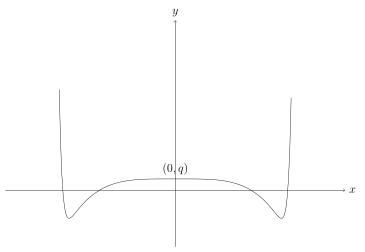
- Sketch the graph of the function \(\mathrm{f}\), where \(\mathrm{f}(x)=x^{1760}-x^{220}+q\), and \(q\) is a constant. Find the possible numbers of \textit{distinct }roots of the equation \(\mathrm{f}(x)=0\), and state the inequalities satisfied by \(q\).
Solution:
- \begin{align*} \int_{1}^{3}\frac{1}{6x^{2}+19x+15}\,\mathrm{d}x &= \int_1^3 \frac1{(2x+3)(3x+5)} \d x \\ &= \int_1^3 \l \frac{2}{2x+3} - \frac{3}{3x+5} \r \d x \\ &= \left [\ln(2x+3) - \ln(3x+5) \right ]_1^3 \\ &= \l \ln9 - \ln14 \r - \l \ln 5 - \ln 8 \r \\ &= \ln \frac{72}{70} \\ &= \ln \frac{36}{35} \end{align*}
- When \(q = 0\) the roots are \(-1, 0, 1\) There can be \(0, 2, 3, 4\) roots. There will be no roots if \(q > -\min (x^{1760} - x^{220})\) since the whole graph will be above the axis. There will be \(2\) roots if \(q = -\min (x^{1760} - x^{220})\) or \(q > 0\) There will be \(4\) roots if \(0 > q > -\min (x^{1760} - x^{220})\). There will be \(3\) roots if \(q =0\)
1990 Paper 2 Q7
A damped system with feedback is modelled by the equation \[ \mathrm{f}'(t)+\mathrm{f}(t)-k\mathrm{f}(t-1)=0,\mbox{ }\tag{\(\dagger\)} \] where \(k\) is a given non-zero constant. Show that (non-zero) solutions for \(\mathrm{f}\) of the form \(\mathrm{f}(t)=A\mathrm{e}^{pt},\) where \(A\) and \(p\) are constants, are possible provided \(p\) satisfies \[ p+1=k\mathrm{e}^{-p}.\mbox{ }\tag{*} \] Show also, by means of a sketch, or otherwise, that equation \((*)\) can have \(0,1\) or \(2\) real roots, depending on the value of \(k\), and find the set of values of \(k\) for which such solutions of \((\dagger)\) exist. For what set of values of \(k\) do such solutions tend to zero as \(t\rightarrow+\infty\)?
Solution: Suppose \(f(t) = Ae^{pt}\) is a solution, then \begin{align*} && 0 &= Ape^{pt} + Ae^{pt} - Ake^{p(t-1)} \\ \Leftrightarrow && 0 &= p +1 - ke^{-p} \\ \Leftrightarrow && p+1 &= ke^{-p} \end{align*}

1990 Paper 3 Q10
By considering the graphs of \(y=kx\) and \(y=\sin x,\) show that the equation \(kx=\sin x,\) where \(k>0,\) may have \(0,1,2\) or \(3\) roots in the interval \((4n+1)\frac{\pi}{2} < x < (4n+5)\frac{\pi}{2},\) where \(n\) is a positive integer. For a certain given value of \(n\), the equation has exactly one root in this interval. Show that \(k\) lies in an interval which may be written \(\sin\delta < k < \dfrac{2}{(4n+1)\pi},\) where \(0 < \delta < \frac{1}{2}\pi\) and \[ \cos\delta=\left((4n+5)\frac{\pi}{2}-\delta\right)\sin\delta. \] Show that, if \(n\) is large, then \(\delta\approx\dfrac{2}{(4n+5)\pi}\) and obtain a second, improved, approximation.
Solution:

- be below \(((4n+1)\tfrac{\pi}{2}, 1)\) and
- not touch the second gradient