Problems
Filters
9 problems found
2019 Paper 3 Q9
In this question, \(\mathbf{i}\) and \(\mathbf{j}\) are perpendicular unit vectors and \(\mathbf{j}\) is vertically upwards. A smooth hemisphere of mass \(M\) and radius \(a\) rests on a smooth horizontal table with its plane face in contact with the table. The point \(A\) is at the top of the hemisphere and the point \(O\) is at the centre of its plane face. Initially, a particle \(P\) of mass \(m\) rests at \(A\). It is then given a small displacement in the positive \(\mathbf{i}\) direction. At a later time \(t\), when the particle is still in contact with the hemisphere, the hemisphere has been displaced by \(-s\mathbf{i}\) and \(\angle AOP = \theta\).
- Let \(\mathbf{r}\) be the position vector of the particle at time \(t\) with respect to the initial position of \(O\). Write down an expression for \(\mathbf{r}\) in terms of \(a\), \(\theta\) and \(s\) and show that $$\dot{\mathbf{r}} = (a\dot{\theta} \cos \theta - \dot{s})\mathbf{i} - a\dot{\theta} \sin \theta \mathbf{j}.$$ Show also that $$\dot{s} = (1 - k)a\dot{\theta} \cos \theta,$$ where \(k = \frac{M}{m + M}\), and deduce that $$\dot{\mathbf{r}} = a\dot{\theta}(k \cos \theta \mathbf{i} - \sin \theta \mathbf{j}).$$
- Show that $$a\dot{\theta}^2 \left(k \cos^2 \theta + \sin^2 \theta\right) = 2g(1 - \cos \theta).$$
- At time \(T\), when \(\theta = \alpha\), the particle leaves the hemisphere. By considering the component of \(\ddot{\mathbf{r}}\) parallel to the vector \(\sin \theta \mathbf{i} + k \cos \theta \mathbf{j}\), or otherwise, show that at time \(T\) $$a\dot{\theta}^2 = g \cos \alpha.$$ Find a cubic equation for \(\cos \alpha\) and deduce that \(\cos \alpha > \frac{2}{3}\).
Solution:
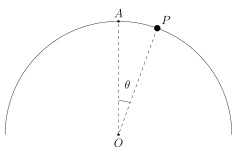
- \(\mathbf{r} = (a \sin \theta - s) \mathbf{i}+a\cos \theta\mathbf{j}\), so \begin{align*} && \dot{\mathbf{r}} &=(a \dot{\theta} \cos \theta - \dot{s}) \mathbf{i}- a\dot{\theta} \sin \theta \mathbf{j}\\ \\ \text{COM}(\rightarrow): && 0 &= M(-\dot{s}) + m(a \dot{\theta} \cos \theta - \dot{s}) \\ \Rightarrow && \dot{s} &= \frac{ma \dot{\theta} \cos \theta}{m+M} \\ &&&= \left ( 1- \frac{M}{m+M} \right) a\dot{\theta} \cos \theta \\ &&&= (1 - k) a\dot{\theta} \cos \theta \\ \\ \Rightarrow && \dot{\mathbf{r}} &=(a \dot{\theta} \cos \theta - \dot{s}) \mathbf{i}- a\dot{\theta} \sin \theta \mathbf{j} \\ &&&= (a \dot{\theta} \cos \theta - (1 - k) a\dot{\theta} \cos \theta) \mathbf{i}- a\dot{\theta} \sin \theta \mathbf{j} \\ &&&= a\dot{\theta} \left ( k \cos \theta \mathbf{i} - \sin \theta \mathbf{j} \right) \end{align*}
- \(\,\) \begin{align*} COE: &&\underbrace{0}_{\text{k.e.}}+ \underbrace{mga}_{\text{GPE}} &= \underbrace{\frac12 m \mathbf{\dot{r}}\cdot\mathbf{\dot{r}}}_{\text{k.e. }P} + \underbrace{mg a\cos \theta}_{\text{GPE}} + \underbrace{\frac12 M \dot{s}^2}_{\text{k.e. hemisphere}} \\ \Rightarrow && 2amg(1-\cos \theta) &= a^2m \dot{\theta}^2(k^2 \cos^2 \theta + \sin^2 \theta)+ M(1 - k)^2 a^2\dot{\theta}^2 \cos^2 \theta \\ \Rightarrow && 2mg(1-\cos \theta) &= a \dot{\theta}^2 \left (m\sin^2 \theta + (mk^2 + M(1-k)^2)\cos^2 \theta \right) \\ &&&= a \dot{\theta}^2 \left (m\sin^2 \theta + mk\cos^2 \theta \right) \\ \Rightarrow && 2g(1-\cos \theta) &= a \dot{\theta}^2 \left (\sin^2 \theta + k\cos^2 \theta \right) \\ \end{align*}
- The equation of motion is \(m \ddot{\mathbf{r}} = \mathbf{R} - mg\mathbf{j}\) and the particle will leave the surface when \(\mathbf{R} = 0\). If we take the component in the directions suggested: \begin{align*} && \ddot{\mathbf{r}} &= a\ddot{\theta}(k \cos \theta \mathbf{i}- \sin \theta \mathbf{j}) + a \dot{\theta}(-k\dot{\theta} \sin \theta \mathbf{i}- \dot{\theta} \cos \theta \mathbf{j}) \\ &&&= ak (\ddot{\theta} \cos \theta - \dot{\theta}^2 \sin \theta) \mathbf{i} -a(\ddot{\theta} \sin \theta + \dot{\theta}^2 \cos \theta) \mathbf{j} \\ \Rightarrow && \mathbf{\ddot{r}} \cdot (\sin \theta \mathbf{i} + k \cos \theta \mathbf{j}) &= ak (\ddot{\theta} \cos \theta - \dot{\theta}^2 \sin \theta) \sin \theta -ak(\ddot{\theta} \sin \theta + \dot{\theta}^2 \cos \theta)\cos \theta \\ &&&= - ak \dot{\theta}^2 \\ && (-g\mathbf{j}) \cdot (\sin \theta \mathbf{i} + k \cos \theta \mathbf{j}) &= -gk \cos \theta \\ \mathbf{R} = 0: && gk \cos \theta &= ak \dot{\theta}^2 \\ \Rightarrow && g \cos \theta &= a \dot{\theta}^2 \end{align*}
- \(\,\) \begin{align*} && 2g(1-\cos \theta) &= a \dot{\theta}^2(k \cos^2 \theta + \sin^2 \theta) \\ && a \dot{\theta}^2 &= g \cos \alpha \\ \Rightarrow && 2g(1-\cos \alpha) &= g \cos \alpha(k \cos^2 \alpha + (1-\cos^2 \alpha)) \\ \Rightarrow && 0 &= g(k-1)c^3+3gc-2g \\ \Rightarrow && 0 &= (k-1)c^3+3c - 2 \end{align*} When \(c =1, f(c) = k > 0\) when \(c = \frac23, f(c) = k-1 < 0\). Therefore there is a root with \(\cos \alpha > \frac23\)
2016 Paper 2 Q9
A small bullet of mass \(m\) is fired into a block of wood of mass \(M\) which is at rest. The speed of the bullet on entering the block is \(u\). Its trajectory within the block is a horizontal straight line and the resistance to the bullet's motion is \(R\), which is constant.
- The block is fixed. The bullet travels a distance \(a\) inside the block before coming to rest. Find an expression for \(a\) in terms of \(m\), \(u\) and \(R\).
- Instead, the block is free to move on a smooth horizontal table. The bullet travels a distance \(b\) inside the block before coming to rest relative to the block, at which time the block has moved a distance \(c\) on the table. Find expressions for \(b\) and \(c\) in terms of \(M\), \(m\) and \(a\).
Solution:
- Since \(R\) is constant, \(F=ma \Rightarrow \text{acc} = \frac{R}{m}\) and \(v^2 = u^2 + 2as\) so \(0 = u^2 - 2 \frac{R}{m}a\), ie \(a = \frac{m u^2}{2R}\)
- By conservation of momentum, the bullet/block combination will eventually be travelling at \(v = \frac{m}{m+M}u\). The bullet will slow down to this speed in a time of \(\frac{m}{m+M}u = u - \frac{R}{m} T \Rightarrow T = \frac{Mm}{R(m+M)}u\) and will travel \(b+c = \frac{\left ( 1 - \left ( \frac{m}{m+M} \right)^2\right)u^2m}{2R}= \left ( 1 - \left ( \frac{m}{m+M} \right)^2\right)a\). The block will travell \(c = \frac12 \frac{R}{M} \frac{M^2m^2u^2}{R^2(m+M)^2} = \frac{Mm}{(m+M)^2}a\) Therefore the \(b = \left ( 1 - \left ( \frac{m}{m+M} \right)^2\right)a - \frac{Mm}{(m+M)^2}a = \frac{M}{M+m}a\)
2011 Paper 3 Q10
Particles \(P\) and \(Q\), each of mass \(m\), lie initially at rest a distance \(a\) apart on a smooth horizontal plane. They are connected by a light elastic string of natural length \(a\) and modulus of elasticity \(\frac12 m a \omega^2\), where \(\omega\) is a constant. Then \(P\) receives an impulse which gives it a velocity \(u\) directly away from \(Q\). Show that when the string next returns to length \(a\), the particles have travelled a distance \(\frac12 \pi u/\omega\,\), and find the speed of each particle. Find also the total time between the impulse and the subsequent collision of the particles.
2010 Paper 3 Q11
A bullet of mass \(m\) is fired horizontally with speed \(u\) into a wooden block of mass \(M\) at rest on a horizontal surface. The coefficient of friction between the block and the surface is \(\mu\). While the bullet is moving through the block, it experiences a constant force of resistance to its motion of magnitude \(R\), where \(R>(M+m)\mu g\). The bullet moves horizontally in the block and does not emerge from the other side of the block.
- Show that the magnitude, \(a\), of the deceleration of the bullet relative to the block while the bullet is moving through the block is given by \[ a= \frac R m + \frac {R-(M+m)\mu g}{M}\, . \]
- Show that the common speed, \(v\), of the block and bullet when the bullet stops moving through the block satisfies \[ av = \frac{Ru-(M+m)\mu gu}M\,. \]
- Obtain an expression, in terms of \(u\), \(v\) and \(a\), for the distance moved by the block while the bullet is moving through the block.
- Show that the total distance moved by the block is \[ \frac{muv}{2(M+m)\mu g}\,. \]
2007 Paper 1 Q10
The Norman army is advancing with constant speed \(u\) towards the Saxon army, which is at rest. When the armies are \(d\) apart, a Saxon horseman rides from the Saxon army directly towards the Norman army at constant speed \(x\). Simultaneously a Norman horseman rides from the Norman army directly towards the Saxon army at constant speed \(y\), where $y > u$. The horsemen ride their horses so that \(y - 2x < u < 2y - x\). When each horseman reaches the opposing army, he immediately rides straight back to his own army without changing his speed. Represent this information on a displacement-time graph, and show that the two horsemen pass each other at distances \[ \frac{xd }{ x + y} \;\; \mbox{and} \;\; \frac{xd(2y -x-u)} {(u+x ) ( x + y )} \] from the Saxon army. Explain briefly what will happen in the cases (i) \(u > 2y - x\) and (ii) \(u < y - 2x\).
2007 Paper 2 Q11
{\sl In this question take the acceleration due to gravity to be \(10\,{\rm m \,s}^{-2}\) and neglect air resistance.} The point \(O\) lies in a horizontal field. The point \(B\) lies \(50\,\)m east of \(O\). A particle is projected from \(B\) at speed \(25\,{\rm m\,s}^{-1}\) at an angle \(\arctan \frac12\) above the horizontal and in a direction that makes an angle \(60^\circ\) with \(OB\); it passes to the north of \(O\).
- Taking unit vectors \(\mathbf i\), \(\mathbf j\) and \(\mathbf k\) in the directions east, north and vertically upwards, respectively, find the position vector of the particle relative to \(O\) at time \(t\)~seconds after the particle was projected, and show that its distance from \(O\) is \[ 5(t^2- \sqrt5 t +10)\, {\rm m}. \] When this distance is shortest, the particle is at point \(P\). Find the position vector of \(P\) and its horizontal bearing from \(O\).
- Show that the particle reaches its maximum height at \(P\).
- When the particle is at \(P\), a marksman fires a bullet from \(O\) directly at \(P\). The initial speed of the bullet is \(350\,{\rm m\,s}^{-1}\). Ignoring the effect of gravity on the bullet show that, when it passes through \(P\), the distance between \(P\) and the particle is approximately~\(3\,\)m.
2003 Paper 3 Q11
Point \(B\) is a distance \(d\) due south of point \(A\) on a horizontal plane. Particle \(P\) is at rest at \(B\) at \(t=0\), when it begins to move with constant acceleration \(a\) in a straight line with fixed bearing~\(\beta\,\). Particle \(Q\) is projected from point \(A\) at \(t=0\) and moves in a straight line with constant speed \(v\,\). Show that if the direction of projection of \(Q\) can be chosen so that \(Q\) strikes \(P\), then \[ v^2 \ge ad \l 1 - \cos \beta \r\;. \] Show further that if \(v^2 >ad(1-\cos\beta)\) then the direction of projection of \(Q\) can be chosen so that \(Q\) strikes \(P\) before \(P\) has moved a distance \(d\,\).
1998 Paper 2 Q11
A fielder, who is perfectly placed to catch a ball struck by the batsman in a game of cricket, watches the ball in flight. Assuming that the ball is struck at the fielder's eye level and is caught just in front of her eye, show that \(\frac{ {\rm d}}{{\rm d t}} (\tan\theta ) \) is constant, where \(\theta\) is the angle between the horizontal and the fielder's line of sight. In order to catch the next ball, which is also struck towards her but at a different velocity, the fielder runs at constant speed \(v\) towards the batsman. Assuming that the ground is horizontal, show that the fielder should choose \(v\) so that \(\frac{ {\rm d}}{{\rm d t}} (\tan\theta ) \) remains constant.
Solution: Set up a coordinate frame such that the position of the catch is the origin and the time of the catch is \(t = 0\) . We must have then that the trajectory of the ball is \(\mathbf{s} =\mathbf{u} t + \frac12 \mathbf{g} t^2 = \binom{u_x t}{u_y t - \frac12 gt^2}\). We must then have: \begin{align*} && \tan \theta &= \frac{u_y t - \frac12 gt^2}{u_x t} \\ &&&= \frac{u_y}{u_x} - \frac{g}{2u_x} t \\ \Rightarrow && \frac{\d}{\d \theta} \left ( \tan \theta \right) &= 0 - \frac{g}{2 u_x} \end{align*} which is clearly constant. Set coordinates so \(y\)-axis starts from eye-level and \(t = 0\) the first time the ball reaches that level. (Or move the trajectory backwards if that's not the case). Then the ball has trajectory \(\binom{u_xt}{u_yt - \frac12 gt^2}\). The ball reaches eye level a second time when \(t = \frac{2u_y}{g}\), ie at a point \(\frac{2u_xu_y}{g}\). The fielder therefore needs to have position \(f + (u_x-\frac{g}{2u_y}f)t\) at all times. Therefore \begin{align*} && \tan \theta &= \frac{u_y t - \frac12 gt^2}{f + (u_x-\frac{g}{2u_y}f)t - u_x t} \\ &&&= \frac{u_y t - \frac12 gt^2}{f(1-\frac{g}{2u_y}t)} \\ &&&= \frac{u_yt ( 1- \frac{g}{2u_y}t)}{f( 1- \frac{g}{2u_y}t)} \\ &&&= u_y t \\ \Rightarrow && \frac{\d}{\d \theta} \left ( \tan \theta \right) &= u_y \end{align*} Ie \( \frac{\d}{\d \theta} \left ( \tan \theta \right) \) is constant as required.
1992 Paper 1 Q10
A projectile of mass \(m\) is fired horizontally from a toy cannon of mass \(M\) which slides freely on a horizontal floor. The length of the barrel is \(l\) and the force exerted on the projectile has the constant value \(P\) for so long as the projectile remains in the barrel. Initially the cannon is at rest. Show that the projectile emerges from the barrel at a speed relative to the ground of \[ \sqrt{\frac{2PMl}{m(M+m)}}. \]