Problems
Filters
5 problems found
2003 Paper 1 Q9
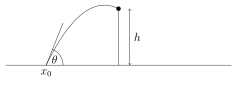
A particle is projected with speed \(V\) at an angle \(\theta\) above the horizontal. The particle passes through the point \(P\) which is a horizontal distance \(d\) and a vertical distance \(h\) from the point of projection. Show that \[ T^2 -2kT + \frac{2kh}{d}+1=0\;, \] where \(T=\tan\theta\) and \(\ds k= \frac{V^2}{gd}\,\). %Derive an equation relating \(\tan \theta\), \(V\), \(g\), \(d\) and \(h\). Show that, if \(\displaystyle {kd > h + \sqrt {h^2 + d^2}}\;\), there are two distinct possible angles of projection. Let these two angles be \(\alpha\) and \(\beta\). Show that \(\displaystyle \alpha + \beta = \pi - \arctan ( {d/ h}) \,\).
1997 Paper 2 Q6
Show that, if \(\,\tan^2\phi=2\tan\phi+1\), then \(\tan2\phi=-1\). Find all solutions of the equation $$\tan\theta=2+\tan3\theta$$ which satisfy \(0<\theta< 2\pi\), expressing your answers as rational multiples of \(\pi\). Find all solutions of the equation the equation $$\cot\theta=2+\cot3\theta$$ which satisfy $$-\frac{3\pi}{2}<\theta<\frac{\pi}{2}.$$
1995 Paper 1 Q9
A particle is projected from a point \(O\) with speed \(\sqrt{2gh},\) where \(g\) is the acceleration due to gravity. Show that it is impossible, whatever the angle of projection, for the particle to reach a point above the parabola \[ x^{2}=4h(h-y), \] where \(x\) is the horizontal distance from \(O\) and \(y\) is the vertical distance above \(O\). State briefly the simplifying assumptions which this solution requires.
Solution: The position of the particle is projected at angle \(\theta\) is \((x,y) = (v \cos \theta t, v \sin \theta t - \frac12 g t^2)\), ie \(t = \frac{x}{v \cos \theta}\), \begin{align*} && y &= x\tan \theta -\frac12 g \frac{x^2}{v^2} \sec^2 \theta \\ && y &= x \tan \theta -\frac{1}{4h} (1+\tan^2 \theta) x^2 \\ && 0 &= \frac{1}{4h} x^2\tan^2 \theta - x \tan \theta + \frac{x^2}{4h} +y \\ \Delta \geq 0: && 0 &\leq \Delta = x^2-4\frac{x^2}{4h}\left (\frac{x^2}{4h}+y \right) \\ &&&=1-\frac{1}{4h^2}(x^2+4hy) \\ \Rightarrow && x^2+4hy &\leq 4h^2 \\ \Rightarrow && x^2 &\leq 4h(h-y) \end{align*} We are assuming that there are no forces acting other than gravity (eg air resistance)
1992 Paper 2 Q11
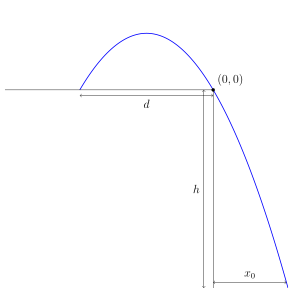
I am standing next to an ice-cream van at a distance \(d\) from the top of a vertical cliff of height \(h\). It is not safe for me to go any nearer to the top of the cliff. My niece Padma is on the broad level beach at the foot of the cliff. I have just discovered that I have left my wallet with her, so I cannot buy her an ice-cream unless she can throw the wallet up to me. She can throw it at speed \(V\), at any angle she chooses and from anywhere on the beach. Air resistance is negligible; so is Padma's height compared to that of the cliff. Show that she can throw the wallet to me if and only if \[ V^{2}\geqslant g(2h+d). \]
Solution:
1988 Paper 1 Q10
A sniper at the top of a tree of height \(h\) is hit by a bullet fired from the undergrowth covering the horizontal ground below. The position and elevation of the gun which fired the shot are unknown, but it is known that the bullet left the gun with speed \(v\). Show that it must have been fired from a point within a circle centred on the base of the tree and of radius \((v/g)\sqrt{v^{2}-2gh}\). {[}Neglect air resistance.{]}
Solution: