Problems
Filters
2 problems found
2019 Paper 3 Q8
A pyramid has a horizontal rectangular base \(ABCD\) and its vertex \(V\) is vertically above the centre of the base. The acute angle between the face \(AVB\) and the base is \(\alpha\), the acute angle between the face \(BVC\) and the base is \(\beta\) and the obtuse angle between the faces \(AVB\) and \(BVC\) is \(\pi - \theta\).
- The edges \(AB\) and \(BC\) are parallel to the unit vectors \(\mathbf{i}\) and \(\mathbf{j}\), respectively, and the unit vector \(\mathbf{k}\) is vertical. Find a unit vector that is perpendicular to the face \(AVB\). Show that $$\cos \theta = \cos \alpha \cos \beta.$$
- The edge \(BV\) makes an angle \(\phi\) with the base. Show that $$\cot^2 \phi = \cot^2 \alpha + \cot^2 \beta.$$ Show also that $$\cos^2 \phi = \frac{\cos^2 \alpha + \cos^2 \beta - 2 \cos^2 \theta}{1 - \cos^2 \theta} \geq \frac{2 \cos \theta - 2 \cos^2 \theta}{1 - \cos^2 \theta}$$ and deduce that \(\phi < \theta\).
Solution:
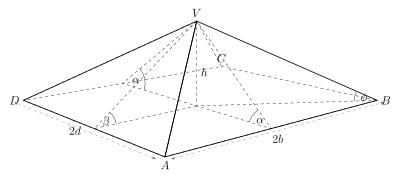
- Let \(A = (0,0,0)\) and then \(B = 22b \mathbf{i}, D = 2d\mathbf{j}, C = 2b\mathbf{i}+2d\mathbf{j}\) and \(V = b \mathbf{i} + d\mathbf{j} + h\mathbf{k}\) We also have \begin{align*} && \tan \alpha &= \frac{h}{d}\\ && \tan \beta &= \frac{d}{b} \\ && \vec{AV} \times \vec{VB} &= \begin{pmatrix} b \\ d \\ h \end{pmatrix} \times \begin{pmatrix} -b \\ d \\ h \end{pmatrix} \\ &&&= \begin{pmatrix} 0 \\ -2bh \\ 2db \end{pmatrix} \\ &&&= 2b \begin{pmatrix} 0 \\ -d \tan \alpha \\ d \end{pmatrix} \\ &&&= k \begin{pmatrix} 0 \\ - \sin \alpha \\ \cos \alpha \end{pmatrix} \end{align*} similarly for the vector perpendicular to the other face it must be \(\begin{pmatrix}-\sin \beta \\ 0 \\ \cos \beta \end{pmatrix}\) Looking at the angle between these perpendicular (to find the angles between the faces we see: \begin{align*} \begin{pmatrix} 0 \\ - \sin \alpha \\ \cos \alpha \end{pmatrix} \cdot \begin{pmatrix}-\sin \beta \\ 0 \\ \cos \beta \end{pmatrix} &= \cos \alpha \cos \beta \end{align*} But this is also \(\pi -\) the angle between the planes, ie \(\cos \theta = \cos \alpha \cos \beta\)
- \(\,\) \begin{align*} && \cot^2 \phi &= \frac{b^2+d^2}{h^2} \\ && \cot^2 \alpha &= \frac{d^2}{h^2} \\ && \cot^2 \beta &= \frac{b^2}{h^2} \\ \Rightarrow && cot^2 \phi &= \cot^2 \beta+\cot^2 \alpha \end{align*} \begin{align*} && \cos^2 \phi &= \frac{b^2+d^2}{b^2+d^2+h^2} \\ && \cos^2 \alpha &= \frac{d^2}{d^2+h^2} \\ && \cos^2 \beta &= \frac{b^2}{b^2+h^2} \\ && \frac{\cos^2 \alpha + \cos^2 \beta - 2 \cos^2 \theta}{1-\cos^2 \theta} &= \frac{\frac{d^2}{d^2+h^2}+\frac{b^2}{b^2+h^2}-2\cdot \frac{d^2}{d^2+h^2} \cdot \frac{b^2}{b^2+h^2}}{1 - \frac{d^2}{d^2+h^2} \cdot\frac{b^2}{b^2+h^2}} \\ &&&= \frac{d^2(b^2+h^2)+b^2(d^2+h^2)-2d^2b^2}{(d^2+h^2)(b^2+h^2)-d^2b^2} \\ &&&= \frac{h^2(b^2+d^2)}{h^2(b^2+d^2+h^2)} \\ &&&= \frac{b^2+d^2}{b^2+d^2+h^2} \\ &&&= \cos^2\phi \end{align*} Also notice that \begin{align*} && \cos^2 \alpha + \cos^2 \beta &\underbrace{\geq}_{AM-GM} 2 \cos \alpha \cos \beta \\ &&&= 2 \cos \theta \\ \Rightarrow && \frac{\cos^2 \alpha + \cos^2 \beta - 2 \cos^2 \theta}{1-\cos^2 \theta} &\geq \frac{2 \cos \theta - 2\cos^2 \theta}{1-\cos^2 \theta} \\ &&&= \frac{2\cos \theta}{1+\cos \theta} = \cos \theta \frac{2}{1+\cos \theta} \\ &&&> \cos^2 \theta \\ \Rightarrow && \phi &< \theta \end{align*}
2002 Paper 1 Q6
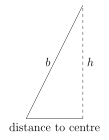
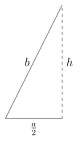
A pyramid stands on horizontal ground. Its base is an equilateral triangle with sides of length~\(a\), the other three sides of the pyramid are of length \(b\) and its volume is \(V\). Given that the formula for the volume of any pyramid is $ \textstyle \frac13 \times \mbox{area of base} \times \mbox {height} \,, $ show that \[ V= \frac1{12} {a^2(3b^2-a^2)}^{\frac12}\;. \] The pyramid is then placed so that a non-equilateral face lies on the ground. Show that the new height, \(h\), of the pyramid is given by \[ h^2 = \frac{a^2(3b^2-a^2)}{4b^2-a^2}\;. \] Find, in terms of \(a\) and \(b\,\), the angle between the equilateral triangle and the horizontal.
Solution: First let's consider the area of the base. It is an equilateral triangle with side length \(a\), so \(\frac12 a^2 \sin 60^\circ = \frac{\sqrt{3}}4a^2\).