Problems
Filters
3 problems found
2006 Paper 1 Q9
A block of mass \(4\,\)kg is at rest on a smooth, horizontal table. A smooth pulley \(P\) is fixed to one edge of the table and a smooth pulley \(Q\) is fixed to the opposite edge. The two pulleys and the block lie in a straight line. Two horizontal strings are attached to the block. One string runs over pulley \(P\); a particle of mass \(x\,\)kg hangs at the end of this string. The other string runs over pulley \(Q\); a particle of mass \(y\,\)kg hangs at the end of this string, where \(x > y\) and \(x + y = 6\,\). The system is released from rest with the strings taut. When the \(4\,\)kg block has moved a distance \(d\), the string connecting it to the particle of mass \(x\,\)kg is cut. Show that the time taken by the block from the start of the motion until it first returns to rest (assuming that it does not reach the edge of the table) is \(\sqrt{d/(5g)\,} \,\f(y)\), where \[ \f(y)= \frac{10}{ \sqrt{6-2y}}+ \left(1 + \frac{4}{ y} \right) \sqrt {6 -2y}. \] Calculate the value of \(y\) for which \(\f'(y)=0\).
1991 Paper 1 Q11
A piledriver consists of a weight of mass \(M\) connected to a lighter counterweight of mass \(m\) by a light inextensible string passing over a smooth light fixed pulley. By considerations of energy or otherwise, show that if the weights are released from rest, and move vertically, then as long as the string remains taut and no collisions occur, the weights experience a constant acceleration of magnitude \[ g\left(\frac{M-m}{M+m}\right). \] Initially the weight is held vertically above the pile, and is released from rest. During the subsequent motion both weights move vertically and the only collisions are between the weight and the pile. Treating the pile as fixed and the collisions as completely inelastic, show that, if just before a collision the counterweight is moving with speed \(v\), then just before the next collision it will be moving with speed \(mv/\left(M+m\right)\). {[}You may assume that when the string becomes taut, the momentum lost by one weight equals that gained by the other.{]} Further show that the times between successive collisions with the pile form a geometric progression. Show that the total time before the weight finally comes to rest is three times the time from the start to the first impact.
1989 Paper 3 Q14
- A solid circular disc has radius \(a\) and mass \(m.\) The density is proportional to the distance from the centre \(O\). Show that the moment of inertia about an axis through \(C\) perpendicular to the plane of the disc is \(\frac{3}{5}ma^{2}.\)
- A light inelastic string has one end fixed at \(A\). It passes under and supports a smooth pulley \(B\) of mass \(m.\) It then passes over a rough pulley \(C\) which is a disc of the type described in (i), free to turn about its axis which is fixed and horizontal. The string carries a particle \(D\) of mass \(M\) at its other end. The sections of the string which are not in contact with the pulleys are vertical. The system is released from rest and moves under gravity for \(t\) seconds. At the end of this interval the pulley \(B\) is suddenly stopped. Given that \(m<2M\), find the resulting impulse on \(D\) in terms of \(m,M,g\) and \(t\). {[}You may assume that the string is long enough for there to be no collisions between the elements of the system, and that the pulley \(C\) is rough enough to prevent slipping throughout.{]}
Solution:
- \begin{align*} m &= \int_0^a \underbrace{(\rho r)}_{\text{mass per area}} \underbrace{\pi r^2}_{\text{area}} \d r \\ &= \rho \pi \frac{a^3}{3} \\ \\ I &= \sum m r^2 \\ &= \sum (\rho r) \pi r^2 \cdot r^2 \\ &\to \int_0^a \rho \pi r^4 \\ &= \frac15 \rho \pi a^5 \\ &= \frac35 m a^2 \end{align*}
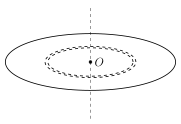
- \begin{align*} \text{N2}(\downarrow, D): && Mg -T_C &= Mf \\ \overset{\curvearrowright}{C} && (T_C - T_B)a &= I \frac{f}{a} \\ &&&= \frac35 m a f \\ \text{N2}(\uparrow, B): && 2T_B-mg &= \frac12 m f \\ \\ \Rightarrow && Mg-T_B &= \left (M + \frac35 m \right)f \\ \Rightarrow && Mg - \frac12 mg &= \left (M + \frac35 m + \frac14 m \right)f \\ \Rightarrow && f &= \frac{(M-\frac12 m)g}{M + \frac{17}{20} m} \\ &&&= \frac{(2M-m)g}{2M +\frac{17}{10}m} \end{align*} Therefore the speed after a time \(t\) is \(\displaystyle \frac{(2M-m)g}{2M +\frac{17}{10}m} t\) and the impulse will be the change in momentum, ie \(\displaystyle \frac{(2M-m)g}{2M +\frac{17}{10}m} Mt\)
