Problems
Filters
33 problems found
2024 Paper 2 Q5
- The functions \(\mathrm{f}_1\) and \(\mathrm{F}_1\), each with domain \(\mathbb{Z}\), are defined by \[ \mathrm{f}_1(n) = n^2 + 6n + 11, \] \[ \mathrm{F}_1(n) = n^2 + 2. \] Show that \(\mathrm{F}_1\) has the same range as \(\mathrm{f}_1\).
- The function \(\mathrm{g}_1\), with domain \(\mathbb{Z}\), is defined by \[ \mathrm{g}_1(n) = n^2 - 2n + 5. \] Show that the ranges of \(\mathrm{f}_1\) and \(\mathrm{g}_1\) have empty intersection.
- The functions \(\mathrm{f}_2\) and \(\mathrm{g}_2\), each with domain \(\mathbb{Z}\), are defined by \[ \mathrm{f}_2(n) = n^2 - 2n - 6, \] \[ \mathrm{g}_2(n) = n^2 - 4n + 2. \] Find any integers that lie in the intersection of the ranges of the two functions.
- Show that \(p^2 + pq + q^2 \geqslant 0\) for all real \(p\) and \(q\). The functions \(\mathrm{f}_3\) and \(\mathrm{g}_3\), each with domain \(\mathbb{Z}\), are defined by \[ \mathrm{f}_3(n) = n^3 - 3n^2 + 7n, \] \[ \mathrm{g}_3(n) = n^3 + 4n - 6. \] Find any integers that lie in the intersection of the ranges of the two functions.
Solution:
- \(\,\) \begin{align*} && f_1(n) &= n^2 + 6n + 11 \\ &&&= (n+3)^2 + 2 \\ &&&=F_1(n+3) \end{align*} Since \(n \mapsto n+3\) is a bijection on \(\mathbb{Z}\) both functions must have exactly the same range.
- \(g_1(n) = n^2-2n+5 = (n-1)^2 + 4\). Since squares are always \(0, 1 \pmod{4}\) it's impossible for \(f_1\) and \(g_1\) to take the same value therefore the ranges have empty intersection.
- \(\,\) \begin{align*} && f_2(n) &= n^2-2n - 6 \\ &&&= (n-1)^2-7 \\ && g_2(n) &= n^2-4n+2 \\ &&&= (n-2)^2 - 2 \end{align*} so suppose \(x^2 - 7 = y^2 - 2\) then \begin{align*} && x^2 - 7 &= y^2 -2 \\ \Rightarrow && 5 &= y^2 - x^2 \\ &&&= (y-x)(y+x) \end{align*} So we have cases: \(y-x = -5, y + x = -1 \Rightarrow y = -3\) and the output is \(7\) \(y-x=-1, y+x = -5 \Rightarrow y = -3\) same output \(y-x=1, y+x = 5 \Rightarrow y = 3\) same output \(y-x=5, y-x = 1 \Rightarrow y = 3\) same ouput.
- \begin{align*} && 0 &\leq \frac12(p^2+q^2)+\frac12(p+q)^2 \\ &&&= p^2 + q^2 + pq \end{align*} Looking at \(f_3\) we see \begin{align*} && f_3(n) &= n^3 - 3n^2 + 7n \\ &&&= (n-1)^3 -3n + 7n +1 \\ &&&= (n-1)^3 +4(n-1) -3 \\ &&&= g_3(n-1) + 3 \end{align*} So suppose we have two values which are equal, ie \begin{align*} && x^3 + 4x -3 &= y^3 +4y -6 \\ \Rightarrow && 3 &= y^3-x^3+4y-4x \\ &&&= (y-x)(y^2+xy+x^2+4) \end{align*} Since \(x^2+xy+y^2 \geq 0\) then the right hand factor is always a positive integer bigger than \(3\) and in particular there will be no solutions and hence no integers in the intersection of the ranges.
2023 Paper 2 Q3
Let \(\mathrm{p}(x)\) be a polynomial of degree \(n\) with \(\mathrm{p}(x) > 0\) for all \(x\) and let \[\mathrm{q}(x) = \sum_{k=0}^{n} \mathrm{p}^{(k)}(x)\,,\] where \(\mathrm{p}^{(k)}(x) \equiv \dfrac{\mathrm{d}^k \mathrm{p}(x)}{\mathrm{d}x^k}\) for \(k \geqslant 1\) and \(\mathrm{p}^{(0)}(x) \equiv \mathrm{p}(x)\).
- Explain why \(n\) must be even and show that \(\mathrm{q}(x)\) takes positive values for some values of \(x\).
- Show that \(\mathrm{q}'(x) = \mathrm{q}(x) - \mathrm{p}(x)\).
- In this part you will be asked to show the same result in three different ways.
- Show that the curves \(y = \mathrm{p}(x)\) and \(y = \mathrm{q}(x)\) meet at every stationary point of \(y = \mathrm{q}(x)\). Hence show that \(\mathrm{q}(x) > 0\) for all \(x\).
- Show that \(\mathrm{e}^{-x}\mathrm{q}(x)\) is a decreasing function. Hence show that \(\mathrm{q}(x) > 0\) for all \(x\).
- Show that \[\int_0^{\infty} \mathrm{p}(x+t)\mathrm{e}^{-t}\,\mathrm{d}t = \mathrm{p}(x) + \int_0^{\infty} \mathrm{p}^{(1)}(x+t)\mathrm{e}^{-t}\,\mathrm{d}t\,.\] Show further that \[\int_0^{\infty} \mathrm{p}(x+t)\mathrm{e}^{-t}\,\mathrm{d}t = \mathrm{q}(x)\,.\] Hence show that \(\mathrm{q}(x) > 0\) for all \(x\).
2023 Paper 2 Q4
- Show that, if \((x-\sqrt{2})^2 = 3\), then \(x^4 - 10x^2 + 1 = 0\). Deduce that, if \(\mathrm{f}(x) = x^4 - 10x^2 + 1\), then \(\mathrm{f}(\sqrt{2}+\sqrt{3}) = 0\).
- Find a polynomial \(\mathrm{g}\) of degree 8 with integer coefficients such that \(\mathrm{g}(\sqrt{2}+\sqrt{3}+\sqrt{5}) = 0\). Write your answer in a form without brackets.
- Let \(a\), \(b\) and \(c\) be the three roots of \(t^3 - 3t + 1 = 0\). Find a polynomial \(\mathrm{h}\) of degree 6 with integer coefficients such that \(\mathrm{h}(a+\sqrt{2}) = 0\), \(\mathrm{h}(b+\sqrt{2}) = 0\) and \(\mathrm{h}(c+\sqrt{2}) = 0\). Write your answer in a form without brackets.
- Find a polynomial \(\mathrm{k}\) with integer coefficients such that \(\mathrm{k}(\sqrt[3]{2}+\sqrt[3]{3}) = 0\). Write your answer in a form without brackets.
Solution:
- \(\,\) \begin{align*} && 3 &= (x-\sqrt2)^2 \\ &&&= x^2 - 2\sqrt2 x + 2 \\ \Rightarrow && 2\sqrt2 x &= x^2-1 \\ \Rightarrow && 8x^2 &= x^4 - 2x^2 + 1 \\ \Rightarrow && 0 &= x^4 - 10x^2 + 1 \end{align*} Noticing that \((\sqrt2+\sqrt3-\sqrt2)^2 = 3\) we note that \(\sqrt2 + \sqrt3\) is a root of our quartic.
- Suppose \(x = \sqrt2 + \sqrt3 + \sqrt5\) then \begin{align*} && 0 &= (x - \sqrt5)^4 - 10(x-\sqrt5)^2 + 1 \\ &&&= x^4 - 4\sqrt5x^3 + 30x^2-20\sqrt5 x +25 - 10x^2+20\sqrt5x -50 + 1\\ &&&= (x^4+20x^2- 24) - 4\sqrt5 x^3 \\ \Rightarrow && 80x^6 &= (x^4+20x^2-24)^2 \\ &&&= x^8 + 40x^6 + 352x^4 - 960x^2+576 \\ \Rightarrow && 0 &= x^8-40x^6 + 352x^4-960x^2+576 \end{align*} So take \(g(x) = x^8-40x^6 + 352x^4-960x^2+576\).
- Notice that if \(p(t) = t^3-3t+1\) then \(p(t -\sqrt2) = 0\) for \(t = a,b,c\) so \begin{align*} && 0 &= (t - \sqrt2)^3 -3(t - \sqrt2) + 1 \\ &&&= t^3-3\sqrt2 t^2 + 6t - 2\sqrt2 - 3t + 3\sqrt 2 + 1 \\ &&&= (t^3+3t+1) - \sqrt2 (3t^2+1) \\ \Rightarrow && 2(3t^2+1)^2 &= (t^3+3t+1)^2 \\ \Rightarrow && 2(9t^4+6t^2+1) &= t^6 + 6t^4+2t^3+9t^2+6t+1 \\ \Rightarrow && 0 &= t^6-12t^4+2t^3-3t^2+6t-1 \end{align*}
- \(\,\) \begin{align*} && t &= \sqrt[3]{2} + \sqrt[3]{3} \\ \Rightarrow && t^3 &= 2 + 3\sqrt[3]{12} + 3\sqrt[3]{18} + 3 \\ &&&= 5 + 3 \sqrt[3]{6}(\sqrt[3]{2} + \sqrt[3]{3}) \\ &&&= 5 + 3\sqrt[3]{6}t \\ \Rightarrow && 162t^3 &= (t^3-5)^3 \\ &&&= t^9-15t^6+75t^3 -125 \\ \Rightarrow && 0 &= t^9-15t^6-87t^3-125 \end{align*} so \(k(x) = x^9 - 15x^6-87x^3-125\)
2021 Paper 2 Q2
In this question, the numbers \(a\), \(b\) and \(c\) may be complex.
- Let \(p\), \(q\) and \(r\) be real numbers. Given that there are numbers \(a\) and \(b\) such that \[ a + b = p, \quad a^2 + b^2 = q \quad \text{and} \quad a^3 + b^3 = r, \qquad (*) \] show that \(3pq - p^3 = 2r\).
- Conversely, you are given that the real numbers \(p\), \(q\) and \(r\) satisfy \(3pq - p^3 = 2r\). By considering the equation \(2x^2 - 2px + (p^2 - q) = 0\), show that there exist numbers \(a\) and \(b\) such that the three equations \((*)\) hold.
- Let \(s\), \(t\), \(u\) and \(v\) be real numbers. Given that there are distinct numbers \(a\), \(b\) and \(c\) such that \[ a + b + c = s, \quad a^2 + b^2 + c^2 = t, \quad a^3 + b^3 + c^3 = u \quad \text{and} \quad abc = v, \] show, using part~(i), that \(c\) is a root of the equation \[ 6x^3 - 6sx^2 + 3(s^2 - t)x + 3st - s^3 - 2u = 0 \] and write down the other two roots. Deduce that \(s^3 - 3st + 2u = 6v\).
- Find numbers \(a\), \(b\) and \(c\) such that \[ a + b + c = 3, \quad a^2 + b^2 + c^2 = 1, \quad a^3 + b^3 + c^3 = -3 \quad \text{and} \quad abc = 2, \qquad (**) \] and verify that your solution satisfies the four equations \((**)\).
2019 Paper 1 Q4
- Find integers \(m\) and \(n\) such that $$\sqrt{3+2\sqrt{2}} = m + n\sqrt{2}.$$
- Let \(f(x) = x^4 - 10x^2 + 12x - 2\). Given that the equation \(f(x) = 0\) has four real roots, explain why \(f(x)\) can be written in the form $$f(x)=(x^2 + sx + p)(x^2 - sx + q)$$ for some real constants \(s\), \(p\) and \(q\), and find three equations for \(s\), \(p\) and \(q\). Show that $$s^2(s^2 - 10)^2 + 8s^2 - 144 = 0$$ and find the three possible values of \(s^2\). Use the smallest of these values of \(s^2\) to solve completely the equation \(f(x) = 0\), simplifying your answers as far as you can.
Solution:
- \((1+\sqrt{2})^2 = 3 + 2\sqrt{2}\) so \(\sqrt{3 + 2\sqrt{2}} = 1 + \sqrt{2}\)
- We can always factorise any quartic in the form \((x^2+ax+b)(x^2+cx+d)\), since \(x^3\) has a coefficient of \(a+b\) we must have \(a = -b\), ie the form in the question. \begin{align*} && 0 &= (x^2+sx+p)(x^2-sx+q) \\ &&&= x^4+(p+q-s^2)x^2+s(q-p)x+pq \\ \Rightarrow && pq &= -2 \\ && s(q-p) &= 12 \\ && p+q-s^2 &= -10 \\ \\ && p+q &= s^2-10 \\ && (p+q)^2 &= (s^2-10)^2 \\ && (q-p)^2 &= \frac{12}{s^2} \\ \Rightarrow && (s^2-10)^2 &= \frac{12}{s^2} + 4pq \\ && (s^2-10)^2 &= \frac{144}{s^2} -8 \\ && 0 &= s^2(s^2-10)^2+8s^2-144 \\ &&&= s^6-20s^4+108s^2-144 \\ &&&= (s^2-2)(s^2-6)(s^2-12) \end{align*} Suppose \(s = \sqrt{2}\), and we have \begin{align*} && q-p &= 6\sqrt{2} \\ && p+q &= -8 \\ \Rightarrow && q &= 3\sqrt{2}-4 \\ && p &= -4-3\sqrt{2} \end{align*} Solving our quadratic equations, we have \begin{align*} && 0 &= x^2-\sqrt{2}x-4+3\sqrt{2} \\ \Rightarrow && x &= \frac{\sqrt{2}\pm \sqrt{2-4\cdot(-4+3\sqrt{2})}}{2} \\ &&&= \frac{\sqrt{2}\pm \sqrt{18-12\sqrt{2}}}{2} \\ &&&= \frac{\sqrt{2}\pm (2\sqrt{3}-\sqrt{6})}{2} \\ \\ && 0 &= x^2+\sqrt{2}x-3\sqrt{2}-4 \\ && x &= \frac{-\sqrt{2} \pm \sqrt{2-4\cdot(3\sqrt{3}-4)}}{2}\\ && &= \frac{-\sqrt{2} \pm \sqrt{18+12\sqrt{2}}}{2}\\ && &= \frac{-\sqrt{2} \pm (\sqrt{6}+2\sqrt{3})}{2}\\ \end{align*}
2019 Paper 2 Q3
For any two real numbers \(x_1\) and \(x_2\), show that $$|x_1 + x_2| \leq |x_1| + |x_2|.$$ Show further that, for any real numbers \(x_1, x_2, \ldots, x_n\), $$|x_1 + x_2 + \cdots + x_n| \leq |x_1| + |x_2| + \cdots + |x_n|.$$
- The polynomial f is defined by
$$f(x) = 1 + a_1 x + a_2 x^2 + \cdots + a_{n-1} x^{n-1} + x^n$$
where the coefficients are real and satisfy \(|a_i| \leq A\) for \(i = 1, 2, \ldots, n-1\), where \(A \geq 1\).
- If \(|x| < 1\), show that $$|f(x) - 1| \leq \frac{A|x|}{1 - |x|}.$$
- Let \(\omega\) be a real root of f, so that \(f(\omega) = 0\). In the case \(|\omega| < 1\), show that $$\frac{1}{1 + A} \leq |\omega| \leq 1 + A. \quad (*)$$
- Show further that the inequalities \((*)\) also hold if \(|\omega| \geq 1\).
- Find the integer root or roots of the quintic equation $$135x^5 - 135x^4 - 100x^3 - 91x^2 - 126x + 135 = 0.$$
Solution: Claim: \(|x_1 + x_2| \leq |x_1| + |x_2|\) Proof: Case 1: \(x_1, x_2 \geq 0\). The inequality is equivalent to \(|x_1 + x_2| = x_1 + x_2 = |x_1|+|x_2|\) so it's an equality. Case 2: \(x_1, x_2 \leq 0\). The inequality is equivalent to \(|x_1+x_2| = -x_1-x_2 = |x_1|+|x_2\), so it's also an equality in this case. Case 3: (wlog) \(|x_1| \geq |x_2| > 0\) and \(x_1x_2 < 0\) then \(|x_1+x_2| = x_1-x_2 \leq x_1 \leq |x_1|+|x_2|\) We can prove this by induction, we've already proven the base case and: \(|x_1+x_2 + \cdots + x_n| \leq |x_1 + x_2 + \cdots x_{n-1}| + |x_n| \leq |x_1| + |x_2| + \cdots + |x_n|\)
- \(\,\) \begin{align*} && |f(x) - 1| &= |a_1 x + a_2x^2 + \cdots + a_{n-1}x^{n-1} + x^n| \\ &&&\leq |a_1x| + |a_2x^2| + \cdots + |a_{n-1}x^{n-1}| + |x^n| \\ &&&\leq |a_1||x| + |a_2||x|^2 + \cdots + |a_{n-1}||x|^{n-1} + |x|^n \\ &&&\leq A|x| + A|x|^2 + \cdots + A|x|^{n-1} + |x|^n \\ &&&=A|x| \frac{1-|x|^{n-1}}{1-|x|} + |x|^n \\ &&&= \frac{A|x|-A|x|^{n}+|x|^{n+1}-|x|^n}{1-|x|} \\ &&&= \frac{A|x|-|x|^n(\underbrace{A-|x|+1}_{\geq0})}{1-|x|} \\ &&&\leq \frac{A|x|}{1-|x|} \end{align*}
- If \(f(\omega) = 0\) then \begin{align*} && 1 & \leq \frac{A|\omega|}{1-|\omega|} \\ \Leftrightarrow && 1-|\omega| &\leq A |\omega| \\ \Leftrightarrow && 1 &\leq (1+A) |\omega| \\ \Leftrightarrow && \frac{1}{1+A} &\leq |\omega| \\ \end{align*} We also know \(\omega \leq 1 < 1 + A\)
- If \(\omega\) is a root of \(f(x)\) then \(1/\omega\) is a root of \(1 + a_{n-1}x + a_{n-2}x^2 + \cdots + a_1x^{n-1}+x^n\) and so \(1/\omega\) satisfies that inequality, ie \begin{align*} && \frac{1}{1+A} && \leq &&|1/\omega| && \leq &&1 + A \\ \Leftrightarrow &&1+A && \geq&& |\omega| && \geq&& \frac{1}{1 + A} \end{align*}
- First notice that it's equivalent to: \(0 = x^5 - 1x^4 - \frac{100}{135}x^3-\frac{91}{135}x^2-\frac{126}{135} + 1\) therefore all integer roots must be between \(-2,-1\) and \(1\) and \(2\). \(1\) doesn't work. \(-1\) works. Clearly \(2\) cannot work by parity argument, therefore the only integer root is \(-1\).
2018 Paper 1 Q1
The line \(y=a^2 x\) and the curve \(y=x(b-x)^2\), where \(0 < a < b\,\), intersect at the origin \(O\) and at points \(P\) and \(Q \). The \(x\)-coordinate of \(P\) is less than the \(x\)-coordinate of \(Q\). Find the coordinates of \(P\) and \(Q\), and sketch the line and the curve on the same axes. Show that the equation of the tangent to the curve at \(P\) is \[ y = a(3a-2b)x + 2a(b-a)^2 . \] This tangent meets the \(y\)-axis at \(R\). The area of the region between the curve and the line segment \(OP\) is denoted by \(S\). Show that \[ S= \frac1{12}(b-a)^3(3a+b)\,. \] The area of triangle \(OPR\) is denoted by \(T\). Show that \(S>\frac{1}{3}T\,\).
Solution:
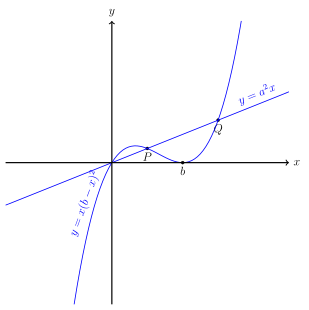
2018 Paper 1 Q5
- Write down the most general polynomial of degree 4 that leaves a remainder of 1 when divided by any of \(x-1\,\), \(x-2\,\), \(x-3\,\) or \(x-4\,\).
- The polynomial \(\P(x)\) has degree \(N\), where \(N\ge1\,\), and satisfies \[ \P(1) = \P(2) = \cdots = \P(N) =1\,. \] Show that \(\P(N+1) \ne 1\,\). Given that \(\P(N+1)= 2\,\), find \(\P(N+r)\) where \(r\) is a positive integer. Find a positive integer \(r\), independent of \(N,\) such that \(\P(N+r) = N+r\,\).
- The polynomial \({\rm S}(x)\) has degree 4. It has integer coefficients and the coefficient of \(x^4\) is 1. It satisfies
\[
{\rm S}(a) =
{\rm S}(b) =
{\rm S}(c) =
{\rm S}(d) = 2001\,,
\]
where \(a\), \(b\), \(c\) and \(d\) are distinct (not necessarily positive)
integers.
- Show that there is no integer \(e\) such that \({\rm S}(e) = 2018\,\).
- Find the number of ways the (distinct) integers \(a\), \(b\), \(c\) and \(d\) can be chosen such that \({\rm S}(0) = 2017\) and \(a < b< c< d\,.\)
Solution:
- \(p(x) = C(x-1)(x-2)(x-3)(x-4)+1\)
- Suppose \(P(N+1) = 1\) them we could consider \(f(x) = P(x) - 1\) to be a polynomial of degree \(N\) with at least \(N+1\) roots, which would be a contradiction. Therefore \(P(N+1) \neq 1\). Since \(P(x) = C(x-1)(x-2)\cdots(x-N) + 1\) and \(P(N+1) = 2\) we must have \(C \cdot N! + 1 = 2 \Rightarrow C = \frac{1}{N!}\), hence \(P(x) = \binom{x-1}{N} + 1\) ie \(P(N+r) = \binom{N+r-1}{N}+1\) so \(P(N+2) = \binom{N+1}{N} +1= N+2\), so we can take \(r=2\).
- Suppose consider \(p(x) = S(x) - 2001\), then \(p(x)\) has roots \(a,b,c,d\) and suppose we can find \(e\) such that \(p(e) = 17\) then we must have \((e-a)(e-b)(e-c)(e-d) = 17\) but the only possible factors of \(17\) are \(-17,-1,1,17\) and we cannot have all \(4\) of them. Hence this is not possible.
- Now we have \(abcd = 16\), so we can have factors \(-16,-8,-4, -2, -1, 1, 2, 4,8,16\) (and we need to have \(4\) of them). If we have \(0\) negatives, the smallest product is \(1 \cdot 2 \cdot 4 \cdot 8 > 16\) If we have \(2\) negatives we must have \(1\) and \(-1\) (otherwise we have the same problem of being too large. So \(\{-1,1,-2,8\},\{-1,1,2,-8\},\{-1,1,-4,4\},\) If we have \(4\) negatives that's the same issue as with \(0\) negatives.
2016 Paper 1 Q1
- For \(n=1\), \(2\), \(3\) and \(4\), the functions \(\p_n\) and \(\q_n\) are defined by \[ \p_n(x) = (x+1)^{2n} - (2n+1)x (x^2+x+1)^{n-1} \] and \[ \q_n(x) = \frac{x^{2n+1}+1}{x+1} \ \ \ \ \ \ \ \ \ \ \ \ (x\ne -1) \,. \ \ \ \ \ \ \ \ \ \ \] Show that \(\p_n(x)\equiv \q_n(x)\) (for \(x\ne-1\)) in the cases \(n=1\), \(n=2\) and \(n=3\). Show also that this does not hold in the case \(n=4\).
- Using results from part (i):
- \(\bf (a)\) express \( \ \dfrac {300^3 +1}{301}\,\) as the product of two factors (neither of which is 1);
- \(\bf (b)\) express \( \ \dfrac {7^{49}+1}{7^7+1}\,\) as the product of two factors (neither of which is 1), each written in terms of various powers of 7 which you should not attempt to calculate explicitly.
Solution:
- \(n=1\): \begin{align*} && p_1(x) &= (x+1)^2 - 3x(x^2+x+1)^0 \\ &&&= x^2+2x+1-3x \\ &&&= x^2-x+1\\ && q_1(x) &= \frac{x^3+1}{x+1} \\ &&&= x^2-x+1 = p_1(x) \\ \\ && p_2(x) &= (x+1)^4-5x(x^2+x+1)^1 \\ &&&= x^4+4x^3+6x^2+4x+1 - 5x^3-5x^2-5x \\ &&&= x^4-x^3+x^2-x+1 \\ &&q_2(x) &= \frac{x^5+1}{x+1} \\ &&&= x^4-x^3+x^2-x+1 = p_2(x) \\ \\ && p_3(x) &= (x+1)^6-7x(x^2+x+1)^2 \\ &&&= x^6+6x^5+15x^4+20x^3+15x^2+6x+1 - 7x(x^4+2x^3+3x^2+2x+1) \\ &&&= x^6-x^5+x^4-x^3+x^2-x+1 \\ && q_3(x) &= \frac{x^7+1}{x+1} \\ &&&= x^6-x^5+x^4-x^3+x^2-x+1 = p_3(x) \\ \\ && p_4(1) &= 2^8 - 9 \cdot 1 \cdot 3^3 \\ &&&= 256 - 243 = 13 \\ && q_4(1) &= \frac{2}{2} = 1 \neq 13 \end{align*}
- \(\bf (a)\) \(\,\) \begin{align*} && \frac{300^3+1}{300+1} &= (300+1)^2 - 3 \cdot 300 \\ &&&= 301^2 - 30^2 \\ &&&= 271 \cdot 331 \end{align*}
- \(\bf (b)\) \(\,\) \begin{align*} && \dfrac {7^{49}+1}{7^7+1} &= (7^7+1)^6 - 7 \cdot 7^7 \cdot (7^2+7+1)^2 \\ &&&= (7^7+1)^6 - 7^8 \cdot (7^2+7+1)^2 \\ &&&= ((7^7+1)^3 - 7^4(7^2+7+1)) \cdot ((7^7+1)^3 + 7^4(7^2+7+1)) \end{align*}
2016 Paper 2 Q2
Use the factor theorem to show that \(a+b-c\) is a factor of \[ (a+b+c)^3 -6(a+b+c)(a^2+b^2+c^2) +8(a^3+b^3+c^3) \,. \tag{\(*\)} \] Hence factorise (\(*\)) completely.
- Use the result above to solve the equation \[ (x+1)^3 -3 (x+1)(2x^2 +5) +2(4x^3+13)=0\,. \]
- By setting \(d+e=c\), or otherwise, show that \((a+b-d-e)\) is a factor of \[ (a+b+d+e)^3 -6(a+b+d+e)(a^2+b^2+d^2+e^2) +8(a^3+b^3+d^3+e^3) \, \] and factorise this expression completely. Hence solve the equation \[ (x+6)^3 - 6(x+6)(x^2+14) +8(x^3+36)=0\,. \]
Solution: Suppose \(c = a+b\) then \begin{align*} (a+b+c)^3 &-6(a+b+c)(a^2+b^2+c^2) +8(a^3+b^3+c^3) \\ &= (2(a+b))^3-6(2(a+b))(a^2+b^2+(a+b)^2) + 8(a^3+b^3+(a+b)^3) \\ &=16(a+b)^3 - 24(a+b)(a^2+b^2+ab)+8(a^3+b^3) \\ &= 8(a+b)(2(a+b)^2-3(a^2+b^2+ab)+(a^2-ab+b^2)) \\ &= 0 \end{align*} Therefore \(a+b-c\) is a factor. By symmetry \(a-b+c\) and \(-a+b+c\) are also factors. Since our polynomial is degree \(3\) it must be \(K(a+b-c)(b+c-a)(c+a-b)\) for some \(K\). Since the coefficient of \(a^3\) is \(3\), \(K = 3\). so we have: \(3(a+b-c)(b+c-a)(c+a-b)\)
- We want \(x + a + b = x+1\), \(x^2 + a^2 + b^2 = x^3+\frac52, x^3 + a^3 + b^3 = x^3+ \frac{13}{4}\). \(a+b = 1, a^2 + b^2 = 5/2\) so \(a = \frac32, b = -\frac12\) \begin{align*} 0 &= (x+1)^3 - 3(x+1)(2x^2+5)+2(4x^3+13) \\ &= 3(x +\frac{3}{2}+\frac{1}{2})(x - \frac{3}{2} - \frac{1}{2})(-x + \frac{3}{2} - \frac{1}{2}) \\ &= 3(x+2)(x-2)(1-x) \end{align*} and so the roots are \(x = 1, 2, -2\)
- Letting \(c = d+e\) we have \begin{align*} (a+b+d+e)^3 &-6(a+b+d+e)(a^2+b^2+d^2+e^2) +8(a^3+b^3+d^3+e^3) \\ &= (a+b+c)^3 -6(a+b+c)(a^2+b^2+c^2-2de) +8(a^3+b^3+c^3 - 3cde) \\ &= (a+b+c)^3 -6(a+b+c)(a^2+b^2+c^2)+8(a^3+b^3+c^3)+12(a+b+c)de - 24cde \\ &= \underbrace{(a+b+c)^3 -6(a+b+c)(a^2+b^2+c^2)+8(a^3+b^3+c^3)}_{\text{has a factor of }a+b-c} + 12(a+b-c)de \end{align*} Therefore there is a factor of \(a+b-c\) or \(a+b-d-e\). By symmetry we must have the factors: \((a+b-d-e)(a-b-d+e)(a-b+d-e)\) and so the final expression must be: \(K(a+b-d-e)(a-b-d+e)(a-b+d-e)\) The coefficient of \(a^3\) is \(3\), therefore \(K = 3\) We want \(x+a+b+c = x + 6\), \(x^2+a^2+b^2+c^2 = 14\) and \(x^3 + a^3+b^3+c^3 = 36\), ie \(a = 1,b=2,c=3\) would work, so \begin{align*} 0 &= (x+6)^3 - 6(x+6)(x^2+14) +8(x^3+36) \\ &= 3(x+1-2-3)(x-1+2-3)(x-1-2+3) \\ &= 3x(x-4)(x-2) \end{align*} ie the roots are \(x = 0, 2, 4\)
2016 Paper 2 Q3
For each non-negative integer \(n\), the polynomial \(\f_n\) is defined by \[ \f_n(x) = 1 + x + \frac{x^2}{2!} + \frac {x^3}{3!} + \cdots + \frac{x^n}{n!} \]
- Show that \(\f'_{n}(x) = \f_{n-1}(x)\,\) (for \(n\ge1\)).
- Show that, if \(a\) is a real root of the equation \[\f_n(x)=0\,,\tag{\(*\)}\] then \(a<0\).
- Let \(a\) and \(b\) be distinct real roots of \((*)\), for \(n\ge2\). Show that \(\f_n'(a)\, \f_n'(b)>0\,\) and use a sketch to deduce that \(\f_n(c)=0\) for some number \(c\) between \(a\) and \(b\). Deduce that \((*)\) has at most one real root. How many real roots does \((*)\) have if \(n\) is odd? How many real roots does \((*)\) have if \(n\) is even?
Solution:
- \(\,\) \begin{align*} && f'_n(x) &= 0 + 1 + \frac{2x}{2!} + \frac{3x^2}{3!} + \cdots + \frac{nx^{n-1}}{n!} \\ &&&= 1 + x + \frac{x^2}{2!} + \frac{x^3}{3!} + \cdots + \frac{x^{n-1}}{(n-1)!} \\ &&&= f_{n-1}(x) \end{align*}
- Claim: \(f_n(x) > 0\) for all \(x > 0\) Proof: (By induction) Base case: (\(n = 1\)) \(f_1(x) = 1 + x > 1\) therefore \(f_1(x) > 0\) Suppose it's true for \(n = k\), then consider \(f_{k+1}\), if we differentiate it, we find it is increasing on \((0, \infty)\) by our inductive hypothesis. But then \(f_{k+1}(0) = 1 > 0\). Therefore \(f_{k+1}(x) > 0\) as well. Therefore by the principle of mathematical induction we are done. Since \(f_n(x) > 0\) for non-negative \(x\), if \(a\) is a root it must be negative.
- Suppose \(f_n(a) = f_n(b) = 0\) then \(f'_n(a) = -\frac{a^n}{n!}\) and \(f'_n(b) = -\frac{b^n}{n!}\), but then \(f_n'(a) f_n'(b) = \frac{(-a)^n(-b)^n}{(n!)^2} > 0\) since \(a < 0, b < 0\). \(_n'(a) f_n'(b)\) is positive, the two gradients must have the same sign (and not be zero). Therefore if they are both increasing, at some point the curve must cross the axis in between. Therefore there is some root \(c\) between \(a\) and \(b\). But then there is also a root between \(c\) and \(a\) and \(c\) and \(b\), and very quickly we find more than \(n\) roots which is not possivel. Therefore there must be at most \(1\) root. If \(n\) is odd there must be exactly one root, since \(f_n\) changes sign as \(x \to -\infty\) vs \(x = 0\). If \(n\) is even then there can't be any roots, since if it crossed the \(x\)-axis there would be two roots (not possible) and it cannot touch the axis, since \(f'_n(a) \neq 0\) unless \(a = 0\), and we know \(a < 0\)
2013 Paper 2 Q3
- Given that the cubic equation \(x^3+3ax^2 + 3bx +c=0\) has three distinct real roots and \(c<0\), show with the help of sketches that either exactly one of the roots is positive or all three of the roots are positive.
- Given that the equation \(x^3 +3ax^2+3bx+c=0\) has three distinct real positive roots show that \begin{equation*} a^2>b>0, \ \ \ \ a<0, \ \ \ \ c<0\,. \tag{\(*\)} \end{equation*} [Hint: Consider the turning points.]
- Given that the equation \(x^3 +3ax^2+3bx+c=0\) has three distinct real roots and that \begin{equation*} ab<0, \ \ \ \ c>0\,, \end{equation*} determine, with the help of sketches, the signs of the roots.
- Show by means of an explicit example (giving values for \(a\), \(b\) and \(c\)) that it is possible for the conditions (\(*\)) to be satisfied even though the corresponding cubic equation has only one real root.
Solution:
- First notice that this cubic has leading first term \(1\) and three real roots, so it must have the shape:
With the \(x\)-axis running somewhere between the dashed lines. Since \(c < 0\), the \(y\)-axis must meet the curve below the \(x\)-axis, ie somewhere on the blue section of this curve:
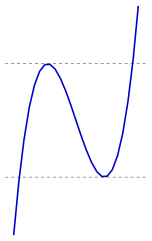 Therefore there will be either \(1\) (if it meets it in the \(\cup\) area) or \(3\) (if it meets it on the far left) positive roots.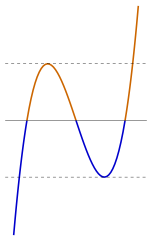
- First notice that if \(c > 0\) we cannot have three positive real roots since the function would need to pass \(0\) between \(0\) and \(-\infty\). Secondly, notice both turning points must be larger than zero, ie \begin{align*} && 0 &= 3x^2 + 6ax + 3b \\ \Leftrightarrow && 0 &= (x+a)^2 + b - a^2 \end{align*} has both roots larger than zero, (and it needs to have two roots, so \(a^2 > b\) and \(-a > 0\), ie \(a < 0\). If \(b < 0\), then just looking at \(x^2+2ax+b\) we can see that it is \(<0\) at \(0\) and one of the roots will be negative, therefore \(c < 0\), \(a^2 > b > 0\) and \(a < 0\)
- Since \(c > 0\) we can see that at least one root is negative.
ie the \(y\)-axis passes through an orange section of this curve. What now matters is where the larger turning point is. Considering \(x^2 + 2ax + b\), we notice that \(ab < 0\) means that \((x-\alpha)(x-\beta)\) we must have \((\alpha + \beta)\alpha \beta > 0\) which isn't possible if both roots are negative. Therefore the \(y\)-axis passes through the orange \(\cap\) and there are \(2\) positive real roots.
- If we take \(a = 1, b = -1, c = 1\) then we have \(x^3 + 3x^2-3x+1\). This has turning points when \(x^2+2x-1 = 0\), ie \(x = -1 \pm \sqrt{2}\) Notice that \begin{align*} && y(-1\pm \sqrt2) &= (-1 \pm \sqrt{2})^3 + 3(-1 \pm \sqrt{2})^2-3(-1 \pm \sqrt{2}) + 1 \\ &&&= (-1\pm \sqrt{2}) \cdot (3 \mp 2\sqrt2) + 3(3 \mp \sqrt2) -3(-1\pm \sqrt2) + 1 \\ &&&= (-7 \pm 5 \sqrt2) + (9 \mp 3\sqrt2) +(3 \mp 3\sqrt2) + 1 \\ &&&= 24 \mp 16\sqrt2 = 8(3 \mp 2 \sqrt2) >0 \end{align*} ie both turning points are above zero and hence only one real root
2012 Paper 2 Q2
If \(\p(x)\) and \(\q(x)\) are polynomials of degree \(m\) and \(n\), respectively, what is the degree of \(\p(\q(x))\)?
- The polynomial \(\p(x)\) satisfies \[ \p(\p(\p(x)))- 3 \p(x)= -2x\, \] for all \(x\). Explain carefully why \(\p(x)\) must be of degree 1, and find all polynomials that satisfy this equation.
- Find all polynomials that satisfy \[ 2\p(\p(x)) +3 [\p(x)]^2 -4\p(x) =x^4 \] for all \(x\).
Solution: If \(\p(x)\) and \(\q(x)\) are polynomials of degree \(m\) and \(n\), \(\p(\q(x))\) has degree \(mn\).
- Suppose \(\p(\p(\p(x)))- 3 \p(x)= -2x\), and suppose \(p(x)\) has degree \(n = \geq 2\), then \(\p(\p(\p(x)))\) has degree \(n^3\) and so the left hand side has degree higher than \(1\) and the right hand side is degree \(1\). Therefore \(\p(x)\) is degree \(1\) or \(0\). If \(p(x) = c\) then \(c^3-3c = -2x\) but the LHS doesn't depend on \(x\) which is also a contradiction. Therefore \(\p(x)\) is degree \(1\). Suppose \(\p(x) = ax+b\) then: \begin{align*} && -2x &= \p(\p(\p(x))) - 3\p(x) \\ &&&= \p(\p(ax+b)) - 3(ax+b) \\ &&&= \p(a(ax+b)+b) - 3ax -3b \\ &&&= a(a^2x+ab+b) + b - 3ax - 3b \\ &&&= (a^3-3a)x + b(a^2+a-2) \\ \Rightarrow &&& \begin{cases} a^3-3a&=-2 \\ b(a^2+a-2) &= 0\end{cases} \\ \Rightarrow &&& \begin{cases} a^3-3a+2 = 0 \\ b = 0, a = 1, a = -2\end{cases} \\ \Rightarrow &&& \begin{cases} (a-1)(a^2+a-2) = 0 \\ b = 0, a = 1, a = -2\end{cases} \\ \Rightarrow && (a,b) &= (1, b), (-2,b) \end{align*}
- Suppose \(2\p(\p(x)) +3 [\p(x)]^2 -4\p(x) =x^4\) and let \(\deg \p(x) = n\), then LHS has degree \(\max(n^2,2n,n)\) and the right hand side has degree \(4\). Therefore \(\p(x)\) must have degree \(2\). Let \(\p(x) = ax^2 + bx + c\), then, considering the coefficient of \(x^4\) in \(2\p(\p(x)) + 3[\p(x)]^2 -4\p(x)\) we will have \(2a^3+3a^2=1 \Rightarrow 2a^3+3a^2-1 = (a+1)^2(2a-1) \Rightarrow a = -1, a=\frac12\). Consider the coefficient of \(x^3\) in \(2\p(\p(x)) + 3[\p(x)]^2 -4\p(x)\) we have \(4a^2b+6ab = 0 \Rightarrow 2ab(2a+3) = 0\) Since \(a = -1, \frac12\) this means \(b = 0\). Consider the constant coefficient in \(2\p(\p(x)) + 3[\p(x)]^2 -4\p(x)\) (using \(b = 0\)). \(2ac^2+c+3c^2-4c = 0 \Rightarrow c(2ac+3c-3) = 0\). Therefore \(c = 0\) or \(a = -1, c = 3, a = \frac12, c = \frac34\), so our possible polynomials are: \(\p(x) = -x^2, \frac12x^2, -x^2+3, \frac12x^2+\frac34\)
2011 Paper 3 Q2
The polynomial \(\f(x)\) is defined by \[ \f(x) = x^n + a_{{n-1}}x^{n-1} + \cdots + a_{2} x^2+ a_{1} x + a_{0}\,, \] where \(n\ge2\) and the coefficients \(a_{0}\), \(\ldots,\) \(a_{{n-1}}\) are integers, with \(a_0\ne0\). Suppose that the equation \(\f(x)=0\) has a rational root \(p/q\), where \(p\) and \(q\) are integers with no common factor greater than \(1\), and \(q>0\). By considering \(q^{n-1}\f(p/q)\), find the value of \(q\) and deduce that any rational root of the equation \(\f(x)=0\) must be an integer.
- Show that the \(n\)th root of \(2\) is irrational for \(n\ge2\).
- Show that the cubic equation \[ x^3- x +1 =0 \] has no rational roots.
- Show that the polynomial equation \[ x^n- 5x +7 =0 \] has no rational roots for \(n\ge2\).
Solution: Let \(\f(x) = x^n + a_{{n-1}}x^{n-1}+ \cdots + a_{2} x^2+ a_{1} x + a_{0}\), and suppose \(f(p/q) = 0\) with \((p,q) = 1\), the consider \begin{align*} && 0 &= q^{n-1}f(p/q) \\ &&&= \frac{p^n}{q} + \underbrace{a_{n-1}p^{n-1} + a_{n-2}p^{n-2}q + \cdots + a_0q^{n-1}}_{\in \mathbb{Z}} \\ \end{align*} But \(p^n/q \not \in \mathbb{Z}\) unless \(q = 1\) therefore \(p/q\) must be an integer, ie all rational roots are integers.
- Note that \(\sqrt[n]2\) is a root of \(x^n - 2 =0\), but this has no integer solutions. (We can try all factors of \(2\)). Therefore all its roots must be irrational, ie \(\sqrt[n]2\) is irrational for \(n \geq 2\)
- If \(n\) is a root of \(x^3 - x+1\) then it must be \(1\) or \(-1\) by the rational root theorem, ie \(1-1+1 \neq 0\) and \(-1 + 1 +1 \neq 0\), therefore no integer roots, therefore no rational roots.
- Suppose \(m\) is an integer root of \(x^n - 5x + 7 = 0\) then by considering parity we must have \(m^n - 5m + 7 \equiv 1 \pmod{2}\) therefore we cannot have any rational roots.
2010 Paper 2 Q7
- By considering the positions of its turning points, show that the curve with equation \[ y=x^3-3qx-q(1+q)\,, \] where \(q>0\) and \(q\ne1\), crosses the \(x\)-axis once only.
- Given that \(x\) satisfies the cubic equation \[ x^3-3qx-q(1+q)=0\,, \] and that \[ x=u+q/u\,, \] obtain a quadratic equation satisfied by \(u^3\). Hence find the real root of the cubic equation in the case \(q>0\), \(q\ne1\).
- The quadratic equation \[ t^2 -pt +q =0\, \] has roots \(\alpha \) and \(\beta\). Show that \[ \alpha^3+\beta^3 = p^3 -3qp\,. \] It is given that one of these roots is the square of the other. By considering the expression \((\alpha^2 -\beta)(\beta^2-\alpha)\), find a relationship between \(p\) and \(q\). Given further that \(q>0\), \(q\ne1\) and \(p\) is real, determine the value of \(p\) in terms of \(q\).