Problems
Filters
4 problems found
2019 Paper 3 Q9
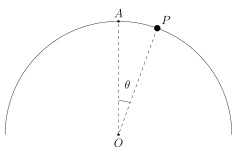
In this question, \(\mathbf{i}\) and \(\mathbf{j}\) are perpendicular unit vectors and \(\mathbf{j}\) is vertically upwards. A smooth hemisphere of mass \(M\) and radius \(a\) rests on a smooth horizontal table with its plane face in contact with the table. The point \(A\) is at the top of the hemisphere and the point \(O\) is at the centre of its plane face. Initially, a particle \(P\) of mass \(m\) rests at \(A\). It is then given a small displacement in the positive \(\mathbf{i}\) direction. At a later time \(t\), when the particle is still in contact with the hemisphere, the hemisphere has been displaced by \(-s\mathbf{i}\) and \(\angle AOP = \theta\).
- Let \(\mathbf{r}\) be the position vector of the particle at time \(t\) with respect to the initial position of \(O\). Write down an expression for \(\mathbf{r}\) in terms of \(a\), \(\theta\) and \(s\) and show that $$\dot{\mathbf{r}} = (a\dot{\theta} \cos \theta - \dot{s})\mathbf{i} - a\dot{\theta} \sin \theta \mathbf{j}.$$ Show also that $$\dot{s} = (1 - k)a\dot{\theta} \cos \theta,$$ where \(k = \frac{M}{m + M}\), and deduce that $$\dot{\mathbf{r}} = a\dot{\theta}(k \cos \theta \mathbf{i} - \sin \theta \mathbf{j}).$$
- Show that $$a\dot{\theta}^2 \left(k \cos^2 \theta + \sin^2 \theta\right) = 2g(1 - \cos \theta).$$
- At time \(T\), when \(\theta = \alpha\), the particle leaves the hemisphere. By considering the component of \(\ddot{\mathbf{r}}\) parallel to the vector \(\sin \theta \mathbf{i} + k \cos \theta \mathbf{j}\), or otherwise, show that at time \(T\) $$a\dot{\theta}^2 = g \cos \alpha.$$ Find a cubic equation for \(\cos \alpha\) and deduce that \(\cos \alpha > \frac{2}{3}\).
Solution:
- \(\mathbf{r} = (a \sin \theta - s) \mathbf{i}+a\cos \theta\mathbf{j}\), so \begin{align*} && \dot{\mathbf{r}} &=(a \dot{\theta} \cos \theta - \dot{s}) \mathbf{i}- a\dot{\theta} \sin \theta \mathbf{j}\\ \\ \text{COM}(\rightarrow): && 0 &= M(-\dot{s}) + m(a \dot{\theta} \cos \theta - \dot{s}) \\ \Rightarrow && \dot{s} &= \frac{ma \dot{\theta} \cos \theta}{m+M} \\ &&&= \left ( 1- \frac{M}{m+M} \right) a\dot{\theta} \cos \theta \\ &&&= (1 - k) a\dot{\theta} \cos \theta \\ \\ \Rightarrow && \dot{\mathbf{r}} &=(a \dot{\theta} \cos \theta - \dot{s}) \mathbf{i}- a\dot{\theta} \sin \theta \mathbf{j} \\ &&&= (a \dot{\theta} \cos \theta - (1 - k) a\dot{\theta} \cos \theta) \mathbf{i}- a\dot{\theta} \sin \theta \mathbf{j} \\ &&&= a\dot{\theta} \left ( k \cos \theta \mathbf{i} - \sin \theta \mathbf{j} \right) \end{align*}
- \(\,\) \begin{align*} COE: &&\underbrace{0}_{\text{k.e.}}+ \underbrace{mga}_{\text{GPE}} &= \underbrace{\frac12 m \mathbf{\dot{r}}\cdot\mathbf{\dot{r}}}_{\text{k.e. }P} + \underbrace{mg a\cos \theta}_{\text{GPE}} + \underbrace{\frac12 M \dot{s}^2}_{\text{k.e. hemisphere}} \\ \Rightarrow && 2amg(1-\cos \theta) &= a^2m \dot{\theta}^2(k^2 \cos^2 \theta + \sin^2 \theta)+ M(1 - k)^2 a^2\dot{\theta}^2 \cos^2 \theta \\ \Rightarrow && 2mg(1-\cos \theta) &= a \dot{\theta}^2 \left (m\sin^2 \theta + (mk^2 + M(1-k)^2)\cos^2 \theta \right) \\ &&&= a \dot{\theta}^2 \left (m\sin^2 \theta + mk\cos^2 \theta \right) \\ \Rightarrow && 2g(1-\cos \theta) &= a \dot{\theta}^2 \left (\sin^2 \theta + k\cos^2 \theta \right) \\ \end{align*}
- The equation of motion is \(m \ddot{\mathbf{r}} = \mathbf{R} - mg\mathbf{j}\) and the particle will leave the surface when \(\mathbf{R} = 0\). If we take the component in the directions suggested: \begin{align*} && \ddot{\mathbf{r}} &= a\ddot{\theta}(k \cos \theta \mathbf{i}- \sin \theta \mathbf{j}) + a \dot{\theta}(-k\dot{\theta} \sin \theta \mathbf{i}- \dot{\theta} \cos \theta \mathbf{j}) \\ &&&= ak (\ddot{\theta} \cos \theta - \dot{\theta}^2 \sin \theta) \mathbf{i} -a(\ddot{\theta} \sin \theta + \dot{\theta}^2 \cos \theta) \mathbf{j} \\ \Rightarrow && \mathbf{\ddot{r}} \cdot (\sin \theta \mathbf{i} + k \cos \theta \mathbf{j}) &= ak (\ddot{\theta} \cos \theta - \dot{\theta}^2 \sin \theta) \sin \theta -ak(\ddot{\theta} \sin \theta + \dot{\theta}^2 \cos \theta)\cos \theta \\ &&&= - ak \dot{\theta}^2 \\ && (-g\mathbf{j}) \cdot (\sin \theta \mathbf{i} + k \cos \theta \mathbf{j}) &= -gk \cos \theta \\ \mathbf{R} = 0: && gk \cos \theta &= ak \dot{\theta}^2 \\ \Rightarrow && g \cos \theta &= a \dot{\theta}^2 \end{align*}
- \(\,\) \begin{align*} && 2g(1-\cos \theta) &= a \dot{\theta}^2(k \cos^2 \theta + \sin^2 \theta) \\ && a \dot{\theta}^2 &= g \cos \alpha \\ \Rightarrow && 2g(1-\cos \alpha) &= g \cos \alpha(k \cos^2 \alpha + (1-\cos^2 \alpha)) \\ \Rightarrow && 0 &= g(k-1)c^3+3gc-2g \\ \Rightarrow && 0 &= (k-1)c^3+3c - 2 \end{align*} When \(c =1, f(c) = k > 0\) when \(c = \frac23, f(c) = k-1 < 0\). Therefore there is a root with \(\cos \alpha > \frac23\)
1996 Paper 3 Q9
A particle of mass \(m\) is at rest on top of a smooth fixed sphere of radius \(a\). Show that, if the particle is given a small displacement, it reaches the horizontal plane through the centre of the sphere at a distance % at least $$a(5\sqrt5+4\sqrt23)/27$$ from the centre of the sphere. [Air resistance should be neglected.]
1992 Paper 3 Q12
\(\,\)
1987 Paper 1 Q11
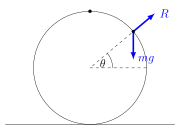
A smooth sphere of radius \(r\) stands fixed on a horizontal floor. A particle of mass \(m\) is displaced gently from equilibrium on top of the sphere. Find the angle its velocity makes with the horizontal when it loses contact with the sphere during the subsequent motion. By energy considerations, or otherwise, find the vertical component of the momentum of the particle as it strikes the floor.
Solution: