Problems
Filters
5 problems found
2018 Paper 2 Q7
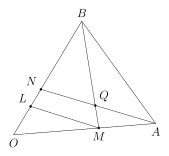
The points \(O\), \(A\) and \(B\) are the vertices of an acute-angled triangle. The points \(M\) and \(N\) lie on the sides \(OA\) and \(OB\) respectively, and the lines \(AN\) and \(BM\) intersect at \(Q\). The position vector of \(A\) with respect to \(O\) is \(\bf a\), and the position vectors of the other points are labelled similarly. Given that \(\vert MQ \vert = \mu \vert QB\vert \), and that \(\vert NQ \vert = \nu \vert QA\vert \), where \(\mu\) and \(\nu\) are positive and \(\mu \nu <1\), show that \[ {\bf m} = \frac {(1+\mu)\nu}{1+\nu} \, {\bf a} \,. \] The point \(L\) lies on the side \(OB\), and \(\vert OL \vert = \lambda \vert OB \vert \,\). Given that \(ML\) is parallel to \(AN\), express \(\lambda\) in terms of \(\mu\) and \(\nu\). What is the geometrical significance of the condition \(\mu\nu<1\,\)?
Solution:
2016 Paper 1 Q6
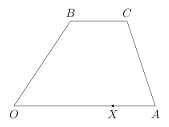
The sides \(OA\) and \(CB\) of the quadrilateral \(OABC\) are parallel. The point \(X\) lies on \(OA\), between \(O\) and \(A\). The position vectors of \(A\), \(B\), \(C\) and \(X\) relative to the origin \(O\) are \(\bf a\), \(\bf b\), \(\bf c\) and \(\bf x\), respectively. Explain why \(\bf c\) and \(\bf x\) can be written in the form \[ {\bf c} = k {\bf a} + {\bf b} \text{ and } {\bf x} = m {\bf a}\,, \] where \(k\) and \(m\) are scalars, and state the range of values that each of \(k\) and \(m\) can take. The lines \(OB\) and \(AC\) intersect at \(D\), the lines \(XD\) and \(BC\) intersect at \(Y\) and the lines \(OY\) and \(AB\) intersect at \(Z\). Show that the position vector of \(Z\) relative to \(O\) can be written as \[ \frac{ {\bf b} + mk {\bf a}}{mk+1}\,. \] The lines \(DZ\) and \(OA\) intersect at \(T\). Show that \[ OT \times OA = OX\times TA \text{ and } \frac 1 {OT} = \frac 1 {OX} + \frac 1 {OA} \,, \] where, for example, \(OT\) denotes the length of the line joining \(O\) and \(T\).
Solution:
2010 Paper 1 Q3
Show that \[ \sin(x+y) -\sin(x-y) = 2 \cos x \, \sin y \] and deduce that \[ \sin A - \sin B = 2 \cos \tfrac12 (A+B) \, \sin\tfrac12 (A-B) \,. \] Show also that \[ \cos A - \cos B = -2 \sin \tfrac12(A+B) \, \sin\tfrac12(A-B)\,. \] The points \(P\), \(Q\), \(R\) and \(S\) have coordinates \(\left(a\cos p,b\sin p\right)\), \(\left(a\cos q,b\sin q\right)\), \(\left(a\cos r,b\sin r\right)\) and \(\left(a\cos s,b\sin s\right)\) respectively, where \(0\le p < q < r < s <2\pi\), and \(a\) and \(b\) are positive. Given that neither of the lines \(PQ\) and \(SR\) is vertical, show that these lines are parallel if and only if \[ r+s-p-q = 2\pi\,. \]
Solution: \begin{align*} && \sin(x+y) - \sin(x-y) &= \sin x \cos y + \cos x \sin y - (\sin x \cos y - \cos x \sin y )\\ &&&= 2 \cos x \sin y \\ \\ && A &= x+y \\ && B &= x - y \\ \Rightarrow && x = \frac12(A+B) &\quad y = \frac12(A-B) \\ \Rightarrow && \sin A - \sin B &= 2 \cos \tfrac12(A+B) \sin \tfrac12(A-B) \\ \\ && \cos (x+y) - \cos (x-y) &= \cos x \cos y - \sin x \sin y -(\cos x \cos y + \sin x \sin y ) \\ &&&= -2 \sin x \sin y \\ \Rightarrow && \cos A - \cos B &= - 2 \sin \tfrac12 (A+B) \sin \tfrac12 (A-B) \end{align*} \begin{align*} && \text{Gradient of }PQ &= \frac{b \sin q - b \sin p}{a \cos q - a \cos p } \\ && \text{Gradient of }SR &= \frac{b \sin s - b \sin r}{a \cos s - a \cos r} \\ PQ \parallel SR \Rightarrow && \frac{b \sin q - b \sin p}{a \cos q - a \cos p } &= \frac{b \sin s - b \sin r}{a \cos s - a \cos r} \\ \Rightarrow && (\sin q - \sin p)(\cos s - \cos r) &= (\sin s - \sin r)(\cos q - \cos r) \\ \Rightarrow && -4 \cos \tfrac12(p+q) \sin\tfrac12(q-p) \sin \tfrac12(s+r) \sin \tfrac12(s-r) &= -4 \cos \tfrac12(s+r) \sin \tfrac12(s-r) \sin \tfrac12 (p+q) \sin\tfrac12 (q-p) \\ \Rightarrow && 0 &= \sin \tfrac12(s-r)\sin\tfrac12(p-q) \left ( \cos \tfrac12(p+q)\sin \tfrac12(s+r) - \sin \tfrac12 (p+q)\cos \tfrac12(s+r) \right) \\ &&&= \sin \tfrac12(s-r)\sin\tfrac12(p-q) \sin \left ( \frac12 (s+r -(p+q))\right) \end{align*} Since \(s \neq r\) and \(p \neq q\) (neither line vertical) we must have \(\frac12 (s+r -(p+q)) = n \pi \Rightarrow s+r - p - q = 0, 2\pi, 4\pi, \cdots\) but given the range constraints it must be \(2 \pi\)
1997 Paper 2 Q13
A needle of length two cm is dropped at random onto a large piece of paper ruled with parallel lines two cm apart.
- By considering the angle which the needle makes with the lines, find the probability that the needle crosses the nearest line given that its centre is \(x\) cm from it, where \(0 < x < 1\).
- Given that the centre of the needle is \(x\) cm from the nearest line and that the needle crosses that line, find the cumulative distribution function for the length of the shorter segment of the needle cut off by the line.
- Find the probability that the needle misses all the lines.
Solution:
- Suppose the needle's center is \(x\) cm from the nearest line and makes an angle of \(\theta\). Then if \(\sin \theta > x\) it will cross the line, otherwise it will not. Given that \(\theta \sim U(0, \frac{\pi}{2})\), we can see that \begin{align*} && \mathbb{P}(\text{needle crosses}) &= \mathbb{P}(\sin \theta > x) \\ &&&= \mathbb{P}(\theta > \sin^{-1} x) \\ &&&= 1-\frac{2\sin^{-1} x}{\pi} \end{align*}
- The length of the short segment is \(L = 1 - \frac{x}{\sin \theta}\) and \(\theta \sim U(\sin^{-1} x, \frac{\pi}{2})\). So \begin{align*} && F_L(l) &= \mathbb{P}(L < l) \\ &&&= \mathbb{P}\left (1 - \frac{x} {\sin \theta} < l\right) \\ &&&= \mathbb{P}\left ( \sin \theta < \frac{x}{1-l}\right) \\ &&&= \mathbb{P}\left (\theta < \sin^{-1} \frac{x}{1-l}\right) \\ &&&= \frac{ \sin^{-1} \frac{x}{1-l} - \sin^{-1} x }{\frac{\pi}{2} - \sin^{-1}x} \end{align*}
- The needle (with probability \(1\)) cannot hit \(2\) lines, so let's only consider the line it's nearest too. The distance to this line is uniform on \([0,1]\), and the so we want to calculate. \begin{align*} && \mathbb{P}(\text{needle crosses}) &= \int_0^1 \left (1 - \frac{2\sin^{-1}x}{\pi} \right) \d x \\ &&&= 1 - \frac{2}{\pi} \int_0^1 \sin^{-1} x \d x\\ &&&= 1 - \frac{2}{\pi} \left ( \frac{\pi}{2} - 1 \right) \\ &&&= \frac{2}{\pi} \end{align*} Therefore the probability it misses is \(1 - \frac{\pi}{2}\)
1993 Paper 3 Q10
The transformation \(T\) of the point \(P\) in the \(x\),\(y\) plane to the point \(P'\) is constructed as follows: \hfil\break Lines are drawn through \(P\) parallel to the lines \(y=mx\) and \(y=-mx\) to cut the line \(y=kx\) at \(Q\) and \(R\) respectively, \(m\) and \(k\) being given constants. \(P'\) is the fourth vertex of the parallelogram \(PQP'R\). Show that if \(P\) is \((x_1,y_1)\) then \(Q\) is $$ \left( {mx_1-y_1 \over m-k}, {k(mx_1-y_1)\over m-k}\right). $$ Obtain the coordinates of \(P'\) in terms of \(x_1\), \(y_1\), \(m\) and \(k\), and express \(T\) as a matrix transformation. Show that areas are transformed under \(T\) into areas of the same magnitude.