Problems
Filters
3 problems found
2022 Paper 2 Q6
In this question, you should consider only points lying in the first quadrant, that is with \(x > 0\) and \(y > 0\).
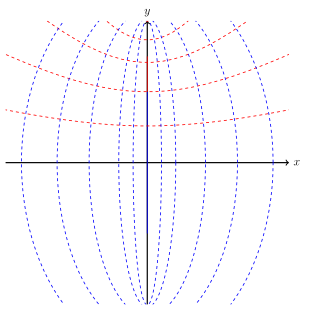
- The equation \(x^2 + y^2 = 2ax\) defines a \emph{family} of curves in the first quadrant, one curve for each positive value of \(a\). A second family of curves in the first quadrant is defined by the equation \(x^2 + y^2 = 2by\), where \(b > 0\).
- Differentiate the equation \(x^2 + y^2 = 2ax\) implicitly with respect to \(x\), and hence show that every curve in the first family satisfies the differential equation \[2xy\frac{\mathrm{d}y}{\mathrm{d}x} = y^2 - x^2.\] Find similarly a differential equation, independent of \(b\), for the second family of curves.
- Hence, or otherwise, show that, at every point with \(y \neq x\) where a curve in the first family meets a curve in the second family, the tangents to the two curves are perpendicular. A curve in the first family meets a curve in the second family at \((c,\,c)\), where \(c > 0\). Find the equations of the tangents to the two curves at this point. Is it true that where a curve in the first family meets a curve in the second family on the line \(y = x\), the tangents to the two curves are perpendicular?
- Given the family of curves in the first quadrant \(y = c\ln x\), where \(c\) takes any non-zero value, find, by solving an appropriate differential equation, a second family of curves with the property that at every point where a curve in the first family meets a curve in the second family, the tangents to the two curves are perpendicular.
- A family of curves in the first quadrant is defined by the equation \(y^2 = 4k(x + k)\), where \(k\) takes any non-zero value. Show that, at every point where one curve in this family meets a second curve in the family, the tangents to the two curves are perpendicular.
2017 Paper 3 Q5
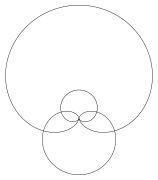
The point with cartesian coordinates \((x,y)\) lies on a curve with polar equation \(r=\f(\theta)\,\). Find an expression for \(\dfrac{\d y}{\d x}\) in terms of \(\f(\theta)\), \(\f'(\theta)\) and \(\tan\theta\,\). Two curves, with polar equations \(r=\f(\theta)\) and \(r=\g(\theta)\), meet at right angles. Show that where they meet \[ \f'(\theta) \g'(\theta) +\f(\theta)\g(\theta) = 0 \,. \] The curve \(C\) has polar equation \(r=\f(\theta)\) and passes through the point given by \(r=4\), \(\theta = - \frac12\pi\). For each positive value of \(a\), the curve with polar equation \(r= a(1+\sin\theta)\) meets~\(C\) at right angles. Find \(\f(\theta)\,\). Sketch on a single diagram the three curves with polar equations \(r= 1+\sin\theta\,\), \ \(r= 4(1+\sin\theta)\) and \(r=\f(\theta)\,\).
Solution: \((x, y) = (f(\theta)\cos(\theta), f(\theta)\sin(\theta))\) so \begin{align*} \frac{dy}{d\theta} &= -f(\theta)\sin(\theta) + f'(\theta)\cos(\theta) \\ \frac{dx}{d\theta} &= f(\theta)\cos(\theta) + f'(\theta)\sin(\theta) \\ \frac{dy}{dx} &= \frac{-f(\theta)\sin(\theta) + f'(\theta)\cos(\theta)}{f(\theta)\cos(\theta) + f'(\theta)\sin(\theta) } \\ &= \frac{-f(\theta)\tan(\theta) + f'(\theta)}{f(\theta) + f'(\theta)\tan(\theta) } \end{align*} If the curves meet at right angles then the product of their gradients is \(-1\), ie \begin{align*} \frac{-f(\theta)\tan(\theta) + f'(\theta)}{f(\theta) + f'(\theta)\tan(\theta) } \cdot \frac{-g(\theta)\tan(\theta) + g'(\theta)}{g(\theta) + g'(\theta)\tan(\theta) } &= -1 \\ f(\theta)g(\theta)\tan^2 \theta - f(\theta)g'(\theta)\tan \theta - f'(\theta)g(\theta)\tan \theta + f'(\theta)g'(\theta) &= \\ \quad - \l f(\theta)g(\theta) + f(\theta)g'(\theta)\tan(\theta) + f'(\theta)g(\theta)\tan(\theta) + f'(\theta)g'(\theta)\tan^2 \theta \r \\ \tan^2\theta \l f(\theta)g(\theta) + f'(\theta)g'(\theta) \r + f'(\theta)g'(\theta) + f(\theta)g(\theta) &= 0 \\ (\tan^2\theta + 1) \l f(\theta)g(\theta) + f'(\theta)g'(\theta) \r &= 0 \\ f(\theta)g(\theta) + f'(\theta)g'(\theta) &= 0 \end{align*} \(g(\theta) = a(1+\sin\theta), g'(\theta) = a\cos\theta\) Therefore \(f'(\theta)a\cos \theta+f(\theta)a(1+\sin(\theta)) = 0\) \begin{align*} && \frac{f'(\theta)}{f(\theta)} &= -\sec(\theta) - \tan(\theta) \\ \Rightarrow && \ln(f(\theta)) &= -\ln |\tan(\theta) + \sec(\theta)| + \ln |\cos(\theta)| + C \\ \Rightarrow && f(\theta) &= A \frac{\cos \theta}{\tan \theta + \sec \theta} \\ &&&= A \frac{\cos^2 \theta}{\sin \theta + 1} \\ &&&= A \frac{1-\sin^2 \theta}{\sin \theta + 1} \\ &&&= A (1-\sin \theta) \end{align*} When \(\theta = -\frac12 \pi, r = 4\), so \(A = 2\).
1989 Paper 2 Q3
The real numbers \(x\) and \(y\) are related to the real numbers \(u\) and \(v\) by \[ 2(u+\mathrm{i}v)=\mathrm{e}^{x+\mathrm{i}y}-\mathrm{e}^{-x-\mathrm{i}y}. \] Show that the line in the \(x\)-\(y\) plane given by \(x=a\), where \(a\) is a positive constant, corresponds to the ellipse \[ \left(\frac{u}{\sinh a}\right)^{2}+\left(\frac{v}{\cosh a}\right)^{2}=1 \] in the \(u\)-\(v\) plane. Show also that the line given by \(y=b\), where \(b\) is a constant and \(0<\sin b<1,\) corresponds to one branch of a hyperbola in the \(u\)-\(v\) plane. Write down the \(u\) and \(v\) coordinates of one point of intersection of the ellipse and hyperbola branch, and show that the curves intersect at right-angles at this point. Make a sketch of the \(u\)-\(v\) plane showing the ellipse, the hyperbola branch and the line segments corresponding to:
- \(x=0\);
- \(y=\frac{1}{2}\pi,\) \(\quad 0\leqslant x\leqslant a.\)
Solution: \begin{align*} && 2(u+iv) &= e^{a+iy} - e^{-a-iy} \\ && &=(e^a \cos y - e^{-a} \cos y) + (e^a \sin y + e^{-a} \sin y)i \\ &&&= 2 \sinh a \cos y + 2\cosh a \sin y i\\ \Rightarrow && \frac{u}{\sinh a} &= \cos y \\ && \frac{v}{\cosh a} &= \sin y \\ \Rightarrow && 1 &= \left(\frac{u}{\sinh a}\right)^{2}+\left(\frac{v}{\cosh a}\right)^{2} \end{align*} \begin{align*} && 2(u+iv) &= e^{x+ib} - e^{-x-ib} \\ &&&= 2\sinh x \cos b + 2\cosh x \sin b i \\ \Rightarrow && \frac{u}{\cos b} &= \sinh x \\ && \frac{v}{\sin b} &= \cosh x \\ \Rightarrow && 1 &= \left (\frac{v}{\sin b} \right)^2 - \left (\frac{u}{\cos b} \right)^2 \end{align*} Therefore all the points lie of a hyperbola, and since \(\frac{v}{\sin b} > 0 \Rightarrow v > 0\) it's one branch of the hyperbola. (And all points on it are reachable as \(x\) varies from \(-\infty < x < \infty\). \begin{align*} 2(u+iv) &= e^{a+ib} - e^{-a-ib} \\ &= 2 \sinh a \cos b + 2 \cosh a \sin b i \end{align*} so we can take \(u = \sinh a \cos b, v = \cosh a \sin b\). \begin{align*} \frac{\d }{\d u} && 0 &= \frac{2 u}{\sinh^2 a} + \frac{2v}{\cosh^2 a} \frac{\d v}{\d u} \\ \Rightarrow && \frac{\d v}{\d u} &= -\frac{u}{v} \coth^2 a \\ \\ && \frac{\d v}{\d u} \rvert_{(u,v)} &= -\frac{\sinh a \cos b}{\cosh a \sin b} \coth^2 a \\ &&&= -\cot b \coth a \\ \frac{\d }{\d u} && 0 &= \frac{2 v}{\sin^2 b} \frac{\d v}{\d u} - \frac{2u}{\cos^2 b} \\ \Rightarrow && \frac{\d v}{\d u} &= \frac{u}{v} \tan^2 b \\ && \frac{\d v}{\d u} \rvert_{(u,v)} &= \frac{\sinh a \cos b}{\cosh a \sin b} \tan^2 b \\ &&&= \tanh a \tan b \end{align*} Therefore they are negative reciprocals and hence perpendicular.