Problems
Filters
22 problems found
2025 Paper 3 Q11
- Let \(\lambda > 0\). The independent random variables \(X_1, X_2, \ldots, X_n\) all have probability density function $$f(t) = \begin{cases} \lambda e^{-\lambda t} & t \geq 0 \\ 0 & t < 0 \end{cases}$$ and cumulative distribution function \(F(x)\). The value of random variable \(Y\) is the largest of the values \(X_1, X_2, \ldots, X_n\). Show that the cumulative distribution function of \(Y\) is given, for \(y \geq 0\), by $$G(y) = (1 - e^{-\lambda y})^n$$
- The values \(L(\alpha)\) and \(U(\alpha)\), where \(0 < \alpha \leq \frac{1}{2}\), are such that $$P(Y < L(\alpha)) = \alpha \text{ and } P(Y > U(\alpha)) = \alpha$$ Show that $$L(\alpha) = -\frac{1}{\lambda}\ln(1 - \alpha^{1/n})$$ and write down a similar expression for \(U(\alpha)\).
- Use the approximation \(e^t \approx 1 + t\), for \(|t|\) small, to show that, for sufficiently large \(n\), $$\lambda L(\alpha) \approx \ln(n) - \ln\left(\ln\left(\frac{1}{\alpha}\right)\right)$$
- Hence show that the median of \(Y\) tends to infinity as \(n\) increases, but that the width of the interval \(U(\alpha) - L(\alpha)\) tends to a value which is independent of \(n\).
- You are given that, for \(|t|\) small, \(\ln(1 + t) \approx t\) and that \(e^3 \approx 20\). Show that, for sufficiently large \(n\), there is an interval of width approximately \(4\lambda^{-1}\) in which \(Y\) lies with probability \(0.9\).
Solution:
- Note that \(\displaystyle F(y) = \mathbb{P}(X_i < y) = \int_0^y \lambda e^{-\lambda t} \d t = 1-e^{-\lambda y}\). Notice also that \begin{align*} G(y) &= \mathbb{P}(Y < y) \\ &= \mathbb{P}(\max_i(X_i) < y) \\ &= \mathbb{P}(X_i < y \text{ for all }i) \\ &= \prod_{i=1}^n \mathbb{P}(X_i < y) \\ &= \prod_{i=1}^n (1-e^{-\lambda y})\\ &= (1-e^{-\lambda y})^n \end{align*} as required.
- \begin{align*} && \mathbb{P}(Y < L(\alpha)) &= \alpha \\ \Rightarrow && (1-e^{-\lambda L(\alpha)})^n &= \alpha \\ \Rightarrow && 1-e^{-\lambda L(\alpha)} &= \alpha^{\tfrac1n} \\ \Rightarrow && L(\alpha) &= -\frac{1}{\lambda}\ln \left (1-\alpha^{\tfrac1n} \right) \end{align*} Notice also: \begin{align*} && \mathbb{P}(Y > U(\alpha)) &= \alpha \\ \Rightarrow && 1 - (1-e^{-\lambda U(\alpha)})^n &= \alpha \\ \Rightarrow && U(\alpha) &= -\frac{1}{\lambda}\ln \left ( 1-(1-\alpha)^{\tfrac1n} \right) \end{align*}
- \begin{align*} \lambda L(\alpha) &= -\ln \left (1-\alpha^{\tfrac1n} \right) \\ &= -\ln \left (1-e^{\tfrac1n \ln \alpha} \right) \\ &\approx - \ln \left ( 1 - 1 - \frac1n \ln \alpha\right) \tag{\(e^t \approx 1 + t\)} \\ &= -\ln \left ( \frac{1}{n} \ln \frac{1}\alpha \right) \\ &= - \ln \frac{1}{n} - \ln \left ( \ln \frac{1}{\alpha} \right )\\ &= \ln n - \ln \left ( \ln \left ( \frac{1}{\alpha} \right ) \right) \end{align*} since if \(n\) is large, \(\frac{\ln \alpha}{n}\) is small.
- The median is the value where \(\mathbb{P}(Y < M) = \frac12\), or in other words \(L(\frac12)\), but this is \(\approx \frac{\ln n - \ln (\ln 2)}{\lambda} \to \infty\). \begin{align*} && \lambda U(\alpha) &\approx \ln n - \ln \left ( \ln \left ( \frac{1}{1-\alpha} \right ) \right) \\ \Rightarrow && \lambda(U(\alpha) - L(\alpha)) &\approx -\ln \left ( \ln \left ( \frac{1}{1-\alpha} \right ) \right)+ \ln \left ( \ln \left ( \frac{1}{\alpha} \right ) \right) \\ \Rightarrow && U(\alpha) - L(\alpha) &\to \frac{1}{\lambda} \left ( \ln \left ( \ln \left ( \frac{1}{\alpha} \right ) \right)-\ln \left ( \ln \left ( \frac{1}{1-\alpha} \right ) \right ) \right) \end{align*} which doesn't depend on \(n\).
- Suppose \(\alpha = \frac{1}{20}\) then \begin{align*} U(\alpha) - L(\alpha) &\approx \frac{1}{\lambda} \left (\ln \ln 20 - \ln \ln \frac{20}{19} \right) \\ &= \lambda^{-1} \left (\ln \ln 20 - \ln \ln (1 + \frac{1}{19}) \right) \\ &\approx \lambda^{-1} \left (\ln 3 - \ln \frac{1}{19} \right) \tag{\(\ln(1+t) \approx t\)} \\ &\approx \lambda^{-1} \ln 3 \cdot 19 \\ &\approx \lambda^{-1} (1 + 3) \\ &\approx 4\lambda^{-1} \end{align*} [Note that \(\ln \ln 20 - \ln \ln \frac{20}{19} = 4.0673\ldots\)]
2023 Paper 2 Q12
Each of the independent random variables \(X_1, X_2, \ldots, X_n\) has the probability density function \(\mathrm{f}(x) = \frac{1}{2}\sin x\) for \(0 \leqslant x \leqslant \pi\) (and zero otherwise). Let \(Y\) be the random variable whose value is the maximum of the values of \(X_1, X_2, \ldots, X_n\).
- Explain why \(\mathrm{P}(Y \leqslant t) = \big[\mathrm{P}(X_1 \leqslant t)\big]^n\) and hence, or otherwise, find the probability density function of \(Y\).
- Find an expression for \(m(n)\) in terms of \(n\). How does \(m(n)\) change as \(n\) increases?
- Show that
\[\mu(n) = \pi - \frac{1}{2^n}\int_0^{\pi} (1-\cos x)^n\,\mathrm{d}x\,.\]
- Show that \(\mu(n)\) increases with \(n\).
- Show that \(\mu(2) < m(2)\).
2020 Paper 3 Q12
\(A\) and \(B\) both toss the same biased coin. The probability that the coin shows heads is \(p\), where \(0 < p < 1\), and the probability that it shows tails is \(q = 1 - p\). Let \(X\) be the number of times \(A\) tosses the coin until it shows heads. Let \(Y\) be the number of times \(B\) tosses the coin until it shows heads.
- The random variable \(S\) is defined by \(S = X + Y\) and the random variable \(T\) is the maximum of \(X\) and \(Y\). Find an expression for \(\mathrm{P}(S = s)\) and show that \[ \mathrm{P}(T = t) = pq^{t-1}(2 - q^{t-1} - q^t). \]
- The random variable \(U\) is defined by \(U = |X - Y|\), and the random variable \(W\) is the minimum of \(X\) and \(Y\). Find expressions for \(\mathrm{P}(U = u)\) and \(\mathrm{P}(W = w)\).
- Show that \(\mathrm{P}(S = 2 \text{ and } T = 3) \neq \mathrm{P}(S = 2) \times \mathrm{P}(T = 3)\).
- Show that \(U\) and \(W\) are independent, and show that no other pair of the four variables \(S\), \(T\), \(U\) and \(W\) are independent.
2018 Paper 3 Q12
A random process generates, independently, \(n\) numbers each of which is drawn from a uniform (rectangular) distribution on the interval 0 to 1. The random variable \(Y_k\) is defined to be the \(k\)th smallest number (so there are \(k-1\) smaller numbers).
- Show that, for \(0\le y\le1\,\), \[ {\rm P}\big(Y_k\le y) =\sum^{n}_{m=k}\binom{n}{m}y^{m}\left(1-y\right)^{n-m} . \tag{\(*\)} \]
- Show that \[ m\binom n m = n \binom {n-1}{m-1} \] and obtain a similar expression for \(\displaystyle (n-m) \, \binom n m\,\). Starting from \((*)\), show that the probability density function of \(Y_k\) is \[ n\binom{ n-1}{k-1} y^{k-1}\left(1-y\right)^{ n-k} \,.\] Deduce an expression for \(\displaystyle \int_0^1 y^{k-1}(1-y)^{n-k} \, \d y \,\).
- Find \(\E(Y_k) \) in terms of \(n\) and \(k\).
Solution:
- \begin{align*} && \mathbb{P}(Y_k \leq y) &= \sum_{j=k}^n\mathbb{P}(\text{exactly }j \text{ values less than }y) \\ &&&= \sum_{j=k}^m \binom{m}{j} y^j(1-y)^{n-j} \end{align*}
- This is the number of ways to choose a committee of \(m\) people with the chair from those \(m\) people. This can be done in two ways. First: choose the committee in \(\binom{n}{m}\) ways and choose the chair in \(m\) ways so \(m \binom{n}{m}\). Alternatively, choose the chain in \(n\) ways and choose the remaining \(m-1\) committee members in \(\binom{n-1}{m-1}\) ways. Therefore \(m \binom{n}{m} = n \binom{n-1}{m-1}\) \begin{align*} (n-m) \binom{n}{m} &= (n-m) \binom{n}{n-m} \\ &= n \binom{n-1}{n-m-1} \\ &= n \binom{n-1}{m} \end{align*} \begin{align*} f_{Y_k}(y) &= \frac{\d }{\d y} \l \sum^{n}_{m=k}\binom{n}{m}y^{m}\left(1-y\right)^{n-m} \r \\ &= \sum^{n}_{m=k} \l \binom{n}{m}my^{m-1}\left(1-y\right)^{n-m} -\binom{n}{m}(n-m)y^{m}\left(1-y\right)^{n-m-1} \r \\ &= \sum^{n}_{m=k} \l n \binom{n-1}{m-1}y^{m-1}\left(1-y\right)^{n-m} -n \binom{n-1}{m} y^{m}\left(1-y\right)^{n-m-1} \r \\ &= n\sum^{n}_{m=k} \binom{n-1}{m-1}y^{m-1}\left(1-y\right)^{n-m} -n\sum^{n+1}_{m=k+1} \binom{n-1}{m-1} y^{m-1}\left(1-y\right)^{n-m} \\ &= n \binom{n-1}{k-1} y^{k-1}(1-y)^{n-k} \end{align*} \begin{align*} &&1 &= \int_0^1 f_{Y_k}(y) \d y \\ &&&= \int_0^1 n \binom{n-1}{k-1} y^{k-1}(1-y)^{n-k} \d y \\ &&&= n \binom{n-1}{k-1} \int_0^1 y^{k-1}(1-y)^{n-k} \d y \\ \Rightarrow && \frac{1}{n \binom{n-1}{k-1}} &= \int_0^1 y^{k-1}(1-y)^{n-k} \d y \\ \end{align*}
- \begin{align*} && \mathbb{E}(Y_k) &= \int_0^1 y f_{Y_k}(y) \d y \\ &&&= \int_0^1 n \binom{n-1}{k-1} y^{k}(1-y)^{n-k} \\ &&&= n \binom{n-1}{k-1}\int_0^1 y^{k}(1-y)^{n-k} \d y \\ &&&= n \binom{n-1}{k-1}\int_0^1 y^{k+1-1}(1-y)^{n+1-(k+1)} \d y \\ &&&= n \binom{n-1}{k-1} \frac{1}{(n+1) \binom{n}{k}}\\ &&&= \frac{n}{n+1} \cdot \frac{k}{n} \\ &&&= \frac{k}{n+1} \end{align*}
2016 Paper 1 Q13
An internet tester sends \(n\) e-mails simultaneously at time \(t=0\). Their arrival times at their destinations are independent random variables each having probability density function \(\lambda \e^{-\lambda t}\) (\(0\le t<\infty\), \( \lambda >0\)).
- The random variable \(T\) is the time of arrival of the e-mail that arrives first at its destination. Show that the probability density function of \(T\) is \[ n \lambda \e^{-n\lambda t}\,,\] and find the expected value of \(T\).
- Write down the probability that the second e-mail to arrive at its destination arrives later than time \(t\) and hence derive the density function for the time of arrival of the second e-mail. Show that the expected time of arrival of the second e-mail is \[ \frac{1}{\lambda} \left( \frac1{n-1} + \frac 1 n \right) \]
Solution:
- \(\,\) \begin{align*} && \mathbb{P}(T > t) &= \mathbb{P}(\text{all emails slower than }t) \\ &&&= \left ( \int_t^{\infty} \lambda e^{-\lambda x} \d x \right)^n \\ &&&= \left ( [- e^{-\lambda x}]_t^\infty\right)^n\\ &&&= e^{-n\lambda t} \\ \Rightarrow && f_T(t) &= n \lambda e^{-n\lambda t} \\ \end{align*} Therefore \(T \sim \text{Exp}(n \lambda)\) and \(\E[T] = \frac{1}{n \lambda}\)
- Let \(T_2\) be the time until the second email arrives, then. \begin{align*} && \P(T_2 > t) &= \P(\text{all emails} > t) + \P(\text{all but 1 emails} > t) \\ &&&= e^{-n\lambda t} + n \cdot e^{-(n-1)\lambda t}(1-e^{-\lambda t}) \\ &&&= (1-n)e^{-n\lambda t} + n \cdot e^{-(n-1)\lambda t} \\ \Rightarrow && f_{T_2}(t) &= - \left ( (1-n) n \lambda e^{-n \lambda t} -n(n-1)\lambda e^{-(n-1)\lambda t} \right) \\ &&&= n(n-1) \lambda \left (e^{-(n-1)\lambda t} - e^{-n\lambda t} \right) \\ \Rightarrow && \E[T_2] &= \int_0^{\infty} t \cdot n(n-1) \lambda \left (e^{-(n-1)\lambda t} - e^{-n\lambda t} \right) \d t \\ &&&= \int_0^{\infty} \left (n \cdot t (n-1) \lambda e^{-(n-1)\lambda t} -(n-1)\cdot tn \lambda e^{-n\lambda t} \right) \d t \\ &&&= \frac{n}{\lambda(n-1)} - \frac{n-1}{\lambda n} \\ &&&= \frac{1}{\lambda} \left (1+\frac{1}{n-1}- \left (1 - \frac{1}{n} \right) \right) \\ &&&= \frac{1}{\lambda} \left ( \frac{1}{n-1} + \frac{1}{n} \right) \end{align*} (We can also view this second expectation as expected time for first email + expected time (of the remaining \(n-1\) emails) for the first email, and we can see that will have that form by the memorilessness property of exponentials)
2008 Paper 1 Q12
In this question, you may use without proof the results: \[ \sum_{r=1}^n r = \tfrac12 n(n+1) \qquad\text{and}\qquad \sum_{r=1}^n r^2 = \tfrac1 6 n(n+1)(2n+1)\,. \] The independent random variables \(X_1\) and \(X_2\) each take values \(1\), \(2\), \(\ldots\), \(N\), each value being equally likely. The random variable \(X\) is defined by \[ X= \begin{cases} X_1 & \text { if } X_1\ge X_2\\ X_2 & \text { if } X_2\ge X_1\;. \end{cases} \]
- Show that \(\P(X=r) = \dfrac{2r-1}{N^2}\,\) for \(r=1\), \(2\), \(\ldots\), \(N\).
- Find an expression for the expectation, \(\mu\), of \(X\) and show that \(\mu=67.165\) in the case \(N=100\).
- The median, \(m\), of \(X\) is defined to be the integer such that \(\P(X\ge m) \ge \frac 12\) and \(\P(X\le m)\ge \frac12\). Find an expression for \(m\) in terms of \(N\) and give an explicit value for \(m\) in the case \(N=100\).
- Show that when \(N\) is very large, \[ \frac \mu m \approx \frac {2\sqrt2}3\,. \]
Solution: \begin{align*} \P(X = r) &= \P(X_1 = r, X_2 \leq r) + \P(X_2 = r, X_1 < r) \\ &= \P(X_1 = r) \P(X_2 \leq r) + \P(X_2 = r)\P( X_1 < r) \\ &= \frac{1}{N} \frac{r}{N} + \frac{1}{N} \frac{r-1}{N} \\ &= \frac{2r-1}{N^2} \end{align*} \begin{align*} \E(X) &= \sum_{r=1}^N r \P(X = r) \\ &= \sum_{r=1}^N \frac{2r^2 - r}{N^2} \\ &= \frac{1}{N^2} \l \frac{N(N+1)(2N+1)}{3} - \frac{N(N+1)}{2} \r \\ &= \frac{N+1}{N} \l \frac{4N-1}{6} \r \end{align*} When \(N = 100\), this is equal to \(\frac{101 \cdot 399}{6 \cdot 100} = \frac{101 \cdot 133}{200} = 67.165\) \begin{align*} &&\frac12 &\leq \P(X \leq m) \\ &&&=\sum_{r=1}^m \P(X=r) \\ &&&=\sum_{r=1}^m \frac{2r-1}{N^2} \\ &&&= \frac{1}{N^2} \l m(m+1) - m \r \\ &&&= \frac{m^2}{N^2} \\ \Rightarrow && m^2 &\geq \frac{N^2}{2} \\ \Rightarrow && m &\geq \frac{N}{\sqrt{2}} \\ \Rightarrow && m &= \left \lceil \frac{N}{\sqrt{2}} \right \rceil \end{align*} When \(N = 100\), \(100/\sqrt{2} = \sqrt{2}50\). \(\sqrt{2} > 1.4 \Rightarrow 50\sqrt{2} > 70\) \(\sqrt{2} < 1.42 \Rightarrow 50 \sqrt{2} < 71\), therefore \(\displaystyle \left \lceil \frac{100}{\sqrt{2}} \right \rceil = 71\) \begin{align*} \lim_{N \to \infty} \frac{\frac{(N+1)(4N-1)}{6N}}{ \left \lceil\frac{N}{\sqrt{2}} \right \rceil} &= \lim_{N \to \infty} \frac{\sqrt{2}}{3}\l \frac{4N^2 +3N - 1}{2N^2} \r \tag{since the floor will be irrelevant}\\ &= \lim_{N \to \infty} \frac{\sqrt{2}}{3}\l 2 + \frac{3}{2N} - \frac{1}{N^2} \r \\ &= \lim_{N \to \infty} \frac{2\sqrt{2}}{3} \end{align*}
2007 Paper 3 Q14
- My favourite dartboard is a disc of unit radius and centre \(O\). I never miss the board, and the probability of my hitting any given area of the dartboard is proportional to the area. Each throw is independent of any other throw. I throw a dart \(n\) times (where \(n>1\)). Find the expected area of the smallest circle, with centre \(O\), that encloses all the \(n\) holes made by my dart. Find also the expected area of the smallest circle, with centre \(O\), that encloses all the \((n-1)\) holes nearest to \(O\).
- My other dartboard is a square of side 2 units, with centre \(Q\). I never miss the board, and the probability of my hitting any given area of the dartboard is proportional to the area. Each throw is independent of any other throw. I throw a dart \(n\) times (where \(n>1\)). Find the expected area of the smallest square, with centre \(Q\), that encloses all the \(n\) holes made by my dart.
- Determine, without detailed calculations, whether the expected area of the smallest circle, with centre \(Q\), on my square dartboard that encloses all the \(n\) holes made by my darts is larger or smaller than that for my circular dartboard.
Solution:
- Firstly, we consider the probability that all darts lie within a distance \(s\) from the centre, ie \begin{align*} \mathbb{P}(\text{all darts within }s) &= \prod_{k=1}^s \mathbb{P}(\text{dart within }s) \\ &= \left ( \frac{\pi s^2}{\pi} \right)^n \\ &= s^{2n} \end{align*} Therefore the pdf is \(2ns^{2n-1}\), and the expected area is \(\int_{s=0}^1 \pi s^2 \cdot 2n s^{2n-1} \d s = 2n \pi \frac{1}{2n+2} = \frac{n}{n+1} \pi\). \begin{align*} \mathbb{P}(\text{n-1 within }s) &= \underbrace{s^{2n}}_{\text{all within }s} + \underbrace{ns^{2n-2}(1-s^2)}_{\text{all but 1 within }s}\\ &= ns^{2n-2}-(n-1)s^{2n} \end{align*} Therefore the pdf is \(n(2n-2)s^{2n-3} - 2n(n-1)s^{2n-1} = 2n(n-1)(s^{2n-3}-s^{2n-1})\) and the expected area is: \begin{align*} \int \pi s^2 \cdot2n(n-1)(s^{2n-3}-s^{2n-1})\d s &= 2n(n-1) \pi \left ( \frac{1}{2n} - \frac{1}{2n+2} \right) \\ &= n(n-1)\pi \frac{2}{n(n+1)} \\ &= \frac{n-1}{n+1} \pi \end{align*}
- Now consider a square of side-length \(s\), we must have \(\mathbb{P}(\text{all darts within square}) = \left ( \frac{s^2}{4} \right)^n\) and therefore the pdf is \(n \frac{s^{n-1}}{4^n}\). Therefore the expected area is \(\displaystyle \int_0^2 s^2 \cdot n \frac{s^{n-1}}{4^n} \d s = \frac{n}{n+1} \frac{2^{2n+1}}{2^{2n}} = \frac{4n}{n+1}\)
- It is clearly larger as the square dartboard contains all of the circular dartboard, and there will be some probability that the darts land outside the circular dartboard, making the circle much larger.
2004 Paper 1 Q13
- Three real numbers are drawn independently from the continuous rectangular distribution on \([ 0, 1 ]\,\). The random variable \(X\) is the maximum of the three numbers. Show that the probability that \(X \le 0.8\) is \(0.512\,\), and calculate the expectation of \(X\).
- \(N\) real numbers are drawn independently from a continuous rectangular distribution on \([ 0, a ]\,\). The random variable \(X\) is the maximum of the \(N\) numbers. A hypothesis test with a significance level of 5\% is carried out using the value, \(x\), of \(X \). The null hypothesis is that \(a=1\) and the alternative hypothesis is that \(a<1 \,\). The form of the test is such that \(H_0\) is rejected if \(x < c\,\), for some chosen number \(c\,\). Using the approximation \(2^{10} \approx 10^3\,\), determine the smallest integer value of \(N\) such that if \(x \le 0.8\) the null hypothesis will be rejected. With this value of \(N\), write down the probability that the null hypothesis is rejected if \(a = 0.8\,\), and find the probability that the null hypothesis is rejected if \(a = 0.9\,\).
Solution: \begin{align*} \P(X \leq 0.8) &= \P(X_1 \leq 0.8,X_2 \leq 0.8,X_3 \leq 0.8) \\ &= 0.8^3 \\ &= 0.512 \end{align*} \begin{align*} && \P(X < c) &= c^3 \\ \Rightarrow && f_X(x) &= 3x^2 \\ \Rightarrow && \E[X] &= \int_0^1 x \cdot (3x^2) \, dx \\ && &= \left [ \frac{3}{4}x^4 \right]_0^1 \\ &&&= \frac{3}{4} \end{align*} \(X\) is distributed the maximum of \(N\) numbers on \([0,a]\). \begin{align*} H_0 : & x= 1 \\ H_1 : & x < 1 \end{align*} \begin{align*} &&\P(X < c) &= c^N \\ &&&= \frac1{20} \\ \Rightarrow && N &= -\frac{\log(20)}{\log(c)} \end{align*} where \(c = 0.8\), we have \begin{align*} N &= \frac{\log(20)}{\log(5/4)} \\ &= \frac{\log(5)+\log(4)}{\log(5)-\log(4)} \\ &= \frac{ \frac{\log(5)}{\log(4)}+1}{\frac{\log(5)}{\log(4)} - 1} \end{align*} \begin{align*} && 2^{10} &\approx 10^{3} \\ && 10\log(2) &\approx 3 (\log(5) + \log(2)) \\ && 7\log(2) &\approx 3 \log(5) \\ && \frac{\log(5)}{2\log(2)} &\approx \frac{7}{6} \end{align*} \begin{align*} &= \frac{ \frac{\log(5)}{\log(4)}+1}{\frac{\log(5)}{\log(4)} - 1} &= \frac{\frac{7}{6} + 1}{\frac{7}{6} -1} \\ &= 13 \end{align*} Since \(2^{10} > 10^3\) then \(N=14\) is the value we seek. \(\P(X < 0.8 | a= 0.8) = 1\) \(\P(X < 0.8 | a= 0.9, N=14) = \frac{8^{14}}{9^{14}}\)
2001 Paper 2 Q13
The life times of a large batch of electric light bulbs are independently and identically distributed. The probability that the life time, \(T\) hours, of a given light bulb is greater than \(t\) hours is given by \[ \P(T>t) \; = \; \frac{1}{(1+kt)^\alpha}\;, \] where \(\alpha\) and \(k\) are constants, and \(\alpha >1\). Find the median \(M\) and the mean \(m\) of \(T\) in terms of \(\alpha\) and \(k\). Nine randomly selected bulbs are switched on simultaneously and are left until all have failed. The fifth failure occurs at 1000 hours and the mean life time of all the bulbs is found to be 2400 hours. Show that \(\alpha\approx2\) and find the approximate value of \(k\). Hence estimate the probability that, if a randomly selected bulb is found to last \(M\) hours, it will last a further \(m-M\) hours.
Solution: The median \(M\) is the value such that \begin{align*} && \frac12 &= \mathbb{P}(T > M) \\ &&&= \frac1{(1+kM)^\alpha} \\ \Rightarrow && 2 &= (1+kM)^{\alpha} \\ \Rightarrow && M &= \frac{2^{1/\alpha}-1}{k} \end{align*} The distribution of \(T\) is \(f_T(t) = \frac{k \alpha}{(1+kt)^{\alpha+1}}\) and so \begin{align*} && m &= \int_0^\infty t f_T(t) \d t \\ &&&= \int_0^\infty \frac{tk \alpha}{(1+kt)^{\alpha+1}} \d t \\ &&&= \int_0^\infty \frac{\alpha+tk \alpha-\alpha}{(1+kt)^{\alpha+1}} \d t \\ &&&= \alpha \int_0^\infty (1+kt)^{-\alpha} \d t - \alpha \int_0^\infty (1+kt)^{-(\alpha+1)} \d t \\ &&&= \alpha \left [ -\frac1{k(\alpha-1)}(1+kt)^{-\alpha+1}\right]_0^\infty- \alpha \left [ -\frac1{k\alpha}(1+kt)^{-\alpha}\right]_0^\infty \\ &&&= \frac{\alpha}{k(\alpha-1)} - \frac{1}{k} \\ &&&= \frac{1}{k(\alpha-1)} \end{align*} \begin{align*} && \frac{2^{1/\alpha}-1}{k} &= 1000 \\ && \frac{1}{k(\alpha-1)} &= 2400 \\ \Rightarrow && \frac{\alpha-1}{2^{1/\alpha}-1} &\approx 2.4 \\ && \frac{2-1}{\sqrt2-1} &= \sqrt{2}+1 \approx 2.4 \\ \Rightarrow && \alpha &\approx 2 \\ && k &= \frac{1}{2400} \end{align*} \begin{align*} && \mathbb{P}(T > m | T > M) &= \frac{\mathbb{P}(T > m)}{\mathbb{P}(T > M)} \\ &&&= \frac{2}{(1+km)^{\alpha}} \\ &&&= \frac{2}{(1 + \frac{1}{\alpha-1})^\alpha} \\ &&&\approx \frac{2}{4} =\frac12 \end{align*}
2001 Paper 3 Q14
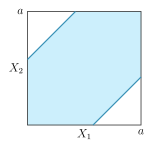
A random variable \(X\) is distributed uniformly on \([\, 0\, , \, a\,]\). Show that the variance of \(X\) is \({1 \over 12} a^2\). A sample, \(X_1\) and \(X_2\), of two independent values of the random variable is drawn, and the variance \(V\) of the sample is determined. Show that \(V = {1 \over 4} \l X_1 -X_2 \r ^2\), and hence prove that \(2 V\) is an unbiased estimator of the variance of X. Find an exact expression for the probability that the value of \(V\) is less than \({1 \over 12} a^2\) and estimate the value of this probability correct to one significant figure.
Solution: \begin{align*} && \E[X] &= \frac{a}{2}\tag{by symmetry} \\ &&\E[X^2] &= \int_0^a \frac{1}{a} x^2 \d x \\ &&&= \frac{a^3}{3a} = \frac{a^2}{3} \\ \Rightarrow && \var[X] &= \frac{a^2}{3} - \frac{a^2}{4} = \frac{a^2}{12} \\ \end{align*} \begin{align*} && V &=\frac{1}{2} \left ( \left ( X_1 - \frac{X_1+X_2}{2} \right )^2+\left ( X_2- \frac{X_1+X_2}{2} \right )^2 \right ) \\ &&&= \frac{1}{8} ((X_1 - X_2)^2 + (X_2 - X_1)^2 ) \\ &&&= \frac14 (X_1-X_2)^2 \\ \\ && \E[2V] &= \E \left [ \frac12 (X_1 - X_2)^2 \right] \\ &&&= \frac12 \E[X_1^2] - \E[X_1X_2] + \frac12 \E[X_2^2] \\ &&&= \frac{a^2}{3} - \frac{a^2}{4} = \frac{a^2}{12} \end{align*} Therefore \(2V\) is an unbiased estimator of the variance of \(X\).
2000 Paper 2 Q14
The random variables \(X_1\), \(X_2\), \(\ldots\) , \(X_{2n+1}\) are independently and uniformly distributed on the interval \(0 \le x \le 1\). The random variable \(Y\) is defined to be the median of \(X_1\), \(X_2\), \(\ldots\) , \(X_{2n+1}\). Given that the probability density function of \(Y\) is \(\g(y)\), where \[ \mathrm{g}(y)=\begin{cases} ky^{n}(1-y)^{n} & \mbox{ if }0\leqslant y\leqslant1\\ 0 & \mbox{ otherwise} \end{cases} \] use the result $$ \int_0^1 {y^{r}}{{(1-y)}^{s}}\,\d y = \frac{r!s!}{(r+s+1)!} $$ to show that \(k={(2n+1)!}/{{(n!)}^2}\), and evaluate \(\E(Y)\) and \({\rm Var}\,(Y)\). Hence show that, for any given positive number \(d\), the inequality $$ {\P\left({\vert {Y - 1/2} \vert} < {d/{\sqrt {n}}} \right)} < {\P\left({\vert {{\bar X} - 1/2} \vert} < {d/{\sqrt {n}}} \right)} $$ holds provided \(n\) is large enough, where \({\bar X}\) is the mean of \(X_1\), \(X_2\), \(\ldots\) , \(X_{2n+1}\). [You may assume that \(Y\) and \(\bar X\) are normally distributed for large \(n\).]
2000 Paper 3 Q13
A set of \(n\) dice is rolled repeatedly. For each die the probability of showing a six is \(p\). Show that the probability that the first of the dice to show a six does so on the \(r\)th roll is $$q^{n r } ( q^{-n} - 1 )$$ where \(q = 1 - p\). Determine, and simplify, an expression for the probability generating function for this distribution, in terms of \(q\) and \(n\). The first of the dice to show a six does so on the \(R\)th roll. Find the expected value of \(R\) and show that, in the case \(n = 2\), \(p=1/6\), this value is \(36/11\). Show that the probability that the last of the dice to show a six does so on the \(r\)th roll is \[ \big(1-q^r\big)^n-\big(1-q^{r-1}\big)^n. \] Find, for the case \(n = 2\), the probability generating function. The last of the dice to show a six does so on the \(S\)th roll. Find the expected value of \(S\) and evaluate this when \(p=1/6\).
1998 Paper 2 Q13
A random variable \(X\) has the probability density function \[ \mathrm{f}(x)=\begin{cases} \lambda\mathrm{e}^{-\lambda x} & x\geqslant0,\\ 0 & x<0. \end{cases} \] Show that $${\rm P}(X>s+t\,\vert X>t) = {\rm P}(X>s).$$ The time it takes an assistant to serve a customer in a certain shop is a random variable with the above distribution and the times for different customers are independent. If, when I enter the shop, the only two assistants are serving one customer each, what is the probability that these customers are both still being served at time \(t\) after I arrive? One of the assistants finishes serving his customer and immediately starts serving me. What is the probability that I am still being served when the other customer has finished being served?
Solution: \begin{align*} && \mathbb{P}(X > t) &= \int_t^{\infty} \lambda e^{-\lambda x} \d x\\ &&&= \left[ -e^{-\lambda x} \right]_t^\infty \\ &&&= e^{-\lambda t}\\ \\ && \mathbb{P}(X > s + t | X > t) &= \frac{\mathbb{P}(X > s + t)}{\mathbb{P}(X > t)} \\ &&&= \frac{e^{-(s+t)\lambda}}{e^{-t\lambda}} \\ &&&= e^{-s\lambda} = \mathbb{P}(X > s) \end{align*} The probability both are still being served (independently) is \(\mathbb{P}(X > t)^2 = e^{-2\lambda t}\). The probability is exactly \(\frac12\). The property we proved in the first part of the questions shows the distribution is memoryless, ie we are both experiencing samples from the same distribution. Therefore we are equally likely to finish first.
1998 Paper 3 Q14
A hostile naval power possesses a large, unknown number \(N\) of submarines. Interception of radio signals yields a small number \(n\) of their identification numbers \(X_i\) (\(i=1,2,...,n\)), which are taken to be independent and uniformly distributed over the continuous range from \(0\) to \(N\). Show that \(Z_1\) and \(Z_2\), defined by $$ Z_1 = {n+1\over n} {\max}\{X_1,X_2,...,X_n\} \hspace{0.3in} {\rm and} \hspace{0.3in} Z_2 = {2\over n} \sum_{i=1}^n X_i \;, $$ both have means equal to \(N\). Calculate the variance of \(Z_1\) and of \(Z_2\). Which estimator do you prefer, and why?
1996 Paper 1 Q12
An examiner has to assign a mark between 1 and \(m\) inclusive to each of \(n\) examination scripts (\(n\leqslant m\)). He does this randomly, but never assigns the same mark twice. If \(K\) is the highest mark that he assigns, explain why \[ \mathrm{P}(K=k)=\left.\binom{k-1}{n-1}\right/\binom{m}{n} \] for \(n\leqslant k\leqslant m,\) and deduce that \[ \sum_{k=n}^{m}\binom{k-1}{n-1}=\binom{m}{n}\,. \] Find the expected value of \(K\).
Solution: If the highest mark is \(k\), then there are \(n-1\) remaining marks to give, and they have to be chosen from the numbers \(1, 2, \ldots, k-1\), ie in \(\binom{k-1}{n-1}\) ways. There are \(n\) numbers to be chosen from \(1, 2, \ldots, m\) in total, therefore \(\displaystyle \mathbb{P}(K=k) = \left.\binom{k-1}{n-1} \right/ \binom{m}{n}\) Since \(K\) can take any of the values \(n, \cdots, m\), we must have \begin{align*} && 1 &= \sum_{k=n}^m \mathbb{P}(K=k) \\ &&&= \sum_{k=n}^m \left.\binom{k-1}{n-1} \right/ \binom{m}{n} \\ \Rightarrow && \binom{m}{n} &= \sum_{k=n}^m \binom{k-1}{n-1} \\ \\ && \mathbb{E}(K) &= \sum_{k=n}^m k \cdot \mathbb{P}(K=k) \\ &&&= \sum_{k=n}^m k \cdot \left.\binom{k-1}{n-1} \right/ \binom{m}{n} \\ &&&= n\binom{m}{n}^{-1} \sum_{k=n}^m \frac{k}{n} \cdot \binom{k-1}{n-1} \\ &&&= n\binom{m}{n}^{-1} \sum_{k=n}^m \binom{k}{n} \\ &&&= n\binom{m}{n}^{-1} \sum_{k=n+1}^{m+1} \binom{k-1}{n+1-1} \\ &&&= n\binom{m}{n}^{-1} \binom{m+1}{n+1} \\ &&&= n \cdot \frac{m+1}{n+1} \end{align*}