Problems
Filters
6 problems found
2024 Paper 3 Q9
The origin \(O\) of coordinates lies on a smooth horizontal table and the \(x\)- and \(y\)-axes lie in the plane of the table. A smooth sphere \(A\) of mass \(m\) and radius \(r\) is at rest on the table with its lowest point at the origin. A second smooth sphere \(B\) has the same mass and radius and also lies on the table. Its lowest point has \(y\)-coordinate \(2r\sin\alpha\), where \(\alpha\) is an acute angle, and large positive \(x\)-coordinate. Sphere \(B\) is now projected parallel to the \(x\)-axis, with speed \(u\), so that it strikes sphere \(A\). The coefficient of restitution in this collision is \(\frac{1}{3}\).
- Show that, after the collision, sphere \(B\) moves with velocity \[\begin{pmatrix} -\frac{1}{3}u\bigl(1 + 2\sin^2\alpha\bigr) \\ \frac{2}{3}u\sin\alpha\cos\alpha \end{pmatrix}.\]
- Show further that the lowest point of sphere \(B\) crosses the \(y\)-axis at the point \((0, Y)\), where \(Y = 2r(\cos\alpha\tan\beta + \sin\alpha)\) and \[\tan\beta = \frac{2\sin\alpha\cos\alpha}{1 + 2\sin^2\alpha}.\]
- Show that, if \(h > Y + 2r\sec\beta\), sphere \(B\) will not strike sphere \(C\) in its motion after the collision with sphere \(A\).
- Show that \(Y < 2r\sec\beta\). Hence show that sphere \(B\) will not strike sphere \(C\) for any value of \(\alpha\), if \(h > \dfrac{8r}{\sqrt{3}}\).
2019 Paper 3 Q10
Two identical smooth spheres \(P\) and \(Q\) can move on a smooth horizontal table. Initially, \(P\) moves with speed \(u\) and \(Q\) is at rest. Then \(P\) collides with \(Q\). The direction of travel of \(P\) before the collision makes an acute angle \(\alpha\) with the line joining the centres of \(P\) and \(Q\) at the moment of the collision. The coefficient of restitution between \(P\) and \(Q\) is \(e\) where \(e < 1\). As a result of the collision, \(P\) has speed \(v\) and \(Q\) has speed \(w\), and \(P\) is deflected through an angle \(\theta\).
- Show that $$u \sin \alpha = v \sin(\alpha + \theta)$$ and find an expression for \(w\) in terms of \(v\), \(\theta\) and \(\alpha\).
- Show further that $$\sin \theta = \cos(\theta + \alpha) \sin \alpha + e \sin(\theta + \alpha) \cos \alpha$$ and find an expression for \(\tan \theta\) in terms of \(\tan \alpha\) and \(e\). Find, in terms of \(e\), the maximum value of \(\tan \theta\) as \(\alpha\) varies.
Solution:
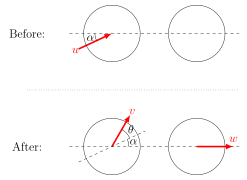
- Since the impulse is along the line of centres, the velocities are as show in the diagram. Additionally, vertical velocity is unchanged, so: \(v \sin (\theta + \alpha) = u \sin \alpha\) \begin{align*} \text{COM}(\rightarrow): && u \cos\alpha &= v \cos(\alpha + \theta) + w \\ \Rightarrow && w &= u \cos \alpha - v \cos (\alpha + \theta) \end{align*}
- Since the approach speed (horizontally) is \(u \cos \alpha\) the speed of separation is \(e u \cos \alpha\), in particular \(w - v \cos(\theta + \alpha) = e u \cos \alpha\) or \(w = v \cos (\theta + \alpha) + e u \cos \alpha\). \begin{align*} && w &= w \\ && v \cos (\theta + \alpha) + e u \cos \alpha &= u \cos \alpha - v \cos (\alpha + \theta) \\ \Rightarrow && \frac{u \sin \alpha}{\sin (\alpha + \theta)} \cos (\theta + \alpha) + e u \cos \alpha &= u \cos \alpha - \frac{u \sin \alpha}{\sin (\alpha + \theta)} \cos (\alpha + \theta) \\ \Rightarrow && \sin \alpha \cos(\theta + \alpha) + e \sin (\alpha+\theta)\cos \alpha &= \sin(\alpha+\theta) \cos \alpha - \cos(\alpha+\theta)\sin \alpha \\ &&&= \sin ((\alpha+\theta)-\alpha) \\ &&&= \sin \theta \end{align*} as required. \begin{align*} && \sin \theta &= \cos(\theta+ \alpha)\sin \alpha + e \sin (\theta + \alpha) \cos \alpha \\ &&&= \cos \theta \cos \alpha \sin \alpha - \sin \theta \sin^2 \alpha + e \sin \theta \cos ^2 \alpha + e \cos \theta \sin \alpha \cos \alpha \\ \Rightarrow && \tan \theta \sec^2 \alpha &= \tan \alpha - \tan \theta \tan^2 \alpha + e \tan \theta + e \tan \alpha \\ \Rightarrow && \tan \theta (1 + \tan^2 \alpha+\tan^2 \alpha-e) &= \tan \alpha + e \tan \alpha \\ \Rightarrow && \tan \theta &= \frac{(1+e)\tan \alpha}{1-e + 2\tan^2 \alpha} \end{align*} We seek to maximise \(y = \frac{x}{c+2x^2}\), \begin{align*} && \frac{\d y}{\d x} &= \frac{c+2x^2-4x^2}{(c+2x^2)^2} \\ &&&= \frac{c-2x^2}{(c+2x^2)^2} \end{align*} Therefore the maximum will occur at \(x = \sqrt{c/2}\), ie \(\tan \alpha = \sqrt{(1-e)/2}\) and theta will be \(\displaystyle \frac{(1+e)\sqrt{(1-e)/2}}{2(1-e)} =\frac{1}{2\sqrt{2}} \frac{1+e}{\sqrt{1-e}}\)
2002 Paper 1 Q11
\(\,\)
2000 Paper 3 Q9
Two small discs of masses \(m\) and \(\mu m\) lie on a smooth horizontal surface. The disc of mass \(\mu m\) is at rest, and the disc of mass \(m\) is projected towards it with velocity \(\mathbf{u}\). After the collision, the disc of mass \(\mu m\) moves in the direction given by unit vector \(\mathbf{n}\). The collision is perfectly elastic.
- Show that the speed of the disc of mass \(\mu m\) after the collision is \ \ $ \dfrac {2\mathbf{u} \cdot \mathbf{n}}{1+\mu}. $
- Given that the two discs have equal kinetic energy after the collision, find an expression for the cosine of the angle between \(\bf n\) and \(\bf u\) and show that \(3-\sqrt8\le \mu \le 3+\sqrt8\).
Solution:
- In the direction of \(\mathbf{n}\), Conservation of momentum gives: \(m \mathbf{u} \cdot \mathbf{n} = m v_m + \mu m v_{\mu m}\) Newton's experimental law gives: \(\frac{\mathbf{u} \cdot \mathbf{n}}{v_{\mu m} - v_m} = 1\) Therefore \begin{align*} && \mathbf{u} \cdot \mathbf{n} &= v_m + \mu v_{\mu m} \\ && \mathbf{u} \cdot \mathbf{n} &= v_{\mu m} - v_m \\ \Rightarrow && 2 \mathbf{u} \cdot \mathbf{n} &= (1 + \mu)v_{\mu m} \\ \Rightarrow && v_{\mu m} &= \frac{2 \mathbf{u} \cdot \mathbf{n}}{1 + \mu} \\ \end{align*}
- Kinetic energy after the collision for the second mass is: \(\frac12 m \mu \frac{4 (\mathbf{u} \cdot \mathbf{n})^2 }{(1 + \mu)^2}\) For the first mass the final speed (in the direction \(\mathbf{n}\) is: \(\mathbf{u} \cdot \mathbf{n}- \frac{2 \mathbf{u} \cdot \mathbf{n}}{1 + \mu} = \frac{(\mu - 1) \mathbf{u} \cdot \mathbf{n}}{1 + \mu}\) It's velocity perpendicular to \(\mathbf{n}\) is unchanged, which is \(\mathbf{u} - (\mathbf{u} \cdot \mathbf{n}) \mathbf{n}\), so it's speed squared is \(\mathbf{u}\cdot \mathbf{u} - (\mathbf{u} \cdot \mathbf{n})^2\) Therefore the total kinetic energy is: \(\frac12 m \frac{(\mu - 1)^2 (\mathbf{u} \cdot \mathbf{n})^2}{(1 + \mu)} + \frac12 m (\mathbf{u}\cdot \mathbf{u} - (\mathbf{u} \cdot \mathbf{n})^2)\) Therefore since the kinetic energies are equal we have: \begin{align*} && \frac12 m \frac{(\mu - 1)^2 (\mathbf{u} \cdot \mathbf{n})^2}{(1 + \mu)} + \frac12 m (\mathbf{u}\cdot \mathbf{u} - (\mathbf{u} \cdot \mathbf{n})^2) &= \frac12 m \mu \frac{4 (\mathbf{u} \cdot \mathbf{n})^2 }{(1 + \mu)^2} \\ \Rightarrow && \frac{(\mu - 1)^2 (\mathbf{u} \cdot \mathbf{n})^2}{(1 + \mu)} + (\mathbf{u}\cdot \mathbf{u} - (\mathbf{u} \cdot \mathbf{n})^2) &= \mu \frac{4 (\mathbf{u} \cdot \mathbf{n})^2 }{(1 + \mu)^2} \\ \Rightarrow && (\mathbf{u} \cdot \mathbf{n})^2 \l 1 + \frac{4\mu}{(1+ \mu)^2} - \frac{(1-\mu)^2}{(1+ \mu)^2} \r &= (\mathbf{u} \cdot \mathbf{u}) \\ \Rightarrow && (\mathbf{u} \cdot \mathbf{n})^2 \l \frac{(1 + \mu)^2 + 4\mu - (1-\mu)^2}{(1+ \mu)^2} \r &= (\mathbf{u} \cdot \mathbf{u}) \\ \Rightarrow && (\mathbf{u} \cdot \mathbf{n})^2 \l \frac{8\mu}{(1+ \mu)^2} \r &= (\mathbf{u} \cdot \mathbf{u}) \\ \Rightarrow && \cos^2 \theta &=\frac{(1 + \mu)^2}{8\mu} \\ \end{align*} We need \begin{align*} && \frac{(1 + \mu)^2}{8\mu} & \leq 1 \\ \Rightarrow && 1 +2 \mu + \mu^2 \leq 8 \mu \\ \Rightarrow && 1 - 6 \mu + \mu^2 \leq 0 \end{align*} This quadratic has roots at \(3 \pm \sqrt{8}\) and therefore our quadratic inequality is satisfied if: \(\boxed{3 - \sqrt{8} \leq \mu \leq 3 + \sqrt{8}}\)
1998 Paper 3 Q10
Two identical spherical balls, moving on a horizontal, smooth table, collide in such a way that both momentum and kinetic energy are conserved. Let \({\bf v}_1\) and \({\bf v}_2\) be the velocities of the balls before the collision and let \({\bf v}'_1\) and \({\bf v}'_2\) be the velocities of the balls after the collision, where \({\bf v}_1\), \({\bf v}_2\), \({\bf v}'_1\) and \({\bf v}'_2\) are two-dimensional vectors. Write down the equations for conservation of momentum and kinetic energy in terms of these vectors. Hence show that their relative speed is also conserved. Show that, if one ball is initially at rest but after the collision both balls are moving, their final velocities are perpendicular. Now suppose that one ball is initially at rest, and the second is moving with speed \(V\). After a collision in which they lose a proportion \(k\) of their original kinetic energy (\(0\le k\le 1\)), the direction of motion of the second ball has changed by an angle \(\theta\). Find a quadratic equation satisfied by the final speed of the second ball, with coefficients depending on \(k\), \(V\) and \(\theta\). Hence show that \(k\le \frac{1}{2}\).
Solution: \begin{align*} \text{COM}: && \mathbf{v}_1+\mathbf{v}_2 &= \mathbf{v}_1'+\mathbf{v}_2' \tag{1}\\ \text{COE}: && \mathbf{v}_1\cdot\mathbf{v}_1+\mathbf{v}_2\cdot\mathbf{v}_2 &= \mathbf{v}_1'\cdot\mathbf{v}_1'+\mathbf{v}_2'\cdot\mathbf{v}_2' \tag{2} \\ \\ (1): && (\mathbf{v}_1+\mathbf{v}_2 )\cdot(\mathbf{v}_1+\mathbf{v}_2 ) &= (\mathbf{v}_1'+\mathbf{v}_2' )\cdot(\mathbf{v}_1'+\mathbf{v}_2' ) \\ \Rightarrow && \mathbf{v}_1 \cdot \mathbf{v}_2 &= \mathbf{v}_1'\cdot \mathbf{v}_2' \\ && \text{Initial relative speed}^2 &= |\mathbf{v}_1 - \mathbf{v}_2|^2 \\ &&&= (\mathbf{v}_1 - \mathbf{v}_2) \cdot (\mathbf{v}_1 - \mathbf{v}_2) \\ &&&= \mathbf{v}_1\cdot \mathbf{v}_1 - 2 \mathbf{v}_1\cdot \mathbf{v}_2 + \mathbf{v}_2\cdot \mathbf{v}_2 \\ &&&= \mathbf{v}_1'\cdot\mathbf{v}_1'+\mathbf{v}_2'\cdot\mathbf{v}_2' -2 \mathbf{v}_1\cdot\mathbf{v}_2\\ &&&= \mathbf{v}_1'\cdot\mathbf{v}_1'+\mathbf{v}_2'\cdot\mathbf{v}_2' -2 \mathbf{v}_1'\cdot\mathbf{v}_2'\\ &&&= | \mathbf{v}_1'-\mathbf{v}_2'|^2 \\ &&&= \text{Final relative speed}^2 \end{align*} Since \(\mathbf{v}_1 \cdot 0 = 0\) we must have \(\mathbf{v}_1'\cdot\mathbf{v}_2' = \mathbf{v}_1\cdot0 = 0\) therefore their final velocities are perpendicular. We now must have \begin{align*} \text{COM}: && \mathbf{v}_1+\mathbf{v}_2 &= \mathbf{v}_1'+\mathbf{v}_2' \tag{3}\\ \Delta\text{E}: && (1-k)(\mathbf{v}_1\cdot\mathbf{v}_1+\mathbf{v}_2\cdot\mathbf{v}_2) &= \mathbf{v}_1'\cdot\mathbf{v}_1'+\mathbf{v}_2'\cdot\mathbf{v}_2' \tag{4} \\ \\ && 0 + \mathbf{v}_2 &= \mathbf{v}_1' + \mathbf{v}_2' \\ \Rightarrow && V^2 &= ( \mathbf{v}_1' + \mathbf{v}_2' ) \cdot ( \mathbf{v}_1' + \mathbf{v}_2' ) \\ &&&= \mathbf{v}_1'\cdot\mathbf{v}_1'+\mathbf{v}_2'\cdot\mathbf{v}_2' +2 \mathbf{v}_1'\cdot \mathbf{v}_2' \\ &&&= (1-k)V^2 + 2 (\mathbf{v}_2-\mathbf{v}_2') \cdot \mathbf{v}_2' \\ &&&= (1-k)V^2 + 2 \mathbf{v}_2 \cdot \mathbf{v}_2'-2\mathbf{v}_2'\cdot \mathbf{v}_2' \\ &&&= (1-k)V^2 + 2Vx \cos \theta - 2x^2 \\ \Rightarrow && 0 &= -kV^2 + 2Vx \cos \theta -2x^2 \\ \Delta \geq 0: && 0 &\leq 4V^2 \cos^2 \theta -8kV^2 \\ \Rightarrow && k &\leq \frac12\cos^2\theta \leq \frac12 \end{align*}
1988 Paper 3 Q12
A smooth billiard ball moving on a smooth horizontal table strikes another identical ball which is at rest. The coefficient of restitution between the balls is \(e(<1)\). Show that after the collision the angle between the velocities of the balls is less than \(\frac{1}{2}\pi.\) Show also that the maximum angle of deflection of the first ball is \[ \sin^{-1}\left(\frac{1+e}{3-e}\right). \]
Solution:
