Problems
Filters
13 problems found
2024 Paper 2 Q10
A triangular prism lies on a horizontal plane. One of the rectangular faces of the prism is vertical; the second is horizontal and in contact with the plane; the third, oblique rectangular face makes an angle \(\alpha\) with the horizontal. The two triangular faces of the prism are right angled triangles and are vertical. The prism has mass \(M\) and it can move without friction across the plane. A particle of mass \(m\) lies on the oblique surface of the prism. The contact between the particle and the plane is rough, with coefficient of friction \(\mu\).
- Show that if \(\mu < \tan\alpha\), then the system cannot be in equilibrium.
- Show that the magnitude, \(F\), of the frictional force between the particle and the prism is \[ F = \frac{m}{M+m}\left|(M+m)g\sin\alpha - P\cos\alpha\right|. \] Find a similar expression for the magnitude, \(N\), of the normal reaction between the particle and the prism.
- Hence show that the force \(P\) must satisfy \[ (M+m)g\tan(\alpha - \lambda) \leqslant P \leqslant (M+m)g\tan(\alpha + \lambda). \]
2023 Paper 2 Q9
A truck of mass \(M\) is connected by a light, rigid tow-bar, which is parallel to the ground, to a trailer of mass \(kM\). A constant driving force \(D\) which is parallel to the ground acts on the truck, and the only resistance to motion is a frictional force acting on the trailer, with coefficient of friction \(\mu\).
- When the truck pulls the trailer up a slope which makes an angle \(\alpha\) to the horizontal, the acceleration is \(a_1\) and there is a tension \(T_1\) in the tow-bar.
- When the truck pulls the trailer on horizontal ground, the acceleration is \(a_2\) and there is a tension \(T_2\) in the tow-bar.
- When the truck pulls the trailer down a slope which makes an angle \(\alpha\) to the horizontal, the acceleration is \(a_3\) and there is a tension \(T_3\) in the tow-bar.
- Show that \(T_1 = T_3\) and that \(M(a_1 + a_3 - 2a_2) = 2(T_2 - T_1)\).
- It is given that \(\mu < 1\).
- Show that \[a_2 < \tfrac{1}{2}(a_1 + a_3) < a_3\,.\]
- Show further that \[a_1 < a_2\,.\]
2018 Paper 1 Q10
A train is made up of two engines, each of mass \(M\), and \(n\) carriages, each of mass \(m\). One of the engines is at the front of the train, and the other is coupled between the \(k\)th and \((k+1)\)th carriages. When the train is accelerating along a straight, horizontal track, the resistance to the motion of each carriage is \(R\) and the driving force on each engine is \(D\), where \(2D >nR\,\). The tension in the coupling between the engine at the front and the first carriage is \(T\).
- Show that \[ T = \frac{n(mD+MR)}{nm+2M}\,. \]
- Show that \(T\) is greater than the tension in any other coupling provided that \(k> \frac12n\,\).
- Show also that, if \(k> \frac12n\,\), then at least one of the couplings is in compression (that is, there is a negative tension in the coupling).
Solution:
- \(\,\)
\begin{align*} \text{N2}(\leftarrow, \text{first engine}): && D-T &= Ma \\ \text{N2}(\leftarrow, \text{rest of train}): && T-nR+D &= (M+nm)a \\ \Rightarrow && \frac{D-T}{M} &= \frac{T+D-nR}{M+nm} \\ \Rightarrow && T \left ( \frac{1}{M+nm}+\frac{1}{M} \right) &= \frac{D}{M} + \frac{nR-D}{M+nm} \\ \Rightarrow && T \left ( 2M+nm\right) &= DM +Dnm + nRM - DM \\ &&&= n(mD+MR) \\ \Rightarrow && T &= \frac{n(mD+MR)}{2M+nm} \end{align*}
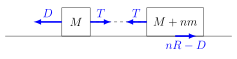
- The greatest coupling must occur behind an engine, because each carriage behind an engine acts as a drag.
Therefore we need only consider the couple between the second engine and the rest of the carriages:
\begin{align*} \text{N2}(\leftarrow, \text{up to second engine}): && 2D - T_2 - kR &= (2M+km)a \\ \text{N2}(\leftarrow, \text{everything else}): && T_2 - (n-k)R &= (n-k)ma \\ \Rightarrow && \frac{2D-T_2-kR}{2M+km} &= \frac{T_2-(n-k)R}{(n-k)m} \\ \Rightarrow && T_2 \left (\frac{1}{(n-k)m} + \frac{1}{2M+km} \right) &= \frac{2D-kR}{2M+km} + \frac{R}{m} \\ \Rightarrow && T_2 \left (2M+ nm \right) &= (2D-kR)m(n-k) + R(2M+km)(n-k) \\ \Rightarrow && T_2 &= \frac{(n-k)\left (2Dm+2RM \right)}{2M+nm} \\ &&&= \frac{2(n-k)(mD + MR)}{2M+nm} \end{align*} Therefore \(T > T_2\) provided \(2(n-k) < n \Leftrightarrow k > \frac12n\)
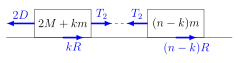
- If there is a coupling which is in negative tension, it must be between the two engines. In particular, if there is one, there must be one directly in front of the first engine.
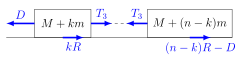
\begin{align*} \text{N2}(\leftarrow, \text{before second engine}): && D - T_3 - kR &= (M+km)a \\ \text{N2}(\leftarrow, \text{everything else}): && T_3 +D- (n-k)R &= (M+(n-k)m)a \\ \Rightarrow && \frac{D-T_3-kR}{M+km} &= \frac{T_3+D-(n-k)R}{M+(n-k)m} \\ \Rightarrow && T_3 \left ( \frac{1}{M+(n-k)m} + \frac{1}{M+km} \right) &= \frac{D-(n-k)R}{M+(n-k)m}+\frac{kR-D}{M+km} \\ \Rightarrow && T_3 (2M+nm) &= (D-(n-k)R)(M+km)+(kR-D)(M+(n-k)m) \\ &&&= D(M+km-M-(n-k)m) + R(kM+k(n-k)m-(n-k)M-k(n-k)m) \\ &&&= D(n-2k)m+RM(2k-n)m \\ &&&= (n-2k)m(D-RM) \end{align*} Therefore \(T_3\) is negative if \(k > \frac12n\) so there are some connections in compression.
2015 Paper 2 Q10
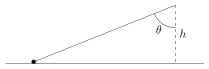
A particle of mass \(m\) is pulled along the floor of a room in a straight line by a light string which is pulled at constant speed \(V\) through a hole in the ceiling. The floor is smooth and horizontal, and the height of the room is \(h\). Find, in terms of \(V\) and \(\theta\), the speed of the particle when the string makes an angle of \(\theta\) with the vertical (and the particle is still in contact with the floor). Find also the acceleration, in terms of \(V\), \(h\) and \(\theta\). Find the tension in the string and hence show that the particle will leave the floor when \[ \tan^4\theta = \frac{V^2}{gh}\,. \]
Solution:
2014 Paper 2 Q11
A small smooth ring \(R\) of mass \(m\) is free to slide on a fixed smooth horizontal rail. A light inextensible string of length~\(L\) is attached to one end,~\(O\), of the rail. The string passes through the ring, and a particle~\(P\) of mass~\(km\) (where \(k>0\)) is attached to its other end; this part of the string hangs at an acute angle \(\alpha\) to the vertical and it is given that \(\alpha\) is constant in the motion. Let \(x\) be the distance between \(O\) and the ring. Taking the \(y\)-axis to be vertically upwards, write down the Cartesian coordinates of~\(P\) relative to~\(O\) in terms of \(x\), \(L\) and~\(\alpha\).
- By considering the vertical component of the equation of motion of \(P\), show that \[ km\ddot x \cos\alpha = T \cos\alpha - kmg\,, \] where \(T\) is the tension in the string. Obtain two similar equations relating to the horizontal components of the equations of motion of \(P\) and \(R\).
- Show that \(\dfrac {\sin\alpha}{(1-\sin\alpha)^2_{\vphantom|}} = k\), and deduce, by means of a sketch or otherwise, that motion with \(\alpha\) constant is possible for all values of~\(k\).
- Show that \(\ddot x = -g\tan\alpha\,\).
2008 Paper 2 Q11
A wedge of mass \(km\) has the shape (in cross-section) of a right-angled triangle. It stands on a smooth horizontal surface with one face vertical. The inclined face makes an angle \(\theta\) with the horizontal surface. A particle \(P\), of mass \(m\), is placed on the inclined face and released from rest. The horizontal face of the wedge is smooth, but the inclined face is rough and the coefficient of friction between \(P\) and this face is \(\mu\).
- When \(P\) is released, it slides down the inclined plane at an acceleration \(a\) relative to the wedge. Show that the acceleration of the wedge is \[ \frac {a \cos\theta}{k+1}\,. \] To a stationary observer, \(P\) appears to descend along a straight line inclined at an angle~\(45^\circ\) to the horizontal. Show that \[ \tan\theta = \frac k {k+1}\,. \] In the case \(k=3\), find an expression for \(a\) in terms of \(g\) and \(\mu\).
- What happens when \(P\) is released if \(\tan\theta \le \mu\)?
2003 Paper 2 Q10
A bead \(B\) of mass \(m\) can slide along a rough horizontal wire. A light inextensible string of length \(2\ell\) has one end attached to a fixed point \(A\) of the wire and the other to \(B\,\). A particle \(P\) of mass \(3m\) is attached to the mid-point of the string and \(B\) is held at a distance \(\ell\) from~\(A\,\). The bead is released from rest. Let \(a_1\) and \(a_2\) be the magnitudes of the horizontal and vertical components of the initial acceleration of \(P\,\). Show by considering the motion of \(P\) relative to \(A\,\), or otherwise, that \(a_1= \sqrt 3 a_2\,\). Show also that the magnitude of the initial acceleration of \(B\) is \(2a_1\,\). Given that the frictional force opposing the motion of \(B\) is equal to \(({\sqrt{3}}/6)R\), where \(R\) is the normal reaction between \(B\) and the wire, show that the magnitude of the initial acceleration of \(P\) is~\(g/18\,\).
1998 Paper 2 Q9
A light smoothly jointed planar framework in the form of a regular hexagon \(ABCDEF\) is suspended smoothly from \(A\) and a weight 1kg is suspended from \(C\). The framework is kept rigid by three light rods \(BD\), \(BE\) and \(BF\). What is the direction and magnitude of the supporting force which must be exerted on the framework at \(A\)? Indicate on a labelled diagram which rods are in thrust (compression) and which are in tension. Find the magnitude of the force in \(BE\).
1998 Paper 2 Q10
A wedge of mass \(M\) rests on a smooth horizontal surface. The face of the wedge is a smooth plane inclined at an angle \(\alpha\) to the horizontal. A particle of mass \(m\) slides down the face of the wedge, starting from rest. At a later time \(t\), the speed \(V\) of the wedge, the speed \(v\) of the particle and the angle \(\beta\) of the velocity of the particle below the horizontal are as shown in the diagram.
- \(V\sin\alpha=v\sin(\beta-\alpha)\);
- \(\tan\beta=(1+m/M)\tan\alpha\);
- \(2gy=v^2(M+m\cos^2\beta)/M\).
1992 Paper 1 Q10
A projectile of mass \(m\) is fired horizontally from a toy cannon of mass \(M\) which slides freely on a horizontal floor. The length of the barrel is \(l\) and the force exerted on the projectile has the constant value \(P\) for so long as the projectile remains in the barrel. Initially the cannon is at rest. Show that the projectile emerges from the barrel at a speed relative to the ground of \[ \sqrt{\frac{2PMl}{m(M+m)}}. \]
1991 Paper 1 Q10
\(\ \)\vspace{-1cm} \noindent
1988 Paper 2 Q12
One end of a thin uniform inextensible, but perfectly flexible, string of length \(l\) and uniform mass per unit length is held at a point on a smooth table a distance \(d(< l)\) away from a small vertical hole in the surface of the table. The string passes through the hole so that a length \(l-d\) of the string hangs vertically. The string is released from rest. Assuming that the height of the table is greater than \(l\), find the time taken for the end of the string to reach the top of the hole.
Solution: Consider some point once the string is moving, there will be \(x\) above the table and \(l - x\) hanging in the air. For the hanging string we must have \((l-x)mg - T = -(l-x)m\ddot{x}\). For the string on the table we must have that \(T = -xm \ddot{x}\). Eliminating T, we have \((l-x)g = -l \ddot{x}\) Solving the differential equation, we must have \(x = A \cosh \sqrt \frac{g}{l}t+B \sinh\sqrt \frac{g}{l}t+l\), Since \(x(0) = d, \dot{x}(0) = 0 \Rightarrow B = 0, A = (-d)\). Therefore \(x = l-(l-d) \cosh \sqrt \frac{g}{l} t \Rightarrow t =\sqrt \frac{l}{g} \cosh^{-1} \l \frac{l-x}{l-d} \r\) and we go over the edge when \(x = 0\), ie \(\sqrt \frac{l}{g} \cosh^{-1} \l \frac{l}{l-d} \r\)
1988 Paper 2 Q13
A librarian wishes to pick up a row of identical books from a shelf, by pressing her hands on the outer covers of the two outermost books and lifting the whole row together. The covers of the books are all in parallel vertical planes, and the weight of each book is \(W\). With each arm, the librarian can exert a maximum force of \(P\) in the vertical direction, and, independently, a maximum force of \(Q\) in the horizontal direction. The coefficient of friction between each pair of books and also between each hand and a book is \(\mu.\) Derive an expression for the maximum number of books that can be picked up without slipping, using this method. {[}You may assume that the books are thin enough for the rotational effect of the couple on each book to be ignored.{]}
Solution:
