Problems
Filters
8 problems found
2018 Paper 3 Q4
The point \(P(a\sec \theta, b\tan \theta )\) lies on the hyperbola \[ \dfrac{x^{2}}{a^{2}}-\dfrac{y^{2}}{b^{2}}=1\,, \] where \(a>b>0\,\). Show that the equation of the tangent to the hyperbola at \(P\) can be written as \[ bx- ay \sin\theta = ab \cos\theta \,. \]
- This tangent meets the lines \(\dfrac x a = \dfrac yb\) and \(\dfrac x a =- \dfrac y b\) at \(S\) and \(T\), respectively. How is the mid-point of \(ST\) related to \(P\)?
- The point \(Q(a\sec \phi, b\tan \phi)\) also lies on the hyperbola and the tangents to the hyperbola at \(P\) and \(Q\) are perpendicular. These two tangents intersect at \((x,y)\). Obtain expressions for \(x^2\) and \(y^2\) in terms of \(a\), \(\theta\) and \(\phi\). Hence, or otherwise, show that \(x^2+y^2 = a^2 -b^2\).
Solution: Note that \begin{align*} && \frac{\d a \sec \theta}{\d \theta} &= a \sec \theta \tan \theta \\ && \frac{\d b \tan \theta}{\d \theta} &= b \sec^2 \theta \\ \Rightarrow && \frac{\d y}{\d x} &= \frac{b \sec^2 \theta}{a \sec \theta \tan \theta} \\ &&&= \frac{b}{a} \frac{1}{\sin \theta} \\ \Rightarrow && \frac{y-b \tan \theta}{x - a \sec \theta} &= \frac{b}{a} \frac{1}{\sin \theta} \\ \Rightarrow && a \sin \theta y - ab \tan \theta \sin \theta &= bx -ab \sec \theta \\ \Rightarrow && bx-ay\sin \theta &= ab \sec x (1 - \sin ^2 \theta) \\ &&&= ab \cos \theta \end{align*}
- \begin{align*} S: &&& \begin{cases} bx-ay &= 0 \\ bx-ay \sin \theta &= ab \cos \theta \end{cases} \\ \Rightarrow && ay(1-\sin \theta) &= ab \cos \theta \\ \Rightarrow && y &= \frac{b \cos \theta}{1-\sin \theta} \\ &&x &=\frac{a\cos \theta}{1-\sin \theta} \\ T: &&& \begin{cases} bx+ay &= 0 \\ bx-ay \sin \theta &= ab \cos \theta \end{cases} \\ \Rightarrow && ay(1+\sin \theta) &= -ab \cos \theta \\ \Rightarrow && y &= \frac{-b \cos \theta}{1+\sin \theta} \\ &&x &=\frac{a\cos \theta}{1+\sin \theta} \\ M: && x &= \frac{a \cos \theta}{2} \frac{2}{1-\sin^2 \theta} \\ &&&= a \sec \theta \\ && y &= \frac{b \cos \theta}{2} \frac{2 \sin \theta}{1-\sin^2 \theta} \\ &&&= b \tan \theta \end{align*} The midpoint of \(ST\) is the same as \(P\).
- The tangents are perpendicular, therefore \(\frac{b}{a} \cosec \theta = - \frac{a}{b} \sin \phi\), ie \(b^2 = -a^2 \sin \phi \sin \theta\) The will intersect at: \begin{align*} &&& \begin{cases} bx - ay \sin \theta &= ab \cos \theta \\ bx - ay \sin \phi &= ab \cos \phi \end{cases} \\ \Rightarrow && ay ( \sin \theta - \sin \phi) &= ab(\cos \phi - \cos \theta) \\ \Rightarrow && y &= \frac{b(\cos \phi - \cos \theta)}{(\sin \theta - \sin \phi)} \\ && y^2 &= \frac{-a^2 \sin \phi \sin \theta (\cos\phi - \cos \theta)^2}{(\sin \theta - \sin \phi)^2} \\ \Rightarrow && bx(\sin \phi - \sin \theta) &= ab(\cos \theta \sin \phi - \cos \phi \sin \theta) \\ \Rightarrow && x &= \frac{a(\cos \theta \sin \phi - \cos \phi \sin \theta)}{\sin \phi - \sin \theta} \\ &&&= \frac{a^2(\cos \theta \sin \phi - \cos \phi \sin \theta)^2}{(\sin \phi - \sin \theta)^2} \end{align*} Therefore \begin{align*} && x^2+y^2 &= \frac{a^2}{(\sin \phi - \sin \theta)^2} \l (\cos \theta \sin \phi- \cos \phi \sin \theta)^2 - \sin \phi \sin \theta (\cos\phi - \cos \theta)^2 \r \\ &&&= \frac{a^2}{(\sin \phi - \sin \theta)^2} \l (\sin \phi - \sin \theta)(\cos^2 \theta \sin \phi - \sin \theta \cos^2 \phi) \r \\ &&&=a^2-b^2 \end{align*}
2015 Paper 2 Q2
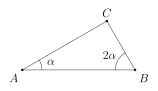
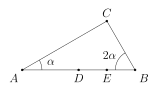
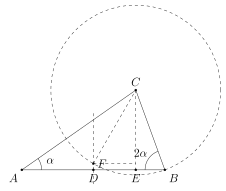
In the triangle \(ABC\), angle \(BAC = \alpha\) and angle \(CBA= 2\alpha\), where \(2\alpha\) is acute, and \(BC= x\). Show that \(AB = (3-4 \sin^2\alpha)x\). The point \(D\) is the midpoint of \(AB\) and the point \(E\) is the foot of the perpendicular from \(C\) to \(AB\). Find an expression for \(DE\) in terms of \(x\). The point \(F\) lies on the perpendicular bisector of \(AB\) and is a distance \(x\) from \(C\). The points \(F\) and \(B\) lie on the same side of the line through \(A\) and \(C\). Show that the line \(FC\) trisects the angle \(ACB\).
Solution:
2014 Paper 3 Q5
A quadrilateral drawn in the complex plane has vertices \(A\), \(B\), \(C\) and \(D\), labelled anticlockwise. These vertices are represented, respectively, by the complex numbers \(a\), \(b\), \(c\) and \(d\). Show that \(ABCD\) is a parallelogram (defined as a quadrilateral in which opposite sides are parallel and equal in length) if and only if \(a+c =b+d\,\). Show further that, in this case, \(ABCD\) is a square if and only if \({\rm i}(a-c)=b-d\). Let \(PQRS\) be a quadrilateral in the complex plane, with vertices labelled anticlockwise, the internal angles of which are all less than \(180^\circ\). Squares with centres \(X\), \(Y\), \(Z\) and \(T\) are constructed externally to the quadrilateral on the sides \(PQ\), \(QR\), \(RS\) and \(SP\), respectively.
- If \(P\) and \(Q\) are represented by the complex numbers \(p\) and \(q\), respectively, show that \(X\) can be represented by \[ \tfrac 12 \big( p(1+{\rm i} ) + q (1-{\rm i})\big) \,. \]
- Show that \(XY\!ZT\) is a square if and only if \(PQRS\) is a parallelogram.
Solution: The vector representing the side \(AB\) is \(b - a\) and the vector representing the side \(DC\) is \(c - d\). \(ABCD\) is a parallelogram if and only if these opposite sides are parallel and equal in length, which is given by \(b - a = c - d\), or equivalently \(a + c = b + d\). Similarly, if \(a + c = b + d\), then \(c - b = d - a\), so the side \(BC\) is parallel and equal in length to the side \(AD\). Thus, \(a + c = b + d\) is the necessary and sufficient condition for \(ABCD\) to be a parallelogram. In a parallelogram, the shape is a square if and only if the diagonals are equal in length and perpendicular to each other. The diagonals are represented by the vectors \(c - a\) and \(d - b\). For these to be equal in length and perpendicular, one must be a \(90^\circ\) rotation of the other. Since \(A, B, C, D\) are labeled anticlockwise, a \(90^\circ\) anticlockwise rotation of the vector \(\vec{AC}\) (which is \(c-a\)) would point in the direction of \(\vec{DB}\) (which is \(b-d\) if we consider the relative orientation). Specifically: \(i(c - a) = d - b \implies -i(a - c) = d - b \implies i(a - c) = b - d\). Thus, \(ABCD\) is a square if and only if \(i(a - c) = b - d\).
- The midpoint of the side \(PQ\) is \(\frac{1}{2}(p + q)\). To find the centre \(X\) of the square built externally on \(PQ\), we start at the midpoint and move a distance equal to half the side length in a direction perpendicular to \(PQ\). Since \(P, Q, R, S\) are anticlockwise, the outward direction is a \(90^\circ\) clockwise rotation of the vector \(\vec{PQ}\). A clockwise rotation of \(90^\circ\) corresponds to multiplication by \(-i\). \[ x = \frac{p+q}{2} + (-i)\left(\frac{q-p}{2}\right) = \frac{p + q - iq + ip}{2} = \frac{1}{2} \big( p(1+i) + q(1-i) \big) \]
- From part (i), we have the representations for the centres: \begin{align*} x &= \tfrac{1}{2}(p(1+i) + q(1-i)) \\ y &= \tfrac{1}{2}(q(1+i) + r(1-i)) \\ z &= \tfrac{1}{2}(r(1+i) + s(1-i)) \\ t &= \tfrac{1}{2}(s(1+i) + p(1-i)) \end{align*} As shown in the first part of the problem, \(XYZT\) is a square if and only if: (1) \(x+z = y+t\) (it is a parallelogram) (2) \(i(x-z) = y-t\) (it is a square) First, examine condition (1): \begin{align*} x+z - (y+t) &= \tfrac{1}{2} \big[ (p+r)(1+i) + (q+s)(1-i) - (q+s)(1+i) - (r+p)(1-i) \big] \\ &= \tfrac{1}{2} \big[ (p+r)(1+i - (1-i)) - (q+s)(1+i - (1-i)) \big] \\ &= \tfrac{1}{2} \big[ (p+r)(2i) - (q+s)(2i) \big] \\ &= i(p+r - (q+s)) \end{align*} Thus, \(x+z = y+t\) if and only if \(p+r = q+s\), which is the condition that \(PQRS\) is a parallelogram. Next, examine condition (2): \begin{align*} i(x-z) &= \tfrac{1}{2} i \big[ p(1+i) + q(1-i) - r(1+i) - s(1-i) \big] \\ &= \tfrac{1}{2} \big[ p(i-1) + q(i+1) - r(i-1) - s(i+1) \big] \\ y-t &= \tfrac{1}{2} \big[ q(1+i) + r(1-i) - s(1+i) - p(1-i) \big] \\ \text{So, } i(x-z) - (y-t) &= \tfrac{1}{2} \big[ p(i-1 + 1-i) + q(i+1 - 1-i) + r(-i+1 - 1+i) + s(-i-1 + 1+i) \big] \\ &= 0 \end{align*} Since \(i(x-z) = y-t\) is an identity (always true for any \(PQRS\)), \(XYZT\) is a square if and only if it is a parallelogram. As established above, this occurs if and only if \(PQRS\) is a parallelogram.
2004 Paper 1 Q6
The three points \(A\), \(B\) and \(C\) have coordinates \(\l p_1 \, , \; q_1 \r\), \(\l p_2 \, , \; q_2 \r\) and \(\l p_3 \, , \; q_3 \r\,\), respectively. Find the point of intersection of the line joining \(A\) to the midpoint of \(BC\), and the line joining~\(B\) to the midpoint of \(AC\). Verify that this point lies on the line joining \(C\) to the midpoint of~\(AB\). The point \(H\) has coordinates \(\l p_1 + p_2 + p_3 \, , \; q_1 + q_2 + q_3 \r\,\). Show that if the line \(AH\) intersects the line \(BC\) at right angles, then \(p_2^2 + q_2^2 = p_3^2 + q_3^2\,\), and write down a similar result if the line \(BH\) intersects the line \(AC\) at right angles. Deduce that if \(AH\) is perpendicular to \(BC\) and also \(BH\) is perpendicular to \(AC\), then \(CH\) is perpendicular to \(AB\).
1998 Paper 2 Q8
Points \(\mathbf{A},\mathbf{B},\mathbf{C}\) in three dimensions have coordinate vectors \(\mathbf{a},\mathbf{b},\mathbf{c}\), respectively. Show that the lines joining the vertices of the triangle \(ABC\) to the mid-points of the opposite sides meet at a point \(R\). \(P\) is a point which is {\bf not} in the plane \(ABC\). Lines are drawn through the mid-points of \(BC\), \(CA\) and \(AB\) parallel to \(PA\), \(PB\) and \(PC\) respectively. Write down the vector equations of the lines and show by inspection that these lines meet at a common point \(Q\). Prove further that the line \(PQ\) meets the plane \(ABC\) at \(R\).
1994 Paper 1 Q5
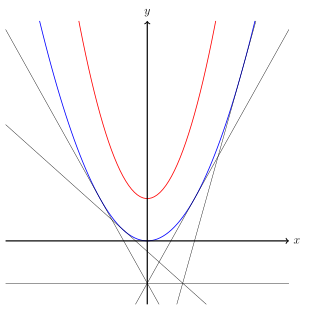
A parabola has the equation \(y=x^{2}.\) The points \(P\) and \(Q\) with coordinates \((p,p^{2})\) and \((q,q^{2})\) respectively move on the parabola in such a way that \(\angle POQ\) is always a right angle.
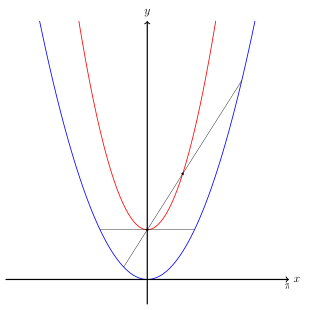
- Find and sketch the locus of the midpoint \(R\) of the chord \(PQ.\)
- Find and sketch the locus of the point \(T\) where the tangents to the parabola at \(P\) and \(Q\) intersect.
Solution:
- The line \(PO\) has gradient \(\frac{p^2}{p} = p\) and teh line \(QO\) has gradient \(q\), therefore we must have that \(pq = -1\). Therefore, \(R\) is the point
\begin{align*}
&& R &= \left ( \frac{p-\frac{1}{p}}{2}, \frac{p^2+\frac{1}{p^2}}{2} \right) \\
&&&= \left ( \frac12\left ( p - \frac{1}{p} \right),2\left (\frac12 \left(p-\frac{1}{p}\right) \right)^2+1 \right) \\
&&&= \left ( t, 2t^2+1\right)
\end{align*}
So we are looking at another parabola.
- The tangents are \(y = 2px+c\), ie \(p^2 = 2p^2+c\), ie \(y = 2px -p^2\) so we have
\begin{align*}
&& y - 2px &= -p^2 \\
&& y - 2qx &= -q^2 \\
\Rightarrow && (2p-2q)x &= p^2-q^2 \\
\Rightarrow && x &= \frac12 (p+q)\\
&& y &= p(p+q)-p^2 \\
&& y &= pq = -1
\end{align*}
Therefore \(x = \frac12(p - \frac1p), y= -1\), so we have the line \(y = -1\) (the directrix)
1992 Paper 3 Q5
The tetrahedron \(ABCD\) has \(A\) at the point \((0,4,-2)\). It is symmetrical about the plane \(y+z=2,\) which passes through \(A\) and \(D\). The mid-point of \(BC\) is \(N\). The centre, \(Y\), of the sphere \(ABCD\) is at the point \((3,-2,4)\) and lies on \(AN\) such that \(\overrightarrow{AY}=3\overrightarrow{YN}.\) Show that \(BN=6\sqrt{2}\) and find the coordinates of \(B\) and \(C\). The angle \(AYD\) is \(\cos^{-1}\frac{1}{3}.\) Find the coordinates of \(D\). [There are two alternative answers for each point.]
Solution: Since \(B\) and \(C\) are reflections of each other in the plane \(y+z=2\) (since that's what it means to be symmetrical), we must have that \(N\) also lies on the plane \(y+z=2\). Since \(\overrightarrow{AY}=3\overrightarrow{YN}.\) we must have \(\overrightarrow{AN}=\overrightarrow{AY}+\overrightarrow{YN} = \frac43\overrightarrow{AY} = \frac43\begin{pmatrix} 3\\-6\\6\end{pmatrix} = \begin{pmatrix} 4\\-8\\8\end{pmatrix}\) and \(N\) is the point \((4,-4,6)\) (which fortunately is on our plane as expected). \(Y\) is the point \((3,-2,4)\) \(|\overrightarrow{AY}| = \sqrt{3^2+(-6)^2+6^2} = 3\sqrt{1+4+4} = 9\)

1988 Paper 1 Q8
\(ABCD\) is a skew (non-planar) quadrilateral, and its pairs of opposite sides are equal, i.e. \(AB=CD\) and \(BC=AD\). Prove that the line joining the midpoints of the diagonals \(AC\) and \(BD\) is perpendicular to each diagonal.
Solution: Let \(\mathbf{a}\) denote the vector position of \(A\) and similarly for \(B, C, D\). Then we know that \((\mathbf{b}-\mathbf{a})\cdot(\mathbf{b}-\mathbf{a})=(\mathbf{c}-\mathbf{d})\cdot(\mathbf{c}-\mathbf{d})\) and \((\mathbf{b}-\mathbf{c})\cdot(\mathbf{b}-\mathbf{c})=(\mathbf{a}-\mathbf{d})\cdot(\mathbf{a}-\mathbf{d})\). Subtracting these two equations we see that \(|\mathbf{a}|^2 -2\mathbf{a}\cdot\mathbf{b}+2\mathbf{c}\cdot\mathbf{b} - |\mathbf{c}|^2 = |\mathbf{c}|^2-2\mathbf{c}\cdot\mathbf{d}+2\mathbf{a}\cdot\mathbf{d}-|\mathbf{a}|^2\) or \(2|\mathbf{a}|^2 -2\mathbf{a}\cdot\mathbf{b}+2\mathbf{c}\cdot\mathbf{b} - 2|\mathbf{c}|^2 +2\mathbf{c}\cdot\mathbf{d}-2\mathbf{a}\cdot\mathbf{d}=0\) The midpoints of the diagonals \(AC\) and \(BD\) are \(\frac{\mathbf{a}+\mathbf{c}}{2}\) and \(\frac{\mathbf{b}+\mathbf{d}}{2}\), so the line is parallel to: \(\mathbf{a}-\mathbf{b}+\mathbf{c}-\mathbf{d}\). The diagonals are parallel to \(\mathbf{a}-\mathbf{c}\) and \(\mathbf{b}-\mathbf{d}\). So it suffices to prove that \((\mathbf{a}-\mathbf{b}+\mathbf{c}-\mathbf{d}) \cdot (\mathbf{a}-\mathbf{c}) = 0\) (since the other will follow by symmetry, \begin{align*} (\mathbf{a}-\mathbf{b}+\mathbf{c}-\mathbf{d}) \cdot (\mathbf{a}-\mathbf{c}) &= |\mathbf{a}|^2-\mathbf{a}\cdot\mathbf{b}-\mathbf{a}\cdot \mathbf{d}+\mathbf{b}\cdot \mathbf{c}-|\mathbf{c}|^2+\mathbf{c}\cdot \mathbf{d} \\ \end{align*} But this is exactly half the equation we determined earlier, so we are done.