Problems
Filters
27 problems found
2024 Paper 2 Q2
In this question, you need not consider issues of convergence.
- Find the binomial series expansion of \((8 + x^3)^{-1}\), valid for \(|x| < 2\). Hence show that, for each integer \(m \geqslant 0\), \[ \int_0^1 \frac{x^m}{8 + x^3}\,\mathrm{d}x = \sum_{k=0}^{\infty} \left( \frac{(-1)^k}{2^{3(k+1)}} \cdot \frac{1}{3k + m + 1} \right). \]
- Show that \[ \sum_{k=0}^{\infty} \frac{(-1)^k}{2^{3(k+1)}} \left( \frac{1}{3k+3} - \frac{2}{3k+2} + \frac{4}{3k+1} \right) = \int_0^1 \frac{1}{x+2}\,\mathrm{d}x\,, \] and evaluate the integral.
- Show that \[ \sum_{k=0}^{\infty} \frac{(-1)^k}{2^{3(k+1)}} \left( \frac{72(2k+1)}{(3k+1)(3k+2)} \right) = \pi\sqrt{a} - \ln b\,, \] where \(a\) and \(b\) are integers which you should determine.
Solution:
- Note that \(\,\) \begin{align*} && (8+x^3)^{-1} &= \tfrac18(1 + \tfrac18x^3)^{-1} \\ &&&= \tfrac18( 1 - \left (\tfrac{x}{2} \right)^3 + \left (\tfrac{x}{2} \right)^6 -\left (\tfrac{x}{2} \right)^9 + \cdots ) \end{align*} So \begin{align*} && \int_0^1 \frac{x^m}{8+x^3} \d x &= \int_0^1 x^m \sum_{k=0}^{\infty} \frac{1}{2^3} \left ( - \frac{x}{2} \right)^{3k} \d x \\ &&&= \sum_{k=0}^{\infty} (-1)^k \frac{1}{2^{3(k+1)}} \int_0^1 x^{m+3k} \d x \\ &&&= \sum_{k=0}^{\infty} \frac{(-1)^k}{2^{3(k+1)}} \frac{1}{3k+m+1} \\ \end{align*}
- Notice that \begin{align*} && S &= \sum_{k=0}^{\infty} \frac{(-1)^k}{2^{3(k+1)}} \left( \frac{1}{3k+3} - \frac{2}{3k+2} + \frac{4}{3k+1} \right) \\ &&&= \int_0^1 \frac{x^2}{8+x^3} \d x - 2\int_0^1 \frac{x^1}{8+x^3}+4\int_0^1 \frac{x^0}{8+x^3} \d x \\ &&&= \int_0^1 \frac{x^2-2x+4}{x^3+8} \d x \\ &&&= \int_0^1 \frac{1}{x+2} \d x = \left[ \ln(x+2)\right]_0^1 \\ &&&= \ln 3 - \ln 2 = \ln \tfrac32 \end{align*}
- Firstly, note that \begin{align*} && \frac{2k+1}{(3k+1)(3k+2)} &= \frac13 \left ( \frac{1}{3k+1} +\frac{1}{3k+2} \right) \end{align*} so \begin{align*} && S_2 &= \sum_{k=0}^{\infty} \frac{(-1)^k}{2^{3(k+1)}} \left( \frac{72(2k+1)}{(3k+1)(3k+2)} \right) \\ &&&= \sum_{k=0}^{\infty} \frac{(-1)^k}{2^{3(k+1)}} 24 \left ( \frac{1}{3k+1} +\frac{1}{3k+2} \right) \\ &&&= 24 \left [ \int_0^1 \frac{x^0}{8+x^3} \d x + \int_0^1 \frac{x^1}{8+x^3} \d x \right] \\ &&&= 24 \left [ \int_0^1 \frac{1+x}{(x+2)(x^2-2x+4)} \d x \right] \\ &&&= 24 \left [ \int_0^1 \frac{x+8}{12(x^2-2x+4)}-\frac{1}{12(x+2)} \d x \right] \\ &&&= 2\left [ \int_0^1 \frac{x+8}{x^2-2x+4}-\frac{1}{x+2} \d x \right] \\ &&&= 2\left [ \int_0^1 \frac{x-1}{x^2-2x+4}+ \frac{9}{(x-1)^2+3}-\frac{1}{x+2} \d x \right] \\ &&&=2 \left [ \int_0^1 \frac12\ln(x^2-2x+4)+3\sqrt{3}\arctan \frac{x-1}{\sqrt{3}} -\ln(x+2) \right]_0^1 \\ &&&=2 \left ( \frac12 \ln3+3\sqrt3 \arctan 0 - \ln 3 \right) - 2\left (\frac12 \ln 4-3\sqrt3 \arctan \frac{1}{\sqrt3} - \ln 2 \right) \\ &&&=\sqrt3 \pi - \ln3 \end{align*}
2018 Paper 2 Q2
A function \(\f(x)\) is said to be concave for \(a< x < b\) if \[ \ t\,\f(x_1) +(1-t)\,\f(x_2) \le \f\big(tx_1+ (1-t)x_2\big) \, ,\] for \(a< x_1 < b\,\), \(a< x_2< b\) and \(0\le t \le 1\,\). Illustrate this definition by means of a sketch, showing the chord joining the points \(\big(x_1, \f(x_1)\big) \) and \(\big(x_2, \f(x_2)\big) \), in the case \(x_1 < x_2\) and \(\f(x_1)< \f(x_2)\,\). Explain why a function \(\f(x)\) satisfying \(\f''(x)<0\) for \(a< x < b\) is concave for \(a< x < b\,\).
- By choosing \(t\), \(x_1\) and \(x_2\) suitably, show that, if \(\f(x)\) is concave for \(a< x < b\,\), then \[ \f\Big(\frac{u+ v+w}3\Big) \ge \frac{ \f(u) +\f(v) +\f(w)}3 \, ,\] for \(a< u < b\,\), \(a< v < b\,\) and \(a< w < b\,\).
- Show that, if \(A\), \(B\) and \(C\) are the angles of a triangle, then \[ \sin A +\sin B + \sin C \le \frac{3\sqrt3}2 \,. \]
- By considering \(\ln (\sin x)\), show that, if \(A\), \(B\) and \(C\) are the angles of a triangle, then \[ \sin A \times \sin B \times \sin C \le \frac {3 \sqrt 3} 8 \,. \]
Solution:
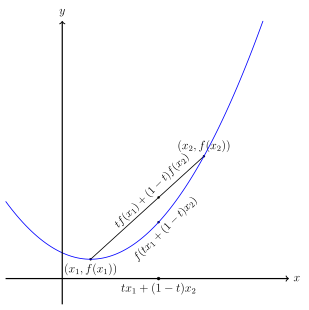
- \(\,\) \begin{align*} && f \left ( \frac{u+v+w}{3} \right) &= f \left ( \frac{2}{3}\cdot \frac{u+v}2+\frac{1}{3}w \right) \\ &&&\geq \frac23 f \left ( \frac{u+v}{2} \right) + \frac13 f(w) \\ &&&\geq \frac23 \left (\frac12 f(u) + \frac12 f(v) \right) + \frac13 f(w) \\ &&&= \frac{f(u)+f(v)+f(w)}{3} \end{align*}
- Notice that if \(A, B, C\) are angles in a triangle then they add to \(\pi\) \(0 < A,B,C < \pi\). We also have \(f(x) = \sin x \Rightarrow f''(x) = - \sin x < 0\) on this interval. Therefore \(\sin A + \sin B + \sin C \leq 3 \sin \frac{A+B+C}{3} = 3 \sin \frac{\pi}{3} = \frac{3\sqrt{3}}2\)
- Also notice that \begin{align*} && f(x) &= \ln ( \sin x) \\ \Rightarrow && f'(x) &= \frac{\cos x}{ \sin x} \\ && f''(x) &= -\textrm{cosec}^2 x < 0 \\ \\ \Rightarrow && \ln( \sin A) + \ln (\sin B) + \ln (\sin C) &\leq 3 \ln \left (\sin \left ( \frac{A + B+ C}{3} \right) \right) \\ &&&= 3 \ln \left ( \frac{\sqrt{3}}{2} \right) = \ln \frac{3\sqrt{3}}{8} \\ \Rightarrow && \sin A \sin B \sin C &\leq \frac{3\sqrt{3}}8 \end{align*}
2017 Paper 1 Q2
- The inequality \(\dfrac 1 t \le 1\) holds for \(t\ge1\). By integrating both sides of this inequality over the interval \(1\le t \le x\), show that \[ \ln x \le x-1 \tag{\(*\)} \] for \(x \ge 1\). Show similarly that \((*)\) also holds for \(0 < x \le 1\).
- Starting from the inequality \(\dfrac{1}{t^2} \le \dfrac1 t \) for \(t \ge 1\), show that \[ \ln x \ge 1-\frac{1}{x} \tag{\(**\)} \] for \(x > 0\).
- Show, by integrating (\(*\)) and (\(**\)), that \[ \frac{2}{ y+1} \le \frac{\ln y}{ y-1} \le \frac{ y+1}{2 y} \] for \( y > 0\) and \( y\ne1\).
Solution:
- \(\,\) \begin{align*} (x \geq 1): && \int_1^x \frac{1}{t} \d t &\leq \int_1^x 1 \d t \\ \Rightarrow && \ln x - \ln 1 &\leq x - 1 \\ \Rightarrow && \ln x & \leq x - 1 \\ \\ (0 < x \leq 1):&& \int_x^1 1\d t &\leq \int_x^1 \frac{1}{t} \d t \\ \Rightarrow&& 1- x &\leq \ln 1 - \ln x \\ \Rightarrow&& \ln x &\leq x - 1 \end{align*}
- \(\,\) \begin{align*} (x \geq 1): && \int_1^x \frac{1}{t^2} \d t &\leq \int_1^x \frac{1}{t} \d t \\ \Rightarrow && -\frac1x+1 &\leq \ln x - \ln 1 \\ \Rightarrow && 1 - \frac1x &\leq \ln x \\ \\ (0 < x \leq 1): && \int_x^1 \frac{1}{t} \d t &\leq \int_x^1 \frac{1}{t^2} \d t \\ \Rightarrow && \ln 1 - \ln x & \leq -1 + \frac{1}{x} \\ \Rightarrow && 1 - \frac1x &\leq \ln x \\ \end{align*}
- \(\,\) \begin{align*} (1 < y): && \int_1^y \left (1 - \frac1{x} \right)\d x &\leq \int_1^y \ln x \d x \\ \Rightarrow && \left [x - \ln x \right]_1^y & \leq \left [ x \ln x - x\right]_1^y \\ \Rightarrow && y - \ln y - 1 &\leq y \ln y - y +1 \\ \Rightarrow && 2y-2 & \leq (y+1) \ln y \\ \Rightarrow && \frac{2}{y+1} & \leq \frac{\ln y}{y-1} \\ (0 < y < 1): && \int_y^1 \left (1 - \frac1{x} \right)\d x &\leq \int_y^1 \ln x \d x \\ \Rightarrow && \left [x - \ln x \right]_y^1 & \leq \left [ x \ln x - x\right]_y^1 \\ \Rightarrow && 1 - (y - \ln y) &\leq -1-(y \ln y-y) \\ \Rightarrow && 2-2y &\leq -(y+1)\ln y \\ \Rightarrow && \frac{2}{y+1} &\leq \frac{-\ln y}{1-y} \tag{\(1-y > 0\)} \\ \Rightarrow && \frac{2}{y+1} &\leq \frac{\ln y}{y-1} \\ \\ (1 < y): && \int_1^y \ln x \d x &\leq \int_1^y (x-1) \d x \\ \Rightarrow && \left [x \ln x -x \right]_1^y &\leq \left[ \frac12 x^2 - x \right]_1^y\\ \Rightarrow && y \ln y - y +1 &\leq \frac12y^2 - y+\frac12 \\ \Rightarrow && y \ln y &\leq \frac12 \left (y^2-1 \right) \\ \Rightarrow && \frac{\ln y}{y-1} &\leq \frac{y+1}{2y} \\ \\ (0 < y < 1) && \int_y^1 \ln x \d x &\leq \int_y^1 (x-1) \d x \\ \Rightarrow && \left [x \ln x -x \right]_y^1&\leq \left[ \frac12 x^2 - x \right]_y^1\\ \Rightarrow && -1-(y \ln y - y +1) &\leq-\frac12 - \left ( \frac12y^2 - y\right)\\ \Rightarrow && \frac12 \left (y^2-1 \right) &\leq y \ln y \\ \Rightarrow && \frac{\ln y}{y-1} & \leq \frac{y+1}{2y} \tag{\(y-1 < 0\)} \end{align*}
2016 Paper 2 Q7
Show that \[ \int_0^a \f(x) \d x= \int _0^a \f(a-x) \d x\,, \tag{\(*\)} \] where f is any function for which the integrals exist.
- Use (\(*\)) to evaluate \[ \int_0^{\frac12\pi} \frac{\sin x}{\cos x + \sin x} \, \d x \,. \]
- Evaluate \[ \int_0^{\frac14\pi} \frac{\sin x}{\cos x + \sin x} \, \d x \,. \]
- Evaluate \[ \int_0^{\frac14\pi} \ln (1+\tan x) \, \d x \,. \]
- Evaluate \[ \int_0^{\frac14 \pi} \frac x {\cos x \, (\cos x + \sin x)}\, \d x \,. \]
Solution: \begin{align*} u = a-x, \d u = - \d x: && \int_0^a f(x) \d x &= \int_{u=a}^{u=0} f(a-u) (-1) \d u \\ &&&= \int_0^a f(a-u) \d u \\ &&&= \int_0^a f(a-x) \d x \end{align*}
- \begin{align*} && I &= \int_0^{\frac12 \pi} \frac{\sin x}{\cos x + \sin x } \d x\\ &&&= \int_0^{\frac12 \pi} \frac{\sin (\frac12 \pi - x)}{\cos (\frac12 \pi-x) + \sin (\frac12 \pi-x) } \d x\\ &&&= \int_0^{\frac12 \pi} \frac{\cos x}{\sin x + \cos x } \d x\\ \Rightarrow && 2I &= \int_0^{\frac12 \pi} 1 \d x \\ \Rightarrow && I &= \frac{\pi}{4} \end{align*}
- \begin{align*} && I &= \int_0^{\frac14 \pi} \frac{\sin x}{\cos x + \sin x } \d x\\ &&&= \int_0^{\frac14 \pi} \frac{\sin (\frac14 \pi - x)}{\cos (\frac14 \pi-x) + \sin (\frac14 \pi-x) } \d x\\ &&&= \int_0^{\frac14 \pi} \frac{\frac1{\sqrt{2}} \cos x - \frac{1}{\sqrt{2}} \sin x}{\frac1{\sqrt{2}} \cos x + \frac{1}{\sqrt{2}} \sin x + \frac1{\sqrt{2}} \cos x - \frac{1}{\sqrt{2}} \sin x} \d x \\ &&&= \int_0^{\frac14 \pi} \frac{\cos x - \sin x}{2 \cos x} \d x \\ &&&= \left [\frac12 x + \ln(\cos x) \right]_0^{\pi/4} \\ &&&= \frac{\pi}{8} -\frac12\ln2 - 1 \end{align*}
- \begin{align*} && I &= \int_0^{\frac14\pi} \ln (1+\tan x) \, \d x \\ &&&= \int_0^{\frac14 \pi} \ln \left (1 + \tan \left(\frac{\pi}{4} - x\right) \right) \, \d x\\ &&&= \int_0^{\frac14 \pi} \ln \left (1 +\frac{1 - \tan x}{1+ \tan x} \right) \, \d x\\ &&&= \int_0^{\frac14 \pi} \ln \left (\frac{2}{1+ \tan x} \right) \, \d x\\ &&&= \frac{\pi}{4} \ln 2 - I \\ \Rightarrow && I &= \frac{\pi}{8} \ln 2 \end{align*}
- \begin{align*} && I &= \int_0^{\frac14 \pi} \frac x {\cos x \, (\cos x + \sin x)}\, \d x \\ &&&= \int_0^{\frac14 \pi} \frac {\frac14 \pi - x} {(\frac1{\sqrt{2}} \cos x + \frac{1}{\sqrt{2}} \sin x) \, (\frac{2}{\sqrt{2}}\cos x)}\, \d x \\ &&&= \int_0^{\frac14 \pi} \frac {\frac14 \pi - x} {\cos x \, (\cos x + \sin x)}\, \d x \\ \\ \Rightarrow && I &= \frac{\pi}{8} \int_0^{\pi/4} \frac{\sec^2 x}{1 + \tan x} \d x\\ &&&= \frac{\pi}{8} \left [\ln (1 + \tan x) \right]_0^{\pi/4} \\ &&&= \frac{\pi}{8} \ln 2 \end{align*}
2016 Paper 3 Q11
A car of mass \(m\) travels along a straight horizontal road with its engine working at a constant rate \(P\). The resistance to its motion is such that the acceleration of the car is zero when it is moving with speed \(4U\).
- Given that the resistance is proportional to the car's speed, show that the distance \(X_1\) travelled by the car while it accelerates from speed \(U\) to speed \(2U\), is given by \[ \lambda X_1 = 2\ln \tfrac 9 5 - 1 \,, \] where \(\lambda= P/(16mU^3)\).
- Given instead that the resistance is proportional to the square of the car's speed, show that the distance \(X_2\) travelled by the car while it accelerates from speed \(U\) to speed \(2U\) is given by \[ \lambda X_2 = \tfrac43 \ln \tfrac 98 \,. \]
- Given that \(3.17<\ln 24 < 3.18\) and \(1.60<\ln 5 < 1.61\), determine which is the larger of \(X_1\) and \(X_2\).
Solution:
- \(\,\) \begin{align*} && F_{res} &= kv \\ && P &= Fv \\ v = 4U: && 0 &= F-F_{res} \\ \Rightarrow && 0 &= \frac{P}{4U} - 4Uk \\ \Rightarrow && k &= \frac{P}{16U^2} \\ \\ &&m v \frac{\d v}{\d x}&= \frac{P}{v} - \frac{P}{16U^2}v \\ \Rightarrow && X_1 &= \int_{v=U}^{v=2U} \frac{16U^2mv^2}{P(16U^2-v^2)} \d v \\ v = Ut&& &= \frac{16mU^2}{P} \int_{t=1}^{t=2}\left ( \frac{t^2}{16-t^2} \right)U\d t \\ &&&= \frac{16mU^3}{P} \int_1^2 \left ( -1 + \frac{16}{16-t^2} \right) \d t \\ &&&= \frac{16mU^3}{P} \int_1^2 \left ( -1 +\frac{2}{4+t} +\frac{2}{4-t} \right) \d t \\ &&&= \frac{1}{\lambda}\left (-1 + 2\ln(6)-2\ln(2)-2\ln(5)+2\ln(3) \right) \\ \Rightarrow && \lambda X_1 &= 2\ln \tfrac95-1 \end{align*}
- \(\,\) \begin{align*} && F_{res} = kv^2 \\ v = 4U: && 0 &= \frac{P}{4U} - 16U^2k \\ \Rightarrow && k &= \frac{P}{64U^3} \\ \\ && mv \frac{\d v}{\d x} &= \frac{P}{v} - \frac{P}{64U^3}v^2 \\ \Rightarrow && X_2 &= \int_{v=U}^{v=2U} \frac{64U^3mv^2}{P(64U^3-v^3)} \d v \\ &&&= \frac{64U^3m}{P} \int_{v=U}^{v=2U} \frac{v^2}{64U^3-v^3} \d v\\ v = Ut &&&= \frac{64U^3m}{P} \int_{t=1}^{t=2} \frac{U^2t^2}{64U^3-U^3v^3} U \d t\\ &&&= \frac{4}{\lambda} \int_1^2 \frac{t^2}{64-t^3} \d t \\ &&&= \frac{4}{\lambda} \left [ -\frac13\ln(64-t^3) \right]_1^2 \\ &&&= \frac{4}{3\lambda} \ln (63/56) \\ \Rightarrow && \lambda X_2 &= \tfrac43 \ln \tfrac98 \end{align*}
- \(\,\) \begin{align*} && 2\ln \tfrac95 - 1 &\overset{?}{>} \frac43 \ln \frac98 \\ \Leftrightarrow && 4 \ln 3 - 2\ln 5 - 1 &\overset{?}{>} \frac83\ln 3 -4 \ln 2 \\ \Leftrightarrow && \frac43(3\ln 3 + 3\ln 2 - 2 \ln 3) &\overset{?}{>} 2 \ln 5 + 1\\ \Leftrightarrow && \frac43\ln 24 &\overset{?}{>} 2 \ln 5 + 1\\ \end{align*} The \(LHS\) is \(>4.22\). The \(RHS\) is \(< 4.22\), and therefore our inequality holds, in particular, \(X_1 > X_2\).
2015 Paper 2 Q1
- By use of calculus, show that \(x- \ln(1+x)\) is positive for all positive \(x\). Use this result to show that \[ \sum_{k=1}^n \frac 1 k > \ln (n+1) \,. \]
- By considering \( x+\ln (1-x)\), show that \[ \sum_{k=1}^\infty \frac 1 {k^2} <1+ \ln 2 \,. \]
Solution:
- Consider \(f(x) = x - \ln (1+ x)\), then \(f'(x) = 1 - \frac{1}{1+x} = \frac{x}{1+x} > 0\) if \(x >0\). Therefore \(f(x)\) is strictly increasing on the positive reals. Since \(f(0) = 0\) we must have \(f(x) > 0\) for all positive \(x\), ie \(x - \ln(1+x)\) is positive for all positive \(x\). \begin{align*} \sum_{k=1}^n \frac1k &\underbrace{>}_{x > \ln(1+x)} \sum_{k=1}^n \ln \left (1 + \frac1k \right ) \\ &= \sum_{k=1}^n \ln \left ( \frac{k+1}{k} \right ) \\ &= \sum_{k=1}^n \left ( \ln (k+1) - \ln (k) \right) \\ &= \ln (n+1) - \ln 1 \\ &= \ln (n+1) \end{align*}
- Let \(g(x) = x + \ln (1-x)\) ,then \(g'(x) = 1 - \frac{1}{1-x} = \frac{-x}{1-x} < 0\) if \(0 < x < 1\) and \(g(0) = 0\). Therefore \(g(x)\) is decreasing and hence negative on \(0 < x < 1\), in particular \(x < -\ln(1-x) \) \begin{align*} \sum_{k=2}^n \frac1{k^2} &\underbrace{<}_{x < -\ln(1+x)} \sum_{k=2}^n - \ln \left (1-\frac1{k^2} \right) \\ &= -\sum_{k=2}^n \ln \left ( \frac{k^2-1}{k^2}\right) \\ &= \sum_{k=2}^n \l 2 \ln k - \ln(k-1) - \ln(k+1) \r \\ &= \ln n - \ln(n+1) - \ln 0+\ln 2 \\ &= \ln 2 + \ln \frac{n}{n+1} \end{align*} as \(n \to \infty\) we must have \(\displaystyle \sum_{k=2}^{\infty} \frac1{k^2} < \ln 2\) ie \[ \sum_{k=1}^\infty \frac 1 {k^2} <1+ \ln 2\]
2014 Paper 1 Q2
- Show that \(\int \ln (2-x) \d x = -(2-x)\ln (2-x) + (2-x) + c \,,\ \) where \(x<2\).
- Sketch the curve \(A\) given by \(y= \ln \vert x^2-4\vert\).
- Show that the area of the finite region enclosed by the positive \(x\)-axis, the \(y\)-axis and the curve \(A\) is \(4\ln(2+\sqrt3)-2\sqrt3\,\).
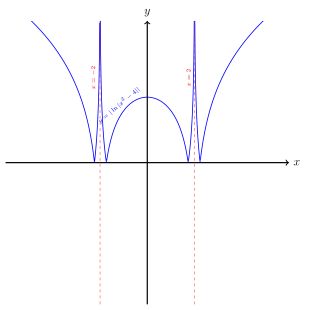
- The curve \(B\) is given by \(y= \vert \ln \vert x^2-4\vert \vert\,\). Find the area between the curve \(B\) and the \(x\)-axis with \(| x| <2\). Note: you may assume that \(t \ln t \to 0\) as \(t\to 0\).
Solution:
- \(\,\) \begin{align*} && \int \ln (2- x) \d x &= \left [ (x-2) \ln (2- x) \right] - \int -\frac{x-2}{2-x} \d x \\ && \int \ln (2- x) \d x &= \left [ (x-2) \ln (2- x) \right] + \int 1 \d x \\ &&&= -(2-x) \ln (2-x) +(2-x) + C \end{align*}
- \(\,\)
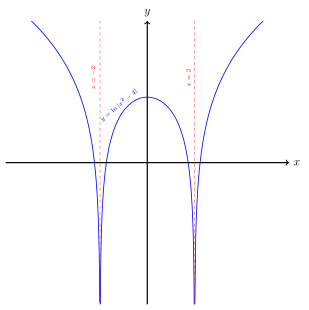
- \begin{align*} && \text{Area} &= \int_0^{\sqrt{3}} \ln | x^2 - 4 | \d x \\ &&&= \int_0^\sqrt{3} \ln(4-x^2) \d x \\ &&&= \int_0^\sqrt{3} \left ( \ln(2-x) + \ln (2+x) \right) \d x \\ &&&= \left [ -(2-x) \ln (2-x) +(2-x) +(2+x)\ln(2+x)-(2+x)\right]_0^{\sqrt{3}} \\ &&&= \left ( -(2-\sqrt{3}) \ln (2-\sqrt{3}) +(2-\sqrt{3}) +(2+\sqrt{3})\ln(2+\sqrt{3})-(2+\sqrt{3}) \right) - \\ &&&\quad \quad \left (- 2\ln (2)+2 +2\ln(2)-2 \right) \\ &&&=\left ( -(2-\sqrt{3}) \ln \left ( \frac{1}{2+\sqrt{3}} \right) -2\sqrt{3} +(2+\sqrt{3})\ln(2+\sqrt{3}) \right) \\ &&&= 4\ln(2 + \sqrt{3}) - 2 \sqrt{3} \end{align*}
- \begin{align*} && \text{Area} &= 2 \left ( \int_0^\sqrt{3} \ln (4-x^2) \d x - \lim_{t \to 2}\int_{\sqrt{3}}^t \ln(4-x^2) \d x \right) \\ &&&= 8\ln(2 + \sqrt{3})-4\sqrt{3} - 2 \lim_{t \to 2}\int_{\sqrt{3}}^t \left ( \ln (2-x) + \ln (2+x) \right) \d x \\ &&&= 8\ln(2 + \sqrt{3})-4\sqrt{3} - 2 \lim_{t \to 2} \left [ -(2-x) \ln (2-x) +(2-x) +(2+x)\ln(2+x)-(2+x)\right]_{\sqrt{3}}^{t} \\ &&&= 16 \ln(2+\sqrt{3})-8\sqrt{3} - 2 \lim_{t \to 2} \left(-(2-t) \ln (2-t) +(2-t) +(2+t)\ln(2+t)-(2+x) \right) \\ &&&= 16 \ln(2+\sqrt{3})-8\sqrt{3} -2(4 \ln4-4) \\ &&&= 16 \ln(2 + \sqrt{3}) - 16 \ln 2 +8(1-\sqrt{3}) \end{align*}
2014 Paper 2 Q4
- By using the substitution \(u=1/x\), show that for \(b>0\) \[ \int_{1/b}^b \frac{x \ln x}{(a^2+x^2)(a^2x^2+1)} \d x =0 \,. \]
- By using the substitution \(u=1/x\), show that for \(b>0\), \[ \int_{1/b}^b \frac{\arctan x}{x} \d x = \frac{\pi \ln b} 2\,. \]
- By using the result \( \displaystyle \int_0^\infty \frac 1 {a^2+x^2} \d x = \frac {\pi}{2 a} \) (where \(a > 0\)),and a substitution of the form \(u=k/x\), for suitable \(k\), show that \[ \int_0^\infty \frac 1 {(a^2+x^2)^2} \d x = \frac {\pi}{4a^3 } \, \ \ \ \ \ \ (a > 0). \]
Solution:
- \begin{align*} && I &= \int_{1/b}^b \frac{x \ln x}{(a^2+x^2)(a^2x^2+1} \d x \\ u = 1/x, \d u = -1/x^2 \d x: &&&= \int_{u=b}^{u=1/b} \frac{1/u \ln(1/u)}{(a^2+u^{-2})(a^2u^{-2}+1)} (- \frac{1}{u^2}) \d u \\ &&&= \int_{1/b}^b \frac{-u\ln u}{(a^2u^2+1)(a^2+u^2)} \d u \\ &&&= -I \\ \Rightarrow && I &= 0 \end{align*}
- \(\,\) \begin{align*} && I &= \int_{1/b}^b \frac{\arctan x}{x} \d x \\ u = 1/x, \d x = -1/u^2 \d u: &&&= \int_{u=b}^{u=1/b} \frac{\arctan \frac1u}{\frac1u} \frac{-1}{u^2} \d u \\ &&&= \int_{1/b}^b \frac{\arctan \frac1u}{u} \d u \\ \Rightarrow && 2I &= \int_{1/b}^b \frac{\arctan x + \arctan \frac1x}{x} \d x \\ &&&= \int_{1/b}^b \frac{\frac{\pi}2}{x} \d x \\ &&&= \pi \ln b \\ \Rightarrow && I &= \frac{\pi}{2} \ln b \end{align*}
- \(\,\) \begin{align*} && I_a &= \int_0^{\infty} \frac{1}{(a^2+x^2)^2} \d x \\ u = a/x, \d x = -a/u^2 \d u:&&&= \int_{u=0}^{u=\infty} \frac{1}{\left (a^2+\frac{a^2}{u^2} \right)^2} \frac{a}{u^2} \d u \\ &&&= \frac1{a^3}\int_0^{\infty} \frac{1}{(u+1/u)^2} \d u \\ &&&= \frac{1}{a^3} \int_0^{\infty} \frac{u^2}{(u^2+1)^2} \d u \\ &&&= \frac{1}{a^3} \int_0^{\infty} \frac{u^2+1-1}{(u^2+1)^2} \d u \\ &&&= \frac{1}{a^3} \int_0^{\infty} \frac{1}{(u^2+1)} - \frac{1}{(u^2+1)^2} \d u \\ &&&= \frac1{a^3} \frac{\pi}{2} - \frac{1}{a^3} I_1 \\ \Rightarrow && 2I_1 &= \frac{\pi}{2} \\ \Rightarrow && I_1 &= \frac{\pi}{4} \\ \Rightarrow && I_a &= \frac{\pi}{4a^3} \end{align*}
2013 Paper 1 Q8
- The functions \(\mathrm{a, b, c}\) and \(\mathrm{d}\) are defined by
- \({\rm a}(x) =x^2 \ \ \ \ (-\infty < x < \infty),\)
- \({\rm b}(x) = \ln x \ \ \ \ (x > 0),\)
- \({\rm c}(x) =2x \ \ \ \ (-\infty < x < \infty),\)
- \({\rm d}(x)= \sqrt x \ \ \ \ (x\ge0) \,.\)
- The functions \(\mathrm{f}\) and \(\mathrm{g}\) are defined by
- \(\f(x)= \sqrt{x^2-1\,} \ \ \ \ (\vert x \vert \ge 1),\)
- \(\g(x) = \sqrt{x^2+1\,} \ \ \ \ (-\infty < x < \infty).\)
- Sketch the graphs of the functions \(\h\) and \({\rm k}\) defined by
- \(\h(x) = x+\sqrt{x^2-1\,}\, \ \ \ \ ( x \ge1)\),
- \({\rm k}(x) = x-\sqrt{x^2-1\,}\, \ \ \ \ (\vert x\vert \ge1),\)
Solution:
- \begin{align*} cb(x) &= c(b(x)) \\ &= 2 \ln x \quad (x > 0) \\ ab(x) &= (b(x))^2 \\ &= (\ln x)^2 \quad (x > 0) \\ da(x) &= \sqrt{a(x)} \\ &= \sqrt{x^2} \\ &= |x| \quad (-\infty < x < \infty) \\ ad(x) &= (d(x))^2 \\ &= (\sqrt{x})^2 \\ &= x \quad (x \geq 0) \end{align*} The domains are specified above. The ranges are \(\mathbb{R}, \mathbb{R}_{\geq 0}, \mathbb{R}_{\geq 0}, \mathbb{R}_{\geq 0}\) respectively.
- \begin{align*} fg(x) &= \sqrt{g(x)^2-1} \quad (|g(x)| \geq 1) \\ &= \sqrt{x^2+1-1} \\ &= |x| \end{align*} So \(fg: \mathbb{R} \to \mathbb{R}_{\geq 0}\). \begin{align*} gf(x) &= \sqrt{f(x)^2 + 1} \\ &= \sqrt{\left ( \sqrt{x^2-1} \right)^2+1} \quad (|x| \geq 1) \\ &= |x| \end{align*} So \(gf: \mathbb{R}_{\geq 0} \to \mathbb{R}_{\geq 0}\)


2013 Paper 1 Q10
Two parallel vertical barriers are fixed a distance \(d\) apart on horizontal ice. A small ice hockey puck moves on the ice backwards and forwards between the barriers, in the direction perpendicular to the barriers, colliding with each in turn. The coefficient of friction between the puck and the ice is \(\mu\) and the coefficient of restitution between the puck and each of the barriers is \(r\). The puck starts at one of the barriers, moving with speed \(v\) towards the other barrier. Show that \[ v_{i+1}^2 - r^2 v_i^2 = - 2 r^2 \mu gd\, \] where \(v_i\) is the speed of the puck just after its \(i\)th collision. The puck comes to rest against one of the barriers after traversing the gap between them \(n\) times. In the case \(r\ne1\), express \(n\) in terms of \(r\) and \(k\), where \(k= \dfrac{v^2}{2\mu g d}\,\). If \(r=\e^{-1}\) (where \(\e\) is the base of natural logarithms) show that \[ n = \tfrac12 \ln\big(1+k(\e^2-1)\big)\,. \] Give an expression for \(n\) in the case \(r=1\).
Solution: \begin{align*} \text{W.E.P.}: && \text{change in energy} &= \text{work done on particle} \\ \Rightarrow && \underbrace{\frac12mv^2}_{\text{speed before hitting barrier}} - \underbrace{\frac12mu^2}_{\text{speed leaving first barrier}} &= \underbrace{\left( -\mu mg \right)}_{F} \cdot \underbrace{d}_{d} \\ \Rightarrow && v^2 &= v_i^2-2\mu gd \end{align*} Newton's experimental law tells us that the speed leaving the barrier will be \(r\) times the speed approaching, ie \begin{align*} && v_{i+1} &= rv \\ \Rightarrow && v_{i+1}^2 &= r^2 v^2 \\ &&&= r^2v_i^2 - 2r^2\mu gd \\ \Rightarrow && v_{i+1}^2 - r^2v_i^2 &= - 2r^2\mu gd \end{align*} It must be the case that after \(n+1\) collisions the speed is zero, ie \(v_{n+1}^2 = 0\). Not that we can consider \(w_i = \frac{v_i^2}{2\mu gd}\) and we have the recurrence: \begin{align*} && w_{i+1} &=r^2w_i -r^2 \\ \end{align*} Looking at this we have a linear recurrence with a constant term, so let's try \(w_i = C\), then \begin{align*} && C &= r^2 C - r^2 \\ \Rightarrow && C &= \frac{-r^2}{1-r^2} \\ \end{align*} So \(w_i = Ar^{2i} - \frac{r^2}{1-r^2}\). \(w_0 = k \Rightarrow A = k+\frac{r^2}{1-r^2}\) Therefore \(w_n = \left (k+\frac{r^2}{1-r^2} \right)r^{2n} - \frac{r^2}{1-r^2}\) Suppose \(w_n = 0\) then, \begin{align*} && 0 &= \left (k+\frac{r^2}{1-r^2} \right)r^{2n} - \frac{r^2}{1-r^2} \\ \Rightarrow && r^{2n} &= \frac{r^2}{1-r^2} \frac{1}{k+\frac{r^2}{1-r^2}} \\ &&&= \frac{r^2}{k(1-r^2)+r^2} \\ \Rightarrow && 2n \ln r &= 2\ln r - \ln[k(1-r^2)+r^2] \\ \Rightarrow && n &= 1 - \frac1{2\ln r} \ln[k(1-r^2)+r^2)] \end{align*} If \(r = e^{-1}\) then \(\ln r = -1\) \begin{align*} && n &= 1 + \frac12 \ln [k(1-e^{-2}) + e^{-2}] \\ &&&= 1 + \frac12 \ln [e^{-2}(k(e^2-1)+1)] \\ &&&= 1 + \frac12 \ln e^{-2} + \frac12 \ln [1+k(e^2-1)] \\ &&&= \frac12 \ln [1+k(e^2-1)] \end{align*} If \(r = 1\) the recurrence becomes: \(w_{i+1} = w_i - 1\), so \(w_i = k-n\), so we have \(k\) collisions.
2012 Paper 1 Q3
- Sketch the curve \(y=\sin x\) for \(0\le x \le \tfrac12 \pi\) and add to your diagram the tangent to the curve at the origin and the chord joining the origin to the point \((b, \sin b)\), where \(0 < b < \frac12\pi\). By considering areas, show that \[ 1-\tfrac12 b^2 <\cos b < 1-\tfrac 12 b \sin b\,. \]
- By considering the curve \(y=a^x\), where \(a>1\), show that \[ \frac{2(a-1)}{a+1} < \ln a < -1 + \sqrt{2a-1\,}\,. \] [Hint: You may wish to write \(a^x\) as \(\e^{x\ln a}\).]
Solution:
- \(\,\)
The area under the blue curve is \(1-\cos b\). The area under the green line is \(\frac12 b \sin b\) The area under the red line is \(\frac12 b^2\) Therefore \(\frac12 b \sin b < 1- \cos b < \frac12 b^2 \Rightarrow 1- \frac12 b^2 < \cos b < 1 - \frac12 b \sin b\)

- \(\,\)
\begin{align*} &&\text{Area under blue curve}: &= \int_0^1 a^x \d x\\ &&&= \left [ \frac{1}{\ln a}e^{x \ln a} \right]_0^1 \\ &&&= \frac{a-1}{\ln a} \\ \\ &&\text{Area under green line}: &=\frac12 \cdot 1 \cdot (a + 1)\\ &&&= \frac{a+1}{2} \\ \\ &&\text{Area under tangent}: &=\frac12 \cdot 1 \cdot (1+\ln a + 1)\\ &&&= \frac{\ln a+2}{2} \\ \\ \Rightarrow && \frac{a+1}{2} & > \frac{a-1}{\ln a} \\ \Rightarrow && \ln a& > \frac{2(a-1)}{a+1} \\ \\ \Rightarrow && \frac{a-1}{\ln a} &> \frac{\ln a +2}{2} \\ \Rightarrow && 2(a-1) -2\ln a - (\ln a)^2 &> 0 \\ \Rightarrow && \ln a & < -1 + \sqrt{2a-1} \end{align*}

2012 Paper 3 Q4
- Show that \[ \sum_{n=1} ^\infty \frac{n+1}{n!} = 2\e - 1 \] and \[ \sum _{n=1}^\infty \frac {(n+1)^2}{n!} = 5\e-1\,. \] Sum the series $\displaystyle \sum _{n=1}^\infty \frac {(2n-1)^3}{n!} \,.$
- Sum the series $\displaystyle \sum_{n=0}^\infty \frac{(n^2+1)2^{-n}}{(n+1)(n+2)}\,$, giving your answer in terms of natural logarithms.
Solution:
- \begin{align*} \sum_{n=1}^{\infty} \frac{n+1}{n!} &= \sum_{n=1}^\infty \left ( \frac{1}{(n-1)!} + \frac{1}{n!} \right) \\ &= \sum_{n=0}^\infty \frac{1}{n!} + \sum_{n=1}^\infty \frac{1}{n!} \\ &= \sum_{n=0}^\infty \frac{1}{n!} + \sum_{n=0}^\infty \frac{1}{n!} - 1 \\ &= e + e - 1 \\ &= 2e-1 \end{align*} \begin{align*} \sum_{n=1}^{\infty} \frac{(n+1)^2}{n!} &= \sum_{n=1}^{\infty} \frac{n(n-1) + 3n + 1}{n!} \\ &= \sum_{n=2}^{\infty} \frac{1}{(n-2)!} + 3 \sum_{n=1}^\infty \frac1{(n-1)!} + \sum_{n=1}^\infty \frac{1}{n!} \\ &= \sum_{n=0}^{\infty} \frac{1}{n!} + 3 \sum_{n=0}^\infty \frac1{n!} + \sum_{n=0}^\infty \frac{1}{n!} -1 \\ &= 5e-1 \end{align*} \begin{align*} \sum_{n=1}^\infty \frac{(2n-1)^3}{n!} &= \sum_{n=1}^\infty \frac{8n^3-12n^2+6n-1}{n!} \\ &= \sum_{n=1}^\infty \frac{8n(n-1)(n-2)+12n^2-10n-1}{n!} \\ &= \sum_{n=1}^\infty \frac{8n(n-1)(n-2)+12n(n-1)+2n-1}{n!} \\ &= 8 e+12e+2e-(e-1) \\ &=21e+1 \end{align*}
- \begin{align*} \frac{n^2+1}{(n+1)(n+2)} &= \frac{n^2+3n+2-3n-1}{(n+1)(n+2)}\\ &= 1 - \frac{3n+1}{(n+1)(n+2)} \\ &= 1 + \frac{2}{n+1} - \frac{5}{n+2} \\ -\log(1-x) &= \sum_{n=1}^\infty \frac1{n}x^{n} \\ \log(2) &= \sum_{n=1}^\infty \frac{2^{-n}}{n} \\ \sum_{n=0}^\infty \frac{(n^2+1)2^{-n}}{(n+1)(n+2)} &= \sum_{n=0}^{\infty} 2^{-n} + 2 \sum_{n=0}^\infty \frac{2^{-n}}{n+1}-5 \sum_{n=0}^\infty \frac{2^{-n}}{n+2} \\ &= 2 + 2\log2-5 \sum_{n=2}^\infty \frac{2^{-n+2}}{n} \\ &= 2 + 2 \log 2 - 5 \left (2\log 2 - 2 \right) \\ &= 12-8\log2 \end{align*}
2009 Paper 2 Q2
The curve \(C\) has equation \[ y= a^{\sin (\pi \e^ x)}\,, \] where \(a>1\).
- Find the coordinates of the stationary points on \(C\).
- Use the approximations \(\e^t \approx 1+t\) and \(\sin t \approx t\) (both valid for small values of \(t\)) to show that \[ y\approx 1-\pi x \ln a \; \] for small values of \(x\).
- Sketch \(C\).
- By approximating \(C\) by means of straight lines joining consecutive stationary points, show that the area between \(C\) and the \(x\)-axis between the \(k\)th and \((k+1)\)th maxima is approximately \[ \Big( \frac {a^2+1}{2a} \Big) \ln \Big ( 1+ \big( k-\tfrac34)^{-1} \Big)\,. \]
Solution:
- \(\,\) \begin{align*} && y & = a^{\sin(\pi e^x)} \\ \Rightarrow && \frac{\d y}{\d x} &= a^{\sin(\pi e^x)} \cdot ( \ln a) \cdot (\cos (\pi e^x)) \cdot \pi e^x \\ \frac{\d y}{\d x} = 0: && 0 &= \cos(\pi e^x) \\ \Rightarrow && \pi e^x &= \left ( \frac{2n+1}{2} \right) \pi \\ \Rightarrow && x &= \ln \left ( \frac{2n+1}{2} \right) \\ && y &= a^{(-1)^n} \\ &&(x,y) &= \left (\ln \left ( \frac{2n+1}{2} \right), a^{(-1)^n} \right) \end{align*}
- \(\,\) \begin{align*} && y &= a^{\sin(\pi e^x)} \\ &&&= e^{\ln a \cdot \sin(\pi e^x)} \\ &&&\approx e^{\ln a \cdot \sin(\pi (1+x))} \\ &&&\approx e^{-\ln a \cdot \sin(\pi x)} \\ &&&\approx e^{-\ln a \cdot \pi x} \\ &&&\approx 1-( \pi\ln a) x \end{align*}
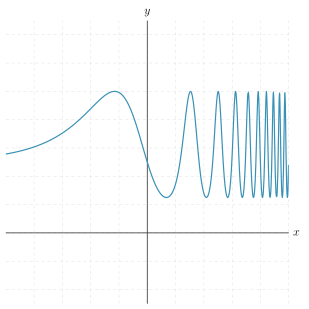
- The \(k\)th maxima is at \(\ln \left ( \frac{4(k-1)+1}{2}\right)\) and \(a\) ,and the \((k+1)\)th is at \(\ln \left ( \frac{4k+1}{2}\right)\). They have a minima between at \(\ln \left ( \frac{4k-3}{2}\right)\). \begin{align*} && \text{Area} &\approx \frac12 \left (\ln \left ( \frac{4k-1}{2}\right)- \ln \left ( \frac{4k-3}{2}\right)\right) \left ( a + \frac1a \right) + \frac12 \left ( \ln \left ( \frac{4k+1}{2}\right)-\ln \left ( \frac{4k-1}{2}\right)\right) \left ( a + \frac1a \right) \\ &&&= \frac{a^2+1}{2a} \ln \left (\frac{4k+1}{4k-3} \right) \\ &&&= \frac{a^2+1}{2a} \ln \left (1 + \frac{4}{4k-3} \right) \\ &&&= \frac{a^2+1}{2a} \ln \left (1 + \frac{1}{k-\tfrac34} \right) \\ &&&= \frac{a^2+1}{2a} \ln \left (1 + (k-\tfrac34)^{-1} \right) \\ \end{align*}
2007 Paper 2 Q13
Given that \(0 < r < n\) and \(r\) is much smaller than \(n\), show that \(\dfrac {n-r}n \approx \e^{-r/n}\). There are \(k\) guests at a party. Assuming that there are exactly 365 days in the year, and that the birthday of any guest is equally likely to fall on any of these days, show that the probability that there are at least two guests with the same birthday is approximately \(1-\e^{-k(k-1)/730}\). Using the approximation \( \frac{253}{365} \approx \ln 2\), find the smallest value of \(k\) such that the probability that at least two guests share the same birthday is at least \(\frac12\). How many guests must there be at the party for the probability that at least one guest has the same birthday as the host to be at least \(\frac12\)?
Solution: Given \(0 < r \ll n\), then \(\frac{r}{n}\) is small and so, \(e^x \approx 1+x\), therefore: \(\displaystyle e^{-r/n} \approx 1 - \frac{r}{n} = \frac{n-r}{n}\). Line everyone in the room up in some order. The first person is always going to have a birthday we haven't seen before. The probability the second person has a new birthday is \(\displaystyle 1 - \frac{1}{365}\) since they can't be born on the same day as the first person. The third person has a \(\displaystyle 1 - \frac{2}{365}\) probability of having a birthday we've not seen before, since they can't share a birthday with either of the first two people. Similarly the \(k\)th person has a \(\displaystyle 1 - \frac{k-1}{365}\) chance of having a unique birthday. \begin{align*} \prod_{i=1}^k \mathbb{P}(\text{the } i \text{th person has a new birthday}) &= \prod_{i=1}^k \l 1 - \frac{i-1}{365}\r \\ &\approx \prod_{i=1}^k \exp \l -\frac{i-1}{365}\r \\ &= \exp\l - \sum_{i=1}^k\frac{i-1}{365}\r \\ &= \exp\l - \frac{k(k-1)}{2\cdot365}\r \\ &= e^{-k(k-1)/730} \end{align*} But this the probability no-one shares a birthday, so the answer we are looking for is \(1-\) this, ie \(1 - e^{-k(k-1)/730}\) Suppose \(1 - e^{-k(k-1)/730} = \frac12\), then \begin{align*} && 1 - e^{-k(k-1)/730} &= \frac12 \\ \Rightarrow && e^{-k(k-1)/730} &= \frac12 \\ \Rightarrow && -k(k-1)/730 &= -\ln 2 \\ \Rightarrow && k(k-1)/730 &\approx \frac{253}{365} \\ \Rightarrow && k(k-1) &\approx 506 \end{align*} Therefore since \(22 \cdot 23 = 506\), we should expect the number to be approximately \(23\). Since \(e^{-r/n} > \frac{n-r}{n}\) we should expect this to be an overestimate, therefore \(23\) should suffice.
2006 Paper 3 Q4
The function \(f\) satisfies the identity \begin{equation} f(x) +f(y) \equiv f(x+y) \tag{\(*\)} \end{equation} for all \(x\) and \(y\). Show that \(2\f(x)\equiv \f(2x)\) and deduce that \(f''(0)=0\). By considering the Maclaurin series for \(\f(x)\), find the most general function that satisfies \((*)\). [{\it Do not consider issues of existence or convergence of Maclaurin series in this question.}]
- By considering the function \(\G\), defined by \(\ln\big(\g(x)\big) =\G(x)\), find the most general function that, for all \(x\) and \(y\), satisfies the identity \[ \g(x) \g(y) \equiv \g(x+y)\,. \]
- By considering the function \(H\), defined by \(\h(\e^u) =H(u)\), find the most general function that satisfies, for all positive \(x\) and \(y\), the identity \[ \h(x) +\h(y) \equiv \h(xy) \,. \]
- Find the most general function \(t\) that, for all \(x\) and \(y\), satisfies the identity \begin{equation*} t(x) + t(y) \equiv t(z)\,, \end{equation*} where \(z= \dfrac{x+y}{1-xy}\,\).
Solution: \begin{align*} &&2f(x) &\equiv f(x) + f(x) \\ &&&\equiv f(x+x) \\ &&&\equiv f(2x) \\ \\ \Rightarrow && 2f(0) &= f(0) \\ \Rightarrow && f(0) &= 0 \\ && f''(0) &= \lim_{h \to 0} \frac{f(2h)-2f(0)+f(-2h)}{h^2} \\ &&&= \lim_{h \to 0} \frac{f(2h)+f(-2h)}{h^2} \\ &&&= \lim_{h \to 0} \frac{f(0)}{h^2} \\ &&&= 0 \\ \Rightarrow && f''(0) &= 0 \end{align*} If \(f(x)\) satisfies the equation, then \(f'(x)\) satisfies the equation. In particular this means that \(f^{(n)}(0) = 0\) for all \(n \geq 2\). Therefore the only non-zero term in the Maclaurin series is \(x^1\). Therefore \(f(x) = cx\)
- Suppose \(g(x)g(y) \equiv g(x+y)\), then if \(G(x) = \ln g(x)\) we must have \(G(x)+G(y) \equiv G(x+y)\), ie \(G(x) = cx \Rightarrow g(x) = e^{cx}\)
- Suppose \(h(x)+h(y) \equiv h(xy)\), then if \(h(e^u) = H(u)\) we must have that \(H(u)+H(v) \equiv h(e^u) + h(e^v) \equiv h(e^{u+v}) \equiv H(u+v)\).Therefore \(H(u) = cu\), ie \(h(e^u) = cu\) or \(h(x) = h(e^{\ln x}) = c \ln x\).
- Finally if \(t(x) + t(y) \equiv t(z)\), the considering \(T(w) = t(\tan w)\) then \(T(x) + T(y) \equiv t(\tan x) + t(\tan y) \equiv t( \frac{\tan x + \tan y}{1- \tan x \tan y}) \equiv t (\tan (x+y)) \equiv T(x+y)\). Therefore \(T(x) = cx\) Therefore \(t(\tan w) = c w \Rightarrow t(x) = c \tan^{-1} x\)