Problems
Filters
2 problems found
2015 Paper 3 Q11
D: 1700.0
B: 1484.0
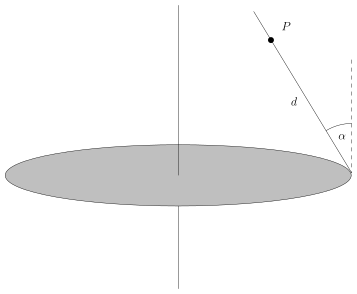
- A horizontal disc of radius \(r\) rotates about a vertical axis through its centre with angular speed \(\omega\). One end of a light rod is fixed by a smooth hinge to the edge of the disc so that it can rotate freely in a vertical plane through the centre of the disc. A particle \(P\) of mass \(m\) is attached to the rod at a distance \(d\) from the hinge. The rod makes a constant angle \(\alpha\) with the upward vertical, as shown in the diagram, and \(d\sin\alpha < r\).
By considering moments about the hinge for the (light) rod, show that the force exerted on the rod by \(P\) is parallel to the rod. Show also that \[ r\cot\alpha = a + d \cos\alpha \,, \] where \(a = \dfrac {g \;} {\omega^2}\,\). State clearly the direction of the force exerted by the hinge on the rod, and find an expression for its magnitude in terms of \(m\), \(g\) and \(\alpha\).
- The disc and rod rotate as in part (i), but two particles (instead of \(P\)) are attached to the rod. The masses of the particles are \(m_1\) and \(m_2\) and they are attached to the rod at distances \(d_1\) and \(d_2\) from the hinge, respectively. The rod makes a constant angle \(\beta\) with the upward vertical and \(d_1\sin\beta < d_2\sin\beta < r\). Show that \(\beta\) satisfies an equation of the form \[ r\cot\beta = a+ b \cos\beta \,, \] where \(b\) should be expressed in terms of \(d_1\), \(d_2\), \(m_1\) and \(m_2\).
Solution:
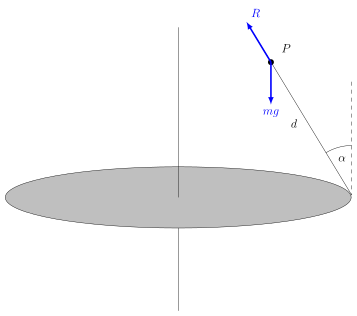
- Since the particle is not moving (relative to the hinge) there is no moment about the hinge and in particular the only forces must be directed towards the hinge, ie parallel to the rod.
\begin{align*} \text{N2}(\uparrow): && R \cos \alpha &= mg \\ \\ \text{N2}(\leftarrow, \text{radially}): && R \sin \alpha &= m (r-d\sin \alpha) \omega^2 \\ \Rightarrow && \cot \alpha &= \frac{g}{(r-d\sin \alpha) \omega^2} \\ \Rightarrow && r\cot \alpha-d \cos \alpha &= a \\ \Rightarrow && r \cot \alpha &= a + d \cos \alpha \end{align*} The force of the hinge is acting in the same direction and magnitude as the rod on the particle (the force \(R\) in the diagram). It has magnitude \(mg \sec \alpha\)
- \(\,\)
\begin{align*} \overset{\curvearrowleft}{\text{hinge}}: && gm_1d_1 \sin \beta+gm_2d_2 \sin \beta &= m_1 (r-d_1 \sin \beta) \omega^2 d_1 \cos \beta + m_2 (r-d_2 \sin \beta) \omega^2 d_2 \cos \beta \\ \Rightarrow && a(m_1d_1+m_2d_2) \tan \beta &= r(m_1d_1+m_2d_2) - (m_1d_1^2+m_2d_2^2) \sin \beta \\ \Rightarrow && r\cot \beta &= a + \frac{m_1d_1^2+m_2d_2^2}{m_1d_1+m_2d_2} \cos \beta \end{align*}

1994 Paper 2 Q9
D: 1600.0
B: 1484.0
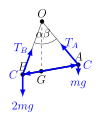
A light rod of length \(2a\) is hung from a point \(O\) by two light inextensible strings \(OA\) and \(OB\) each of length \(b\) and each fixed at \(O\). A particle of mass \(m\) is attached to the end \(A\) and a particle of mass \(2m\) is attached to the end \(B.\) Show that, in equilibrium, the angle \(\theta\) that the rod makes the horizontal satisfies the equation \[ \tan\theta=\frac{a}{3\sqrt{b^{2}-a^{2}}}. \] Express the tension in the string \(AO\) in terms of \(m,g,a\) and \(b\).
Solution: