Problems
Filters
10 problems found
2017 Paper 1 Q10
Particles \(P_1\), \(P_2\), \(\ldots\) are at rest on the \(x\)-axis, and the \(x\)-coordinate of \(P_n\) is \(n\). The mass of \(P_n\) is \(\lambda^nm\). Particle \(P\), of mass \(m\), is projected from the origin at speed \(u\) towards \(P_1\). A series of collisions takes place, and the coefficient of restitution at each collision is \(e\), where \(0 < e <1\). The speed of \(P_n\) immediately after its first collision is \(u_n\) and the speed of \(P_n\) immediately after its second collision is \(v_n\). No external forces act on the particles.
- Show that \(u_1=\dfrac{1+e}{1+\lambda}\, u\) and find expressions for \(u_n\) and \(v_n\) in terms of \(e\), \(\lambda\), \(u\) and \(n\).
- Show that, if \(e > \lambda\), then each particle (except \(P\)) is involved in exactly two collisions.
- Describe what happens if \(e=\lambda\) and show that, in this case, the fraction of the initial kinetic energy lost approaches \(e\) as the number of collisions increases.
- Describe what happens if \(\lambda e=1\). What fraction of the initial kinetic energy is \mbox{eventually} lost in this case?
Solution:
- \begin{align*} \text{COM}: && mu &= mv + \lambda m u_1 \\ \Rightarrow && u &= v + \lambda u_1 \tag{1} \\ \text{NEL}: && e &= \frac{u_1-v}{u} \\ \Rightarrow && eu &= u_1 - v \tag{2} \\ (1)+(2) && (1+e)u &= (1+\lambda) u_1 \\ \Rightarrow && u_1 &= \frac{1+e}{1+\lambda}u \\ && v &= u_1 - eu \\ &&&= \frac{1+e - (1+\lambda)e}{1+\lambda} u \\ &&&= \frac{1-\lambda e}{1+\lambda}u \end{align*} Note that subsequent (first (and second)) are the same as these, therefore: \begin{align*} u_n &= \left ( \frac{1+e}{1+\lambda} \right)^n u \\ v_n &= \frac{1-\lambda e}{1+\lambda } u_n \\ &= \frac{1-\lambda e}{1+\lambda } \left ( \frac{1+e}{1+\lambda} \right)^n u \end{align*}

- If \(e > \lambda\) then \((1-\lambda e) > 1-e^2 > 0\) and \begin{align*} \frac{v_{n+1}}{v_n} &= \frac{1+e}{1+\lambda} > 1 \end{align*} So the particles are moving away from each other - hence no more collisions.
- If \(e = \lambda\) then \(u_n = u\) and \(v_n = (1-\lambda)u\) so all the particles end up moving at the same speed. \begin{align*} \text{initial k.e.} &= \frac12 m u^2 \\ \text{final k.e.} &= \frac12 m((1-e)u)^2 + \sum_{n = 1}^{\infty} \frac12 \lambda^n m ((1-e)u)^2 \\ &= \frac12mu^2(1-e)^2 \left ( \sum_{n=0}^{\infty} e^n \right) \tag{\(e = \lambda\)} \\ &= \frac12 mu^2(1-e)^2 \frac{1}{1-e} \\ &= \frac12m u^2 (1-e) \\ \text{change in k.e.} &= \frac12 m u^2 - \frac12m u^2 (1-e) \\ &= e\frac12m u^2 \end{align*} Ie the total energy lost approaches a fraction of \(e\).
- If \(\lambda e = 1\), after the second collision the particle will be stationary. ie \begin{align*} \text{initial k.e.} &= \frac12 m u^2 \\ \text{k.e. after }n\text{ collisions} &= \frac12 \lambda^n m \left (\left ( \frac{1+e}{1+\lambda} \right)^n u \right)^2\\ &= \frac12 \lambda^n m \left ( \frac{1+\frac1{\lambda}}{1+\lambda} \right)^{2n} u&2\\ &= \frac12 \lambda^n m \left ( \frac{1+\frac1{\lambda}}{1+\lambda} \right)^{2n} u\\ &= \frac12 \lambda^n m \left ( \frac{1}{\lambda} \right)^{2n} u\\ &= \frac12 m \lambda^{-n} u\\ &\to 0 \end{align*} Eventually we lose all the kinetic energy.
2017 Paper 3 Q11
A railway truck, initially at rest, can move forwards without friction on a long straight horizontal track. On the truck, \(n\) guns are mounted parallel to the track and facing backwards, where \(n>1\). Each of the guns is loaded with a single projectile of mass \(m\). The mass of the truck and guns (but not including the projectiles) is \(M\). When a gun is fired, the projectile leaves its muzzle horizontally with a speed \(v-V\) relative to the ground, where \(V\) is the speed of the truck immediately before the gun is fired.
- All \(n\) guns are fired simultaneously. Find the speed, \(u\), with which the truck moves, and show that the kinetic energy, \(K\), which is gained by the system (truck, guns and projectiles) is given by \[ K= \tfrac{1}{2}nmv^2\left(1 +\frac{nm}{M} \right) . \]
- Instead, the guns are fired one at a time. Let \(u_r\) be the speed of the truck when \(r\) guns have been fired, so that \(u_0= 0\). Show that, for \(1\le r \le n\,\), \[ u_r - u_{r-1} = \frac{mv}{M+(n-r)m} \tag{\(*\)} \] and hence that \(u_n < u\,\).
- Let \(K_r\) be the total kinetic energy of the system when \(r\) guns have been fired (one at a time), so that \(K_0 = 0\). Using \((*)\), show that, for \(1\le r\le n\,\), \[ K_r -K_{r-1} = \tfrac 12 mv^2 + \tfrac12 mv (u_r-u_{r-1}) \] and hence show that \[ K_n = \tfrac{1}{2}nmv^2 +\tfrac{1}{2}mvu_n \,. \] Deduce that \(K_n < K\).
Solution:
- \(\,\) \begin{align*} \text{COM}: && 0 &= nm(v-0) - Mu \\ \Rightarrow && u &= \frac{nm}{M}v \\ \\ \Rightarrow && \text{K.E.} &= \underbrace{\tfrac12 nmv^2}_{\text{projectiles}} + \underbrace{\tfrac12Mu^2}_{\text{guns and truck}} \\ &&&= \tfrac12nmv^2 + \tfrac12M \frac{n^2m^2}{M^2}v^2 \\ &&&= \tfrac12 nmv^2 \left (1 + \frac{nm}{M} \right) \end{align*}
- \(\,\) \begin{align*} \text{COM}: && ((n-r+1)m+M)u_{r-1} &= -m(v-u_{r-1})+ ((n-r)m+M)u_r \\ \Rightarrow && mv &= -((n-r+1)m+M-m)u_{r-1}+((n-r)m+M)u_r \\ \Rightarrow && u_r-u_{r-1} &= \frac{mv}{M+(n-r)m} \\ \\ && u_n &= \frac{mv}{M+(n-1)m} + \frac{mv}{M+(n-2)m} + \cdots + \frac{mv}{M} \\ &&&< \frac{mv}M + \cdots + \frac{mv}{M} \\ &&&= \frac{mn}{M}v = u \end{align*}
- \(\,\) \begin{align*} && K_r &= \underbrace{K_{r-1}-\frac12(m(n-r+1)+M)u_{r-1}^2}_{\text{energy of already dispersed projectiles}} + \frac12m(v-u_{r-1})^2 + \frac12(m(n-r)+M)u_r^2 \\ \Rightarrow && K_r-K_{r-1} &= \tfrac12(u_r^2-u_{r-1}^2)(M+m(n-r))+\tfrac12mv^2-mvu_{r-1} \\ &&&=\tfrac12mv^2+ \tfrac12(u_r+u_{r-1})mv-mvu_{r-1} \\ &&&= \tfrac12mv^2 + \tfrac12mv(u_r-u_{r-1}) \\ \\ && K_n &= \frac12nmv^2 + \tfrac12mv(u_n - u_0) \\ &&&= \tfrac12nmv^2 + \tfrac12mvu_n \\ &&&< \tfrac12nmv^2 + \tfrac12mvu \\ &&&= \tfrac12nmv^2 + \tfrac12mv \frac{nm}{M}v \\ &&&= \tfrac12nmv^2 \left (1 +\frac{m}{M} \right) \\ &&&\leq K \end{align*}
2012 Paper 3 Q11
One end of a thin heavy uniform inextensible perfectly flexible rope of length \(2L\) and mass \(2M\) is attached to a fixed point \(P\). A particle of mass \(m\) is attached to the other end. Initially, the particle is held at \(P\) and the rope hangs vertically in a loop below \(P\). The particle is then released so that it and a section of the rope (of decreasing length) fall vertically as shown in the diagram.
2008 Paper 1 Q9
Two identical particles \(P\) and \(Q\), each of mass \(m\), are attached to the ends of a diameter of a light thin circular hoop of radius \(a\). The hoop rolls without slipping along a straight line on a horizontal table with the plane of the hoop vertical. Initially, \(P\) is in contact with the table. At time \(t\), the hoop has rotated through an angle \(\theta\). Write down the position at time \(t\) of \(P\), relative to its starting point, in cartesian coordinates, and determine its speed in terms of \(a\), \(\theta\) and \(\dot\theta\). Show that the total kinetic energy of the two particles is \(2ma^2\dot\theta^2\). Given that the only external forces on the system are gravity and the vertical reaction of the table on the hoop, show that the hoop rolls with constant speed.
Solution:

2001 Paper 2 Q10
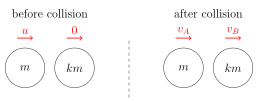
Two particles \(A\) and \(B\) of masses \(m\) and \(km\), respectively, are at rest on a smooth horizontal surface. The direction of the line passing through \(A\) and \(B\) is perpendicular to a vertical wall which is on the other side of \(B\) from \(A\). The particle \(A\) is now set in motion towards \(B\) with speed \(u\). The coefficient of restitution between \(A\) and \(B\) is \(e_1\) and between \(B\) and the wall is \(e_2\). Show that there will be a second collision between \(A\) and \(B\) provided $$ k< \frac {1+e_2(1+e_1)} {e_1}\;. $$ Show that, if \(e_1=\frac13\), \(e_2=\frac12\) and \(k<5\), then the kinetic energy of \(A\) and \(B\) immediately after \(B\) rebounds from the wall is greater than \(mu^2/27\).
Solution: First collision:
2000 Paper 3 Q9
Two small discs of masses \(m\) and \(\mu m\) lie on a smooth horizontal surface. The disc of mass \(\mu m\) is at rest, and the disc of mass \(m\) is projected towards it with velocity \(\mathbf{u}\). After the collision, the disc of mass \(\mu m\) moves in the direction given by unit vector \(\mathbf{n}\). The collision is perfectly elastic.
- Show that the speed of the disc of mass \(\mu m\) after the collision is \ \ $ \dfrac {2\mathbf{u} \cdot \mathbf{n}}{1+\mu}. $
- Given that the two discs have equal kinetic energy after the collision, find an expression for the cosine of the angle between \(\bf n\) and \(\bf u\) and show that \(3-\sqrt8\le \mu \le 3+\sqrt8\).
Solution:
- In the direction of \(\mathbf{n}\), Conservation of momentum gives: \(m \mathbf{u} \cdot \mathbf{n} = m v_m + \mu m v_{\mu m}\) Newton's experimental law gives: \(\frac{\mathbf{u} \cdot \mathbf{n}}{v_{\mu m} - v_m} = 1\) Therefore \begin{align*} && \mathbf{u} \cdot \mathbf{n} &= v_m + \mu v_{\mu m} \\ && \mathbf{u} \cdot \mathbf{n} &= v_{\mu m} - v_m \\ \Rightarrow && 2 \mathbf{u} \cdot \mathbf{n} &= (1 + \mu)v_{\mu m} \\ \Rightarrow && v_{\mu m} &= \frac{2 \mathbf{u} \cdot \mathbf{n}}{1 + \mu} \\ \end{align*}
- Kinetic energy after the collision for the second mass is: \(\frac12 m \mu \frac{4 (\mathbf{u} \cdot \mathbf{n})^2 }{(1 + \mu)^2}\) For the first mass the final speed (in the direction \(\mathbf{n}\) is: \(\mathbf{u} \cdot \mathbf{n}- \frac{2 \mathbf{u} \cdot \mathbf{n}}{1 + \mu} = \frac{(\mu - 1) \mathbf{u} \cdot \mathbf{n}}{1 + \mu}\) It's velocity perpendicular to \(\mathbf{n}\) is unchanged, which is \(\mathbf{u} - (\mathbf{u} \cdot \mathbf{n}) \mathbf{n}\), so it's speed squared is \(\mathbf{u}\cdot \mathbf{u} - (\mathbf{u} \cdot \mathbf{n})^2\) Therefore the total kinetic energy is: \(\frac12 m \frac{(\mu - 1)^2 (\mathbf{u} \cdot \mathbf{n})^2}{(1 + \mu)} + \frac12 m (\mathbf{u}\cdot \mathbf{u} - (\mathbf{u} \cdot \mathbf{n})^2)\) Therefore since the kinetic energies are equal we have: \begin{align*} && \frac12 m \frac{(\mu - 1)^2 (\mathbf{u} \cdot \mathbf{n})^2}{(1 + \mu)} + \frac12 m (\mathbf{u}\cdot \mathbf{u} - (\mathbf{u} \cdot \mathbf{n})^2) &= \frac12 m \mu \frac{4 (\mathbf{u} \cdot \mathbf{n})^2 }{(1 + \mu)^2} \\ \Rightarrow && \frac{(\mu - 1)^2 (\mathbf{u} \cdot \mathbf{n})^2}{(1 + \mu)} + (\mathbf{u}\cdot \mathbf{u} - (\mathbf{u} \cdot \mathbf{n})^2) &= \mu \frac{4 (\mathbf{u} \cdot \mathbf{n})^2 }{(1 + \mu)^2} \\ \Rightarrow && (\mathbf{u} \cdot \mathbf{n})^2 \l 1 + \frac{4\mu}{(1+ \mu)^2} - \frac{(1-\mu)^2}{(1+ \mu)^2} \r &= (\mathbf{u} \cdot \mathbf{u}) \\ \Rightarrow && (\mathbf{u} \cdot \mathbf{n})^2 \l \frac{(1 + \mu)^2 + 4\mu - (1-\mu)^2}{(1+ \mu)^2} \r &= (\mathbf{u} \cdot \mathbf{u}) \\ \Rightarrow && (\mathbf{u} \cdot \mathbf{n})^2 \l \frac{8\mu}{(1+ \mu)^2} \r &= (\mathbf{u} \cdot \mathbf{u}) \\ \Rightarrow && \cos^2 \theta &=\frac{(1 + \mu)^2}{8\mu} \\ \end{align*} We need \begin{align*} && \frac{(1 + \mu)^2}{8\mu} & \leq 1 \\ \Rightarrow && 1 +2 \mu + \mu^2 \leq 8 \mu \\ \Rightarrow && 1 - 6 \mu + \mu^2 \leq 0 \end{align*} This quadratic has roots at \(3 \pm \sqrt{8}\) and therefore our quadratic inequality is satisfied if: \(\boxed{3 - \sqrt{8} \leq \mu \leq 3 + \sqrt{8}}\)
1999 Paper 2 Q10
\(N\) particles \(P_1\), \(P_2\), \(P_3\), \(\ldots\), \(P_N\) with masses \(m\), \(qm\), \(q^2m\), \(\ldots\) , \({q^{N-1}}m\), respectively, are at rest at distinct points along a straight line in gravity-free space. The particle \(P_1\) is set in motion towards \(P_2\) with velocity \(V\) and in every subsequent impact the coefficient of restitution is \(e\), where \(0 < e < 1\). Show that after the first impact the velocities of \(P_1\) and \(P_2\) are $$ {\left({{1-eq}\over{1+q}}\right)}V \mbox{ \ \ \ and \ \ \ } {\left({{1+e}\over{1+q}}\right)}V, $$ respectively. Show that if \(q \le e\), then there are exactly \(N-1\) impacts and that if \(q=e\), then the total loss of kinetic energy after all impacts have occurred is equal to $$ {1\over 2}{me}{\left(1-e^{N-1}\right)}{V^2}. $$
1998 Paper 3 Q10
Two identical spherical balls, moving on a horizontal, smooth table, collide in such a way that both momentum and kinetic energy are conserved. Let \({\bf v}_1\) and \({\bf v}_2\) be the velocities of the balls before the collision and let \({\bf v}'_1\) and \({\bf v}'_2\) be the velocities of the balls after the collision, where \({\bf v}_1\), \({\bf v}_2\), \({\bf v}'_1\) and \({\bf v}'_2\) are two-dimensional vectors. Write down the equations for conservation of momentum and kinetic energy in terms of these vectors. Hence show that their relative speed is also conserved. Show that, if one ball is initially at rest but after the collision both balls are moving, their final velocities are perpendicular. Now suppose that one ball is initially at rest, and the second is moving with speed \(V\). After a collision in which they lose a proportion \(k\) of their original kinetic energy (\(0\le k\le 1\)), the direction of motion of the second ball has changed by an angle \(\theta\). Find a quadratic equation satisfied by the final speed of the second ball, with coefficients depending on \(k\), \(V\) and \(\theta\). Hence show that \(k\le \frac{1}{2}\).
Solution: \begin{align*} \text{COM}: && \mathbf{v}_1+\mathbf{v}_2 &= \mathbf{v}_1'+\mathbf{v}_2' \tag{1}\\ \text{COE}: && \mathbf{v}_1\cdot\mathbf{v}_1+\mathbf{v}_2\cdot\mathbf{v}_2 &= \mathbf{v}_1'\cdot\mathbf{v}_1'+\mathbf{v}_2'\cdot\mathbf{v}_2' \tag{2} \\ \\ (1): && (\mathbf{v}_1+\mathbf{v}_2 )\cdot(\mathbf{v}_1+\mathbf{v}_2 ) &= (\mathbf{v}_1'+\mathbf{v}_2' )\cdot(\mathbf{v}_1'+\mathbf{v}_2' ) \\ \Rightarrow && \mathbf{v}_1 \cdot \mathbf{v}_2 &= \mathbf{v}_1'\cdot \mathbf{v}_2' \\ && \text{Initial relative speed}^2 &= |\mathbf{v}_1 - \mathbf{v}_2|^2 \\ &&&= (\mathbf{v}_1 - \mathbf{v}_2) \cdot (\mathbf{v}_1 - \mathbf{v}_2) \\ &&&= \mathbf{v}_1\cdot \mathbf{v}_1 - 2 \mathbf{v}_1\cdot \mathbf{v}_2 + \mathbf{v}_2\cdot \mathbf{v}_2 \\ &&&= \mathbf{v}_1'\cdot\mathbf{v}_1'+\mathbf{v}_2'\cdot\mathbf{v}_2' -2 \mathbf{v}_1\cdot\mathbf{v}_2\\ &&&= \mathbf{v}_1'\cdot\mathbf{v}_1'+\mathbf{v}_2'\cdot\mathbf{v}_2' -2 \mathbf{v}_1'\cdot\mathbf{v}_2'\\ &&&= | \mathbf{v}_1'-\mathbf{v}_2'|^2 \\ &&&= \text{Final relative speed}^2 \end{align*} Since \(\mathbf{v}_1 \cdot 0 = 0\) we must have \(\mathbf{v}_1'\cdot\mathbf{v}_2' = \mathbf{v}_1\cdot0 = 0\) therefore their final velocities are perpendicular. We now must have \begin{align*} \text{COM}: && \mathbf{v}_1+\mathbf{v}_2 &= \mathbf{v}_1'+\mathbf{v}_2' \tag{3}\\ \Delta\text{E}: && (1-k)(\mathbf{v}_1\cdot\mathbf{v}_1+\mathbf{v}_2\cdot\mathbf{v}_2) &= \mathbf{v}_1'\cdot\mathbf{v}_1'+\mathbf{v}_2'\cdot\mathbf{v}_2' \tag{4} \\ \\ && 0 + \mathbf{v}_2 &= \mathbf{v}_1' + \mathbf{v}_2' \\ \Rightarrow && V^2 &= ( \mathbf{v}_1' + \mathbf{v}_2' ) \cdot ( \mathbf{v}_1' + \mathbf{v}_2' ) \\ &&&= \mathbf{v}_1'\cdot\mathbf{v}_1'+\mathbf{v}_2'\cdot\mathbf{v}_2' +2 \mathbf{v}_1'\cdot \mathbf{v}_2' \\ &&&= (1-k)V^2 + 2 (\mathbf{v}_2-\mathbf{v}_2') \cdot \mathbf{v}_2' \\ &&&= (1-k)V^2 + 2 \mathbf{v}_2 \cdot \mathbf{v}_2'-2\mathbf{v}_2'\cdot \mathbf{v}_2' \\ &&&= (1-k)V^2 + 2Vx \cos \theta - 2x^2 \\ \Rightarrow && 0 &= -kV^2 + 2Vx \cos \theta -2x^2 \\ \Delta \geq 0: && 0 &\leq 4V^2 \cos^2 \theta -8kV^2 \\ \Rightarrow && k &\leq \frac12\cos^2\theta \leq \frac12 \end{align*}
1996 Paper 1 Q10
A spaceship of mass \(M\) is at rest. It separates into two parts in an explosion in which the total kinetic energy released is \(E\). Immediately after the explosion the two parts have masses \(m_{1}\) and \(m_{2}\) and speeds \(v_{1}\) and \(v_{2}\) respectively. Show that the minimum possible relative speed \(v_{1}+v_{2}\) of the two parts of the spaceship after the explosion is \((8E/M)^{1/2}.\)
1993 Paper 2 Q14
A ball of mass \(m\) is thrown vertically upwards from the floor of a room of height \(h\) with speed \(\sqrt{2kgh},\) where \(k>1.\) The coefficient of restitution between the ball and the ceiling or floor is \(a\). Both the ceiling and floor are level. Show that the kinetic energy of the ball immediately before hitting the ceiling for the \(n\)th time is \[ mgh\left(a^{4n-4}(k-1)+\frac{a^{4n-4}-1}{a^{2}+1}\right). \] Hence show that the number of times the ball hits the ceiling is at most \[ 1-\frac{\ln[a^{2}(k-1)+k]}{4\ln a}. \]
Solution: \begin{align*} && \text{energy when projected} &= \frac12 m(2kgh) \\ &&&= kghm \\ && \text{energy when hitting ceiling the first time} &= mgh + \frac12 m v^2 \\ \text{COE}: && kghm &= mgh + \frac12 mv^2 \\ \Rightarrow && v^2 &= 2gh(k-1) \end{align*} It will rebound with speed \(\sqrt{2gh(k-1)}a\). \begin{align*} && \text{energy when rebounding from ceiling} &=gh(k-1)a^2 + mgh \\ && \text{energy before hitting the floor} &= \frac12 mv^2 \\ \text{COE}: && gh(k-1)a^2 + mgh &= \frac12 mv^2 \\ \Rightarrow && v^2 &= 2gh((k-1)a^2+1) \end{align*} The ball will rebound with kinetic energy \(m gh((k-1)a^2+1)a^2 = mgh((k-1)a^4+a^2)\) And will reach the ceiling with kinetic energy \(mgh((k-1)a^4+a^2-1)\). When \(n = 1\), the kinetic energy (before hitting the ceiling for the first time) is \(mgh(k-1)\). Suppose \(s_n\) is the expression for the kinetic energy divided by \(mgh\), ie \(s_1 = k-1\), then: Clearly \(s_1 = k-1 = a^{4\cdot1-4}(k-1) + \frac{a^{4\cdot-4}-1}{a^2+1}\), so our hypothesis holds for \(n=1\). Suppose it is true for \(n\), then the \(n+1\)th time it will be: \begin{align*} s_{n+1} &= s_n a^4+a^2-1 \\ &= \left ( a^{4n-4}(k-1)+\frac{a^{4n-4}-1}{a^{2}+1} \right) a^4 + a^2 - 1 \\ &= a^{4(n+1)-4}(k-1) + \frac{a^{4(n+1)-4}-a^4}{a^2+1} + \frac{a^4-1}{a^2+1} \\ &= a^{4(n+1)-4}(k-1) + \frac{a^{4(n+1)-4}-a^4+a^4-1}{a^2+1} \\ &= a^{4(n+1)-4}(k-1) + \frac{a^{4(n+1)-4}-1}{a^2+1} \end{align*} Which is our desired expression, therefore it is true by induction. We wont reach the ceiling if this energy is not positive, ie: \begin{align*} && 0 &\leq a^{4n-4}(k-1)+\frac{a^{4n-4}-1}{a^{2}+1} \\ \Rightarrow && \frac{1}{a^2+1}&\geq a^{4n-4}\left (k - 1 + \frac{1}{a^2+1} \right) \\ \Rightarrow && a^{4n-4} &\geq \frac{1}{a^2+1} \cdot \frac{1}{k - 1 + \frac{1}{a^2+1}} \\ \Rightarrow && a^{4n-4} &\geq \frac{1}{(k-1)(a^2+1)+1} \\ \Rightarrow && 4(n-1) \ln a &\geq - \ln[(k-1)(a^2+1)+1] \\ \underbrace{\Rightarrow}_{\ln a < 0} && (n-1) &\leq \frac{ - \ln[(k-1)(a^2+1)+1]}{4\ln a} \\ \Rightarrow && n & \leq 1 -\frac{ \ln[(k-1)(a^2+1)+1]}{4\ln a} \\ &&&= 1 -\frac{ \ln[(k-1)a^2+k]}{4\ln a} \end{align*}