Problems
Filters
7 problems found
2021 Paper 3 Q6
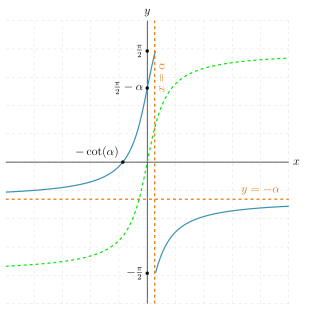
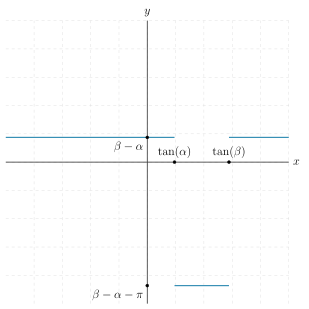
- For \(x \neq \tan\alpha\), the function \(f_\alpha\) is defined by \[ f_\alpha(x) = \tan^{-1}\!\left(\frac{x\tan\alpha + 1}{\tan\alpha - x}\right) \] where \(0 < \alpha < \tfrac{1}{2}\pi\). Show that \(f_\alpha'(x) = \dfrac{1}{1 + x^2}\). Hence sketch \(y = f_\alpha(x)\). On a separate diagram, sketch \(y = f_\alpha(x) - f_\beta(x)\) where \(0 < \alpha < \beta < \tfrac{1}{2}\pi\).
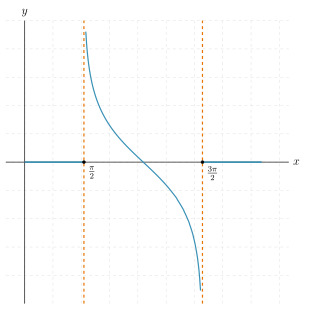
- For \(0 \leqslant x \leqslant 2\pi\) and \(x \neq \tfrac{1}{2}\pi,\, \tfrac{3}{2}\pi\), the function \(g(x)\) is defined by \[ g(x) = \tanh^{-1}(\sin x) - \sinh^{-1}(\tan x). \] For \(\tfrac{1}{2}\pi < x < \tfrac{3}{2}\pi\), show that \(g'(x) = 2\sec x\). Use this result to sketch \(y = g(x)\) for \(0 \leqslant x \leqslant 2\pi\).
Solution:
- \(\,\) \begin{align*}
&& f_\alpha(x) &= \tan^{-1}\!\left(\frac{x\tan\alpha + 1}{\tan\alpha - x}\right) \\
&& f'_\alpha(x) &= \frac{1}{1 + \left(\frac{x\tan\alpha + 1}{\tan\alpha - x}\right) ^2} \cdot \frac{\tan \alpha \cdot (\tan \alpha - x) - (x \tan \alpha + 1) \cdot (-1)}{(\tan \alpha - x)^2} \\
&&&= \frac{\tan^2 \alpha -1}{(\tan \alpha - x)^2 + (x \tan \alpha +1)^2} \\
&&&= \frac{\tan^2 \alpha +1}{\tan^2 \alpha - 2x \tan \alpha + x^2 + x^2 \tan^2 \alpha + 2 x \tan \alpha + 1} \\
&&&= \frac{1+\tan^2 \alpha}{(1+\tan^2 \alpha(x^2 + 1)} = \frac{1}{1+x^2}
\end{align*}
- Let \(g(x) = \tanh^{-1}(\sin x) - \sinh^{-1}(\tan x)\) then
\begin{align*}
&& g'(x) &= \frac{1}{1-\sin^2 x} \cdot \cos x - \frac{1}{\sqrt{\tan^2 +1}} \cdot \sec^2 x \\
&&&= \sec x - \frac{\sec^2 x}{|\sec x|} \\
&&& = \begin{cases} 0 &\text{if } \sec x \geq 0 \\
2 \sec x &\text{ otherwise}
\end{cases}
\end{align*}
Therefore \(g'(x) = 2\sec x\) if \(\tfrac12 \pi < x < \tfrac32\pi\)
Therefore $\displaystyle g(x) = \begin{cases} 0 & \text{if } x \in [0, \frac{\pi}{2}] \cup [\frac{3\pi}{2}, 2\pi] \\
\ln( (\tan x + \sec x)^2) + C &\text{otherwise} \end{cases}$
2016 Paper 1 Q2
Differentiate, with respect to \(x\), \[ (ax^2+bx+c)\,\ln \big( x+\sqrt{1+x^2}\big) +\big(dx+e\big)\sqrt{1+x^2} \,, \] where \(a\), \(b\), \(c\), \(d\) and \(e\) are constants. You should simplify your answer as far as possible. Hence integrate:
- \( \ln \big( x+\sqrt{1+x^2}\,\big) \,;\)
- \(\sqrt{1+x^2} \,; \)
- \( x\ln \big( x+\sqrt{1+x^2}\,\big) \,.\)
Solution: \begin{align*} && y &= (ax^2+bx+c)\,\ln \big( x+\sqrt{1+x^2}\big) +\big(dx+e\big)\sqrt{1+x^2} \\ && y' &= (2ax+b)\,\ln \big( x+\sqrt{1+x^2}\big) + (ax^2+bx+c) \frac{1}{x + \sqrt{1+x^2}} \cdot \left(1 + \frac{x}{\sqrt{1+x^2}} \right) + d\sqrt{1+x^2} + \frac{x(dx+e)}{\sqrt{1+x^2}} \\ &&&= (2ax+b)\,\ln \big( x+\sqrt{1+x^2}\big) + \frac{1}{\sqrt{1+x^2}} \left ( (ax^2+bx+c) + d(1+x^2) + x(dx+e) \right) \\ &&&= (2ax+b)\,\ln \big( x+\sqrt{1+x^2}\big) + \frac{1}{\sqrt{1+x^2}} \left ( (a+2d)x^2+(b+e)x+(d+c) \right) \\ \end{align*}
- We want \(a = 0, b = 1, d = 0, e = -1, c =0\), so \begin{align*} I &= \int \ln \big( x+\sqrt{1+x^2}\,\big) \,\d x \\ &= x\ln(x+\sqrt{1+x^2})-\sqrt{1+x^2}+C \end{align*}
- We want \(a = b =0, e = 0, d = \frac12, c = \frac12\), so \begin{align*} I &= \int \sqrt{1+x^2}\, \d x \\ &= \frac12\ln(x+\sqrt{1+x^2}) + \frac12x\sqrt{1+x^2}+C \end{align*}
- We want \(a = \frac12, b = 0, d = -\frac14, e = 0, c = \frac14\), so \begin{align*} I &= \int x \ln (x+\sqrt{1+x^2}) \, \d x \\ &= \left (\frac12 x^2+\frac14 \right)\ln(x+\sqrt{1+x^2}) -\frac14x\sqrt{1+x^2}+C \end{align*}
2011 Paper 3 Q6
The definite integrals \(T\), \(U\), \(V\) and \(X\) are defined by \begin{align*} T&= \int_{\frac13}^{\frac12} \frac{{\rm artanh}\, t}t \,\d t\,, & U&= \int _{\ln 2 }^{\ln 3 } \frac{u}{2\sinh u}\, \d u \,, \\[3mm] V&= - \int_{\frac13}^{\frac12} \frac{\ln v}{1-v^2} \,\d v \,, & X&= \int _{\frac12\ln2}^{\frac12\ln3} \ln ({\coth x})\, \d x\,. \end{align*} Show, without evaluating any of them, that \(T\), \(U\), \(V\) and \(X\) are all equal.
Solution: \begin{align*} && T &= \int_{\frac13}^{\frac12} \frac{{\rm artanh}\, t}t \,\d t \\ && &=\int_{\frac13}^{\frac12} \frac{1}{2t}\ln \left ( \frac{1+t}{1-t} \right) \,\d t \\ u = \tfrac{1+t}{1-t}, t= \tfrac{u-1}{u+1}, \d t = \tfrac{2}{(u+1)^2} \d t &&&= \int_{u=2}^{u=3} \frac{1}{2t} \ln u \frac{2}{(u+1)^2} \d u \\ &&&= \int_2^3 \frac{u+1}{u-1} \ln u \frac{1}{(u+1)^2} \d u \\ &&&= \int_2^3 \frac{1}{u^2-1} \ln u \d u \end{align*} \begin{align*} && U&= \int _{\ln 2 }^{\ln 3 } \frac{u}{2\sinh u}\, \d u \\ v = e^u, \d v = e^u \d u &&&= \int_{v=2}^{v=3} \frac{\ln v}{v - \frac{1}{v}} \frac{1}{v} \d v \\ &&&= \int_2^3 \frac{1}{v^2-1} \ln v \d v \end{align*} \begin{align*} &&V &= - \int_{\frac13}^{\frac12} \frac{\ln v}{1-v^2} \,\d v \\ u = \tfrac1v, \d u = -\tfrac1{v^2} \d v &&&= -\int_{u=3}^{u=2} \frac{-\ln u}{1 - \frac{1}{u^2}} \frac{-1}{u^2} \d u \\ &&&= -\int_3^2 \frac{\ln u}{u^2-1} \d u \\ &&&= \int_2^3 \frac{1}{u^2-1} \ln u \d u \end{align*} \begin{align*} &&X&= \int _{\frac12\ln2}^{\frac12\ln3} \ln ({\coth x})\, \d x \\ u = \coth x, \d u =(1-u^2) \d x &&&= \int_{u = 3}^{u=2} \ln u \frac{1}{1-u^2} \d u \\ &&&= \int_2^3 \frac{\ln u}{u^2-1} \d u \end{align*} Therefore all integrals are equal to the same integral, namely \(\displaystyle \int_2^3 \frac{\ln u}{u^2-1} \d u\)
2003 Paper 3 Q1
Given that \(x+a>0\) and \(x+b>0\,\), and that \(b>a\,\), show that \[ \frac{\mathrm{d} \ }{\mathrm{d} x} \arcsin \left ( \frac{x + a }{ \ x + b} \right) = \frac{ \sqrt{\;b - a\;}} {( x + b ) \sqrt{ a + b + 2x} \ \ } \] and find $\displaystyle \frac{\mathrm{d} \ }{ \mathrm{d} x} \; \mathrm{arcosh} \left ( \frac{x + b }{ \ x + a} \right)$. Hence, or otherwise, integrate, for \(x > -1\,\),
- \[ \int \frac{1}{ ( x + 1) \sqrt{x + 3} } \mathrm{d} x \]
- \[ \int \frac{1} {( x + 3 ) \sqrt{x + 1} } \mathrm{d} x \] .
Solution: \begin{align*} \frac{\mathrm{d} \ }{\mathrm{d} x} \arcsin \left ( \frac{x + a }{ \ x + b} \right ) &= \frac{1}{\sqrt{1-\left ( \frac{x + a }{ \ x + b} \right )^2}} \left ( \frac{b-a}{(x+b)^2} \right) \\ &= \frac{b-a}{(x+b)\sqrt{(x+b)^2-(x+a)^2}} \\ &= \frac{b-a}{(x+b)\sqrt{(b-a)(2x+b+a)}} \\ &= \frac{\sqrt{b-a}}{(x+b)\sqrt{a+b+2x}} \\ \\ \frac{\mathrm{d} \ }{ \mathrm{d} x} \; \mathrm{arcosh} \left ( \frac{x + b }{ \ x + a} \right) &= \frac{1}{\sqrt{\left ( \frac{x + b }{ \ x + a} \right)^2-1}} \left ( -\frac{b-a}{(x+a)^2} \right) \\ &= -\frac{b-a}{(x+a)\sqrt{(x+b)^2-(x+a)^2}} \\ &= -\frac{b-a}{(x+a)\sqrt{(b-a)(a+b+2x)}} \\ &= -\frac{\sqrt{b-a}}{(x+a)\sqrt{a+b+2x}} \end{align*}
- \begin{align*} \int \frac{1}{ ( x + 1) \sqrt{x + 3} } \mathrm{d} x &= \int \frac{1}{(x+1)\sqrt{\frac12 (2x+6)}} \d x\\ &= \int \frac{\sqrt{2}}{(x+1)\sqrt{2x+1+5}} \d x \\ &= \frac{\sqrt{2}}{2}\int \frac{\sqrt{5-1}}{(x+1)\sqrt{2x+1+5}} \d x \\ &= - \frac{\sqrt{2}}{2}\textrm{arcosh} \left ( \frac{x+5}{x+1} \right) + C \end{align*}
- \begin{align*} \int \frac{1}{(x+3)\sqrt{x+1}} \d x &= \int \frac{1}{(x+3)\sqrt{\tfrac12(2x+2)}} \d x + C \\ &= \int \frac{\sqrt{3-1}}{(x+3)\sqrt{2x+3-1}} \d x \\ &= \textrm{arcsin} \left ( \frac{x-1}{x+3} \right) \end{align*}
2001 Paper 3 Q2
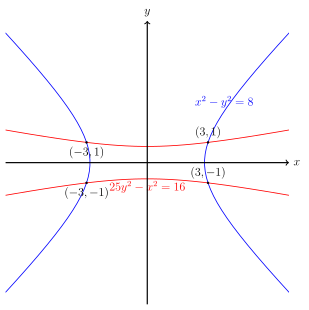
Show that \( \cosh^{-1} x = \ln ( x + \sqrt{x^2-1})\). Show that the area of the region defined by the inequalities \(\displaystyle y^2 \ge x^2-8\) and \(\displaystyle x^2\ge 25y^2 -16 \) is \((72/5) \ln 2\).
Solution: \begin{align*} && x &= \cosh y \\ \Rightarrow && x &= \tfrac12 (e^y + e^{-y} ) \\ \Rightarrow && 0 &= e^{2y} - 2xe^y + 1 \\ \Rightarrow && e^y &= \frac{2x \pm \sqrt{4x^2-4}}{2} \\ &&&= x \pm \sqrt{x^2-1} \\ \Rightarrow &&e^y &= x + \sqrt{x^2-1} \tag{by convention \(\cosh^{-1} > 0\)} \\ \Rightarrow && y &= \ln (x + \sqrt{x^2-1}) \end{align*}
1989 Paper 3 Q5
Given that \(y=\cosh(n\cosh^{-1}x),\) for \(x\geqslant1,\) prove that \[ y=\frac{(x+\sqrt{x^{2}-1})^{n}+(x-\sqrt{x^{2}-1})^{n}}{2}. \] Explain why, when \(n=2k+1\) and \(k\in\mathbb{Z}^{+},\) \(y\) can also be expressed as the polynomial \[ a_{0}x+a_{1}x^{3}+a_{2}x^{5}+\cdots+a_{k}x^{2k+1}. \] Find \(a_{0},\) and show that
- \(a_{1}=(-1)^{k-1}2k(k+1)(2k+1)/3\);
- \(a_{2}=(-1)^{k}2(k-1)k(k+2)(2k+1)/15.\)
Solution: Recall, \(\cosh^{-1} x = \ln (x + \sqrt{x^2-1})\) \begin{align*} \cosh(n \cosh^{-1} x) &= \frac12 \left ( \exp(n \cosh^{-1} x) + \exp(-n\cosh^{-1}x) \right) \\ &= \frac12 \left ((x + \sqrt{x^2-1})^n + (x + \sqrt{x^2-1})^{-n} \right) \\ &= \frac12 \left ((x + \sqrt{x^2-1})^n + (x - \sqrt{x^2-1})^{n} \right) \\ \end{align*} When \(n = 2k+1\) \begin{align*} \cosh(n \cosh^{-1} x)&= \frac12 \left ((x + \sqrt{x^2-1})^n + (x - \sqrt{x^2-1})^{n} \right) \\ &= \frac12 \left (\sum_{i=0}^{2k+1}\binom{2k+1}{i}x^{2k+1-i}\left ( (\sqrt{x^2-1}^{i} + (-\sqrt{x^2-1})^{i} \right) \right) \\ &=\sum_{i=0}^{k} \binom{2k+1}{2i}x^{2k+1-2i}(x^2-1)^i \\ &=\sum_{i=0}^{k} \binom{2k+1}{2i}x^{2(k-i)+1}(x^2-1)^i \\ \end{align*} Which is clearly a polynomial with only odd degree terms. \begin{align*} a_0 &= \frac{\d y}{\d x} \vert_{x=0} \\ &= \sum_{i=0}^k\binom{2k+1}{2i} \left ( (2(k-i)+1)x^{2(k-i)}(x^2-1)^i + 2i\cdot x^{2(k-i)+2}(x^2-1) \right) \\ &= \binom{2k+1}{2k} (-1)^{k} \\ &= (-1)^k(2k+1) \end{align*}
- \begin{align*} a_1 &= \binom{2k+1}{2k}\binom{k}{1}(-1)^{k-1}+\binom{2k+1}{2(k-1)}(-1)^{k-1} \\ &=(-1)^{k-1}\cdot ( (2k+1)k + \frac{(2k+1)\cdot 2k \cdot (2k-1)}{3!}) \\ &= (-1)^{k-1}(2k+1)k\frac{3 + 2k-1}{3} \\ &= (-1)^{k-1}2(2k+1)k (k+1) \end{align*}
- \begin{align*} a_2 &= \binom{2k+1}{2k} \binom{k}{2}(-1)^{k-2} + \binom{2k+1}{2(k-1)} \binom{k-1}{1} (-1)^{k-2}+\binom{2k+1}{2(k-2)} (-1)^{k-2} \\ &= \binom{2k+1}{1} \binom{k}{2}(-1)^{k-2} + \binom{2k+1}{3} \binom{k-1}{1} (-1)^{k-2}+\binom{2k+1}{5} (-1)^{k-2} \\ &= (-1)^{k} \left (\binom{2k+1}{1} \frac{k(k-1)}{2} + \binom{2k+1}{3}(k-1)+\binom{2k+1}{5} \right) \\ &= (-1)^{k} \left ( \frac{(2k+1)k(k-1)}{2} + \frac{(2k+1)k(2k-1)}{3} + \frac{(2k+1)k(2k-1)(k-1)(2k-3)}{5\cdot2\cdot3} \right) \\ &= (-1)^k (2k+1)k\frac{1}{30} \left ( 15(k-1) + 10(2k-1)+(2k-1)(k-1)(2k-3) \right) \end{align*}
1987 Paper 3 Q4

Solution: The initial volume of water in \(A\) is: \begin{align*} \pi \int_0^4 x^2 \, \d y &= \pi \int_0^4 y \d y \\ &= \pi [ \frac{y^2}{2}]_0^4 \\ &= 8\pi \end{align*} We assume that no water is in the tube as it is `thin'. Therefore we must have: \begin{align*} && 8\pi &= \pi \int_0^{h-1} x^2 \d y +\pi \int_0^{h} x^2 \d y \\ &&&= \pi \int_0^{h-1} y \d y +\pi \int_0^{h} \l \sinh \frac{x}{2}\r^2 \d y \\ &&&= \pi \left [\frac{y^2}{2} \right]_0^{h-1} + \pi \int_0^h \frac{-1+\cosh y}{2}\d y \\ &&&= \pi \frac{(h-1)^2}{2} + \pi \left [ -\frac{y}{2} +\frac{\sinh y}{2}\right]_0^h \\ &&&= \pi \frac{(h-1)^2}{2} -\pi \frac{h}{2} + \pi \frac{\sinh h}{2} \\ \Rightarrow && 0 &= h^2-2h+1-h+\sinh h -16 \\ &&&= h^2 -3h+\sinh h - 15 \\ \Rightarrow && 15 &= h^2 -3h+\sinh h \end{align*}