Problems
Filters
8 problems found
2019 Paper 1 Q2
The curve \(C\) is given parametrically by the equations \(x = 3t^2\), \(y = 2t^3\). Show that the equation of the tangent to \(C\) at the point \((3p^2 , 2p^3)\) is \(y = px - p^3\). Find the point of intersection of the tangents to \(C\) at the distinct points \((3p^2 , 2p^3)\) and \((3q^2 , 2q^3)\). Hence show that, if these two tangents are perpendicular, their point of intersection is \((u^2 + 1 , -u)\), where \(u = p + q\). The curve \(\tilde{C}\) is given parametrically by the equations \(x = u^2 + 1\), \(y = -u\). Find the coordinates of the points that lie on both \(C\) and \(\tilde{C}\). Sketch \(C\) and \(\tilde{C}\) on the same axes.
Solution: \begin{align*} && \frac{\d y}{\d x} &= \frac{\frac{\d y}{\d t}}{\frac{\d x}{\d t}} \\ &&&= \frac{6t^2}{6t} = t \\ \Rightarrow && \frac{y-2p^3}{x - 3p^2} &= p \\ \Rightarrow && y &= px-3p^3+2p^3 \\ && y &= px - p^3 \end{align*} The two lines will be \begin{align*} && y &= px - p^3 \\ && y &= qx - q^3 \\ \Rightarrow && p^3-q^3 &= (p-q)x \\ \Rightarrow && x &= p^2+pq+q^2 \\ && y &= p(p^2+pq+q^2)-p^3 \\ &&&= pq(p+q) \\ && (x,y) &= (p^2+pq+q^2,pq(p+q)) \\ \end{align*} If the tangents are \(\perp\) then \(pq=-1\), so we have \begin{align*} && (x,y) &= (p^2+2pq+q^2-pq, pq(p+q)) \\ &&&= ((p+q)^2-1, -(p+q)) \\ &&&= (u^2-1, -u) \end{align*} We have \(x = y^2+1\) and \(\left ( \frac{x}{3} \right)^3 = \left ( \frac{y}{2}\right)^2 \Rightarrow y^2 = \frac{4}{27}x^3\) so \begin{align*} && 0 &= \frac{4}{27}x^3-x+1 \\ &&0&=4x^3-27x+27 \\ &&&= (x+3)(2x-3)^2 \end{align*} So we have the points \((x,y) = \left (\frac32, \pm\frac{1}{\sqrt{2}}\right)\)

2016 Paper 2 Q1
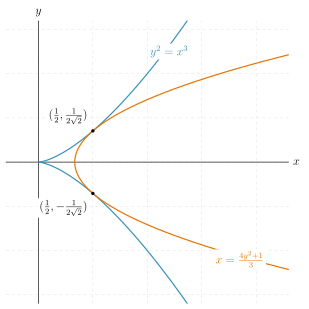
The curve \(C_1\) has parametric equations \(x=t^2\), \(y= t^3\), where \(-\infty < t < \infty\,\). Let \(O\) denote the point \((0,0)\). The points \(P\) and \(Q\) on \(C_1\) are such that \(\angle POQ\) is a right angle. Show that the tangents to \(C_1\) at \(P\) and \(Q\) intersect on the curve \(C_2\) with equation \(4y^2=3x-1\). Determine whether \(C_1\) and \(C_2\) meet, and sketch the two curves on the same axes.
Solution: \(\angle POQ = 90^\circ\) means that if \(P(p^2,p^3)\) and \(Q(q^2,q^3)\) are our points then \(OP^2+OQ^2 = PQ^2\), so \begin{align*} && p^4+p^6+q^4+q^6 &= (p^2-q^2)^2+(p^3-q^3)^2 \\ &&&= p^4+q^4-2p^2q^2+p^6+q^6-2p^3q^3 \\ \Rightarrow && 0 &= 2p^2q^2(1+pq) \\ \Rightarrow && pq &= -1 \\ \\ && \frac{\d y}{ \d x} &= \frac{\frac{\d y }{\d t}}{\frac{\d x}{\d t}} \\ &&&= \frac{3t^2}{2t} = \tfrac32t \\ \Rightarrow && \frac{y-p^3}{x-p^2} &= \tfrac32p \\ \Rightarrow && 2(y-p^3) &=3p(x-p^2) \\ && 2(y-q^3) &=3q(x-q^2) \\ \Rightarrow && 2(q^3-p^3) &= (3p-3q)x+3(q^3-p^3) \\ && p^3-q^3 &= 3(p-q)x \\ \Rightarrow && x &= \tfrac13(p^2+q^2+pq) \\ && 2y &= 3p(\tfrac13(p^2+q^2+pq)-p^2)+2p^3 \\ &&&= p(p^2+q^2+pq)-p^3 \\ &&&= pq^2+p^2q \\ &&&= -p-q \\ &&y&= -\frac{p+q}{2} \\ \\ && 4y^2 &= p^2+q^2 \\ && 3x-1 &= p^2+q^2 \\ \end{align*} To check if they meet, try \(4t^6=3t^2 - 1\). Consider \(y = 4x^3-3x+1\) \(y(0) = 1\) and \(y' = 12x^2-3 = 3(4x^2-1)\) which has roots at \(\pm \tfrac12\), therefore we need to test \(y(\tfrac12) = \tfrac12-\tfrac32 + 1 = 0\), so there is a one intersection at \(x = \tfrac1{2}, y = \tfrac1{2\sqrt{2}}\)
2011 Paper 2 Q1
- Sketch the curve \(y=\sqrt{1-x} + \sqrt{3+x}\;\). Use your sketch to show that only one real value of \(x\) satisfies \[ \sqrt{1-x} + \sqrt{3+x} = x+1\,, \] and give this value.
- Determine graphically the number of real values of \(x\) that satisfy \[ 2\sqrt{1-x} = \sqrt{3+x} + \sqrt{3-x}\;. \] Solve this equation.
Solution:
- Clearly the only solution is \(x = 1\)

- There is clearly only one solution, with \(x \approx -2\) \begin{align*} && 4(1-x) &= 6+2\sqrt{9-x^2} \\ && -2x-1 &=\sqrt{9-x^2} \\ \Rightarrow && 4x^2+4x+1 &= 9-x^2 \\ \Rightarrow && 0 &= 5x^2+4x-8 \\ &&x&= \frac{-2\pm 2\sqrt{11}}{5} \\ \Rightarrow && x &= -\left ( \frac{2+2\sqrt{11}}{5} \right) \end{align*}

2007 Paper 1 Q8
A curve is given by the equation \[ y = ax^3 - 6ax^2+ \left( 12a + 12 \right)x - \left( 8a + 16 \right)\,, \tag{\(*\)} \] where \(a\) is a real number. Show that this curve touches the curve with equation \[ y=x^3 \tag{\(**\)} \] at \(\left( 2 \, , \, 8 \right)\). Determine the coordinates of any other point of intersection of the two curves.
- Sketch on the same axes the curves \((*)\) and \((**)\) when \(a = 2\).
- Sketch on the same axes the curves \((*)\) and \((**)\) when \(a = 1\).
- Sketch on the same axes the curves \((*)\) and \((**)\) when \(a = -2\).
Solution: \begin{align*} && y &= ax^3 - 6ax^2+ \left( 12a + 12 \right)x - \left( 8a + 16 \right) \\ && y(2) &= 8a-24a+24a+24-8a-16 \\ &&&= 8 \\ && y'(x) &= 3ax^2-12ax+(12a+12) \\ && y'(0) &= 12a-24a+12a+12 \\ &&&= 12 \end{align*} Therefore since our curve has the same value and gradient at \((2,8)\) as \(y = x^3\) they must touch at this point. Therefore \begin{align*} && ax^3 - 6ax^2+ \left( 12a + 12 \right)x - \left( 8a + 16 \right) - x^3 &= (x-2)^2((a-1)x-(2a+4)) \end{align*} Therefore if \(a \neq 1\), they touch again when \(x = \frac{2a+4}{a-1}\).


2006 Paper 3 Q1
Sketch the curve with cartesian equation \[ y = \frac{2x(x^2-5)}{x^2-4} \] and give the equations of the asymptotes and of the tangent to the curve at the origin. Hence determine the number of real roots of the following equations:
- \(3x(x^2-5)= (x^2-4)(x+3)\,\);
- \(4x(x^2-5)= (x^2-4)(5x-2)\,\);
- \(4x^2(x^2-5)^2= (x^2-4)^2(x^2+1)\,\).
Solution: \begin{align*} && y &= \frac{2x(x^2-5)}{x^2-4} \\ &&&= 2x(x^2-5)(-\tfrac14)(1-\tfrac14x^2)^{-1} \\ &&&= \tfrac52x + \cdots \\ &&&= \frac{2x(x^2-4)-2x}{x^2-4} \\ &&&= 2x - \frac{2x}{x^2-4} \end{align*}

- We are looking for the intersections of \(y = \frac23(x+3)\) and \(y = f(x)\)
Therefore 3 real roots.

- We are looking for intersections of \(y = \frac12(5x-2)\) and \(y = f(x)\)
so one solution.

- We are looking for intersections of \(y = f(x)^2\) and \(y = x^2+1\), or \(y = \sqrt{x^2+1}\) and \(y = f(x)\) where \(f(x) \geq 0\)
So \(3\) solutions.

1992 Paper 3 Q3
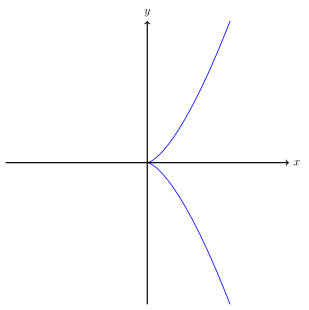
Sketch the curve \(C_{1}\) whose parametric equations are \(x=t^{2},\) \(y=t^{3}.\) The circle \(C_{2}\) passes through the origin \(O\). The points \(R\) and \(S\) with real non-zero parameters \(r\) and \(s\) respectively are other intersections of \(C_{1}\) and \(C_{2}.\) Show that \(r\) and \(s\) are roots of an equation of the form \[ t^{4}+t^{2}+at+b=0, \] where \(a\) and \(b\) are real constants. By obtaining a quadratic equation, with coefficients expressed in terms of \(r\) and \(s\), whose roots would be the parameters of any further intersections of \(C_{1}\) and \(C_{2},\) or otherwise, show that \(O\), \(R\) and \(S\) are the only real intersections of \(C_{1}\) and \(C_{2}.\)
Solution:
1990 Paper 3 Q10
By considering the graphs of \(y=kx\) and \(y=\sin x,\) show that the equation \(kx=\sin x,\) where \(k>0,\) may have \(0,1,2\) or \(3\) roots in the interval \((4n+1)\frac{\pi}{2} < x < (4n+5)\frac{\pi}{2},\) where \(n\) is a positive integer. For a certain given value of \(n\), the equation has exactly one root in this interval. Show that \(k\) lies in an interval which may be written \(\sin\delta < k < \dfrac{2}{(4n+1)\pi},\) where \(0 < \delta < \frac{1}{2}\pi\) and \[ \cos\delta=\left((4n+5)\frac{\pi}{2}-\delta\right)\sin\delta. \] Show that, if \(n\) is large, then \(\delta\approx\dfrac{2}{(4n+5)\pi}\) and obtain a second, improved, approximation.
Solution:

- be below \(((4n+1)\tfrac{\pi}{2}, 1)\) and
- not touch the second gradient
1989 Paper 3 Q4
Sketch the curve whose cartesian equation is \[ y=\frac{2x(x^{2}-5)}{x^{2}-4}, \] and give the equations of the asymptotes and of the tangent to the curve at the origin. Hence, or otherwise, determine (giving reasons) the number of real roots of the following equations:
- \(4x^{2}(x^{2}-5)=(5x-2)(x^{2}-4)\);
- \(4x^{2}(x^{2}-5)^{2}=(x^{2}-4)^{2}(x^{2}+1)\);
- \(4z^{2}(z-5)^{2}=(z-4)^{2}(z+1)\).
Solution:

- \begin{align*} && 4x^{2}(x^{2}-5)&=(5x-2)(x^{2}-4) \\ && \frac{2x(x^2-5)}{x^2-4} &= \frac{5x-2}{2x} = \frac52 -\frac1x \end{align*} Therefore it will have two roots as the hyperbola will intersect our graph in two places. (In the upper left and lower right quadrants).
- \begin{align*}
&& 4x^{2}(x^{2}-5)^{2}&=(x^{2}-4)^{2}(x^{2}+1) \\
&& \frac{2x(x^2-5)}{x^2-4} &= \frac{(x^2-4)(x^2+1)}{2x}
\end{align*}
No solutions \begin{align*} && 4z^{2}(z-5)^{2}&=(z-4)^{2}(z+1) \\ && \frac{2z(z^2-5)}{z^2-4} &= \frac{(z+5)(z-4)(z+1)}{(z-5)(z+4)} \end{align*}
 5 solutions