Problems
Filters
4 problems found
2019 Paper 3 Q7
The Devil's Curve is given by $$y^2(y^2 - b^2) = x^2(x^2 - a^2),$$ where \(a\) and \(b\) are positive constants.
- In the case \(a = b\), sketch the Devil's Curve.
- Now consider the case \(a = 2\) and \(b = \sqrt{5}\), and \(x \geq 0\), \(y \geq 0\).
- Show by considering a quadratic equation in \(x^2\) that either \(0 \leq y \leq 1\) or \(y \geq 2\).
- Describe the curve very close to and very far from the origin.
- Find the points at which the tangent to the curve is parallel to the \(x\)-axis and the point at which the tangent to the curve is parallel to the \(y\)-axis.
- Sketch the Devil's Curve in the case \(a = 2\) and \(b = \sqrt{5}\) again, but with \(-\infty < x < \infty\) and \(-\infty < y < \infty\).
Solution:
- Suppose \(a=b\), ie
\begin{align*}
&& y^2(y^2-a^2) &= x^2(x^2-a^2) \\
\Rightarrow && 0 &= x^4-y^4-a^2(x^2-y^2) \\
&&&= (x^2-y^2)(x^2+y^2-a^2)
\end{align*}
Therefore we have the lines \(y = \pm x\) and a circle radius \(a\).

- Since \(x^4 - 4x^2 - y^2(y^2-5)= 0\), we must have \(0 \leq \Delta = 16 + 4y^2(y^2-5) \Rightarrow y^4-5y^2+4 = (y^2-4)(y^2-1) \geq 0\), therefore \(0 \leq y \leq 1\) or \(y \geq 2\) (since we are only considering positive values of \(y\)).
- When \((x, y) \approx 0\) the equation is more like \(4x^2 \approx 5y^2\) or \(y \approx \frac{2}{\sqrt{5}}x\) If \(|x|, |y|\) are very large, it is more like \(x^4 \approx y^4\), ie \(y \approx x\)
- \(\,\) \begin{align*} && (2y(y^2-5)+y^2(2y))y' &= 2x(x^2-4)+2x^3 \\ \Rightarrow && (4y^3-10y)y' &= 4x^3-8x \end{align*} Therefore the gradient is parallel to the \(x\)-axis when \(x = 0, x = \sqrt{2}\). We need \(x = 0, y \neq 0\), ie \(y = \sqrt{5}\), so \((0, \sqrt{5})\) and \((\sqrt{2}, 0)\) It is parallel to the \(y\)-axis when \(y = 0\) or \(y = \sqrt{\frac52}\), ie \((2, 0)\)

- \(\,\)

2004 Paper 2 Q3
The curve \(C\) has equation $$ y = x(x+1)(x-2)^4. $$ Determine the coordinates of all the stationary points of \(C\) and the nature of each. Sketch \(C\). In separate diagrams draw sketches of the curves whose equations are:
- \( y^2 = x(x+1)(x-2)^4\;\);
- \(y = x^2(x^2+1)(x^2-2)^4\,\).
Solution: \begin{align*} && y &= x(x+1)(x-2)^4 \\ \Rightarrow && y' &= (x+1)(x-2)^4+x(x-2)^4+4x(x+1)(x-2)^3 \\ &&&= (x-2)^3 \left ( (2x+1)(x-2)+4x(x+1) \right) \\ &&&= (x-2)^3 \left (2x^2-3x-2+4x^2+4x \right) \\ &&&=(x-2)^3(6x^2+x-2) \\ &&&=(x-2)^3(2x-1)(3x+2) \end{align*} Therefore there are stationary points at \((2,0), (\frac12, -\frac{625}{64}), (-\frac23, -\frac{4078}{81})\) \((0,2)\) is a minimum by considering the sign of \(y'\) either side. \( (-\frac23, \frac{2560}{729})\) is a minimum, since it's the first stationary point. \( (\frac12, \frac{243}{64})\) is a maximum since you can't have consecutive minima and the second derivative is clearly non-zero.

- \(\,\)

- \(\,\)

1990 Paper 2 Q3
Sketch the curves given by \[ y=x^{3}-2bx^{2}+c^{2}x, \] where \(b\) and \(c\) are non-negative, in the cases: \begin{questionparts} \item \(2b < c\sqrt{3}\) \item \(2b=c\sqrt{3}\neq0\) \item \(c\sqrt{3} < 2b < 2c\), \item \(b=c\neq0\) \item \(b > c > 0\), \item \(c=0,b\neq0\) \item \(c=b=0\). \end{questionpart} Sketch also the curves given by \(y^{2}=x^{3}-2bx^{2}+c^{2}x\) in the cases \((i), (v)\) and \((vii)\).
Solution:


1990 Paper 3 Q7
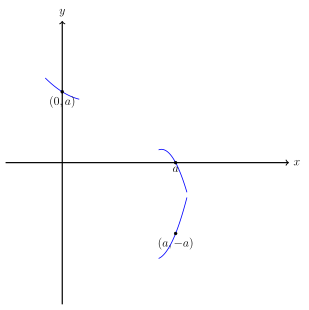
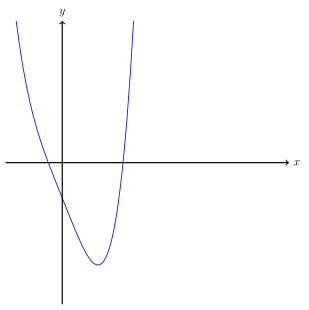
The points \(P\,(0,a),\) \(Q\,(a,0)\) and \(R\,(a,-a)\) lie on the curve \(C\) with cartesian equation \[ xy^{2}+x^{3}+a^{2}y-a^{3}=0,\qquad\mbox{ where }a>0. \] At each of \(P,Q\) and \(R\), express \(y\) as a Taylor series in \(h\), where \(h\) is a small increment in \(x\), as far as the term in \(h^{2}.\) Hence, or otherwise, sketch the shape of \(C\) near each of these points. Show that, if \((x,y)\) lies on \(C\), then \[ 4x^{4}-4a^{3}x-a^{4}\leqslant0. \] Sketch the graph of \(y=4x^{4}-4a^{3}x-a^{4}.\) Given that the \(y\)-axis is an asymptote to \(C\), sketch the curve \(C\).
Solution: \begin{align*} && 0 &= xy^{2}+x^{3}+a^{2}y-a^{3} \\ \frac{\d }{\d x} : && 0 &= y^2+2xyy' + 3x^2+a^2y' \\ \Rightarrow && y' &= -\frac{y^2+3x^2}{a^2+2xy} \\ \\ \frac{\d^2 }{\d x^2}: && 0 &= 2yy'+2yy'+2x(y')^2+2xyy''+6x+a^2y'' \\ \Rightarrow && y'' &= -\frac{4yy'+2x(y')^2+6x}{a^2+2xy} \\ \\ P: && y &= a \\ && y' &= -\frac{a^2}{a^2} = -1 \\ && y'' &= -\frac{-4a}{a^2} = \frac{4}{a} \\ \Rightarrow && y &\approx a - h+\frac{2}{a}h^2 \\ \\ Q: && y &= 0 \\ && y' &= -\frac{3a^2}{a^2} = -3 \\ && y'' &= -\frac{18a+6a}{a^2} = -\frac{24}{a} \\ \Rightarrow && y &\approx 0-3h-\frac{12}{a}h \\ \\ R: && y &= -a \\ && y' &= -\frac{a^2+3a^2}{a^2-2a^2} = 4 \\ && y'' &= -\frac{-16a+32a+6a}{a^2-2a^2} = \frac{22}{a} \\ \Rightarrow && y &\approx -a+4h + \frac{11}{a}h^2 \end{align*} Alternatively: \begin{align*} && 0 &= xy^{2}+x^{3}+a^{2}y-a^{3} \\ P(0,a): && y &\approx a + c_1h + c_2h^2 \\ && 0 &= h(a+c_1h)^2 + a^2(a + c_1h + c_2h^2)-a^3 \\ &&&= a^3-a^3 + (a^2+a^2c_1)h+(2ac_1+a^2c_2)h^2 \\ \Rightarrow && c_1 &=-1, c_2 =\frac{2}{a} \\ \Rightarrow && y &\approx a - h + \frac{2}{a}h^2 \\ \\ Q(a,0): && y &\approx c_1h + c_2h^2 \\ && 0 &= (a+h)(c_1h)^2+(a+h)^3+a^2(c_1h + c_2h^2 )-a^3 \\ &&&= a^3-a^3+(3a^2+a^2c_1)h + (ac_1^2+3a+a^2c_2)h^2 + \cdots \\ \Rightarrow && c_1 &=-3, c_2 = -\frac{12}{a} \\ \Rightarrow && y &\approx -3h -\frac{12}{a}h \\ \\ R(a,-a): && y &\approx -a + c_1h + c_2h^2 \\ && 0 &= (a+h)(-a + c_1h+c_2h^2)^2+(a+h)^3+a^2(-a + c_1h + c_2h^2)-a^3 \\ &&&= (a^2-2a^2c_1+3a^2+a^2c_1)h+(-2ac_1+c_1^2+\cdots)h^2 \\ \Rightarrow && c_1 &=4, c_2 = \frac{11}{a} \\ \Rightarrow && y &\approx -a + 4h + \frac{11}{a} \end{align*}