Problems
Filters
36 problems found
2023 Paper 3 Q6
- By considering the Maclaurin series for \(\mathrm{e}^x\), show that for all real \(x\), \[\cosh^2 x \geqslant 1 + x^2.\] Hence show that the function \(\mathrm{f}\), defined for all real \(x\) by \(\mathrm{f}(x) = \tan^{-1} x - \tanh x\), is an increasing function. Sketch the graph \(y = \mathrm{f}(x)\).
- Function \(\mathrm{g}\) is defined for all real \(x\) by \(\mathrm{g}(x) = \tan^{-1} x - \frac{1}{2}\pi \tanh x\).
- Show that \(\mathrm{g}\) has at least two stationary points.
- Show, by considering its derivative, that \((1+x^2)\sinh x - x\cosh x\) is non-negative for \(x \geqslant 0\).
- Show that \(\dfrac{\cosh^2 x}{1+x^2}\) is an increasing function for \(x \geqslant 0\).
- Hence or otherwise show that \(\mathrm{g}\) has exactly two stationary points.
- Sketch the graph \(y = \mathrm{g}(x)\).
2022 Paper 3 Q4
You may assume that all infinite sums and products in this question converge.
- Prove by induction that for all positive integers \(n\), \[ \sinh x = 2^n \cosh\!\left(\frac{x}{2}\right) \cosh\!\left(\frac{x}{4}\right) \cdots \cosh\!\left(\frac{x}{2^n}\right) \sinh\!\left(\frac{x}{2^n}\right) \] and deduce that, for \(x \neq 0\), \[ \frac{\sinh x}{x} \cdot \frac{\dfrac{x}{2^n}}{\sinh\!\left(\dfrac{x}{2^n}\right)} = \cosh\!\left(\frac{x}{2}\right) \cosh\!\left(\frac{x}{4}\right) \cdots \cosh\!\left(\frac{x}{2^n}\right)\,. \]
- You are given that the Maclaurin series for \(\sinh x\) is \[ \sinh x = \sum_{r=0}^{\infty} \frac{x^{2r+1}}{(2r+1)!}\,. \] Use this result to show that, as \(y\) tends to \(0\), \(\dfrac{y}{\sinh y}\) tends to \(1\). Deduce that, for \(x \neq 0\), \[ \frac{\sinh x}{x} = \cosh\!\left(\frac{x}{2}\right) \cosh\!\left(\frac{x}{4}\right) \cdots \cosh\!\left(\frac{x}{2^n}\right) \cdots\,. \]
- Let \(x = \ln 2\). Evaluate \(\cosh\!\left(\dfrac{x}{2}\right)\) and show that \[ \cosh\!\left(\frac{x}{4}\right) = \frac{1 + 2^{\frac{1}{2}}}{2 \times 2^{\frac{1}{4}}}\,. \] Use part (ii) to show that \[ \frac{1}{\ln 2} = \frac{1 + 2^{\frac{1}{2}}}{2} \times \frac{1 + 2^{\frac{1}{4}}}{2} \times \frac{1 + 2^{\frac{1}{8}}}{2} \cdots\,. \]
- Show that \[ \frac{2}{\pi} = \frac{\sqrt{2}}{2} \times \frac{\sqrt{2+\sqrt{2}}}{2} \times \frac{\sqrt{2+\sqrt{2+\sqrt{2}}}}{2} \cdots\,. \]
2022 Paper 3 Q5
- Show that \[ \int_{-a}^{a} \frac{1}{1+\mathrm{e}^x}\,\mathrm{d}x = a \quad \text{for all } a \geqslant 0. \]
- Explain why, if \(\mathrm{g}\) is a continuous function and \[ \int_0^a \mathrm{g}(x)\,\mathrm{d}x = 0 \quad \text{for all } a \geqslant 0, \] then \(\mathrm{g}(x) = 0\) for all \(x \geqslant 0\). Let \(\mathrm{f}\) be a continuous function with \(\mathrm{f}(x) \geqslant 0\) for all \(x\). Show that \[ \int_{-a}^{a} \frac{1}{1+\mathrm{f}(x)}\,\mathrm{d}x = a \quad \text{for all } a \geqslant 0 \] if and only if \[ \frac{1}{1+\mathrm{f}(x)} + \frac{1}{1+\mathrm{f}(-x)} - 1 = 0 \quad \text{for all } x \geqslant 0, \] and hence if and only if \(\mathrm{f}(x)\mathrm{f}(-x) = 1\) for all \(x\).
- Let \(\mathrm{f}\) be a continuous function such that, for all \(x\), \(\mathrm{f}(x) \geqslant 0\) and \(\mathrm{f}(x)\mathrm{f}(-x) = 1\). Show that, if \(\mathrm{h}\) is a continuous function with \(\mathrm{h}(x) = \mathrm{h}(-x)\) for all \(x\), then \[ \int_{-a}^{a} \frac{\mathrm{h}(x)}{1+\mathrm{f}(x)}\,\mathrm{d}x = \int_0^a \mathrm{h}(x)\,\mathrm{d}x\,. \]
- Hence find the exact value of \[ \int_{-\frac{1}{2}\pi}^{\frac{1}{2}\pi} \frac{\mathrm{e}^{-x}\cos x}{\cosh x}\,\mathrm{d}x\,. \]
Solution:
- \(\,\) \begin{align*} && I &= \int_{-a}^a \frac{1}{1+e^x} \d x \\ &&&= \int_{-a}^a \frac{e^{-x}}{e^{-x}+1} \d x \\ &&&= \left [ -\ln(1 + e^{-x} ) \right ]_{-a}^a \\ &&&= \ln(1 + e^a) - \ln(1 + e^{-a}) \\ &&&= \ln \left ( \frac{1+e^a}{1+e^{-a}} \right) \\ &&&= \ln \left ( e^a \frac{1+e^a}{e^a+1} \right) \\ &&& = a \end{align*}
- Suppose \(g\) is continuous and \(\int_0^a g(x) \d x = 0\) for all \(a \geq 0\) then \(g(x) = 0\) for all \(x\). Proof: Differentiate with respect to \(a\) to obtain \(g(a) = 0\) for all \(a\) as required. \begin{align*} && a &= \int_{-a}^a \frac{1}{1+ f(x)} \d x \\ \Leftrightarrow && 1 &= \frac{1}{1 + f(a)} + \frac{1}{1 + f(-a)} \tag{FTC} \\ \Leftrightarrow && (1+f(x))(1+f(-x)) &= 2+f(-x) + f(x) \\ \Leftrightarrow && f(x) f(-x) & = 1 \end{align*}
- \(\,\) \begin{align*} && J &= \int_{-a}^a \frac{h(x)}{1 + f(x)} \d x \\ y = - x: &&&=\int_{-a}^a \frac{h(-y)}{1 + f(-y)} \d y \\ &&&= \int_{-a}^a \frac{h(y)}{1 + f(-y)} \d y \\ \Rightarrow && 2J &= \int_{-a}^a h(x) \left ( \frac{1}{1+f(x)} + \frac{1}{1+f(-x)} \right) \d x \\ &&&= \int_{-a}^a h(x) \d x \\ &&&= \int_{-a}^0 h(x) \d x + \int_0^a h(x) \d x\\ &&&= \int_0^a h(-x) \d x + \int_0^a h(x) \d x \\ &&&= 2 \int_0^a h(x) \d x \\ \Rightarrow && J &= \int_0^a h(x) \d x \end{align*}
- First notice that \(h(x) = \cos x = h(-x)\). Also notice that if \(f(x) = e^{2x}\) then \(f(x)f(-x) = 1\) so \begin{align*} && K &= \int_{-\frac12 \pi}^{\frac12\pi} \frac{e^{-x}\cos x}{\cosh x} \d x \\ &&&= \int_{-\frac12 \pi}^{\frac12\pi} \frac{2h(x)}{1+f(x)} \d x \\ &&&= 2 \int_0^{\frac12 \pi} h(x) \d x \\ &&&= 2 \int_0^{\frac12 \pi} \cos x \d x \\ &&&= 2 \end{align*}
2021 Paper 3 Q6
- For \(x \neq \tan\alpha\), the function \(f_\alpha\) is defined by \[ f_\alpha(x) = \tan^{-1}\!\left(\frac{x\tan\alpha + 1}{\tan\alpha - x}\right) \] where \(0 < \alpha < \tfrac{1}{2}\pi\). Show that \(f_\alpha'(x) = \dfrac{1}{1 + x^2}\). Hence sketch \(y = f_\alpha(x)\). On a separate diagram, sketch \(y = f_\alpha(x) - f_\beta(x)\) where \(0 < \alpha < \beta < \tfrac{1}{2}\pi\).
- For \(0 \leqslant x \leqslant 2\pi\) and \(x \neq \tfrac{1}{2}\pi,\, \tfrac{3}{2}\pi\), the function \(g(x)\) is defined by \[ g(x) = \tanh^{-1}(\sin x) - \sinh^{-1}(\tan x). \] For \(\tfrac{1}{2}\pi < x < \tfrac{3}{2}\pi\), show that \(g'(x) = 2\sec x\). Use this result to sketch \(y = g(x)\) for \(0 \leqslant x \leqslant 2\pi\).
Solution:
- \(\,\) \begin{align*}
&& f_\alpha(x) &= \tan^{-1}\!\left(\frac{x\tan\alpha + 1}{\tan\alpha - x}\right) \\
&& f'_\alpha(x) &= \frac{1}{1 + \left(\frac{x\tan\alpha + 1}{\tan\alpha - x}\right) ^2} \cdot \frac{\tan \alpha \cdot (\tan \alpha - x) - (x \tan \alpha + 1) \cdot (-1)}{(\tan \alpha - x)^2} \\
&&&= \frac{\tan^2 \alpha -1}{(\tan \alpha - x)^2 + (x \tan \alpha +1)^2} \\
&&&= \frac{\tan^2 \alpha +1}{\tan^2 \alpha - 2x \tan \alpha + x^2 + x^2 \tan^2 \alpha + 2 x \tan \alpha + 1} \\
&&&= \frac{1+\tan^2 \alpha}{(1+\tan^2 \alpha(x^2 + 1)} = \frac{1}{1+x^2}
\end{align*}
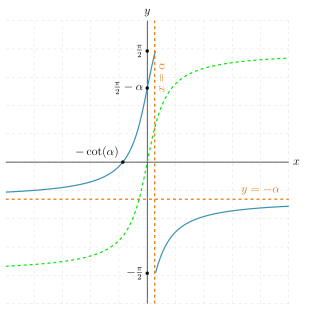
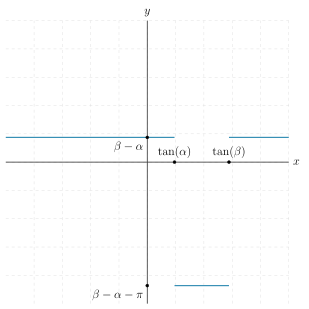
- Let \(g(x) = \tanh^{-1}(\sin x) - \sinh^{-1}(\tan x)\) then
\begin{align*}
&& g'(x) &= \frac{1}{1-\sin^2 x} \cdot \cos x - \frac{1}{\sqrt{\tan^2 +1}} \cdot \sec^2 x \\
&&&= \sec x - \frac{\sec^2 x}{|\sec x|} \\
&&& = \begin{cases} 0 &\text{if } \sec x \geq 0 \\
2 \sec x &\text{ otherwise}
\end{cases}
\end{align*}
Therefore \(g'(x) = 2\sec x\) if \(\tfrac12 \pi < x < \tfrac32\pi\)
Therefore $\displaystyle g(x) = \begin{cases} 0 & \text{if } x \in [0, \frac{\pi}{2}] \cup [\frac{3\pi}{2}, 2\pi] \\
\ln( (\tan x + \sec x)^2) + C &\text{otherwise} \end{cases}$
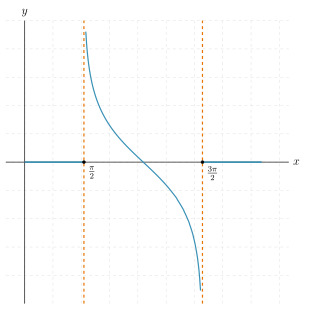
2020 Paper 3 Q2
The curve \(C\) has equation \(\sinh x + \sinh y = 2k\), where \(k\) is a positive constant.
- Show that the curve \(C\) has no stationary points and that \(\dfrac{\mathrm{d}^2 y}{\mathrm{d}x^2} = 0\) at the point \((x,y)\) on the curve if and only if \[ 1 + \sinh x \sinh y = 0. \] Find the co-ordinates of the points of inflection on the curve \(C\), leaving your answers in terms of inverse hyperbolic functions.
- Show that if \((x,y)\) lies on the curve \(C\) and on the line \(x + y = a\), then \[ \mathrm{e}^{2x}(1 - \mathrm{e}^{-a}) - 4k\mathrm{e}^x + (\mathrm{e}^a - 1) = 0 \] and deduce that \(1 < \cosh a \leqslant 2k^2 + 1\).
- Sketch the curve \(C\).
2019 Paper 3 Q2
The definition of the derivative \(f'\) of a (differentiable) function f is $$f'(x) = \lim_{h\to 0} \frac{f(x + h) - f(x)}{h}. \quad (*)$$
- The function f has derivative \(f'\) and satisfies $$f(x + y) = f(x)f(y)$$ for all \(x\) and \(y\), and \(f'(0) = k\) where \(k \neq 0\). Show that \(f(0) = 1\). Using \((*)\), show that \(f'(x) = kf(x)\) and find \(f(x)\) in terms of \(x\) and \(k\).
- The function g has derivative \(g'\) and satisfies $$g(x + y) = \frac{g(x) + g(y)}{1 + g(x)g(y)}$$ for all \(x\) and \(y\), \(|g(x)| < 1\) for all \(x\), and \(g'(0) = k\) where \(k \neq 0\). Find \(g'(x)\) in terms of \(g(x)\) and \(k\), and hence find \(g(x)\) in terms of \(x\) and \(k\).
Solution:
- \(\,\) \begin{align*} && f(0+x) &= f(0)f(x) \\ \Rightarrow && f(0) &= 0, 1\\ &&\text{since }f'(0) \neq 0 & \text{ there is some non-zero } f(x) \\ \Rightarrow && f(0) &= 1 \end{align*} \begin{align*} && f'(x) &= \lim_{h\to 0} \frac{f(x+h)-f(x)}{h} \\ &&&= \lim_{h\to 0} \frac{f(x)f(h)-f(x)}{h} \\ &&&= f(x) \cdot \lim_{h\to 0} \frac{f(h)-1}{h} \\ &&&= f(x) \cdot \lim_{h\to 0} \frac{f(0+h)-f(0)}{h} \\ &&&= f(x) \cdot f'(0) \\ &&&= kf(x) \end{align*} Since \(f'(x) = kf(x)\) we must have \(\frac{f'(x)}{f(x)} = k \Rightarrow \ln f(x) = kx + c \Rightarrow f(x) = Ae^{kx}\) but \(f(0) = 1\) so \(f(x) = e^{kx}\)
- Consider \begin{align*} && g(0+0) &= \frac{g(0)+g(0)}{1+(g(0))^2} \\ \Rightarrow && g(0)(1+(g(0))^2)&= 2g(0) \\ \Rightarrow && 0 &= g(0)\left (1- (g(0))^2 \right) \\ \Rightarrow && g(0) &= -1, 0, 1 \\ \Rightarrow && g(0) &= 0 \tag{\(|g(0)| < 1\)} \end{align*} \begin{align*} && g'(x) &=\lim_{h\to 0} \frac{g(x+h)-g(x)}{h} \\ &&&= \lim_{h\to 0} \frac{\frac{g(x)+g(h)}{1+g(x)g(h)}-g(x)}{h} \\ &&&= \lim_{h\to 0} \frac{g(x)+g(h)-g(x)(1+g(x)g(h))}{h(1+g(x)g(h))} \\ &&&= \lim_{h\to 0} \frac{g(h)-g(x)(g(x)g(h))}{h(1+g(x)g(h))} \\ &&&= (1-(g(x))^2) \cdot \lim_{h \to 0} \frac{1}{1+g(x)g(h)} \cdot \lim_{h \to 0} \frac{g(h)}{h} \\ &&&= (1-(g(x))^2) \cdot \frac{1}{1+g(x)\cdot 0} \cdot \lim_{h \to 0} \frac{g(h) - g(0)}{h} \\ &&&= (1-(g(x))^2) \cdot g'(0)\\ &&&= k (1-(g(x))^2) \\ \end{align*} Let \(y = g(x)\) so \begin{align*} && y' &= k(1-y^2) \\ \Rightarrow && kx &= \int \frac{1}{1-y^2} \d y \\ \Rightarrow &&&= \int \frac12\left ( \frac{1}{1-y} + \frac{1}{1+y} \right) \d y \\ &&&= \frac12\ln \left ( \frac{1+y}{1-y} \right) + C \\ x = 0, y = 0: && 0 &= \ln 1 + C \\ \Rightarrow && C &= 0 \\ \Rightarrow && \frac{1+y}{1-y} &= e^{2kx} \\ \Rightarrow && 1+y &= e^{2kx} - e^{2kx}y \\ \Rightarrow && y &= \frac{e^{2kx}-1}{e^{2kx}+1} \\ &&&= \tanh kx \end{align*}
2016 Paper 3 Q4
- By considering \(\displaystyle \frac1{1+ x^r} - \frac1{1+ x^{r +1}}\) for \(\vert x \vert \ne 1\), simplify \[ \sum_{r=1}^N \frac{x^r}{(1+x^r)(1+x^{r+1})} \] Show that, for \(\vert x \vert <1\), \[ \sum_{r=1}^\infty \frac{x^r}{(1+x^r)(1+x^{r+1})} = \frac x {1-x^2} \]
- Deduce that \[ \sum_{r=1}^\infty \textrm{sech}(ry)\textrm{sech}((r + 1)y) = 2\e^{-y} \textrm{cosech}(2 y) \] for \(y > 0\). Hence simplify \[ \sum_{r=-\infty}^\infty \textrm{sech}(ry) \textrm{sech}((r + 1)y) \] for \(y>0\).
Solution:
- \(\,\) \begin{align*} && \frac{1}{1+x^r} - \frac{1}{1+x^{r+1}} &= \frac{1+x^{r+1}-1-x^r}{(1+x^r)(1+x^{r+1})} \\ &&&= \frac{x^r(x-1)}{(1+x^r)(1+x^{r+1})} \\ \\ && \sum_{r=1}^N \frac{x^r}{(1+x^r)(1+x^{r+1})} &= \sum_{r=1}^N \frac{1}{x-1} \left ( \frac{1}{1+x^r} - \frac{1}{1+x^{r+1}}\right) \\ &&&= \frac{1}{x-1} \Bigg ( \frac{1}{1+x} + \cdots \\ &&& \qquad \qquad \quad - \frac{1}{1+x^2} + \frac{1}{1+x^2} + \cdots \\ &&& \qquad \qquad \quad - \frac{1}{1+x^3} + \frac{1}{1+x^3} + \cdots \\ &&& \qquad \qquad \quad - \cdots \\ &&& \qquad \qquad \quad - \frac{1}{1+x^{N+1}} \Bigg ) \\ &&&= \frac{1}{x-1} \left (\frac{1}{1+x} - \frac{1}{1+x^{N+1}} \right) \\ \\ && \sum_{r=1}^{\infty} \frac{x^r}{(1+x^r)(1+x^{r+1})} &= \lim_{N\to \infty} \frac{1}{x-1} \left (\frac{1}{1+x} - \frac{1}{1+x^{N+1}} \right) \\ &&&= \frac{1}{x-1} \left ( \frac{1}{1+x} - 1\right) \\ &&&= \frac{1}{x-1} \left ( \frac{-x}{1+x} \right) \\ &&&= \frac{x}{1-x^2} \end{align*}
- \(\,\) \begin{align*} && \sum_{r=1}^\infty \textrm{sech}(ry)\textrm{sech}((r + 1)y) &= \sum_{r=1}^\infty \frac{4}{(e^{ry}+e^{-ry})(e^{(r+1)y}+e^{-(r+1)y})} \\ &&&=\sum_{r=1}^\infty \frac{4e^{-(2r+1)y}}{(1+e^{-2ry})(1+e^{-2(r+1)y})} \\ x = e^{-2y}: &&&= \frac{4e^{-y}e^{-2y}}{1-e^{-4y}} \\ &&&= \frac{4e^{-y}e^{-2y}}{e^{-2y}(e^{2y}-e^{-2y})} \\ &&&=2e^{-y}\textrm{cosech}(2y) \end{align*} \begin{align*} && \sum_{r=-\infty}^\infty \textrm{sech}(ry) \textrm{sech}((r + 1)y) &= \sum_{r=1}^\infty \textrm{sech}(ry) \textrm{sech}((r + 1)y) + \sum_{r=-\infty}^0 \textrm{sech}(ry) \textrm{sech}((r + 1)y) \\ &&&= 2e^{-y}\textrm{cosech}(2y) + \sum_{r=0}^\infty \textrm{sech}(-ry) \textrm{sech}(-(r-1)y) \\ &&&= 2e^{-y}\textrm{cosech}(2y) + \sum_{r=0}^\infty \textrm{sech}((r-1)y) \textrm{sech}(ry) \\ &&&= 4e^{-y}\textrm{cosech}(2y) + \textrm{sech}(y) + \textrm{sech}(-y) \\ &&&= 4e^{-y}\textrm{cosech}(2y)+2\textrm{sech}(y) \\ &&&= 4e^{-y} \frac12 \textrm{sech}(y) \textrm{cosech}(y) + 2 \textrm{sech}(y) \\ &&&= 2\textrm{sech}(y) \left ( e^{-y} \textrm{cosech}(y)+1 \right) \\ &&&= 2\textrm{sech}(y) \left ( \frac{2}{e^{2y}-1} + 1 \right) \\ &&&= 2\textrm{sech}(y) \left ( \frac{e^{2y}+1}{e^{2y}-1} \right) \\ &&&= 2 \textrm{cosech}(y) \end{align*}
2016 Paper 3 Q6
Show, by finding \(R\) and \(\gamma\), that \(A \sinh x + B\cosh x \) can be written in the form \(R\cosh (x+\gamma)\) if \(B>A>0\). Determine the corresponding forms in the other cases that arise, for \(A>0\), according to the value of \(B\). Two curves have equations \(y = \textrm{sech} x\) and \(y = a\tanh x + b\,\), where \(a>0\).
- In the case \(b>a\), show that if the curves intersect then the \(x\)-coordinates of the points of intersection can be written in the form \[ \pm\textrm{arcosh} \left( \frac 1 {\sqrt{b^2-a^2}}\right) - {\rm artanh \,} \frac a b .\]
- Find the corresponding result in the case \(a>b>0\,\).
- Find necessary and sufficient conditions on \(a\) and \(b\) for the curves to intersect at two distinct points.
- Find necessary and sufficient conditions on \(a\) and \(b\) for the curves to touch and, given that they touch, express the \(y\)-coordinate of the point of contact in terms of \(a\).
Solution: \begin{align*} && R\cosh(x + \gamma) &=R \cosh x \cosh \gamma + R \sinh x \sinh \gamma \\ \Rightarrow && R \cosh \gamma &= B \\ && R \sinh \gamma &= A \\ \Rightarrow && R^2 &= B^2 - A^2 \\ \Rightarrow && \tanh \gamma &= \frac{A}{B} \\ \end{align*} Therefore it is possible, by writing \(R = \sqrt{B^2-A^2}\) and \(\gamma = \textrm{artanh} \left ( \frac{A}{B} \right)\). This works as long as \(|B| > A > 0\). Supposing \(A >|B| \), try \(S \sinh (x + \delta) = S \sinh x \cosh \delta +S \cosh x \sinh \delta\) \begin{align*} && S \cosh \delta &= A \\ && -S \sinh \delta &= B \\ \Rightarrow && S^2 &= A^2 - B^2 \\ \Rightarrow && \tanh \delta &= \frac{B}{A} \\ \end{align*} Therefore in this case we can write \(\sqrt{A^2-B^2} \sinh \left (x + \tanh^{-1} \left ( \frac{B}{A} \right) \right)\) If \(A = \pm B > 0\) we can we have \(A \sinh x + B \cosh x = \pm Ae^{\pm x}\)
- Suppose \(y \cosh x = 1\) and \(y \cosh x = a \sinh x +b \cosh x\) so \begin{align*} && 1 & = a \sinh x + b \cosh x \\ &&&= \sqrt{b^2-a^2} \cosh(x + \textrm{artanh} \frac{a}{b} ) \\ \Rightarrow && x + \textrm{artanh} \frac{a}{b} &= \pm \textrm{arcosh} \left ( \frac{1}{\sqrt{b^2-a^2}} \right) \\ \Rightarrow && x &= \pm \textrm{arcosh} \left ( \frac{1}{\sqrt{b^2-a^2}} \right) -\textrm{artanh} \frac{a}{b} \end{align*}
- If \( a > b > 0\) we have \begin{align*} && 1 & = \sqrt{a^2-b^2} \sinh \left ( x - \textrm{artanh} \frac{b}{a} \right) \\ \Rightarrow && x &= \textrm{arsinh} \left ( \frac{1}{\sqrt{a^2-b^2}} \right) + \textrm{artanh} \left ( \frac{b}{a} \right) \end{align*}
- To intersect at distinct points we must have \(b > a\) and \(\textrm{arcosh} \left ( \frac{1}{\sqrt{b^2-a^2}} \right) \neq 0\) which is always true.
- For the curves to touch, we need them to intersect and have matching derivatives, ie \begin{align*} && -\tanh x \cdot \textrm{sech}x &= a\textrm{sech}^2 x \\ \Rightarrow && 0 &= \textrm{sech}^2 x (a + \sinh x) \\ \Rightarrow && x &= -\textrm{arsinh} \, a\\ \Rightarrow && \sinh x &= - a\\ \Rightarrow &&\cosh x &= \sqrt{1 + a^2} \\ \end{align*} So if the curves touch, we must have \(1 = -a^2+b\sqrt{1+a^2} \Rightarrow b = \sqrt{1+a^2}\) and since this does work it is a necessary and sufficient condition. We will also have the \(y\) coordinate is \(\frac{1}{\sqrt{1+a^2}}\)
2014 Paper 3 Q2
- Show, by means of the substitution \(u=\cosh x\,\), that \[ \int \frac{\sinh x}{\cosh 2x} \d x = \frac 1{2\sqrt2} \ln \left\vert \frac{\sqrt2 \cosh x - 1}{\sqrt2 \cosh x + 1 } \right\vert + C \,.\]
- Use a similar substitution to find an expression for \[ \int \frac{\cosh x}{\cosh 2x} \d x \,.\]
- Using parts (i) and (ii) above, show that \[ \int_0^1 \frac 1{1+u^4} \d u = \frac{\pi + 2\ln(\sqrt2 +1)}{4\sqrt2}\,. \]
Solution:
- \begin{align*} && \int \frac{\sinh x}{\cosh 2x} \d x &= \int \frac{\sinh x}{2\cosh^2 x -1} \d x \\ u = \cosh x, \d u = \sinh x \d x &&&= \int \frac{1}{2u^2 -1} \d u \\ &&&= \int\frac12 \left ( \frac{1}{\sqrt{2}u-1}-\frac{1}{\sqrt{2}u+1} \right) \d u \\ &&&= \frac1{2\sqrt{2}} \left (\ln (\sqrt{2}u-1) - \ln(\sqrt{2}u+1) \right) + C \\ &&&= \frac{1}{2\sqrt{2}} \ln \left ( \frac{\sqrt{2}\cosh x -1}{\sqrt{2}\cosh x +1} \right) + C \end{align*}
- \begin{align*} && \int \frac{\cosh x}{\cosh 2x} \d x &= \int \frac{\cosh x}{1+2\sinh^2 x} \d x \\ u = \sinh x && &= \int \frac{1}{1+2u^2} \d u \\ &&&=\frac{1}{\sqrt{2}} \tan^{-1} (\sqrt{2}u) + C \\ &&&= \frac{1}{\sqrt{2}} \tan^{-1}(\sqrt{2}\sinh x) + C \end{align*}
- \begin{align*} u = e^x : && \int_0^1 \frac{1}{1+u^4} \d u &= \int_{x=-\infty}^{x=0} \frac{1}{1+e^{4x}}e^{x} \d x \\ &&&= \int_{-\infty}^{0} \frac{e^{-x}}{e^{2x}+e^{-2x}} \d x \\ &&&= \int_{-\infty}^{0} \frac{\cosh x - \sinh x}{2\cosh 2x } \d x \\ &&&= \frac12 \int_{-\infty}^{0} \frac{\cosh x}{\cosh 2x} \d x - \frac12 \int_{-\infty}^{0} \frac{\sinh x}{\cosh 2x} \\ &&&= \frac12 \left [\frac{1}{\sqrt{2}} \tan^{-1}(\sqrt{2}\sinh x) \right]_{-\infty}^{0}-\frac12 \left [ \frac{1}{2\sqrt{2}}\ln \left ( \frac{\sqrt{2}\cosh x -1}{\sqrt{2}\cosh x +1} \right) \right]_{-\infty}^{0} \\ &&&= 0 - \frac1{2\sqrt{2}} \frac{-\pi}{2}-\left (\frac1{4\sqrt{2}} \ln \left (\frac{\sqrt{2}-1}{\sqrt{2}+1} \right) - 0 \right) \\ &&&= \frac{\pi - \ln((\sqrt{2}-1)^2)}{4\sqrt{2}} \\ &&&= \frac{\pi + 2 \ln(1+\sqrt{2})}{4\sqrt{2}} \end{align*}
2014 Paper 3 Q6
Starting from the result that \[ \.h(t) >0\ \mathrm{for}\ 0< t < x \Longrightarrow \int_0^x \.h(t)\ud t > 0 \,, \] show that, if \(\.f''(t) > 0\) for \(0 < t < x_0\) and \(\.f(0)=\.f'(0) =0\), then \(\.f(t)>0\) for \(0 < t < x_0\).
- Show that, for \(0 < x < \frac12\pi\), \[ \cos x \cosh x <1 \,. \]
- Show that, for \(0 < x < \frac12\pi\), \[ \frac 1 {\cosh x} < \frac {\sin x} x < \frac x {\sinh x} \,. \] %
- Show that, for \(0 < x < \frac12\pi\), \(\tanh x < \tan x\).
2014 Paper 3 Q9
A particle of mass \(m\) is projected with velocity \(\+ u\). It is acted upon by the force \(m\+g\) due to gravity and by a resistive force \(-mk \+v\), where \(\+v\) is its velocity and \(k\) is a positive constant. Given that, at time \(t\) after projection, its position \(\+r\) relative to the point of projection is given by \[ \+r = \frac{kt -1 +\.e^{-kt}} {k^2} \, \+g + \frac{ 1-\.e^{-kt}}{k} \, \+u \,, \] find an expression for \(\+v\) in terms of \(k\), \(t\), \(\+g\) and \(\+u\). Verify that the equation of motion and the initial conditions are satisfied. Let \(\+u = u\cos\alpha \, \+i + u \sin\alpha \, \+j\) and $\+g = -g\, \+j\(, where \)0<\alpha<90^\circ\(, and let \)T$ be the time after projection at which \(\+r \,.\, \+j =0\). Show that \[ uk \sin\alpha = \left(\frac{kT}{1-\.e^{-kT}} -1\right)g\,. \] Let \(\beta\) be the acute angle between \(\+v\) and \(\+i\) at time \(T\). Show that \[ \tan\beta = \frac{(\.e^{kT}-1)g}{uk\cos\alpha}-\tan\alpha \,. \] Show further that \(\tan\beta >\tan\alpha\) (you may assume that \(\sinh kT >kT\)) and deduce that~\(\beta >\alpha\).
2013 Paper 2 Q12
The random variable \(U\) has a Poisson distribution with parameter \(\lambda\). The random variables \(X\) and \(Y\) are defined as follows. \begin{align*} X&= \begin{cases} U & \text{ if \(U\) is 1, 3, 5, 7, \(\ldots\,\)} \\ 0 & \text{ otherwise} \end{cases} \\ Y&= \begin{cases} U & \text{ if \(U\) is 2, 4, 6, 8, \(\ldots\,\) } \\ 0 & \text{ otherwise} \end{cases} \end{align*}
- Find \(\E(X)\) and \(\E(Y)\) in terms of \(\lambda\), \(\alpha\) and \(\beta\), where \[ \alpha = 1+\frac{\lambda^2}{2!}+\frac{\lambda^4}{4!} +\cdots\, \text{ \ \ and \ \ } \beta = \frac{\lambda}{1!} + \frac{\lambda^3}{3!} + \frac{\lambda^5}{5!} +\cdots\,. \]
- Show that \[ \var(X) = \frac{\lambda\alpha+\lambda^2\beta}{\alpha+\beta} - \frac{\lambda^2\alpha^2}{(\alpha+\beta)^2} \] and obtain the corresponding expression for \(\var(Y)\). Are there any non-zero values of \(\lambda\) for which \( \var(X) + \var(Y) = \var(X+Y)\,\)?
Solution:
- \begin{align*} \mathbb{E}(X) &= \sum_{r=1}^\infty r \mathbb{P}(X = r) \\ &= \sum_{j=1}^{\infty} (2j-1)\mathbb{P}(U=2j-1) \\ &= \sum_{j=1}^{\infty}(2j-1) \frac{e^{-\lambda} \lambda^{2j-1}}{(2j-1)!} \\ &= \sum_{j=1}^{\infty} e^{-\lambda} \frac{\lambda^{2j-1}}{(2j-2)!} \\ &= \lambda e^{-\lambda} \sum_{j=1}^{\infty} \frac{\lambda^{2j-2}}{(2j-2)!} \\ &= \lambda e^{-\lambda} \alpha \end{align*} Since \(\mathbb{E}(X+Y) = \lambda, \mathbb{E}(Y) = \lambda(1-e^{-\lambda}\alpha) = \lambda(e^{-\lambda}(\alpha+\beta) - e^{-\lambda}\alpha) = \lambda e^{-\lambda} \beta\). Alternatively, as \(\beta + \alpha = e^{\lambda}\), \(\mathbb{E}(X) = \frac{\lambda \alpha}{\alpha+\beta}, \mathbb{E}(Y) = \frac{\lambda \beta}{\alpha+\beta}\)
- \begin{align*} \textrm{Var}(X) &= \mathbb{E}(X^2) - [\mathbb{E}(X) ]^2 \\ &= \sum_{odd} r^2 \mathbb{P}(U = r) - \left [ \mathbb{E}(X) \right]^2 \\ &= \sum_{odd} (r(r-1)+r)\frac{e^{-\lambda}\lambda^r}{r!} - \frac{\lambda^2 \alpha^2}{(\alpha+\beta)^2} \\ &= \sum_{odd} \frac{e^{-\lambda}\lambda^r}{(r-2)!}+\sum_{odd} \frac{e^{-\lambda}\lambda^r}{(r-1)!} - \frac{\lambda^2 \alpha^2}{(\alpha+\beta)^2} \\ &= e^{-\lambda}\lambda^2 \beta + e^{-\lambda}\lambda \alpha - \frac{\lambda^2 \alpha^2}{(\alpha+\beta)^2} \\ &= \frac{\lambda \alpha + \lambda^2 \beta}{\alpha+\beta}- \frac{\lambda^2 \alpha^2}{(\alpha+\beta)^2} \end{align*} Similarly, \begin{align*} \textrm{Var}(Y) &= \mathbb{E}(Y^2) - [\mathbb{E}(Y) ]^2 \\ &= \sum_{even} r^2 \mathbb{P}(U = r) - \left [ \mathbb{E}(Y) \right]^2 \\ &= \sum_{even} (r(r-1)+r)\frac{e^{-\lambda}\lambda^r}{r!} - \frac{\lambda^2 \beta^2}{(\alpha+\beta)^2} \\ &= e^{-\lambda}\lambda^2\alpha + e^{-\lambda}\lambda \beta - \frac{\lambda^2 \beta^2}{(\alpha+\beta)^2} \\ &= \frac{\lambda \beta + \lambda^2 \alpha}{\alpha+\beta}- \frac{\lambda^2 \beta^2}{(\alpha+\beta)^2} \end{align*} Since \(\textrm{Var}(X+Y) = \textrm{Var}(U) = \lambda\), we are interested in solving: \begin{align*} \lambda &= \frac{\lambda \alpha + \lambda^2 \beta}{\alpha+\beta}- \frac{\lambda^2 \alpha^2}{(\alpha+\beta)^2} + \frac{\lambda \beta + \lambda^2 \alpha}{\alpha+\beta}- \frac{\lambda^2 \beta^2}{(\alpha+\beta)^2} \\ &= \frac{\lambda(\alpha+\beta) + \lambda^2(\alpha+\beta)}{\alpha+\beta} - \frac{\lambda^2(\alpha^2+\beta^2)}{(\alpha+\beta)^2} \\ &= \lambda + \lambda^2 \frac{(\alpha+\beta)^2 - (\alpha^2+\beta^2)}{(\alpha+\beta)^2} \\ &= \lambda + \lambda^2 \frac{2\alpha\beta}{(\alpha+\beta)^2} \end{align*} which is clearly not possible if \(\lambda \neq 0\)
2013 Paper 3 Q7
- Let \(y(x)\) be a solution of the differential equation \( \dfrac {\d^2 y}{\d x^2}+y^3=0\) with \(y = 1\) and \(\dfrac{\d y}{\d x} =0\) at \(x=0\), and let \[ {\rm E} (x)= \left ( \frac {\d y}{\d x}\right)^{\!\!2} + \tfrac 12 y^4\,. \] Show by differentiation that \({\rm E}\) is constant and deduce that \( \vert y(x) \vert \le 1\) for all \(x\).
- Let \(v(x)\) be a solution of the differential equation \( \dfrac{\d^2 v}{\d x^2} + x \dfrac {\d v}{\d x} +\sinh v =0\) with \(v = \ln 3\) and \(\dfrac{\d v}{\d x} =0\) at \(x=0\), and let \[ {\rm E} (x)= \left ( \frac {\d v}{\d x}\right)^{\!\!2} + 2 \cosh v\,. \] Show that \(\dfrac{\d{\rm E}}{\d x}\le 0\) for \(x\ge0\) and deduce that \(\cosh v(x) \le \frac53\) for \(x\ge0\).
- Let \(w(x)\) be a solution of the differential equation \[ \frac{\d^2 w}{\d x^2} + (5\cosh x - 4 \sinh x -3) \frac{\d w}{\d x} + (w\cosh w + 2 \sinh w) =0 \] with \(\dfrac{\d w }{\d x}=\dfrac 1 { \sqrt 2 }\) and \(w=0\) at \(x=0\). Show that \(\cosh w(x) \le \frac54\) for \(x\ge0\).
Solution:
- \(\,\) \begin{align*} && E(x) &= \left ( \frac{\d y}{\d x} \right)^2 + \frac12 y^4 \\ \Rightarrow && E'(x) &= 2 \frac{\d y}{\d x} \frac{\d^2 y}{\d x^2} + 2y^3 \frac{\d y}{\d x} \\ &&&= 2\frac{\d y}{\d x} \left ( \frac{\d^2 y}{\d x^2} + y^3 \right) \\ &&&= 0 \end{align*} Therefore \(E\) is constant. \(E(0) = \frac12\) and \begin{align*} &&\frac12 &= \left ( \frac{\d y}{\d x} \right)^2 + \frac12 y^4 \\ &&&\geq \frac12 y^4 \\ \Rightarrow && |y| &\leq 1 \end{align*}
- \(\,\) \begin{align*} && E(x) &= \left ( \frac{\d v}{\d x} \right)^2 + 2 \cosh v \\ \Rightarrow && E'(x) &= 2 \frac{\d v}{\d x}\frac{\d^2 v}{\d^2 x} + 2 \sinh v \frac{\d v}{\d x} \\ &&&= 2 \frac{\d v}{\d x} \left ( \frac{\d^2 v}{\d^2 x} + \sinh v\right) \\ &&&= 2 \frac{\d v}{\d x} \left ( -x \frac{\d v}{\d x}\right) \\ &&&= -2x \left ( \frac{\d v}{\d x} \right)^2 \leq 0 \tag{\(x \geq 0\)} \\ \\ && E(0) &= 0^2 + 2 \cosh \ln 3 \\ &&&= 3 + \frac13 = \frac{10}{3} \\ \Rightarrow && \frac{10}{3} &\geq E(x) \\ &&&= \left ( \frac{\d v}{\d x} \right)^2 + 2 \cosh v \\ &&&\geq 2 \cosh v \\ \Rightarrow && \cosh v &\leq \frac53 \end{align*}
- \(\,\) \begin{align*} && E(x) &= \left ( \frac{\d w}{\d x} \right)^2 + 2(w \sinh w + \cosh w) \\ && E'(x) &= 2 \frac{\d w}{\d x}\frac{\d^2 w}{\d^2 x} + 2(w \cosh w + 2 \sinh w) \frac{\d w}{\d x} \\ &&&= 2 \frac{\d w}{\d x} \left ( \frac{\d^2 w}{\d^2 x}+(w \cosh w + 2 \sinh w)\right) \\ &&&= -2 \left ( \frac{\d w}{\d x} \right)^2 \left (\underbrace{5\cosh x - 4 \sinh x -3}_{\geq0} \right) \\ &&&\leq 0 \\ && E(0) &= \frac12 + 2 = \frac52 \\ \Rightarrow && \frac52 &\geq E(x) \\ &&&=\underbrace{ \left ( \frac{\d w}{\d x} \right)^2}_{\geq0} + 2(\underbrace{w \sinh w}_{\geq 0} + \cosh w) \\ &&&\geq2\cosh w \\ \Rightarrow && \cosh w &\leq \frac54 \end{align*}
2011 Paper 3 Q6
The definite integrals \(T\), \(U\), \(V\) and \(X\) are defined by \begin{align*} T&= \int_{\frac13}^{\frac12} \frac{{\rm artanh}\, t}t \,\d t\,, & U&= \int _{\ln 2 }^{\ln 3 } \frac{u}{2\sinh u}\, \d u \,, \\[3mm] V&= - \int_{\frac13}^{\frac12} \frac{\ln v}{1-v^2} \,\d v \,, & X&= \int _{\frac12\ln2}^{\frac12\ln3} \ln ({\coth x})\, \d x\,. \end{align*} Show, without evaluating any of them, that \(T\), \(U\), \(V\) and \(X\) are all equal.
Solution: \begin{align*} && T &= \int_{\frac13}^{\frac12} \frac{{\rm artanh}\, t}t \,\d t \\ && &=\int_{\frac13}^{\frac12} \frac{1}{2t}\ln \left ( \frac{1+t}{1-t} \right) \,\d t \\ u = \tfrac{1+t}{1-t}, t= \tfrac{u-1}{u+1}, \d t = \tfrac{2}{(u+1)^2} \d t &&&= \int_{u=2}^{u=3} \frac{1}{2t} \ln u \frac{2}{(u+1)^2} \d u \\ &&&= \int_2^3 \frac{u+1}{u-1} \ln u \frac{1}{(u+1)^2} \d u \\ &&&= \int_2^3 \frac{1}{u^2-1} \ln u \d u \end{align*} \begin{align*} && U&= \int _{\ln 2 }^{\ln 3 } \frac{u}{2\sinh u}\, \d u \\ v = e^u, \d v = e^u \d u &&&= \int_{v=2}^{v=3} \frac{\ln v}{v - \frac{1}{v}} \frac{1}{v} \d v \\ &&&= \int_2^3 \frac{1}{v^2-1} \ln v \d v \end{align*} \begin{align*} &&V &= - \int_{\frac13}^{\frac12} \frac{\ln v}{1-v^2} \,\d v \\ u = \tfrac1v, \d u = -\tfrac1{v^2} \d v &&&= -\int_{u=3}^{u=2} \frac{-\ln u}{1 - \frac{1}{u^2}} \frac{-1}{u^2} \d u \\ &&&= -\int_3^2 \frac{\ln u}{u^2-1} \d u \\ &&&= \int_2^3 \frac{1}{u^2-1} \ln u \d u \end{align*} \begin{align*} &&X&= \int _{\frac12\ln2}^{\frac12\ln3} \ln ({\coth x})\, \d x \\ u = \coth x, \d u =(1-u^2) \d x &&&= \int_{u = 3}^{u=2} \ln u \frac{1}{1-u^2} \d u \\ &&&= \int_2^3 \frac{\ln u}{u^2-1} \d u \end{align*} Therefore all integrals are equal to the same integral, namely \(\displaystyle \int_2^3 \frac{\ln u}{u^2-1} \d u\)
2010 Paper 3 Q2
In this question, \(a\) is a positive constant.
- Express \(\cosh a\) in terms of exponentials. By using partial fractions, prove that \[ \int_0^1 \frac 1{ x^2 +2x\cosh a +1} \, \d x = \frac a {2\sinh a}\,. \]
- Find, expressing your answers in terms of hyperbolic functions, \[ \int_1^\infty \frac 1 {x^2 +2x \sinh a -1} \,\d x \, \] and \[ \int_0^\infty \frac 1 {x^4 +2x^2\cosh a +1} \,\d x \,.\]
Solution:
- \(\cosh a = \frac12 (e^a + e^{-a})\) \begin{align*} \int_0^1 \frac 1{ x^2 +2x\cosh a +1} \, \d x &= \int_0^1 \frac{1}{x^2+(e^a+e^{-a})x+e^ae^{-a}} \d x \\ &= \int_0^1 \frac{1}{e^a-e^{-a}}\left (\frac{1}{x+e^{-a}}-\frac{1}{x+e^a} \right)\d x \\ &= \frac{1}{2 \sinh a} \int_0^1 \left (\frac{1}{x+e^{-a}}-\frac{1}{x+e^a} \right)\d x \\ &= \frac{1}{2 \sinh a}\left [\ln(x+e^{-a})-\ln(x+e^a) \right]_0^1 \\ &= \frac{1}{2 \sinh a} \left (\ln(1+e^a)-\ln(1+e^{-a}) - (\ln e^{-a}-\ln e^a) \right) \\ &= \frac{1}{2\sinh a}\left (2a + \ln \frac{1+e^a}{1+e^{-a}}\right) \\ &= \frac1{2\sinh a} \left ( 2a -a \right) \\ &= \frac{a}{2 \sinh a} \end{align*}
- \begin{align*} \int_1^\infty \frac 1 {x^2 +2x \sinh a -1} \,\d x &= \int_1^{\infty} \frac{1}{(x+e^a)(x-e^{-a})} \d x \\ &= \int_1^{\infty} \frac{1}{e^a+e^{-a}} \left ( \frac{1}{x-e^{-a}} - \frac{1}{x+e^{a}} \right)\d x \\ &= \frac{1}{2\cosh a} \int_1^{\infty} \left ( \frac{1}{x-e^{-a}} - \frac{1}{x+e^{a}} \right)\d x \\ &= \frac{1}{2\cosh a} \left [\ln(x-e^{-a}) - \ln (x + e^{a} ) \right]_1^{\infty} \\ &= \frac1{2\cosh a} \left [ \ln \frac{x-e^{-a}}{x+e^{a}} \right]_1^{\infty} \\ &= \frac{1}{2\cosh a} \left ( 0 - \ln \frac{1-e^{-a}}{1+e^a}{}\right) \\ &= \frac{1}{2\cosh a} \ln \frac{1+e^a}{1-e^{-a}}\\ &= \frac{1}{2\cosh a} \left ( a + \ln \coth \frac{a}{2} \right) \end{align*} and \begin{align*} \int_0^\infty \frac 1 {x^4 +2x^2\cosh a +1} \,\d x &= \int_0^\infty\frac{1}{(x^2+e^a)(x^2+e^{-a})} \d x \\ &= \int_0^\infty \frac{1}{e^a-e^{-a}} \left ( \frac{1}{x^2+e^{-a}} - \frac{1}{x^2+e^{a}} \right) \d x \\ &= \frac{1}{2\sinh a} \left [ \frac{1}{e^{-a/2}} \tan^{-1} \frac{x}{e^{-a/2}} - \frac{1}{e^{a/2}}\tan^{-1} \frac{x}{e^{a/2}} \right]_0^{\infty} \\ &= \frac{1}{2\sinh a} \left (e^{a/2}\frac{\pi}{2}-e^{-a/2}\frac{\pi}{2} - 0 \right) \\ &= \frac{1}{2\sinh a} \pi \sinh \frac{a}{2} \\ &= \frac{\pi \sinh \tfrac{a}{2}}{2\sinh a} \\ &= \frac{\pi \sinh \tfrac{a}{2}}{4\sinh \tfrac{a}{2} \cosh \tfrac{a}{2}} \\ &= \frac{\pi}{4\cosh \tfrac{a}{2}} \end{align*}