Problems
Filters
3 problems found
2016 Paper 1 Q3
In this question, \(\lfloor x \rfloor\) denotes the greatest integer that is less than or equal to \(x\), so that (for example) \(\lfloor 2.9 \rfloor = 2\), \(\lfloor 2\rfloor = 2\) and \(\lfloor -1.5 \rfloor = -2\). On separate diagrams draw the graphs, for \(-\pi \le x \le \pi\), of:
Solution:


2013 Paper 1 Q2
In this question, \(\lfloor x \rfloor\) denotes the greatest integer that is less than or equal to \(x\), so that \(\lfloor 2.9 \rfloor = 2 = \lfloor 2.0 \rfloor\) and \(\lfloor -1.5 \rfloor = -2\). The function \(\f\) is defined, for \(x\ne0\), by \(\f(x) = \dfrac{\lfloor x \rfloor}{x}\,\).
- Sketch the graph of \(y=\f(x)\) for \(-3\le x \le 3\) (with \(x\ne0\)).
- By considering the line \(y= \frac7{12}\) on your graph, or otherwise, solve the equation \(\f(x) = \frac7 {12}\,\). Solve also the equations \(\f(x) =\frac{17}{24}\) and \(\f(x) = \frac{4 }{3 }\,\).
- Find the largest root of the equation \(\f(x) =\frac9{10}\,\).
Solution:

- Notice that there are no solutions when \(x < 0\) since \(f(x) \geq 1\) in that region. Suppose \(x = n + \epsilon, 0 < \epsilon < 1\), then \(f(x) = \frac{n}{n+\epsilon}\), ie \(12n = 7n + 7 \epsilon \Rightarrow 5 n = 7\epsilon \Rightarrow \epsilon = \frac{5}{7}n \Rightarrow n < \frac75\), so \(n = 1 ,\epsilon = \frac57, x = \frac{12}5\). \begin{align*} && \frac{17}{24} &= f(x) \\ \Rightarrow && 17n + 17 \epsilon &= 24 n \\ \Rightarrow && 17 \epsilon &= 7 n \\ \Rightarrow && n &< \frac{17}{7} \\ \Rightarrow && n &= 1, 2 \\ \Rightarrow && x &= \frac{24}{17}, \frac{48}{17} \end{align*}. For \(f(x) = \frac{4}{3}\) we notice that \(x < 0\), so let \(x = -n +\epsilon\), ie \begin{align*} && \frac43 &= f(x) \\ \Rightarrow && \frac43 &= \frac{-n}{-n+\epsilon} \\ \Rightarrow && 4\epsilon &= n \\ \Rightarrow && n &= 1,2,3 \\ \Rightarrow && x &= -\frac{5}{4}, -\frac{3}{2}, -\frac{9}{4} \end{align*}
- \begin{align*} && \frac9{10} &= f(x) \\ \Rightarrow && 9n + 9 \epsilon &= 10 n \\ \Rightarrow && 9 \epsilon &= n \\ \Rightarrow && n < 9 \end{align} So largest will be when \(n = 8, \epsilon = \frac{8}{9}\), ie \(\frac{80}{9}\)
2004 Paper 1 Q2
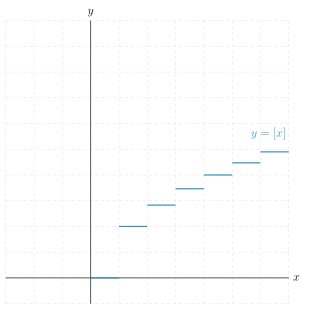
The square bracket notation \(\boldsymbol{[} x\boldsymbol{]}\) means the greatest integer less than or equal to \(x\,\). For example, \(\boldsymbol{[}\pi\boldsymbol{]} = 3\,\), \(\boldsymbol{[}\sqrt{24}\,\boldsymbol{]} = 4\,\) and \(\boldsymbol{[}5\boldsymbol{]}=5\,\).
- Sketch the graph of \(y = \sqrt{\boldsymbol{[}x\boldsymbol{]}}\) and show that \[ \displaystyle \int^a_0 \sqrt{\boldsymbol{[}x\boldsymbol{]}} \; \mathrm{d}x = \sum^{a-1}_{r=0} \sqrt{r} \] when \(a\) is a positive integer.
- Show that $\displaystyle \int^{a}_0 2_{\vphantom{A}}^{\pmb{\boldsymbol {[} } x \pmb{ \boldsymbol{]}} }\; \mathrm{d}x = 2^{a}-1\( when \)a\( is a positive integer.
- Determine an expression for \)\displaystyle \int^{a}_0 2_{\vphantom{\dot A}}^{\pmb{\boldsymbol{[} }x \pmb{ \boldsymbol{]}} } \; \mathrm{d}x\( when \)a$ is positive but not an integer.
Solution:
- \(\,\) \begin{align*} && \int_0^a \sqrt{\boldsymbol{[}x\boldsymbol{]}} \d x &= \sum_{r=0}^{a-1} \int_{x=r}^{x=r+1} \sqrt{\boldsymbol{[}x\boldsymbol{]}} \d x \\ &&&= \sum_{r=0}^{a-1} \int_r^{r+1} \sqrt{r} \d x \\ &&&= \sum_{r=0}^{a-1} \sqrt{r} \\ \end{align*}
- \(\,\) \begin{align*} && \int^{a}_0 2^{\boldsymbol {[} x \boldsymbol{]}} \d x &= \sum_{r=0}^{a-1} \int_{x=r}^{x=r+1} 2^{\boldsymbol {[} x \boldsymbol{]}} \d x \\ &&&= \sum_{r=0}^{a-1} \int_{x=r}^{x=r+1} 2^{r} \d x \\ &&&= \sum_{r=0}^{a-1} 2^{r}\\ &&&= 2^{a}-1 \end{align*}
- \(\,\) \begin{align*} && \int^{a}_0 2^{\boldsymbol {[} x \boldsymbol{]}} \d x &= \int_0^{\boldsymbol {[} a \boldsymbol{]}} 2^{\boldsymbol {[} x \boldsymbol{]}} \d x + \int_{\boldsymbol {[} a \boldsymbol{]}}^a 2^{\boldsymbol {[} x \boldsymbol{]}} \d x \\ &&&= 2^{ \boldsymbol {[} a \boldsymbol{]}}-1 + (a-\boldsymbol {[} a \boldsymbol{]})2^{\boldsymbol {[} a \boldsymbol{]}} \\ &&&= (a-\boldsymbol {[} a \boldsymbol{]}+1)2^{\boldsymbol {[} a \boldsymbol{]}} -1 \end{align*}