Problems
Filters
21 problems found
2024 Paper 3 Q12
- A point is chosen at random in the square \(0 \leqslant x \leqslant 1\), \(0 \leqslant y \leqslant 1\), so that the probability that a point lies in any region is equal to the area of that region. \(R\) is the random variable giving the distance of the point from the origin. Show that the cumulative distribution function of \(R\) is given by \[\mathrm{P}(R \leqslant r) = \sqrt{r^2 - 1} + \tfrac{1}{4}\pi r^2 - r^2 \cos^{-1}(r^{-1}),\] when \(1 \leqslant r \leqslant \sqrt{2}\). What is the cumulative distribution function when \(0 \leqslant r \leqslant 1\)?
- Show that \(\displaystyle\mathrm{E}(R) = \frac{2}{3}\int_1^{\sqrt{2}} \frac{r^2}{\sqrt{r^2-1}}\,\mathrm{d}r\).
- Show further that \(\mathrm{E}(R) = \frac{1}{3}\Bigl(\sqrt{2} + \ln\bigl(\sqrt{2}+1\bigr)\Bigr)\).
2022 Paper 3 Q12
- The point \(A\) lies on the circumference of a circle of radius \(a\) and centre \(O\). The point \(B\) is chosen at random on the circumference, so that the angle \(AOB\) has a uniform distribution on \([0, 2\pi]\). Find the expected length of the chord \(AB\).
- The point \(C\) is chosen at random in the interior of a circle of radius \(a\) and centre \(O\), so that the probability that it lies in any given region is proportional to the area of the region. The random variable \(R\) is defined as the distance between \(C\) and \(O\). Find the probability density function of \(R\). Obtain a formula in terms of \(a\), \(R\) and \(t\) for the length of a chord through \(C\) that makes an acute angle of \(t\) with \(OC\). Show that as \(C\) varies (with \(t\) fixed), the expected length \(\mathrm{L}(t)\) of such chords is given by \[ \mathrm{L}(t) = \frac{4a(1-\cos^3 t)}{3\sin^2 t}\,. \] Show further that \[ \mathrm{L}(t) = \frac{4a}{3}\left(\cos t + \tfrac{1}{2}\sec^2(\tfrac{1}{2}t)\right). \]
- The random variable \(T\) is uniformly distributed on \([0, \frac{1}{2}\pi]\). Find the expected value of \(\mathrm{L}(T)\).
2015 Paper 3 Q13
Each of the two independent random variables \(X\) and \(Y\) is uniformly distributed on the interval~\([0,1]\).
- By considering the lines \(x+y =\) \(\mathrm{constant}\) in the \(x\)-\(y\) plane, find the cumulative distribution function of \(X+Y\).
- Hence show that the probability density function \(f\) of \((X+Y)^{-1}\) is given by \[ \f(t) = \begin{cases} 2t^{-2} -t^{-3} & \text{for \( \tfrac12 \le t \le 1\)} \\ t^{-3} & \text{for \(1\le t <\infty\)}\\ 0 & \text{otherwise}. \end{cases} \] Evaluate \(\E\Big(\dfrac1{X+Y}\Big)\,\).
- Find the cumulative distribution function of \(Y/X\) and use this result to find the probability density function of \(\dfrac X {X+Y}\). Write down \(\E\Big( \dfrac X {X+Y}\Big)\) and verify your result by integration.
Solution:
- \(\mathbb{P}(X + Y \leq c) \) is the area between the \(x\)-axis, \(y\)-axis and the line \(x + y = c\). There are two cases for this: \[\mathbb{P}(X + Y \leq c) = \begin{cases} 0 & \text{ if } c \leq 0 \\ \frac{c^2}{2} & \text{ if } c \leq 1 \\ 1- \frac{(2-c)^2}{2} & \text{ if } 1 \leq c \leq 2 \\ 1 & \text{ otherwise} \end{cases}\]
- \begin{align*} && \mathbb{P}((X + Y)^{-1} \leq t) &= 1- \mathbb{P}(X + Y \leq \frac1{t}) \\ \Rightarrow && f_{(X+Y)^{-1}}(t) &= 0 -\begin{cases} 0 & \text{ if } \frac1{t} \leq 0 \\ \frac{\d}{\d t}\frac{1}{2t^2} & \text{ if } \frac{1}{t} \leq 1 \\ \frac{\d}{\d t} \l 1- \frac{(2-\frac1t)^2}{2} \r & \text{ if } 1 \leq \frac{1}{t} \leq 2 \\ 0 & \text{ otherwise}\end{cases} \\ && &= \begin{cases} t^{-3} & \text{ if } t \geq 1 \\ (2-\frac1t)t^{-2} & \text{ if } \frac12 \leq t \leq 1\\ 0 & \text{ otherwise}\end{cases} \\ && &= \begin{cases} t^{-3} & \text{ if } t \geq 1 \\ 2t^{-2}-t^{-3} & \text{ if } \frac12 \leq t \leq 1\\ 0 & \text{ otherwise}\end{cases} \end{align*} Therefore, \begin{align*} \E \Big(\dfrac1{X+Y}\Big) &= \int_{\frac12}^{\infty} t f_{(X+Y)^{-1}}(t) \, \d t \\ &= \int_{\frac12}^{1} t f_{(X+Y)^{-1}}(t) \, \d t + \int_{1}^{\infty} t f_{(X+Y)^{-1}}(t) \d t\\ &= \int_{\frac12}^{1} \l 2t^{-1} - t^{-2} \r \, \d t + \int_{1}^{\infty} t^{-2} \d t\\ &= \left [ 2 \ln (t) + t^{-1} \right]_{\frac12}^{1} + \left [ -t^{-1} \right ]_{1}^{\infty} \\ &= 1 + 2 \ln 2 -2 + 1 \\ &= 2 \ln 2 \end{align*}
- \begin{align*} &&\mathbb{P} \l \frac{Y}{X} \leq c \r &= \mathbb{P}( Y \leq c X) \\ &&&= \begin{cases} 0 & \text{if } c \leq 0 \\ \frac{c}{2} & \text{if } 0 \leq c \leq 1 \\ 1-\frac{1}{2c} & \text{if } 1 \leq c \end{cases} \\ \\ \Rightarrow && \mathbb{P} \l \frac{X}{X+Y} \leq t\r &= \mathbb{P} \l \frac{1}{1+\frac{Y}{X}} \leq t\r \\ &&&= \mathbb{P} \l \frac{1}{t} \leq 1+\frac{Y}{X}\r \\ &&&= \mathbb{P} \l \frac{1}{t} - 1\leq \frac{Y}{X}\r \\ &&&= 1- \mathbb{P} \l \frac{Y}{X} \leq \frac{1}{t} - 1\r \\ &&&= 1 - \begin{cases} 0 & \text{if } \frac1{t} \leq 0 \\ \frac{1}{2t} - \frac{1}{2} & \text{if } 0 \leq \frac1{t} \leq 1 \\ 1-\frac{t}{2-2t} & \text{if } 1 \leq \frac1{t} \end{cases} \\ && f_{\frac{X}{X+Y}}(t) &= \begin{cases} 0 & \text{if } \frac1{t} \leq 0 \\ \frac{1}{2t^2} & \text{if } t \geq 1 \\ \frac{1}{2(1-t)^2} & \text{if } 0 \leq t \leq 1 \end{cases} \\ \Rightarrow && \mathbb{E} \l \frac{X}{X+Y} \r &= \int_0^\infty t f(t) \d t \\ &&&= \int_0^1 \frac{1}{2(1-t)^2} \d t + \int_1^\infty \frac{1}{t^2} \d t \\ &&& = \frac{1}{4} + \frac{1}{4} = \frac{1}{2} \\ \\ && \mathbb{E} \l \frac{X}{X+Y} \r &= \int_0^1 \int_0^1 \frac{x}{x+y} \d y\d x \\ &&&= \int_0^1 \l x \ln (x+1) - x \ln x \r \d x \\ &&&= \left [\frac{x^2}2 \ln(x+1) - \frac{x^2}{2} \ln(x) \right]_0^1 -\int_0^1 \l \frac{x^2}{2(x+1)} - \frac{x}{2} \r \d x \\ &&&= \frac{\ln 2}{2} + \frac{1}{4} - \int_0^1 \frac{x^2-1+1}{2(x+1)}\d x \\ &&&= \frac{\ln 2}{2} + \frac{1}{4} - \int_0^1 \frac{x -1}{2} + \frac{1}{2(x+1)}\d x \\ &&&= \frac{\ln 2}{2} + \frac{1}{4} - \frac{1}{4} + \frac{1}{2} - \frac{\ln 2}{2} \\ &&&= \frac{1}{2} \end{align*} We can also notice that \(1 = \mathbb{E} \l \frac{X+Y}{X+Y} \r = \mathbb{E} \l \frac{X}{X+Y} \r + \mathbb{E} \l \frac{Y}{X+Y} \r = 2 \mathbb{E} \l \frac{X}{X+Y} \r\) so it's clearly true as long as we can show that the integral converges.
2012 Paper 3 Q12
- A point \(P\) lies in an equilateral triangle \(ABC\) of height 1. The perpendicular distances from \(P\) to the sides \(AB\), \(BC\) and \(CA\) are \(x_1\), \(x_2\) and \(x_3\), respectively. By considering the areas of triangles with one vertex at \(P\), show that \(x_1+x_2+x_3=1\). Suppose now that \(P\) is placed at random in the equilateral triangle (so that the probability of it lying in any given region of the triangle is proportional to the area of that region). The perpendicular distances from \(P\) to the sides \(AB\), \(BC\) and \(CA\) are random variables \(X_1\), \(X_2\) and \(X_3\), respectively. In the case \(X_1= \min(X_1,X_2,X_3)\), give a sketch showing the region of the triangle in which \(P\) lies. Let \(X= \min(X_1,X_2,X_3)\). Show that the probability density function for \(X\) is given by \[ \f(x) = \begin{cases} 6(1-3x) & 0 \le x \le \frac13\,, \\ 0 & \text{otherwise}\,. \end{cases} \] Find the expected value of \(X\).
- A point is chosen at random in a regular tetrahedron of height 1. Find the expected value of the distance from the point to the closest face. \newline [The volume of a tetrahedron is \(\frac13 \times \text{area of base}\times\text{height}\) and its centroid is a distance \(\frac14\times \text{height}\) from the base.]
2007 Paper 3 Q14
- My favourite dartboard is a disc of unit radius and centre \(O\). I never miss the board, and the probability of my hitting any given area of the dartboard is proportional to the area. Each throw is independent of any other throw. I throw a dart \(n\) times (where \(n>1\)). Find the expected area of the smallest circle, with centre \(O\), that encloses all the \(n\) holes made by my dart. Find also the expected area of the smallest circle, with centre \(O\), that encloses all the \((n-1)\) holes nearest to \(O\).
- My other dartboard is a square of side 2 units, with centre \(Q\). I never miss the board, and the probability of my hitting any given area of the dartboard is proportional to the area. Each throw is independent of any other throw. I throw a dart \(n\) times (where \(n>1\)). Find the expected area of the smallest square, with centre \(Q\), that encloses all the \(n\) holes made by my dart.
- Determine, without detailed calculations, whether the expected area of the smallest circle, with centre \(Q\), on my square dartboard that encloses all the \(n\) holes made by my darts is larger or smaller than that for my circular dartboard.
Solution:
- Firstly, we consider the probability that all darts lie within a distance \(s\) from the centre, ie \begin{align*} \mathbb{P}(\text{all darts within }s) &= \prod_{k=1}^s \mathbb{P}(\text{dart within }s) \\ &= \left ( \frac{\pi s^2}{\pi} \right)^n \\ &= s^{2n} \end{align*} Therefore the pdf is \(2ns^{2n-1}\), and the expected area is \(\int_{s=0}^1 \pi s^2 \cdot 2n s^{2n-1} \d s = 2n \pi \frac{1}{2n+2} = \frac{n}{n+1} \pi\). \begin{align*} \mathbb{P}(\text{n-1 within }s) &= \underbrace{s^{2n}}_{\text{all within }s} + \underbrace{ns^{2n-2}(1-s^2)}_{\text{all but 1 within }s}\\ &= ns^{2n-2}-(n-1)s^{2n} \end{align*} Therefore the pdf is \(n(2n-2)s^{2n-3} - 2n(n-1)s^{2n-1} = 2n(n-1)(s^{2n-3}-s^{2n-1})\) and the expected area is: \begin{align*} \int \pi s^2 \cdot2n(n-1)(s^{2n-3}-s^{2n-1})\d s &= 2n(n-1) \pi \left ( \frac{1}{2n} - \frac{1}{2n+2} \right) \\ &= n(n-1)\pi \frac{2}{n(n+1)} \\ &= \frac{n-1}{n+1} \pi \end{align*}
- Now consider a square of side-length \(s\), we must have \(\mathbb{P}(\text{all darts within square}) = \left ( \frac{s^2}{4} \right)^n\) and therefore the pdf is \(n \frac{s^{n-1}}{4^n}\). Therefore the expected area is \(\displaystyle \int_0^2 s^2 \cdot n \frac{s^{n-1}}{4^n} \d s = \frac{n}{n+1} \frac{2^{2n+1}}{2^{2n}} = \frac{4n}{n+1}\)
- It is clearly larger as the square dartboard contains all of the circular dartboard, and there will be some probability that the darts land outside the circular dartboard, making the circle much larger.
2006 Paper 3 Q13
Two points are chosen independently at random on the perimeter (including the diameter) of a semicircle of unit radius. The area of the triangle whose vertices are these two points and the midpoint of the diameter is denoted by the random variable \(A\). Show that the expected value of \(A\) is \((2+\pi)^{-1}\).
Solution: There are \(3\) possible numbers of points on the curved part of the perimeter. \(0\): The area is \(0\) \(1\):


2002 Paper 1 Q12
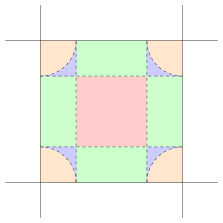
Harry the Calculating Horse will do any mathematical problem I set him, providing the answer is 1, 2, 3 or 4. When I set him a problem, he places a hoof on a large grid consisting of unit squares and his answer is the number of squares partly covered by his hoof. Harry has circular hoofs, of radius \(1/4\) unit. After many years of collaboration, I suspect that Harry no longer bothers to do the calculations, instead merely placing his hoof on the grid completely at random. I often ask him to divide 4 by 4, but only about \(1/4\) of his answers are right; I often ask him to add 2 and 2, but disappointingly only about \(\pi/16\) of his answers are right. Is this consistent with my suspicions? I decide to investigate further by setting Harry many problems, the answers to which are 1, 2, 3, or 4 with equal frequency. If Harry is placing his hoof at random, find the expected value of his answers. The average of Harry's answers turns out to be 2. Should I get a new horse?
Solution: Without loss of generality, let's assume that Harry is putting the center of his hoof within one square.
1999 Paper 1 Q14
When I throw a dart at a target, the probability that it lands a distance \(X\) from the centre is a random variable with density function \[ \mathrm{f}(x)=\begin{cases} 2x & \text{ if }0\leqslant x\leqslant1;\\ 0 & \text{ otherwise.} \end{cases} \] I score points according to the position of the dart as follows: %
- Show that my expected score from one dart is 15/8.
- I play a game with the following rules. I start off with a total score 0, and each time~I throw a dart my score on that throw is added to my total. Then: \newline \hspace*{10mm} if my new total is greater than 3, I have lost and the game ends; \newline \hspace*{10mm} if my new total is 3, I have won and the game ends; \newline \hspace*{10mm} if my new total is less than 3, I throw again. Show that, if I have won such a game, the probability that I threw the dart three times is 343/2231.
1999 Paper 2 Q13
A stick is broken at a point, chosen at random, along its length. Find the probability that the ratio, \(R\), of the length of the shorter piece to the length of the longer piece is less than \(r\). Find the probability density function for \(R\), and calculate the mean and variance of \(R\).
Solution: Let \(X \sim U[0, \tfrac12]\) be the shorter piece, so \(R = \frac{X}{1-X}\), and \begin{align*} && \mathbb{P}(R \leq r) &= \mathbb{P}(\tfrac{X}{1-X} \leq r) \\ &&&= \mathbb{P}(X \leq r - rX) \\ &&&= \mathbb{P}((1+r)X \leq r) \\ &&&= \mathbb{P}(X \leq \tfrac{r}{1+r} ) \\ &&&= \begin{cases} 0 & r < 0 \\ \frac{2r}{1+r} & 0 \leq r \leq 1 \\ 1 & r > 1 \end{cases} \\ \\ && f_R(r) &= \begin{cases} \frac{2}{(1+r)^2} & 0 \leq r \leq 1 \\ 0 & \text{otherwise} \end{cases} \end{align*} Let \(Y \sim U[\tfrac12, 1]\) be the longer piece, then \(R = \frac{1-Y}{Y} = Y^{-1} - 1\) and \begin{align*} \E[R] &= \int_{\frac12}^1 (y^{-1}-1) 2 \d y \\ &= 2\left [\ln y - y \right]_{\frac12}^1 \\ &= -2 + 2\ln2 +2\frac12 \\ &= 2\ln2 -1 \\ \\ \E[R^2] &= \int_{\frac12}^1 (y^{-1}-1)^2 2 \d y\\ &= 2\left [-y^{-1} -2\ln y + 1 \right]_{\frac12}^1 \\ &= 2 \left ( 2 - 2\ln 2+\frac12\right) \\ &= 3-4\ln 2 \\ \var[R] &= 3 - 4 \ln 2 -(2\ln 2-1)^2 \\ &= 2 - 4(\ln 2)^2 \end{align*}
1999 Paper 3 Q13
The cakes in our canteen each contain exactly four currants, each currant being randomly placed in the cake. I take a proportion \(X\) of a cake where \(X\) is a random variable with density function \[{\mathrm f}(x)=Ax\] for \(0\leqslant x\leqslant 1\) where \(A\) is a constant.
- What is the expected number of currants in my portion?
- If I find all four currants in my portion, what is the probability that I took more than half the cake?
1998 Paper 1 Q14
To celebrate the opening of the financial year the finance minister of Genland flings a Slihing, a circular coin of radius \(a\) cm, where \(0 < a < 1\), onto a large board divided into squares by two sets of parallel lines 2 cm apart. If the coin does not cross any line, or if the coin covers an intersection, the tax on yaks remains unchanged. Otherwise the tax is doubled. Show that, in order to raise most tax, the value of \(a\) should be \[\left(1+{\displaystyle \frac{\pi}{4}}\right)^{-1}.\] If, indeed, \(a=\left(1+{\displaystyle \frac{\pi}{4}}\right)^{-1}\) and the tax on yaks is 1 Slihing per yak this year, show that its expected value after \(n\) years will have passed is \[ \left(\frac{8+\pi}{4+\pi}\right)^{n}.\]
1997 Paper 2 Q13
A needle of length two cm is dropped at random onto a large piece of paper ruled with parallel lines two cm apart.
- By considering the angle which the needle makes with the lines, find the probability that the needle crosses the nearest line given that its centre is \(x\) cm from it, where \(0 < x < 1\).
- Given that the centre of the needle is \(x\) cm from the nearest line and that the needle crosses that line, find the cumulative distribution function for the length of the shorter segment of the needle cut off by the line.
- Find the probability that the needle misses all the lines.
Solution:
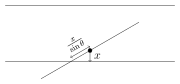
- Suppose the needle's center is \(x\) cm from the nearest line and makes an angle of \(\theta\). Then if \(\sin \theta > x\) it will cross the line, otherwise it will not. Given that \(\theta \sim U(0, \frac{\pi}{2})\), we can see that \begin{align*} && \mathbb{P}(\text{needle crosses}) &= \mathbb{P}(\sin \theta > x) \\ &&&= \mathbb{P}(\theta > \sin^{-1} x) \\ &&&= 1-\frac{2\sin^{-1} x}{\pi} \end{align*}
- The length of the short segment is \(L = 1 - \frac{x}{\sin \theta}\) and \(\theta \sim U(\sin^{-1} x, \frac{\pi}{2})\). So \begin{align*} && F_L(l) &= \mathbb{P}(L < l) \\ &&&= \mathbb{P}\left (1 - \frac{x} {\sin \theta} < l\right) \\ &&&= \mathbb{P}\left ( \sin \theta < \frac{x}{1-l}\right) \\ &&&= \mathbb{P}\left (\theta < \sin^{-1} \frac{x}{1-l}\right) \\ &&&= \frac{ \sin^{-1} \frac{x}{1-l} - \sin^{-1} x }{\frac{\pi}{2} - \sin^{-1}x} \end{align*}
- The needle (with probability \(1\)) cannot hit \(2\) lines, so let's only consider the line it's nearest too. The distance to this line is uniform on \([0,1]\), and the so we want to calculate. \begin{align*} && \mathbb{P}(\text{needle crosses}) &= \int_0^1 \left (1 - \frac{2\sin^{-1}x}{\pi} \right) \d x \\ &&&= 1 - \frac{2}{\pi} \int_0^1 \sin^{-1} x \d x\\ &&&= 1 - \frac{2}{\pi} \left ( \frac{\pi}{2} - 1 \right) \\ &&&= \frac{2}{\pi} \end{align*} Therefore the probability it misses is \(1 - \frac{\pi}{2}\)
1994 Paper 2 Q14
When Septimus Moneybags throws darts at a dart board they are certain to end on the board (a disc of radius \(a\)) but, it must be admitted, otherwise are uniformly randomly distributed over the board.
- Show that the distance \(R\) that his shot lands from the centre of the board is a random variable with variance \(a^{2}/18.\)
- At a charity fete he can buy \(m\) throws for \(\pounds(12+m)\), but he must choose \(m\) before he starts to throw. If at least one of his throws lands with \(a/\sqrt{10}\) of the centre he wins back \(\pounds 12\). In order to show that a good sport he is, he is determined to play but, being a careful man, he wishes to choose \(m\) so as to minimise his expected loss. What values of \(m\) should he choose?
Solution:
- \(\,\) \begin{align*} && \mathbb{P}(R < d) &= \frac{\pi d^2}{\pi a^2} \\ &&&= \frac{d^2}{a^2} \\ \Rightarrow && f_R(d) &= \frac{2d}{a^2}\\ \\ && \E[R] &= \int_0^a x \cdot f_R(x) \d x \\ &&&= \int_0^a \frac{2x^2}{a^2} \d x \\ &&&= \frac{2a}{3} \\ \\ && \E[R^2] &= \int_0^a x^2 \cdot f_R(x) \d x \\ &&&= \int_0^a \frac{2x^3}{a^2} \d x \\ &&&= \frac{a^2}{2} \\ \Rightarrow && \var[R] &= \frac{a^2}2 - \frac{4a^2}{9} \\ &&7= \frac{a^2}{18} \end{align*}
- Let \(p = \mathbb{P}(R < \frac{a}{\sqrt{10}}) = \frac{a^2}{10a^2} = \frac{1}{10}\) be the probability of hitting the target on each throw. His expected loss is \((12+m)p^m + m(1-p^m) = 12p^m + m\). \begin{array}{c|c} m & \text{expected loss} \\ \hline 0 & 12 \\ 1 & \frac{12}{10} + 1 \approx 2.2 \\ 2 & \frac{12}{100} + 2 \approx 2.12 \\ \end{array} If he takes more than \(2\) throws it will definitely cost more than \(3\), therefore he should take exactly \(2\) throws.
1994 Paper 3 Q14
Three points, \(P,Q\) and \(R\), are independently randomly chosen on the perimeter of a circle. Prove that the probability that at least one of the angles of the triangle \(PQR\) will exceed \(k\pi\) is \(3(1-k)^{2}\) if \(\frac{1}{2}\leqslant k\leqslant1.\) Find the probability if \(\frac{1}{3}\leqslant k\leqslant\frac{1}{2}.\)
1993 Paper 1 Q16
By making the substitution \(y=\cos^{-1}t,\) or otherwise, show that \[ \int_{0}^{1}\cos^{-1}t\,\mathrm{d}t=1. \] A pin of length \(2a\) is thrown onto a floor ruled with parallel lines equally spaced at a distance \(2b\) apart. The distance \(X\) of its centre from the nearest line is a uniformly distributed random variable taking values between \(0\) and \(b\) and the acute angle \(Y\) the pin makes with a direction perpendicular to the line is a uniformly distributed random variable taking values between \(0\) and \(\pi/2\). \(X\) and \(Y\) are independent. If \(X=x\) what is the probability that the pin crosses the line? If \(a < b\) show that the probability that the pin crosses a line for a general throw is \(\dfrac{2a}{\pi b}.\)
Solution: \begin{align*} && I &= \int_0^1 \cos^{-1} t \d t \\ \cos y = t: -\sin y \d y = \d t: &&&= \int_{\frac{\pi}{2}}^0 -y \sin y \d y \\ &&&= \int_0^{\pi/2} y \sin y \d y \\ &&&= \left [-y \cos y \right]_0^{\pi/2} + \int_0^{\pi/2} \cos y \d y \\ &&&= \left [ \sin y \right]_0^{\pi/2} = 1 \end{align*}