Problems
Filters
4 problems found
2020 Paper 2 Q4
- Given that \(a\), \(b\) and \(c\) are the lengths of the sides of a triangle, explain why \(c < a + b\), \(a < b + c\) and \(b < a + c\).
- Use a diagram to show that the converse of the result in part (i) also holds: if \(a\), \(b\) and \(c\) are positive numbers such that \(c < a + b\), \(a < b + c\) and \(b < c + a\) then it is possible to construct a triangle with sides of length \(a\), \(b\) and \(c\).
- When \(a\), \(b\) and \(c\) are the lengths of the sides of a triangle, determine in each case whether the following sets of three lengths can
- always
- sometimes but not always
- never
- Let \(\mathrm{f}\) be a function defined on the positive real numbers and such that, whenever \(x > y > 0\), \[\mathrm{f}(x) > \mathrm{f}(y) > 0 \quad \text{but} \quad \frac{\mathrm{f}(x)}{x} < \frac{\mathrm{f}(y)}{y}.\] Show that, whenever \(a\), \(b\) and \(c\) are the lengths of the sides of a triangle, then \(\mathrm{f}(a)\), \(\mathrm{f}(b)\) and \(\mathrm{f}(c)\) can also be the lengths of the sides of a triangle.
Solution:
- Not that unless a side is the largest side, it is clearly shorter than the sum of the other two sides (since it's greater than or equal to one on its own). Note also that the distance from one vertex to the other (say \(c\)) is shorter than going via the other vertex \(a+b\), therefore \(c < a+b\).
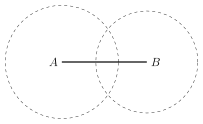
- Draw a line of the length of the largest number, say \(c\), then since \(c < a+b\) we must have circles radius \(a\) and \(b\) at the endpoints cross, and at their intersection we have a vertex of a \(c\)-\(a\)-\(b\) triangle.
- (A) always. Suppose \(c\) is the longest side, then \(c < a+b \Rightarrow c+1 < a + 1 + b+1\) so \((a+1,b+1,c+1)\) are still sides of a triangle. (B) sometimes, but not always. \((1,1,1) \to (1,1,1)\) is still a triangle, but \((10, 10, 1) \to (1, 10, \frac{1}{10})\) is not a triangle since \(10 > 1 + \frac{1}{10}\) (C) never, suppose \(a \leq b \leq c\) then the sides are \(b-a, c-b, c-a\) but \(c-a = (c-b)+(b-a)\) so the triangle inequality cannot be satisfied. (D) always - without loss of generality let \(c\) be the longest side, and since every term is homogeneous degree \(2\) we can divide through by \(c^2\) to see we have the sides \(a^2+b, b^2+a, 1+ab\) and note that \(1 + ab < a+b +ab < a+b+a^2+b^2\), also \(a^2+b < 1 + b < 1 + (a+b)b = 1 + b^2 + ab < (1+ab)+(b^2+a)\).
- Suppose \(f\) is increasing and \(\f(x)/x\) is decreasing, and suppose \(a,b,c\) are side-lengths of a triangle. Wlog \(c\) is the longest side, then note \(f(c) > f(b), f(a)\), so it suffices to prove that \(f(c) < f(a)+f(b)\) \begin{align*} \frac{f(c)}{c} < \frac{f(a)}{a}: && f(a) &> \frac{a}{c} f(c) \\ \frac{f(c)}{c} < \frac{f(b)}{b}: && f(b) &> \frac{b}{c} f(c) \\ \Rightarrow && f(a)+f(b) &> f(c) \underbrace{\left ( \frac{a+b}{c} \right)}_{>1} \\ &&&> f(c) \end{align*} as required
2017 Paper 1 Q7
The triangle \(ABC\) has side lengths \(\left| BC \right| = a\), \(\left| CA \right| = b\) and \(\left| AB \right| = c\). Equilateral triangles \(BXC\), \(CYA\) and \(AZB\) are erected on the sides of the triangle \(ABC\), with \(X\) on the other side of \(BC\) from \(A\), and similarly for \(Y\) and \(Z\). Points \(L\), \(M\) and \(N\) are the centres of rotational symmetry of triangles \(BXC\), \(CY\!A\) and \(AZB\) respectively.
- Show that \(| CM| = \dfrac {\ b} {\sqrt3} \,\) and write down the corresponding expression for \(| CL|\).
- Use the cosine rule to show that \[ 6 \left| LM \right|^2 = a^2+b^2+c^2 + 4\sqrt3 \, \Delta \,, \] where \(\Delta\) is the area of triangle \(ABC\). Deduce that \(LMN\) is an equilateral triangle. Show further that the areas of triangles \(LMN\) and \(ABC\) are equal if and only if \[ a^2+b^2 +c^2 = 4\sqrt3 \, \Delta \,. \]
- Show that the conditions \[ (a -b)^2 = -2ab \big( 1 -\cos(C-60^\circ)\big) \,\] and \[ a^2+b^2 +c^2 = 4\sqrt3 \, \Delta \] are equivalent. Deduce that the areas of triangles \(LMN\) and \(ABC\) are equal if and only if \(ABC\) is equilateral.
Solution:
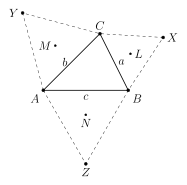
- Consider the equilateral triangle \(CYA\), notice that \(YM\) is a vertical line of symmetry, and \(\angle ACM = 30^\circ\) therefore \(\frac{AC/2}{CM} = \cos 30^\circ \Rightarrow |CM| = \frac{b}{2} \cdot \frac{2}{\sqrt{3}} = \frac{b}{\sqrt{3}}\). Similarly \(|CL| = \frac{a}{\sqrt{3}}\)
- \(\,\) \begin{align*} && |LM|^2 &= |CM|^2 + |CL|^2 - 2 \cdot |CM| \cdot |CL| \cdot \cos \angle MCL \\ &&&= \frac{b^2}{3} + \frac{a^2}{3} - 2 \frac{ab}{3} \cos \left (\angle CMA + \angle CAB + \angle BCL \right) \\ &&&= \frac13 \left (b^2 + a^2 - 2ab \cos \left ( \frac{\pi}{3} + \angle CAB \right) \right) \\ &&&= \frac13 \left (b^2 + a^2 - ab \cos \left ( \angle CAB \right) + \sqrt{3}ab \sin \angle CAB \right) \\ &&&= \frac13 \left (b^2 + a^2 - ab \cos \angle CAB + 2\sqrt{3} \Delta\right) \\ &&&= \frac13 \left (b^2 + a^2 - ab \left (\frac{a^2+b^2-c^2}{2ab} \right) + 2\sqrt{3} \Delta\right) \\ &&&= \frac13 \left ( \frac12(a^2+b^2+c^2) + 2\sqrt{3}\Delta \right) \\ \Rightarrow && 6|LM|^2 &= a^2 + b^2 + c^2 + 4\sqrt{3} \Delta \end{align*} However, nothing in our reasoning here was special about \(LM\), therefore \(LN\) and \(MN\) also equal this value, and we find that the triangle is equilateral. The area of equilateral triangle [LMN] is \(\frac{\sqrt{3}}4 |LM|^2\), ie \begin{align*} &&& \text{areas are equal} \\ \Leftrightarrow && \Delta &= \frac{\sqrt{3}}4 |LM|^2 \\ &&&= \frac{\sqrt{3}}4 \frac{a^2+b^2+c^2+4\sqrt{3}\Delta}{6} \\ &&&= \frac{\sqrt{3}}{24} (a^2+b^2+c^2) + \frac12 \Delta \\ \Leftrightarrow && \Delta &= \frac{\sqrt{3}}{12}(a^2+b^2+c^2)\\ \Leftrightarrow && 4\sqrt{3}\Delta &=a^2+b^2+c^2\\ \end{align*}
- \(\,\) \begin{align*} && (a-b)^2 &= -2ab(1 - \cos(C - 60^{\circ})) \\ \Leftrightarrow && a^2+b^2 - 2ab &=-2ab + 2ab \cos(C - 60^{\circ}) \\ \Leftrightarrow && a^2+b^2 &= ab \cos C+\sqrt{3}ab\sin C \\ \Leftrightarrow && a^2+b^2 &= ab \frac{a^2+b^2-c^2}{2ab} + 2\sqrt{3} \Delta \\ \Leftrightarrow && a^2+b^2+c^2 &= 4\sqrt{3}\Delta \end{align*} Since the LHS is non-positive, and the RHS is positive, the only way they can be equal is if they are both \(0\), ie \(a=b\) and \(C = 60^{\circ}\) ie \(ABC\) is equilateral.
2014 Paper 2 Q1
In the triangle \(ABC\), the base \(AB\) is of length 1 unit and the angles at~\(A\) and~\(B\) are \(\alpha\) and~\(\beta\) respectively, where \(0<\alpha\le\beta\). The points \(P\) and~\(Q\) lie on the sides \(AC\) and \(BC\) respectively, with \(AP=PQ=QB=x\). The line \(PQ\) makes an angle of~\(\theta\) with the line through~\(P\) parallel to~\(AB\).
- Show that \(x\cos\theta = 1- x\cos\alpha - x\cos\beta\), and obtain an expression for \(x\sin\theta\) in terms of \(x\), \(\alpha\) and~\(\beta\). Hence show that \begin{equation} \label{eq:2*} \bigl(1+2\cos(\alpha+\beta)\bigr)x^2 - 2(\cos\alpha + \cos\beta)x + 1 = 0\,. \tag{\(*\)} \end{equation} Show that \((*)\) is also satisfied if \(P\) and \(Q\) lie on \(AC\) produced and \(BC\) produced, respectively. [By definition, \(P\) lies on \(AC\) produced if \(P\) lies on the line through \(A\) and~\(C\) and the points are in the order \(A\), \(C\), \(P\)\,.]
- State the condition on \(\alpha\) and \(\beta\) for \((*)\) to be linear in \(x\). If this condition does not hold (but the condition \(0<\alpha \le \beta\) still holds), show that \((*)\) has distinct real roots.
- Find the possible values of~\(x\) in the two cases (a) \(\alpha = \beta = 45^\circ\) and (b) \(\alpha = 30^\circ\), \(\beta = 90^\circ\), and illustrate each case with a sketch.
2001 Paper 2 Q7
In an Argand diagram, \(O\) is the origin and \(P\) is the point \(2+0\mathrm{i}\). The points \(Q\), \(R\) and \(S\) are such that the lengths \(OP\), \(PQ\), \(QR\) and \(RS\) are all equal, and the angles \(OPQ\), \(PQR\) and \(QRS\) are all equal to \({5{\pi}}/6\), so that the points \(O\), \(P\), \(Q\), \(R\) and \(S\) are five vertices of a regular 12-sided polygon lying in the upper half of the Argand diagram. Show that \(Q\) is the point \(2 + \sqrt 3 + \mathrm{i}\) and find \(S\). The point \(C\) is the centre of the circle that passes through the points \(O\), \(P\) and \(Q\). Show that, if the polygon is rotated anticlockwise about \(O\) until \(C\) first lies on the real axis, the new position of \(S\) is $$ - \tfrac{1}{2} (3\sqrt 2+ \sqrt6)(\sqrt3-\mathrm{i})\;. $$