Problems
Filters
6 problems found
2018 Paper 2 Q9
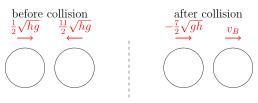
Two small beads, \(A\) and \(B\), of the same mass, are threaded onto a vertical wire on which they slide without friction, and which is fixed to the ground at \(P\). They are released simultaneously from rest, \(A\) from a height of \(8h\) above \(P\) and \(B\) from a height of \(17h\) above \(P\). When \(A\) reaches the ground for the first time, it is moving with speed \( V\). It then rebounds with coefficient of restitution \(\frac{1}{2}\) and subsequently collides with \(B\) at height \(H\) above \(P\). Show that \(H= \frac{15}8h\) and find, in terms of \(g\) and \(h\), the speeds \(u_A\) and \(u_B\) of the two beads just before the collision. When \(A\) reaches the ground for the second time, it is again moving with speed \( V\). Determine the coefficient of restitution between the two beads.
Solution: \begin{align*} && v^2 &= u^2 +2as \\ \Rightarrow && V^2 &= 2 g \cdot (8h)\\ \Rightarrow && V &=4\sqrt{hg}\\ \end{align*} When the first particle collides with the ground, the second particle is at \(9h\) traveling with speed \(V\), the first particle is at \(0\) traveling (upwards) with speed \(\tfrac12 V\). For a collision we need: \begin{align*} && \underbrace{\frac12 V t- \frac12 g t^2}_{\text{position of A}} &= \underbrace{9h - Vt - \frac12 gt^2}_{\text{position of B}} \\ \Rightarrow && \frac32Vt &= 9h \\ \Rightarrow && t &= \frac{6h}{V} \\ \\ && \underbrace{\frac12 V t- \frac12 g t^2}_{\text{position of A}} &= \frac12 V \frac{6h}{V} - \frac12 g t^2 \\ &&&= 3h - \frac12 g\frac{36h^2}{16hg} \\ &&&= 3h - \frac{9}{8}h \\ &&&= \frac{15}{8}h \end{align*} Just before the collision, \(A\) will be moving with velocity (taking upwards as positive) \begin{align*} && u_A &= \frac12 V-gt \\ &&&= 2\sqrt{hg}-g \frac{6h}{V} \\ &&&= 2\sqrt{hg} - g \frac{6h}{4\sqrt{hg}} \\ &&&= 2\sqrt{hg}-\frac32\sqrt{hg} \\ &&&= \frac12 \sqrt{hg} \end{align*} Similarly, for \(B\). \begin{align*} && u_B &= -V -gt \\ &&&= -4\sqrt{hg} - \frac32\sqrt{hg} \\ &&&= -\frac{11}{2}\sqrt{hg} \end{align*} Considering \(A\), to figure out \(v_A\). \begin{align*} && v^2 &= u^2 + 2as \\ && V^2 &= v_A^2 + 2g\frac{15}{8}h \\ && 16hg &= v_A^2 + \frac{15}{4}gh \\ \Rightarrow && v_A^2 &= \frac{49}{4}gh \\ \Rightarrow && v_A &= -\frac{7}{2}\sqrt{gh} \end{align*}
2014 Paper 1 Q10
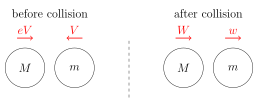
- A uniform spherical ball of mass \(M\) and radius \(R\) is released from rest with its centre a distance \(H+R\) above horizontal ground. The coefficient of restitution between the ball and the ground is \(e\). Show that, after bouncing, the centre of the ball reaches a height \(R+He^2\) above the ground.
- A second uniform spherical ball, of mass \(m\) and radius \(r\), is now released from rest together with the first ball (whose centre is again a distance \(H+R\) above the ground when it is released). The two balls are initially one on top of the other, with the second ball (of mass \(m\)) above the first. The two balls separate slightly during their fall, with their centres remaining in the same vertical line, so that they collide immediately after the first ball has bounced on the ground. The coefficient of restitution between the balls is also \(e\). The centre of the second ball attains a height \(h\) above the ground. Given that \(R=0.2\), \(r=0.05\), \(H=1.8\), \(h=4.5\) and \(e=\frac23\), determine the value of \(M/m\).
Solution:
- The story for first ball (before it collides with the second ball) will be exactly the same, ie it rebounds with speed \(eV\).
For the second ball, it will also have fallen a distance \(H\) and will be travelling with the same speed \(V\). Their speed of approach therefore will be \((1+e)V\), and the speed of separating therefore must be \(e(1+e)V\)
Given the centre of the second ball reaches a height of \(h\) (from a position of height) \(2R+r\), we must have:
\begin{align*}
&& v^2 &= u^2 + 2as \\
&& 0 &= w^2 - 2g(h - 2R-r) \\
\Rightarrow && w^2 &= 2g(h-2R-r)
\end{align*}
Taking upwards to be positive, then we have:
\begin{align*} \text{COM}: && MeV + m(-V) &= M(w-e(1+e)V) + mw \\ \Rightarrow && V(Me-m)+e(1+e)MV &= w(M+m) \\ \Rightarrow && w &= \frac{2Me+e^2M-m}{M+m} V \\ \Rightarrow && w^2 &= \left ( \frac{M/m(2e+e^2)-1}{M/m+1}\right)^2 V^2 \\ \Rightarrow && 2g(h-2R-r) &= \left ( \frac{M/m(2e+e^2)-1}{M/m+1}\right)^2 2gH \\ \Rightarrow && \left ( \frac{M/m(2e+e^2)-1}{M/m+1}\right)^2 &= \frac{h-2R-r}{H} \\ &&&= \frac{4.5-0.4-0.05}{1.8} \\ &&&= \frac{9}{4} \\ \Rightarrow && \frac{M/m(\frac43+\frac49)-1}{M/m+1} &= \frac32 \\ \Rightarrow && \frac{16}9M/m-1 &= \frac32 M/m+\frac32 \\ \Rightarrow && \frac{5}{18}M/m &= \frac{5}{2} \\ \Rightarrow && M/m &= 9 \end{align*}
2012 Paper 1 Q10
I stand at the top of a vertical well. The depth of the well, from the top to the surface of the water, is \(D\). I drop a stone from the top of the well and measure the time that elapses between the release of the stone and the moment when I hear the splash of the stone entering the water. In order to gauge the depth of the well, I climb a distance \(\delta\) down into the well and drop a stone from my new position. The time until I hear the splash is \(t\) less than the previous time. Show that \[ t = \sqrt{\frac{2D}g} - \sqrt{\frac{2(D-\delta)}g} + \frac \delta u\,, \] where \(u\) is the (constant) speed of sound. Hence show that \[ D = \tfrac12 gT^2\,, \] where \(T= \dfrac12 \beta + \dfrac \delta{\beta g}\) and \(\beta = t - \dfrac \delta u\,\). Taking \(u=300\,\)m\,s\(^{-1}\) and \(g=10\,\)m\,s\(^{-2}\), show that if \(t= \frac 15\,\)s and \(\delta=10\,\)m, the well is approximately \(185\,\)m deep.
Solution: \begin{align*} && s &= ut + \frac12at^2 \\ && D &= \frac12gt_D^2 \\ \Rightarrow && t_D &= \sqrt{\frac{2D}{g}} \\ \Rightarrow && t_{D-\delta} &= \sqrt{\frac{2(D-\delta}{g}} \end{align*} Therefore the difference in times of what I hear will be: \begin{align*} t &= \underbrace{\sqrt{\frac{2D}{g}}}_{\text{time for first stone to hit water}} + \underbrace{\frac{D}{u}}_{\text{time to hear about it}} - \left (\underbrace{\sqrt{\frac{2(D-\delta)}{g}}}_{\text{time for second stone to hit water}} + \underbrace{\frac{D-\delta}{u}}_{\text{time to hear about it}} \right) \\ &= \sqrt{\frac{2D}g} - \sqrt{\frac{2(D-\delta)}g} + \frac \delta u \end{align*} \begin{align*} && t &= \sqrt{\frac{2D}g} - \sqrt{\frac{2(D-\delta)}g} + \frac \delta u \\ \Rightarrow && \beta &= \sqrt{\frac{2D}g} - \sqrt{\frac{2(D-\delta)}g} \\ && \beta^2 &= \frac{2D}{g} + \frac{2(D-\delta)}{g} - \frac{4}{g}\sqrt{D(D-g)} \\ &&&= \frac{4D}{g} - \frac{2\delta}{g} - \frac{4}{g} \sqrt{D(D-\delta)}\\ \Rightarrow && g\beta^2 &= 4D-2\delta -4\sqrt{D(D-\delta)}\\ \Rightarrow && (g \beta^2-4D+2\delta)^2 &= 16D(D-\delta) \\ \Rightarrow && g^2\beta^4 + 16D^2 + 4\delta^2 -8g\beta^2D+4g\beta^2 \delta -16D\delta &= 16D^2-16D\delta \\ \Rightarrow && 8g\beta^2D &= g\beta^4 +4\delta^2 +4g\beta^2 \delta \\ \Rightarrow && D &= \frac1{8g\beta^2} \left ( g^2\beta^4 +4\delta^2 +4g\beta^2 \delta\right) \\ &&&= \frac1{8g\beta^2} \left ( g\beta^2 +2\delta \right)^2 \\ &&&= \frac12g \left ( \frac{\beta}{2} + \frac{\delta}{g\beta} \right)^2 \end{align*} If \(u = 300, g = 10, t = \frac15, \delta = 10\), then \begin{align*} && \beta &= \frac15-\frac{10}{300}\\ &&&= \frac15 - \frac1{30} \\ &&&= \frac{1}{6}\\ && D &= \frac12 \cdot 10 \left ( \frac1{12} + 6 \right)^2 \\ &&&= 5\cdot (36 + 1 + \frac{1}{12^2}) \\ &&&\approx 37 \cdot 5 = 185 \end{align*}
2011 Paper 1 Q10
A particle, \(A\), is dropped from a point \(P\) which is at a height \(h\) above a horizontal plane. A~second particle, \(B\), is dropped from \(P\) and first collides with \(A\) after \(A\) has bounced on the plane and before \(A\) reaches \(P\) again. The bounce and the collision are both perfectly elastic. Explain why the speeds of \(A\) and \(B\) immediately before the first collision are the same. The masses of \(A\) and \(B\) are \(M\) and \(m\), respectively, where \(M>3m\), and the speed of the particles immediately before the first collision is \(u\). Show that both particles move upwards after their first collision and that the maximum height of \(B\) above the plane after the first collision and before the second collision is \[ h+ \frac{4M(M-m)u^2}{(M+m)^2g}\,. \]
2006 Paper 3 Q11
A lift of mass \(M\) and its counterweight of mass \(M\) are connected by a light inextensible cable which passes over a fixed frictionless pulley. The lift is constrained to move vertically between smooth guides. The distance between the floor and the ceiling of the lift is \(h\). Initially, the lift is at rest, and the distance between the top of the lift and the pulley is greater than \(h\). A small tile of mass \(m\) becomes detached from the ceiling of the lift and falls to the floor of the lift. Show that the speed of the tile just before the impact is \[ \sqrt{\frac{(2M-m)gh \;}{M}}\;. \] The coefficient of restitution between the tile and the floor of the lift is \(e\). Given that the magnitude of the impulsive force on the lift due to tension in the cable is equal to the magnitude of the impulsive force on the counterweight due to tension in the cable, show that the loss of energy of the system due to the impact is \(mgh(1-e^2)\). Comment on this result.
2000 Paper 2 Q9
In an aerobatics display, Jane and Karen jump from a great height and go through a period of free fall before opening their parachutes. While in free fall at speed \(v\), Jane experiences air resistance \(kv\) per unit mass but Karen, who spread-eagles, experiences air resistance \mbox{\(kv + (2k^2/g)v^2\)} per unit mass. Show that Jane's speed can never reach \(g/k\). Obtain the corresponding result for Karen. Jane opens her parachute when her speed is \(g/(3{k})\). Show that she has then been in free fall for time \(k^{-1}\ln (3/2)\). Karen also opens her parachute when her speed is \(g/(3{k})\). Find the time she has then been in free fall.
Solution: Looking at the forces on Jane, \(kv < g \Rightarrow v < \frac{g}{k}\). For Karen we have \begin{align*} kv + (2k^2/g)v^2 &< g\\ -g^2 + gkv + (2k^2)v^2 &< 0 \\ (2kv-g)(kv+g) &< 0\\ \Rightarrow v &< \frac{g}{2k} \end{align*} \begin{align*} && \dot{v} &= g - kv \\ \Rightarrow && \frac{\dot{v}}{g - kv} &= 1 \\ \Rightarrow && T &= \int_0^{g/(3k)} \frac{1}{g - kv} dv \\ && &= \int_0^{g/(3k)} \frac{1}{g - kv} dv\\ && &= \int_0^{g/(3k)} \frac{1}{g - kv} dv \\ && &= \left [-\frac{1}{k} \ln \l g - kv \r \right ]_0^{g/(3k)} \\ && &= \frac{1}{k} \ln \l g \r - \frac{1}{k} \ln \l \frac{2}{3}g \r\\ &&&= \frac{1}{k} \ln \l \frac{3}{2} \r \end{align*} \begin{align*} && \dot{v} &= g - kv - (2k^2/g)v^2 \\ \Rightarrow && \frac{\dot{v}}{g - kv - (2k^2/g)v^2} &= 1 \\ \Rightarrow && T &= \int_0^{g/(3k)} \frac{1}{g - kv - (2k^2/g)v^2} dv \\ && &= \int_0^{g/(3k)} \frac{g}{(g-2kv)(kv+g)} dv\\ && &= \int_0^{g/(3k)} \l \frac{2}{3(g-2kv)} + \frac{1}{3(kv+g)} \r dv\\ && &= \left [ \l -\frac{1}{3k} \ln (g-2kv) + \frac{1}{3k}\ln(kv+g) \r \right ]_0^{g/(3k)} \\ && &= \left [ \l -\frac{1}{3k}\ln \l \frac{g}{3} \r + \frac{1}{3k}\ln \l \frac{4g}{3} \r \r \right ] - \left [- \frac1{3k} \ln(g) + \frac{1}{3k} \ln (g) \right ] \\ && &= \frac{1}{3k} \ln \l 4 \r \end{align*} NB: \(\sqrt[3]{4} \approx 1.58 > \frac{3}{2}\) so Karen has been in free-fall for longer, but not \emph{much} longer than Jane.