Problems
Filters
11 problems found
2021 Paper 2 Q5
- Use the substitution \(y = (x - a)u\), where \(u\) is a function of \(x\), to solve the differential equation \[ (x - a)\frac{dy}{dx} = y - x, \] where \(a\) is a constant.
- The curve \(C\) with equation \(y = f(x)\) has the property that, for all values of \(t\) except \(t = 1\), the tangent at the point \(\bigl(t,\, f(t)\bigr)\) passes through the point \((1, t)\).
- Given that \(f(0) = 0\), find \(f(x)\) for \(x < 1\). Sketch \(C\) for \(x < 1\). You should find the coordinates of any stationary points and consider the gradient of \(C\) as \(x \to 1\). You may assume that \(z\ln|z| \to 0\) as \(z \to 0\).
- Given that \(f(2) = 2\), sketch \(C\) for \(x > 1\), giving the coordinates of any stationary points.
2016 Paper 1 Q4
- Differentiate $\displaystyle \; \frac z {(1+z^2)^{\frac12}} \;$ with respect to \(z\).
- The {\em signed curvature} \(\kappa\) of the curve \(y=\f(x)\) is defined by \[ \kappa = \frac {\f''(x)}{\big({1+ (\f'(x))^2\big)^{\frac32}}} \,.\] Use this definition to determine all curves for which the signed curvature is a non-zero constant. For these curves, what is the geometrical significance of \(\kappa\)?
Solution:
- Let \(\displaystyle y = \frac z {(1+z^2)^{\frac12}}\) then \(\frac{d y}{d x} = \frac{(1+z^2)^{\frac12} - z^2(1+z^2)^{-\frac12}}{1+z^2} = \frac{(1+z^2)-z^2}{(1+z^2)^\frac32} = \frac{1}{(1+z^2)^\frac32}\)
- \(\kappa = \frac {f''(x)}{\big({1+ (f'(x))^2\big)^{\frac32}}}\) then \begin{align*} && \int \kappa \, dx &= \int \frac{f''(x)}{( 1 + (f'(x))^2)^{\frac32}} \, dx \\ && \kappa x &= \frac{f'(x)}{(1 + (f'(x))^2)^\frac12} + C \\ \Rightarrow && (\kappa x-C)^2 &= \frac{f'(x)^2}{1 + (f'(x))^2} \\ \Rightarrow && f'(x)^2((\kappa x - C)^2 - 1) &= -(\kappa x-C)^2 \\ \Rightarrow && f'(x) &= \frac{\kappa x - C}{\sqrt{1-(\kappa x - C)^2 }} \\ \Rightarrow && f(x) &= \frac{1}{\kappa} \sqrt{1 - (\kappa x - C)^2} \\ \Rightarrow && (\kappa y)^2 + (\kappa x - C)^2 &= 1 \\ \Rightarrow && y^2 + (x - C')^2 &= \frac{1}{\kappa^2} \end{align*} Therefore all the curves are circles and \(\kappa\) is the reciprocal of the radius.
2016 Paper 2 Q6
This question concerns solutions of the differential equation \[ (1-x^2) \left(\frac{\d y}{\d x}\right)^2 + k^2 y^2 = k^2\, \tag{\(*\)} \] where \(k\) is a positive integer. For each value of \(k\), let \(y_k(x)\) be the solution of \((*)\) that satisfies \(y_k(1)=1\); you may assume that there is only one such solution for each value of \(k\).
- Write down the differential equation satisfied by \(y_1(x)\) and verify that \(y_1(x) = x\,\).
- Write down the differential equation satisfied by \(y_2(x)\) and verify that \(y_2(x) = 2x^2-1\,\).
- Let \(z(x) = 2\big(y_n(x)\big)^2 -1\). Show that \[ (1-x^2) \left(\frac{\d z}{\d x}\right)^2 +4n^2 z^2 = 4n^2\, \] and hence obtain an expression for \(y_{2n}(x)\) in terms of \(y_n(x)\).
- Let \(v(x) = y_n\big(y_m(x)\big)\,\). Show that \(v(x) = y_{mn}(x)\,\).
Solution:
- When \(k =1\), we have \((1-x^2)(y')^2 + y^2 = 1\). Notice that if \(y_1 = x\) we have \(y_1' = 1\) and \((1-x^2) \cdot 1 + x^2 = 1\) so \(y_1\) is a solution, and we are allowed to assume this is the only solution. And notice that \(y_1(1) = 1\).
- When \(k = 2\) we have \((1-x^2)(y')^2 + 4y^2 = 4\). Trying \(y_2 = 2x^2-1\) we see that \(y_2' = 4x\) and \((1-x^2)(4x)^2 + 4(2x^2-1)^2 = 16x^2-16x^4+16x^4-16x^2+4 = 4\). We can also check that \(y(1) = 2 \cdot 1^2 - 1 = 1\)
- Let \(z(x) = 2(y_n(x))^2-1\), then \begin{align*} && \frac{\d z}{\d x} &= 4y'_n(x)y_n(x) \\ \Rightarrow && LHS &= (1-x^2)\left ( \frac{\d z}{\d x} \right)^2 + 4n^2 z^2 \\ &&&= (1-x^2)16(y'_n(x))^2(y_n(x))^2 + 4n^2(2(y_n(x))^2-1)^2 \\ &&&= 16y_n^2(1-x^2) \left [\frac{n^2-n^2y_n^2}{(1-x^2)} \right] + 16n^2y_n^4-16n^2y_n^2+4n^2 \\ &&&= 4n^2 = RHS \end{align*} Therefore \(y_{2n}(x) = 2(y_n(x))^2-1 = y_2(y_n(x))\) (notice also that \(z(1) = 2(y_n(1))^2-1 = 2-1 = 1\)).
- Let \(v(x) = y_n(y_m(x))\) so \begin{align*} && (y_m')^2 &= \frac{m^2(1-y_m^2)}{1-x^2} \\ && (y_n')^2 &= \frac{n^2(1-y_n^2)}{1-x^2} \\ \\ && \frac{\d v}{\d x} &= y_n'(y_m(x)) \cdot y_m'(x) \\ && (1-x^2)(v')^2 &= (1-x^2) \cdot (y_n'(y_m(x)))^2 (y_m')^2 \\ &&&= (1-x^2) \cdot (y_n'(y_m(x)))^2 \left ( \frac{m^2(1-y_m^2)}{1-x^2} \right) \\ &&&= (y_n'(y_m(x)))^2 m^2(1-y_m^2) \\ &&&= \frac{n^2(1-(y_n(y_m(x)))^2)}{1-y_m^2}m^2(1-y_m^2) \\ &&&= n^2m^2(1-v^2) \end{align*} Therefore \(v\) satisfies our differential equation and \(v(1) = y_n(y_m(1)) = y_n(1) = 1\) so it must be our desired solution.
2015 Paper 3 Q8
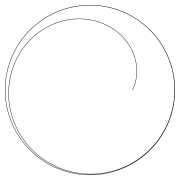
- Show that under the changes of variable \(x= r\cos\theta\) and \(y = r\sin\theta\), where \(r\) is a function of \(\theta\) with \(r>0\), the differential equation \[ (y+x)\frac{\d y}{\d x} = y-x \] becomes \[ \frac{\d r}{\d\theta} + r=0 \,. \] Sketch a solution in the \(x\)-\(y\) plane.
- Show that the solutions of \[ \left( y+x -x(x^2+y^2) \right) \, \frac{\d y }{\d x} = y-x - y(x^2+y^2) \] can be written in the form \\ \[ r^2 = \dfrac 1 {1+A\e^{2\theta}}\, \]\\ and sketch the different forms of solution that arise according to the value of \(A\).
Solution:
- \begin{align*}
&& (y+x)\frac{\d y}{\d x} &= y-x \\
\Rightarrow && (r \sin \theta + r \cos\theta) \frac{\frac{dy}{d\theta}}{\frac{dx}{d\theta}} &= (r \sin\theta - r \cos\theta) \\
\Rightarrow && ( \sin \theta + \cos\theta) \frac{dy}{d\theta} &= (\sin\theta - \cos\theta){\frac{dx}{d\theta}} \\
\Rightarrow && ( \sin \theta + \cos\theta) \left ( \frac{dr}{d\theta} \cos \theta - r \sin \theta\right ) &= (\sin\theta - \cos\theta)\left ( \frac{dr}{d\theta} \sin\theta + r \cos \theta\right) \\
\Rightarrow && \frac{dr}{d\theta} \left (\sin \theta \cos \theta + \cos^2 \theta - \sin^2 \theta + \sin \theta \cos \theta \right)&= r \left (\sin \theta \cos \theta - \cos^2 \theta + \sin^2 \theta + \sin\theta \cos \theta\right) \\
\Rightarrow && \frac{dr}{d\theta}&= -r \\
\end{align*}
Therefore \(r = Ae^{-\theta}\)

- \begin{align*}
&& \left( y+x -x(x^2+y^2) \right) \, \frac{\d y }{\d x} &= y-x - y(x^2+y^2) \\
\Rightarrow && \left( r \sin \theta+r\cos \theta -r^3\cos \theta \right) \, \frac{\d y }{\d \theta} &= \left ( r \sin \theta- r \cos \theta- r^3\sin \theta \right)\frac{\d x }{\d \theta} \\
\Rightarrow && \left( r \sin \theta+r\cos \theta -r^3\cos \theta \right) \, \left (\frac{\d r}{\d \theta} \sin \theta + r \cos \theta \right) &= \\
&& \left ( r \sin \theta- r \cos \theta- r^3\sin \theta \right)&\left (\frac{\d r}{\d \theta} \cos \theta - r \sin \theta \right) \\
\Rightarrow && \frac{\d r}{\d \theta} \left (\sin \theta ( \sin \theta + \cos \theta - r^2 \cos \theta) - \cos \theta (\sin \theta - \cos \theta - r^2 \sin \theta) \right) &= \\
&& r ( -\sin \theta (\sin \theta - \cos \theta - r^2 \sin \theta) - \cos \theta ( \sin \theta + \cos \theta &- r^2 \cos \theta)) \\
\Rightarrow && \frac{\d r}{\d \theta} &= r ( -1 +r^2) \\
\Rightarrow && \int \frac{1}{r(r-1)(r+1)} \d r &= \int \d \theta \\
\Rightarrow && \int \l \frac{-1}{r} + \frac{1}{2(r-1)} + \frac{1}{2(r+1)} \r \d r &= \int \d \theta \\
\Rightarrow && \l -\log r+ \frac12 \log (1+r)+ \frac12 \log (1-r)\r + C &= \theta \\
\Rightarrow && \frac12 \log \left (\frac{1-r^2}{r^2} \right) + C &= \theta \\
\Rightarrow && \log \left (\frac{1}{r^2}-1 \right) + C &= 2\theta \\
\Rightarrow && r &= \frac{1}{1 + Ae^{2\theta}} \\
\end{align*}


2007 Paper 2 Q6
- Differentiate \(\ln\big (x+\sqrt{3+x^2}\,\big)\) and \(x\sqrt{3+x^2}\) and simplify your answers. Hence find \(\int \! \sqrt{3+x^2}\, \d x\).
- Find the two solutions of the differential equation \[ 3\left(\frac{\d y}{\d x}\right)^{\!2} + 2 x \frac {\d y}{\d x} =1 \] that satisfy \(y=0\) when \(x=1\).
Solution:
- \(\,\) \begin{align*} && y &= \ln (x + \sqrt{3+x^2}) \\ \Rightarrow && y' &= \frac{1}{x + \sqrt{3+x^2}} \cdot \left (1 + \frac{x}{\sqrt{3+x^2}} \right) \\ &&&= \frac{1}{\sqrt{3+x^2}} \\ \\ && y &= x\sqrt{3+x^2} \\ && y' &= \sqrt{3+x^2} + \frac{x^2}{\sqrt{3+x^2}} \\ &&&= 2\sqrt{3+x^2} - \frac{3}{\sqrt{3+x^2}} \\ \\ \Rightarrow && \sqrt{3+x^2} &= \frac12(x \sqrt{3+x^2})' + \frac32(\ln(x+\sqrt{3+x^2})' \\ \Rightarrow && \int \sqrt{3+x^2}\, \d x &= \frac12x\sqrt{3+x^2} + \frac32 \ln (x+\sqrt{3+x^2}) + C \end{align*}
- \(\,\) \begin{align*} && 3 \left ( \frac{\d y}{\d x} \right)^2 + 2x \frac{\d y}{\d x} &= 1 \\ && \frac{\d y}{\d x} &= \frac{-x \pm \sqrt{x^2+3} }3 \\ \Rightarrow && y &= -\frac{x^2}{6} \pm \frac16x\sqrt{3+x^2} \pm \frac12 \ln (x+\sqrt{3+x^2}) + C \\ y = 0, x = 1: && 0 &= -\frac16 \pm \frac13 \pm \frac12 \ln 3 \\ \Rightarrow && y &= -\frac{x^2}{6} \pm \frac12x\sqrt{3+x^2} \pm \frac32 \ln (x+\sqrt{3+x^2}) + \frac16 \mp \frac13 \mp \frac12 \ln 3 \end{align*}
2001 Paper 2 Q5
The curve \(C_1\) passes through the origin in the \(x\)--\(y\) plane and its gradient is given by $$ \frac{\d y}{\d x} =x(1-x^2)\e^{-x^2}. $$ Show that \(C_1\) has a minimum point at the origin and a maximum point at \(\left(1,{\frac12\, \e^{-1}} \right)\). Find the coordinates of the other stationary point. Give a rough sketch of \(C_1\). The curve \(C_2\) passes through the origin and its gradient is given by $$ \frac{\d y}{\d x}= x(1-x^2)\e^{-x^3}. $$ Show that \(C_2\) has a minimum point at the origin and a maximum point at \((1,k)\), where \phantom{} \(k > \frac12 \,\e^{-1}.\) (You need not find \(k\).)
2000 Paper 2 Q9
In an aerobatics display, Jane and Karen jump from a great height and go through a period of free fall before opening their parachutes. While in free fall at speed \(v\), Jane experiences air resistance \(kv\) per unit mass but Karen, who spread-eagles, experiences air resistance \mbox{\(kv + (2k^2/g)v^2\)} per unit mass. Show that Jane's speed can never reach \(g/k\). Obtain the corresponding result for Karen. Jane opens her parachute when her speed is \(g/(3{k})\). Show that she has then been in free fall for time \(k^{-1}\ln (3/2)\). Karen also opens her parachute when her speed is \(g/(3{k})\). Find the time she has then been in free fall.
Solution: Looking at the forces on Jane, \(kv < g \Rightarrow v < \frac{g}{k}\). For Karen we have \begin{align*} kv + (2k^2/g)v^2 &< g\\ -g^2 + gkv + (2k^2)v^2 &< 0 \\ (2kv-g)(kv+g) &< 0\\ \Rightarrow v &< \frac{g}{2k} \end{align*} \begin{align*} && \dot{v} &= g - kv \\ \Rightarrow && \frac{\dot{v}}{g - kv} &= 1 \\ \Rightarrow && T &= \int_0^{g/(3k)} \frac{1}{g - kv} dv \\ && &= \int_0^{g/(3k)} \frac{1}{g - kv} dv\\ && &= \int_0^{g/(3k)} \frac{1}{g - kv} dv \\ && &= \left [-\frac{1}{k} \ln \l g - kv \r \right ]_0^{g/(3k)} \\ && &= \frac{1}{k} \ln \l g \r - \frac{1}{k} \ln \l \frac{2}{3}g \r\\ &&&= \frac{1}{k} \ln \l \frac{3}{2} \r \end{align*} \begin{align*} && \dot{v} &= g - kv - (2k^2/g)v^2 \\ \Rightarrow && \frac{\dot{v}}{g - kv - (2k^2/g)v^2} &= 1 \\ \Rightarrow && T &= \int_0^{g/(3k)} \frac{1}{g - kv - (2k^2/g)v^2} dv \\ && &= \int_0^{g/(3k)} \frac{g}{(g-2kv)(kv+g)} dv\\ && &= \int_0^{g/(3k)} \l \frac{2}{3(g-2kv)} + \frac{1}{3(kv+g)} \r dv\\ && &= \left [ \l -\frac{1}{3k} \ln (g-2kv) + \frac{1}{3k}\ln(kv+g) \r \right ]_0^{g/(3k)} \\ && &= \left [ \l -\frac{1}{3k}\ln \l \frac{g}{3} \r + \frac{1}{3k}\ln \l \frac{4g}{3} \r \r \right ] - \left [- \frac1{3k} \ln(g) + \frac{1}{3k} \ln (g) \right ] \\ && &= \frac{1}{3k} \ln \l 4 \r \end{align*} NB: \(\sqrt[3]{4} \approx 1.58 > \frac{3}{2}\) so Karen has been in free-fall for longer, but not \emph{much} longer than Jane.
1993 Paper 2 Q3
- Solve the differential equation \[ \frac{\mathrm{d}y}{\mathrm{d}x}-y-3y^{2}=-2 \] by making the substitution \(y=-\dfrac{1}{3u}\dfrac{\mathrm{d}u}{\mathrm{d}x}.\)
- Solve the differential equation \[ x^{2}\frac{\mathrm{d}y}{\mathrm{d}x}+xy+x^{2}y^{2}=1 \] by making the substitution \[ y=\frac{1}{x}+\frac{1}{v}, \] where \(v\) is a function of \(x\).
1992 Paper 2 Q2
Suppose that \(y\) satisfies the differential equation \[ y=x\frac{\mathrm{d}y}{\mathrm{d}x}-\cosh\left(\frac{\mathrm{d}y}{\mathrm{d}x}\right).\tag{*} \] By differentiating both sides of \((*)\) with respect to \(x\), show that either \[ \frac{\mathrm{d}^{2}y}{\mathrm{d}x^{2}}=0\qquad\mbox{ or }\qquad x-\sinh\left(\frac{\mathrm{d}y}{\mathrm{d}x}\right)=0. \] Find the general solutions of each of these two equations. Determine the solutions of \((*)\).
Solution: \begin{align*} && y & =x\frac{\mathrm{d}y}{\mathrm{d}x}-\cosh\left(\frac{\mathrm{d}y}{\mathrm{d}x}\right) \\ \Rightarrow && \frac{\d y}{\d x} &= \frac{\d y}{\d x} + x\frac{\d ^2 y}{\d x^2} - \sinh \left ( \frac{\d y}{\d x} \right) \frac{\d^2 y}{\d x^2} \\ \Rightarrow && 0 &= \frac{\d^2 y}{\d x^2} \left ( x - \sinh \left ( \frac{\d y}{\d x}\right)\right) \end{align*} Therefore \(\frac{\d^2y}{\d x^2} = 0\) or \( x - \sinh \left ( \frac{\d y}{\d x}\right) = 0\) as required. \begin{align*} && \frac{\d ^2 y}{\d x^2} &= 0 \\ \Rightarrow && y &= ax + b \\ \\ && 0 &= x - \sinh \left ( \frac{\d y}{\d x}\right) \\ \Rightarrow && \frac{\d y}{\d x} &= \sinh^{-1} (x) \\ \Rightarrow && y &= x \sinh^{-1} x - \sqrt{x^2+1} + C \end{align*} Since it is necessary the solution satisfies one of those equations, we just need to check if either of these types of solutions work for our differential equation, ie \begin{align*} && ax + b &\stackrel{?}{=} ax - \cosh(a) \\ \Rightarrow && b &= -\cosh(a) \\ \Rightarrow && y &= ax -\cosh(a) \\ \\ && x \sinh^{-1} x - \sqrt{x^2+1} + C &\stackrel{?}{=} x\sinh^{-1} x - \cosh ( \sinh^{-1} x) \\ &&&= \sinh^{-1} x -\sqrt{x^2+1} \\ \Rightarrow && C &= 0 \end{align*} Therefore the general solutions are, \(y = ax - \cosh(a)\) and \(y = x \sinh^{-1} x - \sqrt{x^2+1}\)
1991 Paper 2 Q8
Solve the quadratic equation \(u^{2}+2u\sinh x-1=0\), giving \(u\) in terms of \(x\). Find the solution of the differential equation \[ \left(\frac{\mathrm{d}y}{\mathrm{d}x}\right)^{2}+2\frac{\mathrm{d}y}{\mathrm{d}x}\sinh x-1=0 \] which satisfies \(y=0\) and \(y'>0\) at \(x=0\). Find the solution of the differential equation \[ \sinh x\left(\frac{\mathrm{d}y}{\mathrm{d}x}\right)^{2}+2\frac{\mathrm{d}y}{\mathrm{d}x}-\sinh x=0 \] which satisfies \(y=0\) at \(x=0\).
Solution: \begin{align*} && 0 &= u^2 + 2u \sinh x -1 \\ &&&= u^2 + u(e^x-e^{-x})-e^{x}e^{-x} \\ &&&= (u-e^{-x})(u+e^x) \\ \Rightarrow && u &= e^{-x}, -e^x \end{align*} \begin{align*} && 0 &= \left(\frac{\mathrm{d}y}{\mathrm{d}x}\right)^{2}+2\frac{\mathrm{d}y}{\mathrm{d}x}\sinh x-1 \\ \Rightarrow && \frac{\d y}{\d x} &= e^{-x}, -e^x \\ \Rightarrow && y &= -e^{-x}+C, -e^x+C \\ y(0) = 0: && C &= 1\text{ both cases } \\ y'(0) > 0: && y &= 1-e^{-x} \end{align*} \begin{align*} && 0 &= \sinh x u^2 + 2u -\sinh x \\ \Rightarrow && u &= \frac{-2 \pm \sqrt{4+4\sinh^2 x}}{2\sinh x} \\ &&&= \frac{-1 \pm \cosh x}{\sinh x} = - \textrm{cosech }x \pm \textrm{coth}x \\ \\ && 0 &= \sinh x\left(\frac{\mathrm{d}y}{\mathrm{d}x}\right)^{2}+2\frac{\mathrm{d}y}{\mathrm{d}x}-\sinh x \\ \Rightarrow && \frac{\d y}{\d x} &= - \textrm{cosech }x \pm \textrm{coth}x \\ \Rightarrow && y &= -\ln \left ( \tanh \frac{x}{2} \right) \pm \ln \sinh x+C \end{align*} For \(x \to 0\) to be defined, we need \(+\), so \begin{align*} && y &= \ln \left (\frac{\sinh x}{\tanh \frac{x}{2}} \right) + C \\ && y &= \ln \left (\frac{2\sinh \frac{x}{2} \cosh \frac{x}{2}}{\tanh \frac{x}{2}} \right)+C \\ &&&= \ln \left (2 \cosh^2 x \right) + C \\ y(0) = 0: && 0 &= \ln 2+C \\ \Rightarrow && y &= \ln(2 \cosh^2 x) -\ln 2 \\ && y &= 2 \ln (\cosh x) \end{align*}
1988 Paper 3 Q10
Four greyhounds \(A,B,C\) and \(D\) are held at positions such that \(ABCD\) is a large square. At a given instant, the dogs are released and \(A\) runs directly towards \(B\) at constant speed \(v\), \(B\) runs directly towards \(C\) at constant speed \(v\), and so on. Show that \(A\)'s path is given in polar coordinates (referred to an origin at the centre of the field and a suitable initial line) by \(r=\lambda\mathrm{e}^{-\theta},\) where \(\lambda\) is a constant. Generalise this result to the case of \(n\) dogs held at the vertices of a regular \(n\)-gon (\(n\geqslant3\)).
Solution:

