Problems
Filters
14 problems found
2024 Paper 3 Q7
In this question, you need not consider issues of convergence. For positive integer \(n\) let \[\mathrm{f}(n) = \frac{1}{n+1} + \frac{1}{(n+1)(n+2)} + \frac{1}{(n+1)(n+2)(n+3)} + \ldots\] and \[\mathrm{g}(n) = \frac{1}{n+1} - \frac{1}{(n+1)(n+2)} + \frac{1}{(n+1)(n+2)(n+3)} - \ldots\,.\]
- Show, by considering a geometric series, that \(0 < \mathrm{f}(n) < \dfrac{1}{n}\).
- Show, by comparing consecutive terms, that \(0 < \mathrm{g}(n) < \dfrac{1}{n+1}\).
- Show, for positive integer \(n\), that \((2n)!\,\mathrm{e} - \mathrm{f}(2n)\) and \(\dfrac{(2n)!}{\mathrm{e}} + \mathrm{g}(2n)\) are both integers.
- Show that if \(q\,\mathrm{e} = \dfrac{p}{\mathrm{e}}\) for some positive integers \(p\) and \(q\), then \(q\,\mathrm{f}(2n) + p\,\mathrm{g}(2n)\) is an integer for all positive integers \(n\).
- Hence show that the number \(\mathrm{e}^2\) is irrational.
2018 Paper 2 Q6
- Find all pairs of positive integers \((n,p)\), where \(p\) is a prime number, that satisfy \[ n!+ 5 =p \,. \]
- In this part of the question you may use the following two theorems:
- For \(n\ge 7\), \(1! \times 3! \times \cdots \times (2n-1)! > (4n)!\,\).
- For every positive integer \(n\), there is a prime number between \(2n\) and \(4n\).
Solution:
- Let \(n! + 5 = p\). If \(n \geq 5\) then \(5\) divides the LHS and so must also divide the RHS. Since \(n!+5 > 5\) this means the RHS cannot be prime. Therefore consider \(n = 1, 2, 3, 4\). \begin{align*} n = 1: && 1! + 5 = 6 &&\text{ nope} \\ n=2: && 2! + 5 = 7 && \checkmark \\ n=3: && 3! + 5 = 11 && \checkmark \\ n=4: && 4! + 5 = 29 && \checkmark \end{align*} Therefore the solutions are \((2,7), (3,11), (4,29)\).
- Suppose \(1! \times 3! \times \cdots \times (2n-1)! = m!\). If \(n \geq 7\) then \(m! > (4n)!\) (by the first theorem) in particular \(m > 4n\). Therefore (by the second theorem) the RHS is divisible by some prime which cannot divide the LHS. Therefore consider \(n = 1,2,3,4,5,6\) \begin{align*} n = 1: && 1! = 1 = 1! && \checkmark \\ n = 2: && 1! \times 3! = 6 = 3! && \checkmark \\ n = 3: && 1! \times 3! \times 5! = 6! && \checkmark \\ n = 4: && 1! \times 3! \times 5! \times 7! = 6! \times 7! = 10! && \checkmark \\ n = 5: && 1! \times 3! \times 5! \times 7! \times 9! = 10! 9! > 11! && \text{would need a factor of } 11\text{ so no} \\ n = 6: && 1! \times 3! \times 5! \times 7! \times 9! \times 11! = 10! 11! 9! > 13! && \text{would need a factor of } 13\text{ so no} \\ \end{align*} Therefore all solutions are \((1,1), (2,3), (3,6), (4,10)\)
2015 Paper 3 Q1
- Let \[ I_n= \int_0^\infty \frac 1 {(1+u^2)^n}\, \d u \,, \] where \(n\) is a positive integer. Show that \[ I_n - I_{n+1} = \frac 1 {2n} I_n \] and deduce that \[ I_{n+1} = \frac{(2n)!\, \pi}{2^{2n+1}(n!)^2} \,. \]
- Let \[ J = \int_0^\infty \f\big( (x- x^{-1})^2\big ) \, \d x \,, \] where \(\f\) is any function for which the integral exists. Show that \[ J = \int_0^\infty x^{-2} \f\big( (x- x^{-1})^2\big) \, \d x \, = \frac12 \int_0^\infty (1 + x^{-2}) \f\big( (x- x^{-1})^2\big ) \, \d x \, = \int_0^\infty \f\big(u^2\big) \,\d u \,. \]
- Hence evaluate \[ \int_0^\infty \frac {x^{2n-2}}{(x^4-x^2+1)^n} \, \d x \,, \] where \(n\) is a positive integer.
Solution: \begin{align*} I_n - I_{n+1} &= \int_0^\infty \frac 1 {(1+u^2)^n}\, \d u - \int_0^\infty \frac 1 {(1+u^2)^{n+1}}\, \d u \\ &= \int_0^\infty \l \frac 1 {(1+u^2)^n}- \frac 1 {(1+u^2)^{n+1}} \r\, \d u \\ &= \int_0^\infty \frac {u^2} {(1+u^2)^{n+1}} \, \d u \\ &= \left [ u \frac{u}{(1+u^2)^{n+1}} \right]_0^{\infty} - \frac{-1}{2n}\int_0^{\infty} \frac{1}{(1+u^2)^n} \d u \tag{\(IBP: u = u, v' = \frac{u}{(1+u^2)^{n+1}}\)}\\ &= \frac{1}{2n} I_n \end{align*} \(\displaystyle I_1 = \int_0^{\infty} \frac{1}{1+u^2} \d u = \left [ \tan^{-1} u \right]_0^\infty = \frac{\pi}{2}\) as expected. We also have, \(I_{n+1} = \frac{2n(2n-1)}{2n \cdot 2n} I_n \), by rearranging the recurrence relation. Therefore, when we multiply out the top we will have \(2n!\) and the bottom we will have two factors of \(n!\) and two factors of \(2^n\) combined with the original \(\frac{\pi}{2}\) we get \[ I_{n+1} = \frac{(2n)! \pi}{2^{2n+1} (n!)^2} \] \begin{align*} J = \int_0^\infty f\big( (x- x^{-1})^2\big ) \, \d x &= \int_{u = \infty}^{u = 0} f((u^{-1}-u)^2)(-u^{-2} )\d u \tag{\(u = x^{-1}, \d u = -x^{-2} \d x\)} \\ &= \int^{u = \infty}_{u = 0} f((u^{-1}-u)^2)u^{-2} \d u \\ &= \int^{\infty}_{0} u^{-2}f((u-u^{-1})^2) \d u \\ \end{align*} Therefore adding the two forms for \(J\) we have \begin{align*} 2 J &= \int_0^\infty f\big( (x- x^{-1})^2\big ) \, \d x + \int_0^\infty x^{-2} f\big( (x- x^{-1})^2\big ) \, \d x \\ &= \int_0^\infty (1+x^{-2}) f\big( (x- x^{-1})^2\big ) \, \d x \end{align*} And letting \(u = x - x^{-1}\), we have \(\d u = (1 + x^{-2}) \d x\), and \(u\) runs from \(-\infty\) to \(\infty\) so we have: \begin{align*} \int_0^\infty (1+x^{-2}) f\big( (x- x^{-1})^2\big ) \, \d x &= \int_{-\infty}^\infty f(u^2) \, \d u \\ &=2 \int_{0}^\infty f(u^2) \, \d u \end{align*} Since both of these are \(2J\) we have the result we are after. Finally, \begin{align*} \int_0^\infty \frac {x^{2n-2}}{(x^4-x^2+1)^n} \, \d x &= \int_0^{\infty} \frac{x^{2n-2}}{x^{2n}(x^2-1+x^{-2})^n} \d x \\ &= \int_0^{\infty} \frac{x^{-2}}{((x-x^{-1})^2+1)^n} \d x \\ &= \int_0^{\infty} \frac{1}{(x^2+1)^n} \d x \tag{Where \(f(x) = (1+x^2)^{-n}\) in \(J\) integral} \\ &= I_n = \frac{(2n-2)! \pi}{2^{2n-1} ((n-1)!)^2} \end{align*}
2013 Paper 2 Q2
For \(n\ge 0\), let \[ I_n = \int_0^1 x^n(1-x)^n\d x\,. \]
- For \(n\ge 1\), show by means of a substitution that \[ \int_0^1 x^{n-1}(1-x)^n\d x = \int_0^1 x^n(1-x)^{n-1}\d x\, \] and deduce that \[ 2 \int_0^1 x^{n-1}(1-x)^n\d x = I_{n-1}\,. \] Show also, for \(n\ge1\), that \[ I_n = \frac n {n+1} \int_0^1 x^{n-1} (1-x)^{n+1} \d x \] and hence that \(I_n = \dfrac{n}{2(2n+1)} I_{n-1}\,.\)
- When \(n\) is a positive integer, show that \[ I_n = \frac{(n!)^2}{(2n+1)!}\,. \]
- Use the substitution \(x= \sin^2 \theta\) to show that \(I_{\frac12}= \frac \pi 8\), and evaluate \(I_{\frac32}\).
Solution:
- \(\,\) \begin{align*} u = 1-x, \d u = -\d x && \int_0^1 x^{n-1}(1-x)^n \d x &= \int_{u=1}^{u=0} (1-u)^{n-1}u^n (-1) \d u \\ &&&= \int_0^1 u^n (1-u)^{n-1} \d u \\ &&&= \int_0^1 x^n (1-x)^{n-1} \d x \\ \\ \Rightarrow && 2\int_0^1 x^{n-1}(1-x)^n \d x &= \int_0^1 \left ( x^{n-1}(1-x)^n + x^{n}(1-x)^{n-1} \right)\d x \\ &&&= \int_0^1x^{n-1}(1-x)^{n-1} \left ( (1-x) + x \right) \d x\\ &&&= I_{n-1} \\ \\ && I_n &= \left [x^n \cdot (-1)\frac{(1-x)^{n+1}}{n+1}\right]_0^1 + \int_0^1 n x^{n-1} \frac{(1-x)^{n+1}}{n+1} \d x\\ &&&= \frac{n}{n+1} \int_0^1 x^{n-1} (1-x)^{n+1} \d x \\ \\ && I_n &= \frac{n}{n+1} \int_0^1 x^{n-1} (1-x)^{n+1} \d x \\ &&&= \frac{n}{n+1} \int_0^1 \left ( x^{n-1} (1-x)^{n} - x^n(1-x)^n \right) \d x \\ &&&= \frac{n}{n+1} \left (\frac12 I_{n-1} - I_n \right) \\ \Rightarrow && I_n \cdot \left ( \frac{2n+1}{n+1} \right) &= \frac{n}{2(n+1)} I_{n-1}\\ \Rightarrow && I_n &= \frac{n}{2(2n+1)} I_{n-1} \end{align*}
- \(\,\) \begin{align*} && I_0 &= \int_0^1 1 \d x = 1 \\ \Rightarrow && I_1 &= \frac{1}{2 \cdot 3} \\ && I_n &= \frac{n}{2(2n+1)} \cdot \frac{n-1}{2(2n-1)}\cdot \frac{n-2}{2(2n-3)} \cdots \frac{1}{2 \cdot 3} \\ &&&= \frac{n!}{2^n (2n+1)(2n-1)(2n-3) \cdots 3} \\ &&&= \frac{n! (2n)(2n-2)\cdots 2}{2^n (2n+1)!} \\ &&&= \frac{(n!)^2 2^n}{2^n(2n+1)!} \\ &&&= \frac{(n!)^2}{(2n+1)^2} \end{align*}
- \(\,\) \begin{align*} && I_{\frac12} &= \int_0^1 \sqrt{x(1-x)} \d x\\ x = \sin^2 \theta, \d x = 2 \sin \theta \cos \theta \d \theta: &&&= \int_{\theta =0}^{\theta = \frac{\pi}{2}} \sin \theta \cos \theta 2 \sin \theta \cos \theta \d \theta \\ &&&= \frac12 \int_0^{\pi/2} \sin^2 2 \theta \d \theta \\ &&&= \frac12 \int_0^{\pi/2} \frac{1-\cos 2 \theta}{2} \d \theta \\ &&&= \frac14 \left [\theta - \frac12 \sin 2 \theta \right]_0^{\pi/2} \\ &&&= \frac{\pi}{8} \\ \\ && I_{\frac32} &= \frac{3/2}{2 \cdot ( 2 \cdot \frac32 + 1)} I_{\frac12} \\ &&&= \frac{3}{4 \cdot 4} \frac{\pi}{8} \\ &&&= \frac{3 \pi}{128} \end{align*}
2012 Paper 3 Q4
- Show that \[ \sum_{n=1} ^\infty \frac{n+1}{n!} = 2\e - 1 \] and \[ \sum _{n=1}^\infty \frac {(n+1)^2}{n!} = 5\e-1\,. \] Sum the series $\displaystyle \sum _{n=1}^\infty \frac {(2n-1)^3}{n!} \,.$
- Sum the series $\displaystyle \sum_{n=0}^\infty \frac{(n^2+1)2^{-n}}{(n+1)(n+2)}\,$, giving your answer in terms of natural logarithms.
Solution:
- \begin{align*} \sum_{n=1}^{\infty} \frac{n+1}{n!} &= \sum_{n=1}^\infty \left ( \frac{1}{(n-1)!} + \frac{1}{n!} \right) \\ &= \sum_{n=0}^\infty \frac{1}{n!} + \sum_{n=1}^\infty \frac{1}{n!} \\ &= \sum_{n=0}^\infty \frac{1}{n!} + \sum_{n=0}^\infty \frac{1}{n!} - 1 \\ &= e + e - 1 \\ &= 2e-1 \end{align*} \begin{align*} \sum_{n=1}^{\infty} \frac{(n+1)^2}{n!} &= \sum_{n=1}^{\infty} \frac{n(n-1) + 3n + 1}{n!} \\ &= \sum_{n=2}^{\infty} \frac{1}{(n-2)!} + 3 \sum_{n=1}^\infty \frac1{(n-1)!} + \sum_{n=1}^\infty \frac{1}{n!} \\ &= \sum_{n=0}^{\infty} \frac{1}{n!} + 3 \sum_{n=0}^\infty \frac1{n!} + \sum_{n=0}^\infty \frac{1}{n!} -1 \\ &= 5e-1 \end{align*} \begin{align*} \sum_{n=1}^\infty \frac{(2n-1)^3}{n!} &= \sum_{n=1}^\infty \frac{8n^3-12n^2+6n-1}{n!} \\ &= \sum_{n=1}^\infty \frac{8n(n-1)(n-2)+12n^2-10n-1}{n!} \\ &= \sum_{n=1}^\infty \frac{8n(n-1)(n-2)+12n(n-1)+2n-1}{n!} \\ &= 8 e+12e+2e-(e-1) \\ &=21e+1 \end{align*}
- \begin{align*} \frac{n^2+1}{(n+1)(n+2)} &= \frac{n^2+3n+2-3n-1}{(n+1)(n+2)}\\ &= 1 - \frac{3n+1}{(n+1)(n+2)} \\ &= 1 + \frac{2}{n+1} - \frac{5}{n+2} \\ -\log(1-x) &= \sum_{n=1}^\infty \frac1{n}x^{n} \\ \log(2) &= \sum_{n=1}^\infty \frac{2^{-n}}{n} \\ \sum_{n=0}^\infty \frac{(n^2+1)2^{-n}}{(n+1)(n+2)} &= \sum_{n=0}^{\infty} 2^{-n} + 2 \sum_{n=0}^\infty \frac{2^{-n}}{n+1}-5 \sum_{n=0}^\infty \frac{2^{-n}}{n+2} \\ &= 2 + 2\log2-5 \sum_{n=2}^\infty \frac{2^{-n+2}}{n} \\ &= 2 + 2 \log 2 - 5 \left (2\log 2 - 2 \right) \\ &= 12-8\log2 \end{align*}
2006 Paper 2 Q2
Using the series \[ \e^x = 1 + x +\frac{x^2}{2!} + \frac{x^3}{3!} + \frac{x^4}{4!}+\cdots\,, \] show that \(\e>\frac83\). Show that \(n!>2^n\) for \(n\ge4\) and hence show that \(\e<\frac {67}{24}\). Show that the curve with equation \[ y= 3\e^{2x} +14 \ln (\tfrac43-x)\,, \qquad {x<\tfrac43} \] has a minimum turning point between \(x=\frac12\) and \(x=1\) and give a sketch to show the shape of the curve.
Solution: \begin{align*} && e &= 1 + 1 + \frac{1}{2!} + \frac{1}{3!} + \cdots \\ &&&> 1 + 1+ \frac12 + \frac16 \\ &&&= \frac{12+3+1}{6} = \frac83 \end{align*} \(4! = 24 > 16 = 2^4\), notice that \(n! = \underbrace{n \cdot (n-1) \cdots 5}_{>2^{n-4}} \cdot \underbrace{4!}_{>2^4} >2^n\). \begin{align*} && e &= 1 + 1 + \frac{1}{2!} + \frac{1}{3!} + \cdots \\ &&&< \frac83 + \frac{1}{2^4} + \frac{1}{2^5} + \cdots \\ &&&= \frac83 + \frac{1}{2^4} \frac{1}{1-\tfrac12} \\ &&&= \frac83 + \frac1{8} \\ &&&= \frac{67}{24} \end{align*} \begin{align*} && y &= 3e^{2x} +14 \ln(\tfrac43-x) \\ && y' &= 6e^{2x} - \frac{14}{\tfrac43-x} \\ && y'(\tfrac12) &= 6e - \frac{14}{\tfrac43-\tfrac12} \\ &&&= 6e -\tfrac{84}{5} = 6(e-\tfrac{14}5) < 0 \\ && y'(1) &= 6e^2 - \frac{14}{\tfrac43-1} \\ &&&= 6e^2 - 42 = 6(e^2-7) \\ &&&> 6(\tfrac{64}{9} - 7) > 0 \end{align*} Therefore \(y'\) changes from negative (decreasing) to positive (increasing) in our range, and therefore there is a minima in this range.

2000 Paper 1 Q3
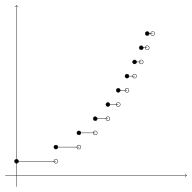
For any number \(x\), the largest integer less than or equal to \(x\) is denoted by \([x]\). For example, \([3.7]=3\) and \([4]=4\). Sketch the graph of \(y=[x]\) for \(0\le x<5\) and evaluate \[ \int_0^5 [x]\;\d x. \] Sketch the graph of \(y=[\e^{x}]\) for \(0\le x< \ln n\), where \(n\) is an integer, and show that \[ \int_{0}^{\ln n}[\e^{x}]\, \d x =n\ln n - \ln (n!). \]
Solution:

2000 Paper 3 Q7
Given that $$\e = 1 + {1 \over 1 !} + {1 \over 2 !} + {1 \over 3 !} + \cdots + {1 \over r !} + \cdots \; ,$$ use the binomial theorem to show that $$ {\left( 1 + {1 \over n} \right)}^{\!n} < \e $$ for any positive integer \(n\). The product \({\rm P }( n )\) is defined, for any positive integer \(n\), by $$ {\rm P} ( n ) = {3 \over 2} \cdot {5 \over 4} \cdot {9 \over 8} \cdot \ldots \cdot {2^n + 1 \over 2^n} . $$ Use the arithmetic-geometric mean inequality, $$ {a_1 + a_2 + \cdots + a_n \over n} \ge \ {\left( a_1 \cdot a_2 \cdot \ldots \cdot a_n \right)}^{1 \over n}\,, $$ to show that \({\rm P }( n ) < \e\) for all \(n\) . Explain briefly why \({\rm P} ( n )\) tends to a limit as \(n\to\infty\). Show that this limit, \(L\), satisfies \(2 < L\le\e\).
1998 Paper 3 Q2
Let $$ {\rm I}(a,b) = \int_0^1 t^{a}(1-t)^{b} \, \d t \; \qquad (a\ge0,\ b\ge0) .$$
- Show that \({\rm I}(a,b)={\rm I}(b,a)\),
- Show that \({\rm I}(a,b)={\rm I}(a+1,b)+{\rm I}(a,b+1)\).
- Show that \((a+1){\rm I}(a,b)=b{\rm I}(a+1,b-1)\) when \(a\) and \(b\) are positive and hence calculate \({\rm I}(a,b)\) when \(a\) and \(b\) are positive integers.
Solution:
- Let \(u = 1-t, \d u = -\d t\), then: \begin{align*} \mathrm{I}(a,b) &= \int_0^1 t^a(1-t)^b \d t \\ &= \int_{u=1}^{u=0} -(1-u)^a u^b \d u \\ &= \int_0^1(1-u)^a u^b \d u \\ &= \mathrm{I}(b, a) \end{align*}
- \begin{align*} \mathrm{I}(a+1,b)+\mathrm{I}(a,b+1) &= \int_0^1 t^{a+1}(1-t)^b + t^a(1-t)^{b+1} \d t \\ &= \int_0^1 (t+(1-t))t^a(1-t)^b \d t \\ &= \int_0^1 t^a(1-t)^b \d t \\ &= \mathrm{I}(a,b) \end{align*}
- Integrating by parts with \(\frac{du}{dt} = t^a, v = (1-t)^{b}\)\begin{align*} \mathrm{I}(a,b) &= \int_0^1 t^a (1-t)^b \d t \\ &= \left [ \frac{t^{a+1}}{a+1} (1-t)^b \right ]_0^1 + \int_0^1 \frac{t^{a+1}}{a+1} b(1-t)^{b-1} \\ &= \frac{b}{a+1} \int_0^1 t^{a+1}(1-t)^{b-1} \d t \\ &= \frac{b}{a+1} \mathrm{I}(a+1,b-1) \end{align*} Claim: \(\mathrm{I}(a,b) = \frac{a!b!}{(a+b+1)!}\) Proof: Note that \(I(a,0) = \frac{1}{a+1}\) so the formula holds for this case. We will induct on \(b\). The base case is done. Suppose that for \(b = k\) our formula is true, ie: \(\mathrm{I}(a,k) = \frac{a!k!}{(a+k+1)!}\) for all \(a\) (and fixed \(k\)) \begin{align*} \mathrm{I}(a,k+1) &= \frac{k+1}{a+1} \mathrm{I}(a+1,k) \\ &= \frac{k+1}{a+1} \frac{(a+1)!k!}{(a+1+k+1)!} \\ &= \frac{a!(k+1)!}{(a+(k+1)+1)!} \end{align*} So the formula is true for \(b=k+1\). Therefore, since it is true if \(b=0\) and if \(b=k\) is true then \(b=k+1\) is true, it is true for all values of \(b\).
1997 Paper 3 Q7
For each positive integer \(n\), let \begin{align*} a_n&=\frac1{n+1}+\frac1{(n+1)(n+2)}+\frac1{(n+1)(n+2)(n+3)}+\cdots;\\ b_n&=\frac1{n+1}+\frac1{(n+1)^2}+\frac1{(n+1)^3}+\cdots. \end{align*}
- Evaluate \(b_n\).
- Show that \(0
- Deduce that \(a_n=n!{\rm e}-[n!{\rm e}]\) (where \([x]\) is the integer part of \(x\)).
- Hence show that \(\mathrm{e}\) is irrational.
1996 Paper 1 Q2
- Show that \[ \int_{0}^{1}\left(1+(\alpha-1)x\right)^{n}\,\mathrm{d}x=\frac{\alpha^{n+1}-1}{(n+1)(\alpha-1)} \] when \(\alpha\neq1\) and \(n\) is a positive integer.
- Show that if \(0\leqslant k\leqslant n\) then the coefficient of \(\alpha^{k}\) in the polynomial \[ \int_{0}^{1}\left(\alpha x+(1-x)\right)^{n}\,\mathrm{d}x \] is \[ \binom{n}{k}\int_{0}^{1}x^{k}(1-x)^{n-k}\,\mathrm{d}x\,. \]
- Hence, or otherwise, show that \[ \int_{0}^{1}x^{k}(1-x)^{n-k}\,\mathrm{d}x=\frac{k!(n-k)!}{(n+1)!}\,. \]
Solution:
- \begin{align*} u = 1+(\alpha-1)x: && \int_0^1 (1 + (\alpha - 1)x)^n \d x &= \int_{u=1}^{u=\alpha} u^n \frac{1}{\alpha - 1} \d u \\ &&&= \left [\frac{u^{n+1}}{(n+1)(\alpha-1)} \right]_1^\alpha \\ &&&= \frac{\alpha^{n+1}-1}{(n+1)(\alpha-1)} \end{align*}
- \begin{align*} && \int_0^1 (\alpha x + (1-x))^n \d x &= \int_0^1 \sum_{k=0}^n \binom{n}{k} \alpha^k x^k (1-x)^{n-k} \d x \\ &&&= \sum_{k=0}^n \alpha^k \int_0^1 \binom{n}{k} x^k (1-x)^{n-k} \d x \end{align*} Therefore the coefficient of \(\alpha^k\) is \(\displaystyle \int_0^1 \binom{n}{k} x^k (1-x)^{n-k} \d x\)
- The coefficient of \(\alpha^{k}\) in \(\displaystyle \frac{\alpha^{n+1}-1}{(n+1)(\alpha-1)}\) is \(\displaystyle \frac1{n+1}\). Therefore \begin{align*} && \frac1{n+1} &= \binom{n}{k} \int_0^1 x^k(1-x)^{n-k} \d x \\ \Rightarrow && \int_0^1 x^k (1-x)^{n-k} \d x &= \frac{k!(n-k)!}{(n+1)n!} \\ &&&= \frac{k!(n-k)!}{(n+1)!} \end{align*}
1989 Paper 1 Q2
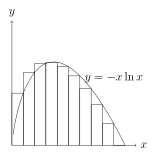
For \(x>0\) find \(\int x\ln x\,\mathrm{d}x\). By approximating the area corresponding to \(\int_{0}^{1}x\ln(1/x)\, \d x\) by \(n\) rectangles of equal width and with their top right-hand vertices on the curve \(y=x\ln(1/x)\), show that, as \(n\rightarrow\infty\), \[ \frac{1}{2}\left(1+\frac{1}{n}\right)\ln n-\frac{1}{n^{2}}\left[\ln\left(\frac{n!}{0!}\right)+\ln\left(\frac{n!}{1!}\right)+\ln\left(\frac{n!}{2!}\right)+\cdots+\ln\left(\frac{n!}{(n-1)!}\right)\right]\rightarrow\frac{1}{4}. \] {[}You may assume that \(x\ln x\rightarrow0\) as \(x\rightarrow0\).{]}
Solution: Integrating by parts we obtain: \begin{align*} \int x \ln x \, \d x &= [\frac12 x^2 \ln x] - \int \frac12x^2 \cdot \frac1x \d x \\ &= \frac12 x^2 \ln x - \frac14 x^2 + C \end{align*}
1987 Paper 2 Q7
A definite integral can be evaluated approximately by means of the Trapezium rule: \[ \int_{x_{0}}^{x_{N}}\mathrm{f}(x)\,\mathrm{d}x\approx\tfrac{1}{2}h\left\{ \mathrm{f}\left(x_{0}\right)+2\mathrm{f}\left(x_{1}\right)+\ldots+2\mathrm{f}\left(x_{N-1}\right)+\mathrm{f}\left(x_{N}\right)\right\} , \] where the interval length \(h\) is given by \(Nh=x_{N}-x_{0}\), and \(x_{r}=x_{0}+rh\). Justify briefly this approximation. Use the Trapezium rule with intervals of unit length to evaluate approximately the integral \[ \int_{1}^{n}\ln x\,\mathrm{d}x, \] where \(n(>2)\) is an integer. Deduce that \(n!\approx\mathrm{g}(n)\), where \[ \mathrm{g}(n)=n^{n+\frac{1}{2}}\mathrm{e}^{1-n}, \] and show by means of a sketch, or otherwise, that \[ n!<\mathrm{g}(n). \] By using the Trapezium rule on the above integral with intervals of width \(k^{-1}\), where \(k\) is a positive integer, show that \[ \left(kn\right)!\approx k!n^{kn+\frac{1}{2}}\left(\frac{\mathrm{e}}{k}\right)^{k\left(1-n\right)}. \] Determine whether this approximation or \(\mathrm{g}(kn)\) is closer to \(\left(kn\right)!\).
Solution:


1987 Paper 3 Q1
Find the set of positive integers \(n\) for which \(n\) does not divide \((n-1)!.\) Justify your answer. [Note that small values of \(n\) may require special consideration.]
Solution: Claim: \(n \not \mid (n-1)!\) if and only if \(n\) is prime or \(4\) Proof: \((\Leftarrow)\)
- \(4 \not \mid 3! = 6\).
- If \(p\) is prime, then \(p \not \mid k\) for \(k < n\), therefore \(p \not \mid (n-1)!\)