Problems
Filters
2 problems found
2015 Paper 3 Q8
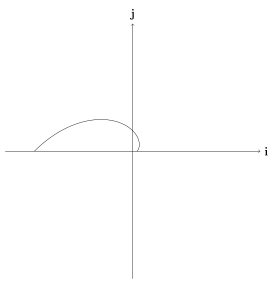
- Show that under the changes of variable \(x= r\cos\theta\) and \(y = r\sin\theta\), where \(r\) is a function of \(\theta\) with \(r>0\), the differential equation \[ (y+x)\frac{\d y}{\d x} = y-x \] becomes \[ \frac{\d r}{\d\theta} + r=0 \,. \] Sketch a solution in the \(x\)-\(y\) plane.
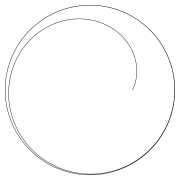
- Show that the solutions of \[ \left( y+x -x(x^2+y^2) \right) \, \frac{\d y }{\d x} = y-x - y(x^2+y^2) \] can be written in the form \\ \[ r^2 = \dfrac 1 {1+A\e^{2\theta}}\, \]\\ and sketch the different forms of solution that arise according to the value of \(A\).
Solution:
- \begin{align*}
&& (y+x)\frac{\d y}{\d x} &= y-x \\
\Rightarrow && (r \sin \theta + r \cos\theta) \frac{\frac{dy}{d\theta}}{\frac{dx}{d\theta}} &= (r \sin\theta - r \cos\theta) \\
\Rightarrow && ( \sin \theta + \cos\theta) \frac{dy}{d\theta} &= (\sin\theta - \cos\theta){\frac{dx}{d\theta}} \\
\Rightarrow && ( \sin \theta + \cos\theta) \left ( \frac{dr}{d\theta} \cos \theta - r \sin \theta\right ) &= (\sin\theta - \cos\theta)\left ( \frac{dr}{d\theta} \sin\theta + r \cos \theta\right) \\
\Rightarrow && \frac{dr}{d\theta} \left (\sin \theta \cos \theta + \cos^2 \theta - \sin^2 \theta + \sin \theta \cos \theta \right)&= r \left (\sin \theta \cos \theta - \cos^2 \theta + \sin^2 \theta + \sin\theta \cos \theta\right) \\
\Rightarrow && \frac{dr}{d\theta}&= -r \\
\end{align*}
Therefore \(r = Ae^{-\theta}\)

- \begin{align*}
&& \left( y+x -x(x^2+y^2) \right) \, \frac{\d y }{\d x} &= y-x - y(x^2+y^2) \\
\Rightarrow && \left( r \sin \theta+r\cos \theta -r^3\cos \theta \right) \, \frac{\d y }{\d \theta} &= \left ( r \sin \theta- r \cos \theta- r^3\sin \theta \right)\frac{\d x }{\d \theta} \\
\Rightarrow && \left( r \sin \theta+r\cos \theta -r^3\cos \theta \right) \, \left (\frac{\d r}{\d \theta} \sin \theta + r \cos \theta \right) &= \\
&& \left ( r \sin \theta- r \cos \theta- r^3\sin \theta \right)&\left (\frac{\d r}{\d \theta} \cos \theta - r \sin \theta \right) \\
\Rightarrow && \frac{\d r}{\d \theta} \left (\sin \theta ( \sin \theta + \cos \theta - r^2 \cos \theta) - \cos \theta (\sin \theta - \cos \theta - r^2 \sin \theta) \right) &= \\
&& r ( -\sin \theta (\sin \theta - \cos \theta - r^2 \sin \theta) - \cos \theta ( \sin \theta + \cos \theta &- r^2 \cos \theta)) \\
\Rightarrow && \frac{\d r}{\d \theta} &= r ( -1 +r^2) \\
\Rightarrow && \int \frac{1}{r(r-1)(r+1)} \d r &= \int \d \theta \\
\Rightarrow && \int \l \frac{-1}{r} + \frac{1}{2(r-1)} + \frac{1}{2(r+1)} \r \d r &= \int \d \theta \\
\Rightarrow && \l -\log r+ \frac12 \log (1+r)+ \frac12 \log (1-r)\r + C &= \theta \\
\Rightarrow && \frac12 \log \left (\frac{1-r^2}{r^2} \right) + C &= \theta \\
\Rightarrow && \log \left (\frac{1}{r^2}-1 \right) + C &= 2\theta \\
\Rightarrow && r &= \frac{1}{1 + Ae^{2\theta}} \\
\end{align*}


2010 Paper 1 Q10
A particle \(P\) moves so that, at time \(t\), its displacement \( \bf r \) from a fixed origin is given by \[ {\bf r} =\left( \e^{t}\cos t \right) {\bf i}+ \left(\e^t \sin t\right) {\bf j}\,.\] Show that the velocity of the particle always makes an angle of \(\frac{\pi}{4}\) with the particle's displacement, and that the acceleration of the particle is always perpendicular to its displacement. Sketch the path of the particle for \(0\le t \le \pi\). A second particle \(Q\) moves on the same path, passing through each point on the path a fixed time \(T\) after \(P\) does. Show that the distance between \(P\) and \(Q\) is proportional to \(\e^{t}\).
Solution: \begin{align*} && {\bf r} &=\left( \e^{t}\cos t \right) {\bf i}+ \left(\e^t \sin t\right) {\bf j} \\ \Rightarrow && \dot{\bf r} &= \left( \e^{t}\cos t -\e^t \sin t\right) {\bf i}+ \left(\e^t \sin t+\e^t \cos t\right) {\bf j} \\ \Rightarrow && \mathbf{r}\cdot\dot{ \mathbf{r}} &= e^{2t}(\cos^2 t - \sin t \cos t) + e^{2t}(\sin^2 t+ \sin t \cos t) \\ &&&= e^{2t} (\cos^2 t + \sin ^2 t)\\ &&&= e^{2t} \\ \\ && | {\bf r}| &= e^{t} \\ && |{\bf \dot{r}}| &= e^t \sqrt{(\cos t - \sin t)^2 + (\sin t + \cos t)^2} \\ &&&= e^t \sqrt{2 \cos^2 t + 2 \sin^2 t} \\ &&&= \sqrt{2} e^t \\ \\ \Rightarrow && \frac{\mathbf{r}\cdot\dot{ \mathbf{r}}}{ |{\bf {r}}| |{\bf \dot{r}}|} &= \frac{e^{2t}}{\sqrt{2}e^te^t} \\ &&&= \frac{1}{\sqrt{2}} \end{align*} Therefore the angle between the velocity and displacement is \(\frac{\pi}{4}\). \begin{align*} && \ddot{\bf{r}} &= \left( \e^{t}(\cos t - \sin t) - \e^t (\sin t + \cos t)\right) {\bf i}+ \left(\e^t (\sin t + \cos t) + \e^t(\cos t - \sin t)\right) {\bf j} \\ &&&= \left ( -2\e^{t} \sin t \right) {\bf i}+ \left ( 2\e^{t} \cos t \right) {\bf j} \\ \Rightarrow && {\bf r} \cdot \ddot{\bf{r}} &= 2e^{2t} \left ( -\sin t \cos t + \sin t \cos t \right) \\ &&&= 0 \end{align*} Therefore the acceleration is perpendicular.