Problems
Filters
42 problems found
2024 Paper 3 Q7
In this question, you need not consider issues of convergence. For positive integer \(n\) let \[\mathrm{f}(n) = \frac{1}{n+1} + \frac{1}{(n+1)(n+2)} + \frac{1}{(n+1)(n+2)(n+3)} + \ldots\] and \[\mathrm{g}(n) = \frac{1}{n+1} - \frac{1}{(n+1)(n+2)} + \frac{1}{(n+1)(n+2)(n+3)} - \ldots\,.\]
- Show, by considering a geometric series, that \(0 < \mathrm{f}(n) < \dfrac{1}{n}\).
- Show, by comparing consecutive terms, that \(0 < \mathrm{g}(n) < \dfrac{1}{n+1}\).
- Show, for positive integer \(n\), that \((2n)!\,\mathrm{e} - \mathrm{f}(2n)\) and \(\dfrac{(2n)!}{\mathrm{e}} + \mathrm{g}(2n)\) are both integers.
- Show that if \(q\,\mathrm{e} = \dfrac{p}{\mathrm{e}}\) for some positive integers \(p\) and \(q\), then \(q\,\mathrm{f}(2n) + p\,\mathrm{g}(2n)\) is an integer for all positive integers \(n\).
- Hence show that the number \(\mathrm{e}^2\) is irrational.
2023 Paper 2 Q3
Let \(\mathrm{p}(x)\) be a polynomial of degree \(n\) with \(\mathrm{p}(x) > 0\) for all \(x\) and let \[\mathrm{q}(x) = \sum_{k=0}^{n} \mathrm{p}^{(k)}(x)\,,\] where \(\mathrm{p}^{(k)}(x) \equiv \dfrac{\mathrm{d}^k \mathrm{p}(x)}{\mathrm{d}x^k}\) for \(k \geqslant 1\) and \(\mathrm{p}^{(0)}(x) \equiv \mathrm{p}(x)\).
- Explain why \(n\) must be even and show that \(\mathrm{q}(x)\) takes positive values for some values of \(x\).
- Show that \(\mathrm{q}'(x) = \mathrm{q}(x) - \mathrm{p}(x)\).
- In this part you will be asked to show the same result in three different ways.
- Show that the curves \(y = \mathrm{p}(x)\) and \(y = \mathrm{q}(x)\) meet at every stationary point of \(y = \mathrm{q}(x)\). Hence show that \(\mathrm{q}(x) > 0\) for all \(x\).
- Show that \(\mathrm{e}^{-x}\mathrm{q}(x)\) is a decreasing function. Hence show that \(\mathrm{q}(x) > 0\) for all \(x\).
- Show that \[\int_0^{\infty} \mathrm{p}(x+t)\mathrm{e}^{-t}\,\mathrm{d}t = \mathrm{p}(x) + \int_0^{\infty} \mathrm{p}^{(1)}(x+t)\mathrm{e}^{-t}\,\mathrm{d}t\,.\] Show further that \[\int_0^{\infty} \mathrm{p}(x+t)\mathrm{e}^{-t}\,\mathrm{d}t = \mathrm{q}(x)\,.\] Hence show that \(\mathrm{q}(x) > 0\) for all \(x\).
2021 Paper 2 Q8
- Show that, for \(n = 2, 3, 4, \ldots\), \[ \frac{d^2}{dt^2}\bigl[t^n(1-t)^n\bigr] = n\,t^{n-2}(1-t)^{n-2}\bigl[(n-1) - 2(2n-1)t(1-t)\bigr]. \]
- The sequence \(T_0, T_1, \ldots\) is defined by \[ T_n = \int_0^1 \frac{t^n(1-t)^n}{n!}\,e^t\,dt. \] Show that, for \(n \geqslant 2\), \[ T_n = T_{n-2} - 2(2n-1)T_{n-1}. \]
- Evaluate \(T_0\) and \(T_1\) and deduce that, for \(n \geqslant 0\), \(T_n\) can be written in the form \[ T_n = a_n + b_n e, \] where \(a_n\) and \(b_n\) are integers (which you should not attempt to evaluate).
- Show that \(0 < T_n < \dfrac{e}{n!}\) for \(n \geqslant 0\). Given that \(b_n\) is non-zero for all~\(n\), deduce that \(\dfrac{-a_n}{b_n}\) tends to \(e\) as \(n\) tends to infinity.
2019 Paper 3 Q2
The definition of the derivative \(f'\) of a (differentiable) function f is $$f'(x) = \lim_{h\to 0} \frac{f(x + h) - f(x)}{h}. \quad (*)$$
- The function f has derivative \(f'\) and satisfies $$f(x + y) = f(x)f(y)$$ for all \(x\) and \(y\), and \(f'(0) = k\) where \(k \neq 0\). Show that \(f(0) = 1\). Using \((*)\), show that \(f'(x) = kf(x)\) and find \(f(x)\) in terms of \(x\) and \(k\).
- The function g has derivative \(g'\) and satisfies $$g(x + y) = \frac{g(x) + g(y)}{1 + g(x)g(y)}$$ for all \(x\) and \(y\), \(|g(x)| < 1\) for all \(x\), and \(g'(0) = k\) where \(k \neq 0\). Find \(g'(x)\) in terms of \(g(x)\) and \(k\), and hence find \(g(x)\) in terms of \(x\) and \(k\).
Solution:
- \(\,\) \begin{align*} && f(0+x) &= f(0)f(x) \\ \Rightarrow && f(0) &= 0, 1\\ &&\text{since }f'(0) \neq 0 & \text{ there is some non-zero } f(x) \\ \Rightarrow && f(0) &= 1 \end{align*} \begin{align*} && f'(x) &= \lim_{h\to 0} \frac{f(x+h)-f(x)}{h} \\ &&&= \lim_{h\to 0} \frac{f(x)f(h)-f(x)}{h} \\ &&&= f(x) \cdot \lim_{h\to 0} \frac{f(h)-1}{h} \\ &&&= f(x) \cdot \lim_{h\to 0} \frac{f(0+h)-f(0)}{h} \\ &&&= f(x) \cdot f'(0) \\ &&&= kf(x) \end{align*} Since \(f'(x) = kf(x)\) we must have \(\frac{f'(x)}{f(x)} = k \Rightarrow \ln f(x) = kx + c \Rightarrow f(x) = Ae^{kx}\) but \(f(0) = 1\) so \(f(x) = e^{kx}\)
- Consider \begin{align*} && g(0+0) &= \frac{g(0)+g(0)}{1+(g(0))^2} \\ \Rightarrow && g(0)(1+(g(0))^2)&= 2g(0) \\ \Rightarrow && 0 &= g(0)\left (1- (g(0))^2 \right) \\ \Rightarrow && g(0) &= -1, 0, 1 \\ \Rightarrow && g(0) &= 0 \tag{\(|g(0)| < 1\)} \end{align*} \begin{align*} && g'(x) &=\lim_{h\to 0} \frac{g(x+h)-g(x)}{h} \\ &&&= \lim_{h\to 0} \frac{\frac{g(x)+g(h)}{1+g(x)g(h)}-g(x)}{h} \\ &&&= \lim_{h\to 0} \frac{g(x)+g(h)-g(x)(1+g(x)g(h))}{h(1+g(x)g(h))} \\ &&&= \lim_{h\to 0} \frac{g(h)-g(x)(g(x)g(h))}{h(1+g(x)g(h))} \\ &&&= (1-(g(x))^2) \cdot \lim_{h \to 0} \frac{1}{1+g(x)g(h)} \cdot \lim_{h \to 0} \frac{g(h)}{h} \\ &&&= (1-(g(x))^2) \cdot \frac{1}{1+g(x)\cdot 0} \cdot \lim_{h \to 0} \frac{g(h) - g(0)}{h} \\ &&&= (1-(g(x))^2) \cdot g'(0)\\ &&&= k (1-(g(x))^2) \\ \end{align*} Let \(y = g(x)\) so \begin{align*} && y' &= k(1-y^2) \\ \Rightarrow && kx &= \int \frac{1}{1-y^2} \d y \\ \Rightarrow &&&= \int \frac12\left ( \frac{1}{1-y} + \frac{1}{1+y} \right) \d y \\ &&&= \frac12\ln \left ( \frac{1+y}{1-y} \right) + C \\ x = 0, y = 0: && 0 &= \ln 1 + C \\ \Rightarrow && C &= 0 \\ \Rightarrow && \frac{1+y}{1-y} &= e^{2kx} \\ \Rightarrow && 1+y &= e^{2kx} - e^{2kx}y \\ \Rightarrow && y &= \frac{e^{2kx}-1}{e^{2kx}+1} \\ &&&= \tanh kx \end{align*}
2017 Paper 3 Q4
For any function \(\f\) satisfying \(\f(x) > 0\), we define the geometric mean, F, by \[ F(y) = e^{\frac{1}{y} \int_{0}^{y} \ln f(x) \, dx} \quad (y > 0). \]
- The function f satisfies \(\f(x) > 0\) and \(a\) is a positive number with \(a\ne1\). Prove that \[ F(y) = a^{\frac{1}{y} \int_{0}^{y} \log_a f(x) \, dx}. \]
- The functions f and g satisfy \(\f(x) > 0\) and \(\g(x) > 0\), and the function \(\h\) is defined by \(\h(x) = \f(x)\g(x)\). Their geometric means are F, G and H, respectively. Show that \(H(y)= \F(y) \G(y)\,\).
- Prove that, for any positive number \(b\), the geometric mean of \(b^x\) is \(\sqrt{b^y}\,\).
- Prove that, if \(\f(x)>0\) and the geometric mean of \(\f(x)\) is \(\sqrt{\f(y)}\,\), then \(\f(x) = b^x\) for some positive number \(b\).
Solution:
- \begin{align*} && a^{\frac{1}{y} \int_{0}^{y} \log_a f(x) \, dx} &= e^{\ln a \cdot \frac{1}{y} \int_{0}^{y} \log_a f(x) \, dx} \\ &&&= e^{\ln a \cdot \frac{1}{y} \int_{0}^{y} \frac{\ln f(x)}{\ln a} \, dx} \\ &&&= e^{ \frac{1}{y} \int_{0}^{y} \ln f(x) \, dx} \\ &&&= F(y) \end{align*}
- \(\,\) \begin{align*} && H(y) &= e^{\frac1y \int_0^y \ln h(x) \d x} \\ &&&= e^{\frac1y \int_0^y \ln (f(x)g(x))\d x} \\ &&&= e^{\frac1y \int_0^y \left ( \ln f(x)+\ln g(x) \right)\d x} \\ &&&= e^{\frac1y \int_0^y \ln f(x) \d x +\frac1y \int_0^y \ln g(x) \d x} \\ &&&= e^{\frac1y \int_0^y \ln f(x) \d x }e^{\frac1y \int_0^y \ln g(x) \d x} \\ &&&= F(y)G(y) \end{align*}
- Suppose \(f(x) = b^x\), then \begin{align*} && F(y) &= b^{\frac1y \int_0^y \log_b f(x) \d x} \\ &&&= b^{\frac1y \int_0^y x \d x}\\ &&&= b^{\frac1y \frac{y^2}{2}} \\ &&&= b^{\frac{y}2} = \sqrt{b^y} \end{align*}
- Suppose the geometric mean of \(f(x)\) is \(\sqrt{f(y)}\) then the geometric mean of \(f(x)^2\) is \(f(y)\) by the the second part.
2016 Paper 3 Q3
- Given that \[ \int \frac {x^3-2}{(x+1)^2}\, \e ^x \d x = \frac{\P(x)}{Q(x)}\,\e^x + \text{constant} \,, \] where \(\P(x)\)and \(Q(x)\) are polynomials, show that \(Q(x)\) has a factor of \(x + 1\). Show also that the degree of \(\P(x)\) is exactly one more than the degree of \(Q(x)\), and find \(\P(x)\) in the case \(Q(x) =x+1\).
- Show that there are no polynomials \(\P(x)\) and \(Q(x)\) such that \[ \int \frac 1 {x+1} \, \, \e^x \d x = \frac{\P(x)}{Q(x)}\,\e^x +\text{constant} \,. \] You need consider only the case when \(\P(x)\) and \(Q(x)\) have no common factors.
Solution:
- \begin{align*} && \int \frac {x^3-2}{(x+1)^2}\, \e ^x \d x &= \frac{\P(x)}{Q(x)}\,\e^x + \text{constant} \\ \underbrace{\Rightarrow}_{\frac{\d}{\d x}} && \frac{x^3-2}{(x+1)^2}e^x &= \frac{P'(x)Q(x)-Q'(x)P(x)}{Q(x)^2}e^x + \frac{P(x)}{Q(x)}e^x \\ \Rightarrow && \frac{x^3-2}{(x+1)^2} &= \frac{(P(x)+P'(x))Q(x)-Q'(x)P(x)}{Q(x)^2} \\ \Rightarrow && Q(x)^2(x^3-2) &= ((P(x)+P'(x))Q(x)-Q'(x)P(x))(x+1)^2 \\ \Rightarrow && Q(-1) &= 0 \\ \Rightarrow && x+1 &\mid Q(x) \end{align*} We have \(\frac{x^3-2}{(x+1)^2}\) has degree \(1\) (plus some remainder term). Therefore \begin{align*} 1 &= \deg \l (P(x)+P'(x))Q(x)-Q'(x)P(x)\r - 2 \deg Q(x) \\ &= \deg P(x) + \deg Q(x) - 2 \deg Q(x) \\ &= \deg P(x) - \deg Q(x) \end{align*} as required. Suppose \(Q(x) = x+1, P(x) = ax^2+bx+c\) then \begin{align*} && \frac{x^3-2}{(x+1)^2} &= \frac{(P(x)+P'(x))(x+1)-P(x)}{(x+1)^2} \\ \Rightarrow && x^3-2 &= (P(x)+P'(x))(x+1) - P(x) \\ \Rightarrow && x^3-2 &= (ax^2+bx+c+2ax+b)(x+1) - (ax^2+bx+c) \\ &&&= a x^3+ x^2 (2 a + b) + x (2 a + b + c)+b \\ \Rightarrow && a &= 1 \\ && b &= -2 \\ && c &= 0 \end{align*} So \(P(x) = x^2-2x\)
- \begin{align*} && \int \frac1{x+1}e^x \d x &= \frac{P(x)}{Q(x)}e^x + c \\ \Rightarrow && \frac{1}{x+1} e^x &= \frac{P'(x)Q(x)-Q'(x)P(x)}{Q(x)^2}e^x + \frac{P(x)}{Q(x)}e^x \\ \Rightarrow && \frac{1}{x+1} &= \frac{(P(x)+P'(x))Q(x)-Q'(x)P(x)}{Q(x)^2} \end{align*} Therefore \(Q(-1) = 0\) and so \(x +1 \mid Q(x)\). Considering degrees, we must have that \(P(x)\) has degree \(1\) less than \(Q(x)\). Consider also the number of factors of \(x+1\) in the numerator and denominator. Since \(P(x)\) and \(Q(x)\) have no common factors, the \(Q(x)\) could have \(q\) factors and \(P(x)\) must have none. The denominator therefore has \(2q\) factors and the numerator must have \(q-1\) factors (coming from \(Q'(x)\)), we must have \(2q = (q-1) + 1\), but that implies \(q = 0\). Contradiction! \end{align*}
2015 Paper 1 Q1
- Sketch the curve \(y = \e^x (2x^2 -5x+ 2)\,.\) Hence determine how many real values of \(x\) satisfy the equation \(\e^x (2x^2 -5x+ 2)= k\) in the different cases that arise according to the value of \(k\). {\em You may assume that \(x^n \e^x\to 0\) as \(x\to-\infty\) for any integer \(n\).}
- Sketch the curve \(\displaystyle y = \e^{x^2} (2x^4 -5x^2+ 2)\,\).
Solution:
- \(y = e^x(2x^2-5x+2) = e^x(2x-1)(x-2)\), we also have \(y' = e^x(2x^2-5x+2 + 4x-5) = e^x(2x^2-x-3) = e^x(2x-3)(x+1)\)
\(y(-1) = \frac{9}{e}\), \(y(\frac32) = -e^{3/2}\)
If \(k < -e^{3/2}\) there are no solutions. If \(k = -e^{3/2}\) there is a unique solution. If \(-e^{3/2} < k \leq 0\) there are two solutions. If \(0 < k < \frac{9}{e}\) there are three solutions. Otherwise there is a unique solution.


2011 Paper 1 Q2
The number \(E\) is defined by $\displaystyle E= \int_0^1 \frac{\e^x}{1+x} \, \d x\,.$ Show that \[ \int_0^1 \frac{x \e^x}{1+x} \, \d x = \e -1 -E\, ,\] and evaluate \(\ds \int_0^1 \frac{x^2\e^x}{1+x} \, \d x\) in terms of \(\e\) and \(E\). Evaluate also, in terms of \(E\) and \(\rm e\) as appropriate:
- \[ \int_0^1 \frac{\e^{\frac{1-x}{1+x}}}{1+x}\, \d x\,\]
- \[ \int_1^{\sqrt2} \frac {\e^{x^2}}x \, \d x \, \]
Solution: \begin{align*} \int_0^1 \frac{x \e^x}{1+x} \, \d x &= \int_0^1 \frac{(x+1-1) \e^x}{1+x} \, \d x \\ &= \int_0^1 \left ( e^x -\frac{\e^x}{1+x} \right )\, \d x \\ &= \e-1-E \end{align*} \begin{align*} \int_0^1 \frac{x^2 \e^x}{1+x} \, \d x &= \int_0^1 \frac{(x^2+x-x) \e^x}{1+x} \, \d x \\ &= \int_0^1 \left ( xe^x -\frac{x\e^x}{1+x} \right )\, \d x \\ &= \left [xe^{x} \right]_0^1 - \int_0^1 e^x \, \d x -(\e-1-E) \\ &= \e-(\e-1)-(\e -1 -E) \\ &= 2-\e + E \end{align*}
- Since \(\displaystyle u = \frac{1-x}{1+x},\frac{\d u}{\d x} = \frac{-(1+x)-(1-x)}{(1+x)^2}\), \begin{align*} && \int_0^1 \frac{\e^{\frac{1-x}{1+x}}}{1+x}\, \d x &= \int_{u=1}^{u=0} \frac{e^u}{1+x} \cdot \frac{(1+x)^2}{-2} \d u \\ &&&= \int_0^1 \frac{(1+x) e^u}{2} \d u \\ &&&= \int_0^1 \frac{\left ( 1 + \frac{1-u}{1+u} \right) e^u}{2}\, \d u \\ &&&= \frac12 \int_0^1 \left (e^u + \frac{e^{u}}{1+u} - \frac{ue^u}{1+u} \right) \, \d u \\ &&&= \frac12 \left( \e-1 + E - (\e - 1 - E) \right) \\ &&&= E \end{align*}
- Since \(\displaystyle u = x^2-1, \d u = 2x \d x\)\begin{align*} \int_1^{\sqrt2} \frac {\e^{x^2}}x \, \d x &= \int_{u=0}^{u=1} \frac{e^{u+1}}{x} \frac{1}{2x} \d u \\ &= \int_0^1 \frac{e^{u+1}}{2(u+1)} \d u \\ &= \frac{\e}{2} E \\ &= \frac{E\e}{2} \end{align*}
2010 Paper 1 Q2
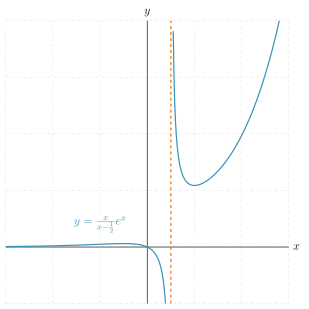
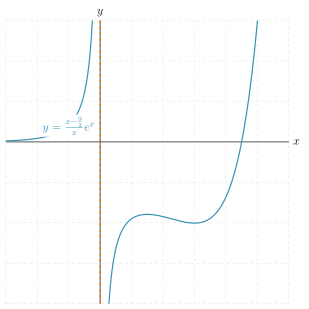
The curve \(\displaystyle y=\Bigl(\frac{x-a}{x-b}\Bigr)\e^{x}\), where \(a\) and \(b\) are constants, has two stationary points. Show that \[ a-b<0 \ \ \ \text{or} \ \ \ a-b>4 \,. \]
- Show that, in the case \(a=0\) and \(b= \frac12\), there is one stationary point on either side of the curve's vertical asymptote, and sketch the curve.
- Sketch the curve in the case \( a=\tfrac{9}{2}\) and \(b=0\,\).
Solution: \begin{align*} && y &= \left ( \frac{x-a}{x-b} \right )e^x \\ &&y'& = \left ( \frac{x-a}{x-b} \right )e^x + \left ( \frac{(x-b)-(x-a)}{(x-b)^2}\right )e^x \\ &&&= \left ( \frac{(x-b)(x-a) +a-b}{(x-b)^2} \right)e^x \\ &&&= \left ( \frac{x^2-(a+b)x+a-b+ab}{(x-b)^2} \right)e^x \\ && 0 &< \Delta = (a+b)^2 - 4 \cdot 1 \cdot (a-b+ab) \\ &&&= a^2+2ab+b^2-4a+4b-4ab \\ &&&= a^2-2ab+b^2-4a+4b\\ &&&= (a-b)^2-4(a-b) \\ &&&= (a-b)(a-b-4) \\ \end{align*} Considered as a quadratic in \(a-b\) we can see \(a-b < 0\) or \(a-b > 4\)
- If \(a = 0, b = \frac12\), we have \(x^2-\frac12x -\frac12 = 0 \Rightarrow (2x+1)(x-1) = 0 \Rightarrow x = -\frac12, x=1\). The asymptote is at \(x = \frac12\) so they are on either side.
- \(\,\)
2010 Paper 1 Q6
Show that, if \(y=\e^x\), then \[ (x-1) \frac{\d^2 y}{\d x^2} -x \frac{\d y}{\d x} +y=0\,. \tag{\(*\)} \] In order to find other solutions of this differential equation, now let \(y=u\e^x\), where \(u\) is a function of \(x\). By substituting this into \((*)\), show that \[ (x-1) \frac{\d^2 u}{\d x^2} + (x-2) \frac{\d u}{\d x} =0\,. \tag{\(**\)} \] By setting \( \dfrac {\d u}{\d x}= v\) in \((**)\) and solving the resulting first order differential equation for \(v\), find \(u\) in terms of \(x\). Hence show that \(y=Ax + B\e^x\) satisfies \((*)\), where \(A\) and \(B\) are any constants.
Solution: \begin{align*} && y &= e^x \\ && y' &= e^x \\ && y'' &= e^x \\ \Rightarrow && (x-1)y'' - x y' + y &= (x-1)e^x - xe^x + e^x \\ &&&= 0 \end{align*} Suppose \(y = ue^x\) then \begin{align*} && y' &= u'e^x + ue^x \\ && y'' &= (u''+u')e^x + (u'+u)e^x \\ &&&= (u''+2u' +u)e^x \\ \\ && 0 &= (x-1)y'' - x y' + y \\ &&&= [(x-1)(u''+2u'+u) - x(u'+u)+u]e^x \\ &&&= [(x-1)u'' +(x-2)u']e^x \\ \Rightarrow && 0 &= (x-1)u'' + (x-2)u' \\ v = u': && 0 &= (x-1)v' + (x-2) v \\ \Rightarrow && \frac{v'}{v} &= -\frac{x-2}{x-1} \\ &&&= -1-\frac{1}{x-1} \\ \Rightarrow && \ln v &= -x - \ln(x-1) + C \\ \Rightarrow && v &= A(x-1)e^{-x} \\ && u &= \int Axe^{-x} - Ae^{-x} \d x \\ &&&= \left [-Axe^{-x} +Ae^{-x} \right] + \int Ae^{-x} \d x \\ &&&= -Axe^{-x} + D\\ \Rightarrow && y &= ue^x \\ &&&= -Ax + De^x \end{align*}
2010 Paper 2 Q8
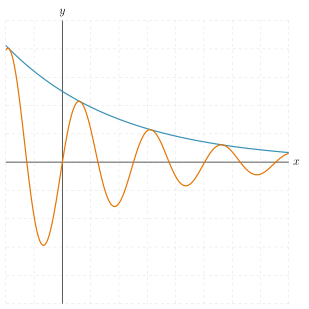
The curves \(C_1\) and \(C_2\) are defined by \[ y= \e^{-x} \quad (x>0) \quad \text{ and } \quad y= \e^{-x}\sin x \quad (x>0), \] respectively. Sketch roughly \(C_1\) and \(C_2\) on the same diagram. Let \(x_n\) denote the \(x\)-coordinate of the \(n\)th point of contact between the two curves, where \(0 < x_1 < x_2 < \cdots\), and let \(A_n\) denote the area of the region enclosed by the two curves between \(x_n\) and \(x_{n+1}\). Show that \[ A_n = \tfrac12(\e^{2\pi}-1) \e^{-(4n+1)\pi/2} \] and hence find \(\displaystyle \sum_{n=1}^\infty A_n\).
Solution:
2009 Paper 1 Q7
Show that, for any integer \(m\), \[ \int_0^{2\pi} \e^x \cos mx \, \d x = \frac {1}{m^2+1}\big(\e^{2\pi}-1\big)\,. \]
- Expand \(\cos(A+B) +\cos(A-B)\). Hence show that \[\displaystyle \int_0^{2\pi} \e^x \cos x \cos 6x \, \d x\, = \tfrac{19}{650}\big( \e^{2\pi}-1\big)\,. \]
- Evaluate $\displaystyle \int_0^{2\pi} \e^x \sin 2x \sin 4x \cos x \, \d x\,$.
Solution: \begin{align*} && I &= \int_0^{2 \pi} e^{x} \cos m x \d x \\ &&&= \left [e^x \cos m x \right]_0^{2 \pi}-\int_0^{2 \pi} e^x m (-\sin mx) \d x\\ &&&= e^{2\pi}-1 + m\int_0^{2\pi}e^x \sin m x \d x \\ &&&= e^{2\pi}-1 + m\left [e^x \sin m x \right]_0^{2\pi} - m \int_0^{2\pi} e^x m \cos x \d x \\ &&&= e^{2\pi}-1+0 - m^2 I\\ \Rightarrow && (m^2+1)I &= e^{2\pi}-1 \\ \Rightarrow && I &= \frac{1}{m^2+1} (e^{2\pi}-1) \end{align*}
- \(\,\) \begin{align*} && \cos(A+B) + \cos(A-B) &= \cos A\cos B - \sin A \sin B + \cos A \cos B + \sin A \sin B \\ &&&= 2 \cos A \cos B \end{align*} Therefore \begin{align*} && I &= \int_0^{2\pi} e^x \cos x \cos 6x \d x \\ &&&= \int_0^{2\pi} e^x \frac12\left (\cos 7x + \cos 5x \right) \d x\\ &&&= \left ( \frac{1}{2(1+7^2)} + \frac1{2(1+5^2)}\right)(e^{2\pi}-1) \\ &&&= \left (\frac{1}{100}+\frac{1}{52} \right) (e^{2\pi}-1) \\ &&&= \frac{19}{650}(e^{2\pi}-1) \end{align*}
- \(\,\) \begin{align*} && I &= \int_0^{2\pi} e^x \sin 2x \sin 4x \cos x \d x\\ &&&= \int_0^{2\pi} e^x \tfrac12(\cos2x-\cos 6x) \cos x \d x\\ &&&= \frac12 \int_0^{2\pi} e^x \left (\cos 2x \cos x -\cos 6x \cos x \right) \d x \\ &&&= \frac14 \int_0^{2\pi} e^x \left (\cos 3x + \cos x-\cos 7x-\cos 5x \right) \d x \\ &&&= \frac14 \left (\frac{1}{1+3^2}+\frac{1}{1+1^2}-\frac{1}{1+7^2} - \frac{1}{1+5^2} \right)(e^{2\pi}-1) \\ &&&= \frac14 \left (\frac{1}{10}+\frac{1}{2}-\frac{1}{50} - \frac{1}{26} \right)(e^{2\pi}-1) \\ &&&= \frac{44}{325}(e^{2\pi}-1) \end{align*}
2009 Paper 2 Q2
The curve \(C\) has equation \[ y= a^{\sin (\pi \e^ x)}\,, \] where \(a>1\).
- Find the coordinates of the stationary points on \(C\).
- Use the approximations \(\e^t \approx 1+t\) and \(\sin t \approx t\) (both valid for small values of \(t\)) to show that \[ y\approx 1-\pi x \ln a \; \] for small values of \(x\).
- Sketch \(C\).
- By approximating \(C\) by means of straight lines joining consecutive stationary points, show that the area between \(C\) and the \(x\)-axis between the \(k\)th and \((k+1)\)th maxima is approximately \[ \Big( \frac {a^2+1}{2a} \Big) \ln \Big ( 1+ \big( k-\tfrac34)^{-1} \Big)\,. \]
Solution:
- \(\,\) \begin{align*} && y & = a^{\sin(\pi e^x)} \\ \Rightarrow && \frac{\d y}{\d x} &= a^{\sin(\pi e^x)} \cdot ( \ln a) \cdot (\cos (\pi e^x)) \cdot \pi e^x \\ \frac{\d y}{\d x} = 0: && 0 &= \cos(\pi e^x) \\ \Rightarrow && \pi e^x &= \left ( \frac{2n+1}{2} \right) \pi \\ \Rightarrow && x &= \ln \left ( \frac{2n+1}{2} \right) \\ && y &= a^{(-1)^n} \\ &&(x,y) &= \left (\ln \left ( \frac{2n+1}{2} \right), a^{(-1)^n} \right) \end{align*}
- \(\,\) \begin{align*} && y &= a^{\sin(\pi e^x)} \\ &&&= e^{\ln a \cdot \sin(\pi e^x)} \\ &&&\approx e^{\ln a \cdot \sin(\pi (1+x))} \\ &&&\approx e^{-\ln a \cdot \sin(\pi x)} \\ &&&\approx e^{-\ln a \cdot \pi x} \\ &&&\approx 1-( \pi\ln a) x \end{align*}
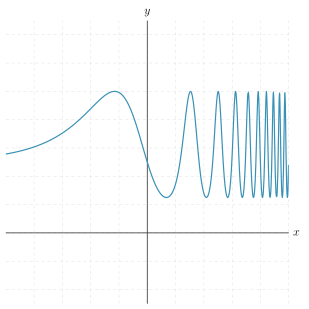
- The \(k\)th maxima is at \(\ln \left ( \frac{4(k-1)+1}{2}\right)\) and \(a\) ,and the \((k+1)\)th is at \(\ln \left ( \frac{4k+1}{2}\right)\). They have a minima between at \(\ln \left ( \frac{4k-3}{2}\right)\). \begin{align*} && \text{Area} &\approx \frac12 \left (\ln \left ( \frac{4k-1}{2}\right)- \ln \left ( \frac{4k-3}{2}\right)\right) \left ( a + \frac1a \right) + \frac12 \left ( \ln \left ( \frac{4k+1}{2}\right)-\ln \left ( \frac{4k-1}{2}\right)\right) \left ( a + \frac1a \right) \\ &&&= \frac{a^2+1}{2a} \ln \left (\frac{4k+1}{4k-3} \right) \\ &&&= \frac{a^2+1}{2a} \ln \left (1 + \frac{4}{4k-3} \right) \\ &&&= \frac{a^2+1}{2a} \ln \left (1 + \frac{1}{k-\tfrac34} \right) \\ &&&= \frac{a^2+1}{2a} \ln \left (1 + (k-\tfrac34)^{-1} \right) \\ \end{align*}
2009 Paper 2 Q7
Let \(y= (x-a)^n \e^{bx} \sqrt{1+x^2}\,\), where \(n\) and \(a\) are constants and \(b\) is a non-zero constant. Show that \[ \frac{\d y}{\d x} = \frac{(x-a)^{n-1} \e^{bx} \q(x)}{\sqrt{1+x^2}}\,, \] where \(\q(x)\) is a cubic polynomial. Using this result, determine:
- $\displaystyle \int \frac {(x-4)^{14} \e^{4x}(4x^3-1)} {\sqrt{1+x^2\;}} \, \d x\,;\(
- \)\displaystyle \int \frac{(x-1)^{21}\e^{12x}(12x^4-x^2-11)} {\sqrt{1+x^2\;}}\,\d x\,;\(
- \)\displaystyle \int \frac{(x-2)^{6}\e^{4x}(4x^4+x^3-2)} {\sqrt{1+x^2\;}}\,\d x\,.$
2009 Paper 3 Q3
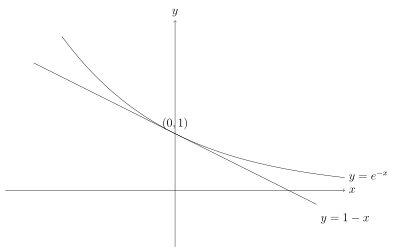
The function \(\f(t)\) is defined, for \(t\ne0\), by \[ \f(t) = \frac t {\e^t-1}\,. \] \begin{questionparts} \item By expanding \(\e^t\), show that \(\displaystyle \lim _{t\to0} \f(t) = 1\,\). Find \(\f'(t)\) and evaluate \(\displaystyle \lim _{t\to0} \f'(t)\,\). \item Show that \(\f(t) +\frac12 t\) is an even function. [{\bf Note:} A function \(\g(t)\) is said to be {\em even} if \(\g(t) \equiv \g(-t)\).] \item Show with the aid of a sketch that \( \e^t( 1-t)\le 1\,\) and deduce that \(\f'(t)\ne 0\) for \(t\ne0\). \end{questionpart} Sketch the graph of \(\f(t)\).
Solution:
- Claim \(f(t) + \frac12 t\) is an even function. Proof: Consider \(f(-t) - \frac12t\), then \begin{align*} f(-t) - \frac12t &= \frac{-t}{e^{-t}-1} - \frac12t \\ &= \frac{-te^t}{1-e^t} - \frac12 t \\ &= \frac{t(1-e^t) -t}{1-e^t} - \frac12 t \\ &= t - \frac{t}{1-e^t} - \frac12 t \\ &= \frac{t}{e^t-1} + \frac12 t \end{align*} So it is even.
- Drawing the tangent to \(y = e^{-x}\) at \((0,1)\) we find that \(e^{-t} \geq (1-t)\) for all \(t\), in particular, \(e^t(1-t) \leq 1\) \(f'(t) = \frac{(e^t(1-t) -1}{(e^t-1)^2} \leq 0\) and \(f'(t) = -\frac12\) when \(t = 0\)