Problems
Filters
10 problems found
2016 Paper 3 Q9
Three pegs \(P\), \(Q\) and \(R\) are fixed on a smooth horizontal table in such a way that they form the vertices of an equilateral triangle of side \(2a\). A particle \(X\) of mass \(m\) lies on the table. It is attached to the pegs by three springs, \(PX\), \(QX\) and \(RX\), each of modulus of elasticity \(\lambda\) and natural length \(l\), where \(l < \frac{ \ 2 }{\sqrt3}\, a\). Initially the particle is in equilibrium. Show that the extension in each spring is \(\frac{\ 2}{\sqrt3}\,a -l\,\). The particle is then pulled a small distance directly towards \(P\) and released. Show that the tension \(T\) in the spring \(RX\) is given by \[ T= \frac {\lambda} l \left( \sqrt{\frac {4a^2}3 + \frac{2ax}{\sqrt3} +x^2\; }\; -l\right) , \] where \(x\) is the displacement of \(X\) from its equilibrium position. Show further that the particle performs approximate simple harmonic motion with period \[ 2\pi \sqrt{ \frac{4mla}{3 (4a-\sqrt3 \, l)\lambda } \; }\,. \]
2008 Paper 3 Q10
A long string consists of \(n\) short light strings joined together, each of natural length \(\ell\) and modulus of elasticity \(\lambda\). It hangs vertically at rest, suspended from one end. Each of the short strings has a particle of mass \(m\) attached to its lower end. The short strings are numbered \(1\) to \(n\), the \(n\)th short string being at the top. By considering the tension in the \(r\)th short string, determine the length of the long string. Find also the elastic energy stored in the long string. A uniform heavy rope of mass \(M\) and natural length \(L_0\) has modulus of elasticity \(\lambda\). The rope hangs vertically at rest, suspended from one end. Show that the length, \(L\), of the rope is given by \[ L=L_0\biggl(1+ \frac{Mg}{2\lambda}\biggr), \] and find an expression in terms of \(L\), \(L_0\) and \(\lambda\) for the elastic energy stored in the rope.
2005 Paper 3 Q11
A horizontal spindle rotates freely in a fixed bearing. Three light rods are each attached by one end to the spindle so that they rotate in a vertical plane. A particle of mass \(m\) is fixed to the other end of each of the three rods. The rods have lengths \(a\), \(b\) and \(c\), with \(a > b > c\,\) and the angle between any pair of rods is \(\frac23 \pi\). The angle between the rod of length \(a\) and the vertical is \(\theta\), as shown in the diagram. \vspace*{-0.1in}
2000 Paper 1 Q10
Three particles \(P_1\), \(P_2\) and \(P_3\) of masses \(m_{1}\), \(m_{2}\) and \(m_{3}\) respectively lie at rest in a straight line on a smooth horizontal table. \(P_1\) is projected with speed \(v\) towards \(P_2\) and brought to rest by the collision. After \(P_2\) collides with \(P_3\), the latter moves forward with speed \(v\). The coefficients of restitution in the first and second collisions are \(e\) and \(e'\), respectively. Show that \[ e'= \frac{m_{2}+m_{3}-m_{1}}{m_{1}}. \] Show that \(2m_1\ge m_2 +m_3\ge m_1\) for such collisions to be possible. If \(m_1\), \(m_3\) and \(v\) are fixed, find, in terms of \(m_1\), \(m_3\) and \(v\), the largest and smallest possible values for the final energy of the system.
1997 Paper 1 Q11
A particle of unit mass is projected vertically upwards in a medium whose resistance is \(k\) times the square of the velocity of the particle. If the initial velocity is \(u\), prove that the velocity \(v\) after rising through a distance \(s\) satisfies \begin{equation*} v^{2}=u^{2}\e^{-2ks}+\frac{g}{k}(\e^{-2ks}-1). \tag{*} \end{equation*} Find an expression for the maximum height of the particle above he point of projection. Does equation \((*)\) still hold on the downward path? Justify your answer.
Solution: \begin{align*} \text{N2}(\uparrow): && 1 \cdot v\frac{\d v}{\d s} &= -g - kv^2 \\ \Rightarrow && \int \frac{v}{g+kv^2} \d v &= \int -1 \d s \\ \Rightarrow && \frac{1}{2k}\ln(g+kv^2) &= -s + C \\ s =0, v = u: && \frac{1}{2k} \ln(g+ku^2) &= C \\ \Rightarrow && s &= \frac{1}{2k} \ln \frac{g+ku^2}{g+kv^2} \\ \Rightarrow && e^{-2ks} &= \frac{g+kv^2}{g+ku^2} \\ \Rightarrow && v^2 &= u^2e^{-2ks} + \frac{g}{k}(e^{-2ks}-1) \end{align*} The maximum height will be when \(v = 0\), ie \(\displaystyle s = \frac{1}{2k}\ln\left(1 + \frac{k}{g}u^2 \right)\). On the downward path the resistance will be going upwards, ie \begin{align*} \text{N2}(\uparrow): && 1 \cdot v\frac{\d v}{\d s} &= -g + kv^2 \end{align*} but our solution is solving a different differential equation, therefore unless \(k=0\) the equation will be different.
1997 Paper 2 Q10
\noindent{\it In this question the effect of gravity is to be neglected.} A small body of mass \(M\) is moving with velocity \(v\) along the axis of a long, smooth, fixed, circular cylinder of radius \(L\). An internal explosion splits the body into two spherical fragments, with masses \(qM\) and \((1-q)M\), where \(q\le\frac{1}{2}\). After bouncing perfectly elastically off the cylinder (one bounce each) the fragments collide and coalesce at a point \(\frac{1}{2}L\) from the axis. Show that \(q=\frac{3}{ 8}\). The collision occurs at a time \(5L/v\) after the explosion. Find the energy imparted to the fragments by the explosion, and find the velocity after coalescence.
1994 Paper 3 Q11
A step-ladder has two sections \(AB\) and \(AC,\) each of length \(4a,\) smoothly hinged at \(A\) and connected by a light elastic rope \(DE,\) of natural length \(a/4\) and modulus \(W\), where \(D\) is on \(AB,\) \(E\) is on \(AC\) and \(AD=AE=a.\) The section \(AB,\) which contains the steps, is uniform and of weight \(W\) and the weight of \(AC\) is negligible. The step-ladder rests on a smooth horizontal floor and a man of weight \(4W\) carefully ascends it to stand on a rung distant \(\beta a\) from the end of the ladder resting on the floor. Find the height above the floor of the rung on which the man is standing when \(\beta\) is the maximum value at which equilibrium is possible.
Solution:

1993 Paper 1 Q10
A small lamp of mass \(m\) is at the end \(A\) of a light rod \(AB\) of length \(2a\) attached at \(B\) to a vertical wall in such a way that the rod can rotate freely about \(B\) in a vertical plane perpendicular to the wall. A spring \(CD\) of natural length \(a\) and modulus of elasticity \(\lambda\) is joined to the rod at its mid-point \(C\) and to the wall at a point \(D\) a distance \(a\) vertically above \(B\). The arrangement is sketched below. \noindent
1992 Paper 2 Q11
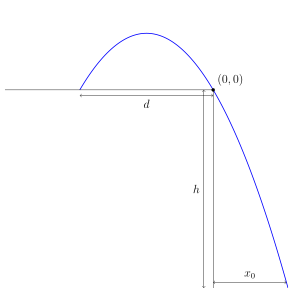
I am standing next to an ice-cream van at a distance \(d\) from the top of a vertical cliff of height \(h\). It is not safe for me to go any nearer to the top of the cliff. My niece Padma is on the broad level beach at the foot of the cliff. I have just discovered that I have left my wallet with her, so I cannot buy her an ice-cream unless she can throw the wallet up to me. She can throw it at speed \(V\), at any angle she chooses and from anywhere on the beach. Air resistance is negligible; so is Padma's height compared to that of the cliff. Show that she can throw the wallet to me if and only if \[ V^{2}\geqslant g(2h+d). \]
Solution:
1987 Paper 1 Q10
A rubber band band of length \(2\pi\) and modulus of elasticity \(\lambda\) encircles a smooth cylinder of unit radius, whose axis is horizontal. A particle of mass \(m\) is attached to the lowest point of the band, and hangs in equilibrium at a distance \(x\) below the axis of the cylinder. Obtain an expression in terms of \(x\) for the stretched length of the band in equilibrium. What is the value of \(\lambda\) if \(x=2\)?
Solution:
