Problems
Filters
32 problems found
2024 Paper 3 Q8
- Explain why the equation \((y - x + 3)(y + x - 5) = 0\) represents a pair of straight lines with gradients \(1\) and \(-1\). Show further that the equation \[y^2 - x^2 + py + qx + r = 0\] represents a pair of straight lines with gradients \(1\) and \(-1\) if and only if \(p^2 - q^2 = 4r\).
- Explain why the coordinates of any point which lies on both of the curves \(C_1\) and \(C_2\) also satisfy the equation \[y^2 + 2sy + s(s+1) - x + k(y - x^2) = 0\] for any real number \(k\). Given that \(s\) is such that \(C_1\) and \(C_2\) intersect at four distinct points, show that choosing \(k = 1\) gives an equation representing a pair of straight lines, with gradients \(1\) and \(-1\), on which all four points of intersection lie.
- Show that if \(C_1\) and \(C_2\) intersect at four distinct points, then \(s < -\frac{3}{4}\).
- Show that if \(s < -\frac{3}{4}\), then \(C_1\) and \(C_2\) intersect at four distinct points.
2023 Paper 3 Q1
The distinct points \(P(2ap,\, ap^2)\) and \(Q(2aq,\, aq^2)\) lie on the curve \(x^2 = 4ay\), where \(a > 0\).
- Given that \[(p+q)^2 = p^2q^2 + 6pq + 5\,,\tag{\(*\)}\] show that the line through \(P\) and \(Q\) is a tangent to the circle with centre \((0,\, 3a)\) and radius \(2a\).
- Show that, for any given value of \(p\) with \(p^2 \neq 1\), there are two distinct real values of \(q\) that satisfy equation \((*)\). Let these values be \(q_1\) and \(q_2\). Find expressions, in terms of \(p\), for \(q_1 + q_2\) and \(q_1 q_2\).
- Show that, for any given value of \(p\) with \(p^2 \neq 1\), there is a triangle with one vertex at \(P\) such that all three vertices lie on the curve \(x^2 = 4ay\) and all three sides are tangents to the circle with centre \((0,\, 3a)\) and radius \(2a\).
2022 Paper 3 Q3
- The curve \(C_1\) has equation \[ ax^2 + bxy + cy^2 = 1 \] where \(abc \neq 0\) and \(a > 0\). Show that, if the curve has two stationary points, then \(b^2 < 4ac\).
- The curve \(C_2\) has equation \[ ay^3 + bx^2y + cx = 1 \] where \(abc \neq 0\) and \(b > 0\). Show that the \(x\)-coordinates of stationary points on this curve satisfy \[ 4cb^3 x^4 - 8b^3 x^3 - ac^3 = 0\,. \] Show that, if the curve has two stationary points, then \(4ac^6 + 27b^3 > 0\).
- Consider the simultaneous equations \begin{align*} ay^3 + bx^2 y + cx &= 1 \\ 2bxy + c &= 0 \\ 3ay^2 + bx^2 &= 0 \end{align*} where \(abc \neq 0\) and \(b > 0\). Show that, if these simultaneous equations have a solution, then \(4ac^6 + 27b^3 = 0\).
2021 Paper 3 Q5
Two curves have polar equations \(r = a + 2\cos\theta\) and \(r = 2 + \cos 2\theta\), where \(r \geqslant 0\) and \(a\) is a constant.
- Show that these curves meet when \[ 2\cos^2\theta - 2\cos\theta + 1 - a = 0. \] Hence show that these curves touch if \(a = \tfrac{1}{2}\) and find the other two values of \(a\) for which the curves touch.
- Sketch the curves \(r = a + 2\cos\theta\) and \(r = 2 + \cos 2\theta\) on the same diagram in the case \(a = \tfrac{1}{2}\). Give the values of \(r\) and \(\theta\) at the points at which the curves touch and justify the other features you show on your sketch.
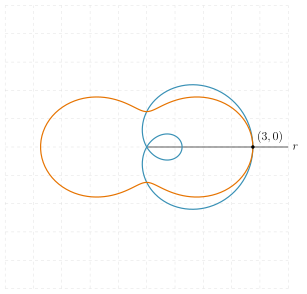
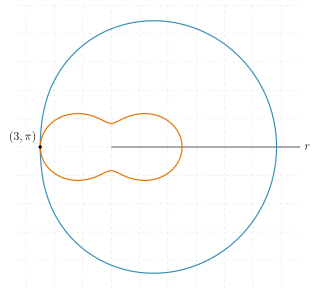
- On two further diagrams, one for each of the other two values of \(a\), sketch both the curves \(r = a + 2\cos\theta\) and \(r = 2 + \cos 2\theta\). Give the values of \(r\) and \(\theta\) at the points at which the curves touch and justify the other features you show on your sketch.
Solution:
- The curves meet when they have the same radius for a given \(\theta\) ie \begin{align*} && a + 2 \cos \theta &= 2 + \cos 2 \theta \\ &&&= 2 + 2\cos^2 \theta - 1 \\ \Rightarrow && 0 &= 2 \cos ^2 \theta - 2 \cos \theta + 1 - a \end{align*} The curves touch if this has a repeated root, ie \(0 = \Delta = 4 - 8(1-a) \Rightarrow a = \frac12\). The second way the curves can touch is if there is a single root, but it's at an extreme value of \(\cos \theta = \pm 1\) ie \(0 = 2 - 2\cdot(\pm1) + 1 - a \Rightarrow a = 3 \pm 2 = 1, 5\)
- Suppose \(a = \frac12\) then the curves touch when \(0 = 2\cos^2 \theta - 2 \cos \theta + \frac12 = (2 \cos \theta-1 )(\cos \theta -\frac12) \Rightarrow \theta = \pm \frac{\pi}{3}\)
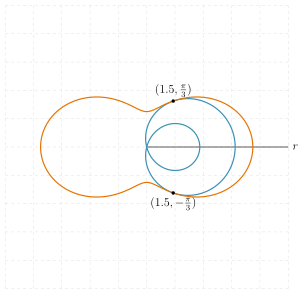
- \(a = 1\)
\(a = 5\)
2019 Paper 1 Q10
In this question, the \(x\)-axis is horizontal and the positive \(y\)-axis is vertically upwards. A particle is projected from the origin with speed \(u\) at an angle \(\alpha\) to the vertical. The particle passes through the fixed point \((h \tan \beta, h)\), where \(0 < \beta < 90^{\circ}\) and \(h > 0\).
- Show that
$$c^2 - ck \cot \beta + 1 + k \cot^2 \beta = 0, \quad (*)$$
where \(c = \cot \alpha\) and \(k = \frac{2u^2}{gh}\).
You are given that there are two distinct values of \(\alpha\) that satisfy equation \((*)\). Let \(\alpha_1\) and \(\alpha_2\) be these values.
- Show that $$\cot \alpha_1 + \cot \alpha_2 = k \cot \beta.$$ Show also that $$\alpha_1 + \alpha_2 = \beta.$$
- Show that $$k > 2(1 + \sec \beta).$$
- By considering the greatest height attained by the particle, show that \(k \geq 4 \sec^2 \alpha\).
Solution:
- The horizontal position of the particle at time \(t\) is \(u \sin\alpha t\), so \(T = \frac{h \tan \beta}{u \sin \alpha}\)
The vertical position of the particle at this time \(T\) satisifes:
\begin{align*}
&& h &= u \cos\alpha \frac{h \tan \beta}{u \sin\alpha} - \frac12 g \left ( \frac{h \tan \beta}{u \sin\alpha} \right)^2 \\
&&&= h\cot \alpha \tan \beta - \frac{gh^2}{2u^2} \tan^2 \beta \cosec^2 \beta \\
\Rightarrow && 1 &= c \tan \beta - \frac{1}{k} \tan^2 \beta (1 + c^2) \\
\Rightarrow && k \cot^2 \beta &= kc\cot \beta -1-c^2 \\
\Rightarrow && 0 &= c^2 -ck \cot \beta + 1 + k \cot^2 \beta
\end{align*}
- As a quadratic in \(c\) the sum of the roots is \(k \cot \beta\), therefore \(\cot \alpha_1 + \cot \alpha_2 = k \cot \beta\). We also have that \(\cot \alpha_1 \cot \alpha_2 = 1 + k \cot^2 \beta\), so \begin{align*} && \cot (\alpha_1 + \alpha_2) &= \frac{\cot \alpha_1 \cot \alpha_2-1}{\cot \alpha_1 + \cot \alpha_2} \\ &&&= \frac{1 + k \cot^2 \beta - 1}{k \cot \beta} \\ &&&= \cot \beta \\ \Rightarrow && \beta &= \alpha_1 + \alpha_2 \pmod{\pi} \end{align*} but since \(\alpha_i \in (0, \frac{\pi}{2})\) the equation must hold exactly.
- Since it has two real roots we must have \begin{align*} && 0 &<\Delta = k^2 \cot^2 \beta - 4 (1 + k \cot^2 \beta) \\ &&&= k^2 \cot^2 \beta-4k \cot^2 \beta -4 \\ &&&= \cot^2 \beta (k^2 - 4k - 4(\sec^2 \beta - 1)) \\ &&&= \cot^2 \beta ( (k-2)^2 -4\sec^2 \beta) \\ \Rightarrow && k &> 2 + 2\sec \beta = 2(1+\sec \beta) \end{align*}
- The greatest height will satisfy \(v^2 = u^2 + 2as\) so \(0 = u^2 \cos^2 \alpha - 2gh_{max} \Rightarrow 4\sec^2 \alpha = \frac{2u^2}{gh_{max}} = k_{max}\), but this decreases with \(h\), so the smallest \(k\) can be is \(4\sec^2 \alpha\), ie \(k \geq 4 \sec^2 \alpha\)
2018 Paper 1 Q7
- In the cubic equation \(x^3-3pqx+pq(p+q)=0\,\), where \(p\) and \(q\) are distinct real numbers, use the substitution \[ x=\frac{pz+q}{z+1} \] to show that the equation reduces to \(az^3+b = 0\,\), where \(a\) and \(b\) are to be expressed in terms of \(p\) and \(q\).
- Show further that the equation \(x^3 - 3cx + d = 0\,\), where \(c\) and \(d\) are non-zero real numbers, can be written in the form \(x^3-3pqx+pq(p+q)=0\,\), where \(p\) and \(q\) are distinct real numbers, provided \(d^2 > 4c^3\,\).
- Find the real root of the cubic equation \(x^3+6x-2=0\,\).
- Find the roots of the equation \(x^3 - 3p^2x +2p^3=0\,\), and hence show how the equation \(x^3 - 3cx + d = 0\) can be solved in the case \(d^2 = 4c^3\,\).
Solution:
- Let \(x = \frac{pz+q}{z+1}\) then \begin{align*} && 0 &= x^3-3pqx+pq(p+q) \\ &&&= \left ( \frac{pz+q}{z+1} \right)^3 - 3pq \left ( \frac{pz+q}{z+1} \right) + pq(p+q) \\ &&&= \frac{(pz+q)^3-3pq(pz+q)(z+1)^2+pq(p+q)(z+1)^3}{(z+1)^3} \\ &&&= \frac{1}{(z+1)^3} \Big ((p^3+pq(p+q)-3p^2q)z^3 + (3p^2q-6p^2q+3pq^2+3p^2q+3pq^2)z^2 + \\ &&&\qquad \qquad\quad\quad +(3pq^2-3p^2q-6pq^2+3p^2q+3qp^2)z+(q^3-3pq^2+p^2q+pq^2) \Big ) \\ &&&= \frac{(p^3+pq^2-2p^2q)z^3+(q^3+p^2q-2pq^2)}{(z+1)^3} \\ \Rightarrow && 0 &= (p^3+pq^2-2p^2q)z^3+(q^3+p^2q-2pq^2) \\ &&&= p(p-q)^2z^3 + q(p-q)^2 \\ \Rightarrow && 0 &= pz^3 + q \end{align*}
- We would like to find \(pq = c\) and \(pq(p+q) = d\), so \(p\) and \(q\) are roots of the quadratic \(x^2-\frac{d}{c}x + c = 0\), which has distinct real roots if \(\Delta = \frac{d^2}{c^2}-4c > 0 \Rightarrow d^2>4c^3\)
- Note that \(c = -2, d = -2\) so \begin{align*} && 0 &= x^3+6x-2 \\ \text{consider} && 0 &= X^2-X-2 \\ && &= (X+1)(X-2) \\ \Rightarrow && p = -1, &q = 2\\ \Rightarrow && 0 &= x^3-3\cdot 2 \cdot(-1) x + 2\cdot(-1) \cdot(-2+1) \\ \Rightarrow && 0 &= -z^3+2 \\ \Rightarrow && z &= \sqrt[3]{2} \\ \Rightarrow && \frac{-z+2}{z+1} &= \sqrt[3]{2} \\ \Rightarrow && -z+2 &= \sqrt[3]{2} z + \sqrt[3]{2} \\ \Rightarrow && z &= \frac{2-\sqrt[3]{2}}{\sqrt[3]{2}+1} \end{align*}
- \(\,\) \begin{align*} && 0 &= x^3 - 3p^2x + 2p^3 \\ &&&= (x-p)(x^2+px-2p^2) \\ &&&=(x-p)^2(x+2p)\\ \Rightarrow && x &= p, p, -2p \end{align*} Therefore if we have a repeated root to our associated quadratic we can find a cubic of the form \(x^3-3p^2x+2p^3\), but we know this has roots we can find.
2017 Paper 1 Q4
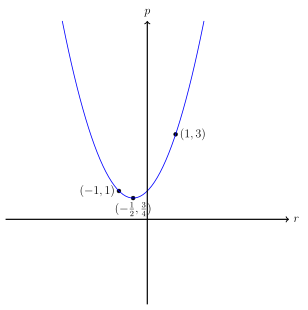
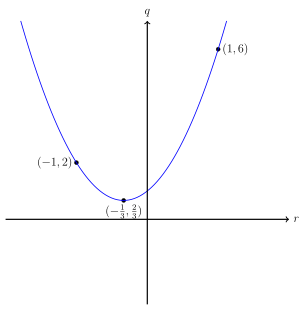
- Let \(r\) be a real number with \(\vert r \vert<1\) and let \[ S = \sum_{n=0}^\infty r^n\,. \] You may assume without proof that \(S = \displaystyle \frac{1}{1-r}\, \). Let \(p= 1 + r +r^2\). Sketch the graph of the function \(1+r+r^2\) and deduce that \(\frac{3}{4} \le p < 3\,\). Show that, if \(1 < p < 3\), then the value of \( p\) determines \(r\), and hence \(S\), uniquely. Show also that, if \(\frac{3}{4} < p < 1\), then there are two possible values of \(S\) and these values satisfy the equation \((3-p)S^2-3S+1=0\).
- Let \(r\) be a real number with \(\vert r \vert<1\) and let \[ T =\sum_{n=1}^\infty nr^{n-1}\,. \] You may assume without proof that \(T = \displaystyle \dfrac{1}{(1-r)^2}\,.\) Let \( q= 1+2r+3r^2\). Find the set of values of \( q\) that determine \(T\) uniquely. Find the set of values of \(q\) for which \(T\) has two possible values. Find also a quadratic equation, with coefficients depending on \( q\), that is satisfied by these two values.
Solution:
- \(\,\)
Notice that \(1+r+r^2\) ranges from \(\frac34\) to \(3\) over \((-1,1)\) therefore \(\frac34 \leq p < 3\) attaining its minimum but not its maximum. If \(p > 1\) we know we must be on the right branch and hence we can determine \(r\) and \(S\) uniquely. If \(\frac34 < p < 1\) then we must have two possible values for \(r\), satisfying \(r_i^2 + r+1 = p\) and so our two possible values for \(S_i = \frac{1}{1-r_i}\) or \(r_i = 1-\frac{1}{S_i}\) and so \begin{align*} && p &= \left ( 1 - \frac{1}{S} \right)^2 + 1 - \frac1S + 1 \\ \Rightarrow && pS^2 &= (S-1)^2 + S^2-S + S^2 \\ \Rightarrow && 0 &= (3-p)S^2 -3S + 1 \end{align*}
- \(\,\)
So \(\frac23 \leq q < 6\) and \(r\) and hence \(T\) is uniquely determined if \(2 \leq q < 6\). if \(\frac23
2016 Paper 2 Q4
Let \[ y=\dfrac{x^2+x\sin\theta+1}{x^2+x\cos\theta+1} \,.\]
- Given that \(x\) is real, show that \[ (y\cos\theta -\sin\theta)^2 \ge 4 (y-1)^2 \,. \] Deduce that \[ y^2+1 \ge 4(y-1)^2 \,, \] and hence that \[ \dfrac {4-\sqrt7}3 \le y \le \dfrac {4+\sqrt7}3 \,. \]
- In the case $y= \dfrac {4+\sqrt7}3 \,$, show that \[\sqrt{y^2+1}=2(y-1)\] and find the corresponding values of \(x\) and \(\tan\theta\).
Solution:
- \(\,\) \begin{align*} && y&=\frac{x^2+x\sin\theta+1}{x^2+x\cos\theta+1} \\ \Leftrightarrow && 0 &= x^2(y-1) + x(y \cos \theta - \sin \theta) + y-1 \\ \Leftrightarrow && 0 &\leq \Delta = (y\cos \theta - \sin \theta)^2 - 4(y-1)^2 \\ \Leftrightarrow && (y\cos \theta - \sin \theta)^2 &\geq 4(y-1)^2 \end{align*} [Assuming that \(y \neq 1\), if \(y = 1\) then the RHS is \(0\) and it is automatically satisfied]. Notice that \((y\cos \theta - \sin \theta)^2 \leq (y^2+1)(\cos^2 \theta + \sin^2 \theta)\) by Cauchy-Schwarz, so \(y^2 + 1 \geq 4(y-1)^2\). \begin{align*} && y^2 + 1 &\geq 4(y-1)^2 \\ \Leftrightarrow && 0 &\geq 3y^2-8y+3 \\ \text{c.v.} && y&= \frac{8 \pm \sqrt{64-4\cdot3 \cdot 3}}{6} \\ &&&= \frac{4 \pm \sqrt{16-9}}{3} = \frac{4 \pm \sqrt{7}}3 \end{align*} so \(\frac{4-\sqrt{7}}3 \leq y \leq \frac{4+\sqrt7}3\).
- If \(y = \frac{4+\sqrt7}3\) then \(y - 1 = \frac{1+\sqrt7}3\) and since \(y^2+1 = 4(y-1)^2\) taking square roots we obtain \(\sqrt{y^2+1} = 2(y-1)\). Since equality must hold in our C-S identity, we must have \(\langle y, -1 \rangle\) parallel to \( \langle \cos \theta , \sin \theta \rangle\), ie \(\tan \theta = -\frac{3}{4+\sqrt{7}}\) and \begin{align*} && x & = \frac{-(y \cos \theta - \sin \theta) \pm \sqrt{\Delta}}{2(y-1)} \\ &&&= \frac{\pm2(y-1)}{2(y-1)} \\ &&&= \pm1 \end{align*}
2014 Paper 2 Q1
In the triangle \(ABC\), the base \(AB\) is of length 1 unit and the angles at~\(A\) and~\(B\) are \(\alpha\) and~\(\beta\) respectively, where \(0<\alpha\le\beta\). The points \(P\) and~\(Q\) lie on the sides \(AC\) and \(BC\) respectively, with \(AP=PQ=QB=x\). The line \(PQ\) makes an angle of~\(\theta\) with the line through~\(P\) parallel to~\(AB\).
- Show that \(x\cos\theta = 1- x\cos\alpha - x\cos\beta\), and obtain an expression for \(x\sin\theta\) in terms of \(x\), \(\alpha\) and~\(\beta\). Hence show that \begin{equation} \label{eq:2*} \bigl(1+2\cos(\alpha+\beta)\bigr)x^2 - 2(\cos\alpha + \cos\beta)x + 1 = 0\,. \tag{\(*\)} \end{equation} Show that \((*)\) is also satisfied if \(P\) and \(Q\) lie on \(AC\) produced and \(BC\) produced, respectively. [By definition, \(P\) lies on \(AC\) produced if \(P\) lies on the line through \(A\) and~\(C\) and the points are in the order \(A\), \(C\), \(P\)\,.]
- State the condition on \(\alpha\) and \(\beta\) for \((*)\) to be linear in \(x\). If this condition does not hold (but the condition \(0<\alpha \le \beta\) still holds), show that \((*)\) has distinct real roots.
- Find the possible values of~\(x\) in the two cases (a) \(\alpha = \beta = 45^\circ\) and (b) \(\alpha = 30^\circ\), \(\beta = 90^\circ\), and illustrate each case with a sketch.
2008 Paper 1 Q8
- The gradient \(y'\) of a curve at a point \((x,y)\) satisfies \[ (y')^2 -xy'+y=0\,. \tag{\(*\)} \] By differentiating \((*)\) with respect to \(x\), show that either \(y''=0\) or \(2y'=x\,\). Hence show that the curve is either a straight line of the form \(y=mx+c\), where \(c=-m^2\), or the parabola \(4y=x^2\).
- The gradient \(y'\) of a curve at a point \((x,y)\) satisfies \[ (x^2-1)(y')^2 -2xyy'+y^2-1=0\,. \] Show that the curve is either a straight line, the form of which you should specify, or a circle, the equation of which you should determine.
Solution:
- \(\,\) \begin{align*} && 0 &= (y')^2 -xy'+y\\ \Rightarrow && 0 &= 2y' y'' -y' - xy'' + y' \\ &&&= 2y'y'' - xy'' \\ &&&= y'' (2y'-x) \end{align*} Therefore \(y'' = 0 \Rightarrow y = mx + c\) or \(y' = \frac12 x \Rightarrow x = \frac14x^2 + C\). Plugging these into the original equation we have \(m^2 - xm+mx+c = 0 \Rightarrow c = -m^2\) \(\frac14 x^2 - \frac12 x^2 + \frac14x^2 + C = 0 \Rightarrow C = 0\). Therefore \(4y = x^2\)
- \begin{align*} && 0 &= (x^2-1)(y')^2 -2xyy'+y^2-1 \\ \Rightarrow && 0 &= 2x(y')^2 +(x^2-1)2y'y'' - 2yy' - 2x(y')^2-2xyy''+2yy' \\ &&&= (x^2-1)2y'y'' -2xyy'' \\ &&&= 2y'' ((x^2-1)y'-xy) \end{align*} Therefore \(y'' = 0\) so \(y = mx + c\) or \begin{align*} && \frac{\d y}{\d x} &= \frac{xy}{x^2-1} \\ \Rightarrow && \int \frac1y \d y &= \int \frac{x}{x^2-1} \d x \\ \Rightarrow && \ln |y| &= \frac12 \ln |x^2-1| + C \\ \Rightarrow && y^2 &= A(x^2-1) \end{align*} Suppose \(y = mx+c\) then we must have \((x^2-1)m^2-2xm(mx+c)+(mx+c)^2 = -m^2+c^2 \Rightarrow c^2 = m^2\) If \(y^2 = A(x^2-1)\) then \(2yy' = 2xA\) and \begin{align*} && 0 &= \frac{y^2}{A}\left ( \frac{xA}{y} \right)^2 - 2x^2A+A(x^2-1)-1 \\ &&&= x^2A-2x^2A+x^2A-A-1 \\ \Rightarrow && A &= -1 \end{align*} Therefore \(x^2 + y^2 = 1\)
2006 Paper 1 Q3
In this question \(b\), \(c\), \(p\) and \(q\) are real numbers.
- By considering the graph \(y=x^2 + bx + c\) show that \(c < 0\) is a sufficient condition for the equation \(\displaystyle x^2 + bx + c = 0\) to have distinct real roots. Determine whether \(c < 0\) is a necessary condition for the equation to have distinct real roots.
- Determine necessary and sufficient conditions for the equation \(\displaystyle x^2 + bx + c = 0\) to have distinct positive real roots.
- What can be deduced about the number and the nature of the roots of the equation \(x^3 + px + q = 0\) if \(p>0\) and \(q<0\)? What can be deduced if \(p<0\,\) and \(q<0\)? You should consider the different cases that arise according to the value of \(4p^3+ 27q^2\,\).
Solution:
- Since \(y(0) < 0\) and \(y(\pm \infty) > 0\) we must cross the axis twice. Therefore there are two distinct real roots. It is not necessary, for example \((x-2)(x-3)\) has distinct real roots by the constant term is \(6 > 0\)

- For \(x^2+bx+c=0\) to have distinct, positive real roots we need \(\Delta > 0\) and \(\frac{-b -\sqrt{\Delta}}{2a} > 0\) where \(\Delta = b^2-4ac\), ie \(b < 0\) and \(b^2 > \Delta = b^2-4ac\) or \(4ac > 0\). Therefore we need \(b^2-4ac > 0, b < 0, 4ac > 0\)
- Since \(q < 0\) at least one of the roots is positive. The gradient is \(3x^2+p > 0\) therefore there is exactly one positive root. If \(p < 0\) then there are turning points when \(3x^2+p = 0\) ie \(x = \pm \sqrt{\frac{-p}{3}}\). If the first turning point is above the \(x\)-axis then there will be 3 roots. If it is on the \(x\)-axis then 2, otherwise only 1. \begin{align*} y &= \left (-\sqrt{\frac{-p}{3}}\right)^3 + p\left (-\sqrt{\frac{-p}{3}}\right)+q \\ &= \sqrt{\frac{-p}{3}} \left (p - \frac{p}{3} \right) + q \\ &= \frac{2}{3} \sqrt{\frac{-p}{3}}p +q \\ \end{align*} Therefore it is positive if \(-\frac{4}{27}p^3 >q^2\) ie if \(4p^3+27q^2 < 0\)
2005 Paper 1 Q3
In this question \(a\) and \(b\) are distinct, non-zero real numbers, and \(c\) is a real number.
- Show that, if \(a\) and \(b\) are either both positive or both negative, then the equation \[ \displaystyle \frac {x }{ x-a} + \frac{x }{ x-b} = 1 \] has two distinct real solutions.
- Show that, if \(c\ne1\), the equation \[\displaystyle \frac x { x-a} + \frac{x}{ x-b} = 1 + c\] has exactly one real solution if \(\displaystyle c^2 = - \frac {4ab}{\l a - b \r ^2}\) Show that this condition can be written \(\displaystyle c^2= 1 - \l \frac {a+b}{a-b} \r ^2 \) and deduce that it can only hold if \(0 < c^2 \le 1\,\).
Solution:
- \(\,\) \begin{align*} && 1 &= \frac{x}{x-a} + \frac{x}{x-b} \\ \Leftrightarrow && (x-a)(x-b) &= x(2x-a-b) \\ \Leftrightarrow && 0 &= x^2-ab \end{align*} Therefore if \(a,b\) are both positive or both negative, \(ab > 0\) and there are two distinct solutions \(x = \pm \sqrt{ab}\)
- \(\,\) \begin{align*} && 1+c &= \frac{x}{x-a} + \frac{x}{x-b} \\ \Leftrightarrow && (1+c)(x-a)(x-b) &= x(2x-a-b) \\ \Leftrightarrow && 0 &= (c-1)x^2-c(a+b)x+ab(1+c) \\ \\ && 0 &= \Delta = c^2(a+b)^2 - 4 \cdot(c-1)\cdot ab(1+c) \\ &&&= c^2(a+b)^2-4ab(c^2-1) \\ &&&= c^2 ((a+b)^2-4ab)+4ab \\ &&&= c^2(a-b)^2+4ab \\ \Rightarrow && c^2 &= -\frac{4ab}{(a-b)^2} \\ &&&= -\frac{(a+b)^2-(a-b)^2}{(a-b)^2} \\ &&&= 1 - \left ( \frac{a+b}{a-b} \right)^2 \end{align*} Note that \(c^2 \geq 0\) and \(1-x^2 \leq 1\) so \(0 \leq c^2 \leq 1\). \(c^2 = 0 \Rightarrow ab = 0\), but this is not possible since \(a,b \neq 0\), therefore \(0 < c^2 \leq 1\)
2005 Paper 3 Q5
Let \(P\) be the point on the curve \(y=ax^2+bx+c\) (where \(a\) is non-zero) at which the gradient is \(m\). Show that the equation of the tangent at \(P\) is \[ y-mx=c-\frac{(m-b)^2}{4a}\;. \] Show that the curves \(y=a_1 x^2+b_1 x+c_1\) and \(y=a_2 x^2+b_2 x+c_2\) (where \(a_1\) and \(a_2\) are non-zero) have a common tangent with gradient \(m\) if and only if \[ (a_2 -a_1 )m^2 + 2(a_1 b_2-a_2 b_1)m + 4a_1 a_2(c_2-c_1)+ a_2 b_1^2-a_1 b_2 ^2=0\;. \] Show that, in the case \(a_1 \ne a_2 \,\), the two curves have exactly one common tangent if and only if they touch each other. In the case \(a_1 =a_2\,\), find a necessary and sufficient condition for the two curves to have exactly one common tangent.
Solution: \begin{align*} && y' &= 2ax+b \\ \Rightarrow && m &= 2ax_t+b \\ \Rightarrow && x_t &= \frac{m-b}{2a} \end{align*} Therefore we must have \begin{align*} mx_t &= 2ax_t^2+bx_t \\ y - mx &= ax_t^2+bx_t+c - mx_t \\ &= ax_t^2+bx_t+c - (2ax_t^2+bx_t) \\ &= c - ax_t^2 \\ &= c-a\left (\frac{m-b}{2a} \right)^2 \\ &= c - \frac{(m-b)^2}{4a} \end{align*} They will have a common tangent if and only if the constant terms are equal, ie \begin{align*} && c_1 - \frac{(m-b_1)^2}{4a_1} &= c_2 - \frac{(m-b_2)^2}{4a_2} \\ \Leftrightarrow && (c_1-c_2) &= \frac{(m-b_1)^2}{4a_1} -\frac{(m-b_2)^2}{4a_2} \\ \Leftrightarrow && 4a_1a_2(c_1-c_2) &= a_2(m-b_1)^2-a_1(m-b_2)^2 \\ &&&= (a_2-a_1)m^2+2(a_1b_2-a_2b_1)m+a_2b_1^2-a_1b_2^2 \end{align*} as required. Treating this as a polynomial in \(m\), we can see that the two curves will have exactly one common tangent iff \(\Delta = 0\), ie: \begin{align*} && 0 &= \Delta \\ &&&= (2(a_1b_2-a_2b_1))^2 - 4 (a_2-a_1)(4a_1 a_2(c_2-c_1)+ a_2 b_1^2-a_1 b_2 ^2) \\ &&&= 4a_1^2b_2^2-8a_1a_2b_1b_2+4a_2b_1^2 - 4a_2^2b_1^2-4a_1^2b_2^2 + 4a_1a_2(b_1^2+b_2^2)-16(a_2-a_1)a_1a_2(c_2-c_1) \\ &&&=-8a_1a_2b_1b_2+4a_1a_2(b_1^2+b_2^2)-16(a_2-a_1)a_1a_2(c_2-c_1) \\ &&&=a_1a_2(4(b_1-b_2)^2-16(a_2-a_1)(c_2-c_1)) \\ &&&= 4a_1a_2((b_2-b_1)^2 - 4(a_2-a_1)(c_2-c_1) \end{align*} But this is just the discriminant of the difference, ie equivalent to the two parabolas just touching. (Assuming \(a_1-a_2 \neq 0\) and we do end up with a quadratic). If \(a_1 = a_2 = a\) then we need exactly one solution to \(2a(b_1-b_2)m +4a^2(c_2-c_1)+a(b_1^2-b_2^2) = 0\), ie \(b_1 \neq b_2\).
2004 Paper 2 Q2
Prove that, if \(\vert \alpha\vert < 2\sqrt{2},\) then there is no value of \(x\) for which \begin{equation} x^2 -{\alpha}\vert x \vert + 2 < 0\;. \tag{\(*\)} \end{equation} Find the solution set of \((*)\) for \({\alpha}=3\,\). For \({\alpha} > 2\sqrt{2}\,\), the sum of the lengths of the intervals in which \(x\) satisfies \((*)\) is denoted by \(S\,\). Find \(S\) in terms of \({\alpha}\) and deduce that \(S < 2{\alpha}\,\). Sketch the graph of \(S\,\) against \(\alpha \,\).
Solution: There are two cases to consider by they are equivalent to \(x^2 \pm \alpha x + 2 < 0\), which has no solution solutions if \(\Delta < 0\), ie if \(\alpha^2 - 4\cdot1\cdot2 < 0 \Leftrightarrow |\alpha| < 2\sqrt{2}\). If \(\alpha = 3\), we have \begin{align*} && 0 & > x^2-3x+2 \\ &&&= (x-2)(x-1) \\ \Rightarrow && x & \in (1,2) \\ \\ && 0 &> x^2+3x+2 \\ &&& = (x+2)(x+1) \\ \Rightarrow && x &\in (-2,-1) \end{align*} Both cases work here, so \(x \in (-2, -1) \cup (1,2)\). \begin{align*} && 0 &> x^2 \pm \alpha x + 2 \\ &&&= (x \pm \tfrac{\alpha}{2})^2 -\frac{\alpha^2-8}{4} \end{align*} The potential intervals therefore are \((\frac{\alpha -\sqrt{\alpha^2-8}}{2}, \frac{\alpha +\sqrt{\alpha^2-8}}{2})\) and \((\frac{-\alpha -\sqrt{\alpha^2-8}}{2}, \frac{-\alpha +\sqrt{\alpha^2-8}}{2})\). Neither of these intervals overlap with \(0\), since \(\alpha^2 > \alpha^2-8\), and their lengths are both \(\sqrt{\alpha^2-8}\), therefore \(S = 2\sqrt{\alpha^2-8} < 2\alpha\)

2003 Paper 1 Q9
A particle is projected with speed \(V\) at an angle \(\theta\) above the horizontal. The particle passes through the point \(P\) which is a horizontal distance \(d\) and a vertical distance \(h\) from the point of projection. Show that \[ T^2 -2kT + \frac{2kh}{d}+1=0\;, \] where \(T=\tan\theta\) and \(\ds k= \frac{V^2}{gd}\,\). %Derive an equation relating \(\tan \theta\), \(V\), \(g\), \(d\) and \(h\). Show that, if \(\displaystyle {kd > h + \sqrt {h^2 + d^2}}\;\), there are two distinct possible angles of projection. Let these two angles be \(\alpha\) and \(\beta\). Show that \(\displaystyle \alpha + \beta = \pi - \arctan ( {d/ h}) \,\).