Problems
Filters
9 problems found
2022 Paper 2 Q1
- By integrating one of the two terms in the integrand by parts, or otherwise, find \[\int \left(2\sqrt{1+x^3} + \frac{3x^3}{\sqrt{1+x^3}}\right)\,\mathrm{d}x\,.\]
- Find \[\int (x^2+2)\frac{\sin x}{x^3}\,\mathrm{d}x\,.\]
- Sketch the graph with equation \(y = \dfrac{\mathrm{e}^x}{x}\), giving the coordinates of any stationary points.
- Find \(a\) if \[\int_a^{2a} \frac{\mathrm{e}^x}{x}\,\mathrm{d}x = \int_a^{2a} \frac{\mathrm{e}^x}{x^2}\,\mathrm{d}x\,.\]
- Show that it is not possible to find distinct integers \(m\) and \(n\) such that \[\int_m^n \frac{\mathrm{e}^x}{x}\,\mathrm{d}x = \int_m^n \frac{\mathrm{e}^x}{x^2}\,\mathrm{d}x\,.\]
2019 Paper 1 Q8
The function \(f\) is defined, for \(x > 1\), by $$f(x) = \int_1^x \sqrt{\frac{t-1}{t+1}} dt.$$ Do not attempt to evaluate this integral.
- Show that, for \(x > 2\), $$\int_2^x \sqrt{\frac{u-2}{u+2}} du = 2f\left(\frac{1}{2}x\right).$$
- Evaluate in terms of \(f\), for \(x > 0\), $$\int_0^x \sqrt{\frac{u}{u+4}} du.$$
- Evaluate in terms of \(f\), for \(x > 5\), $$\int_5^x \sqrt{\frac{u-5}{u+1}} du.$$
- Evaluate in terms of \(f\) $$\int_1^2 \frac{u^2}{\sqrt{u^2+4}} du.$$
Solution:
- Let \(2t = u\), \begin{align*} \int_2^x \sqrt{\frac{u-2}{u+2}} du &= \int_{t=1}^{t=x/2} \sqrt{\frac{2t-2}{2t+2}}2 \d t \\ &= 2\int_{t=1}^{x/2} \sqrt{\frac{t-1}{t+1}} \d t \\ &= 2f\l\frac{x}{2}\r \end{align*}
- Let \(v = u-2\), \begin{align*} \int_0^x \sqrt{\frac{u}{u+4}} du &= \int_{v = 2}^{x+2} \sqrt{\frac{v-2}{v+2}} \d v \\ &= 2 f \l \frac{x+2}{2} \r \end{align*}
- Let \(v = u-2, \d v = \d u\) \begin{align*} \int_5^x \frac{u-5}{u+1} du &= \int_3^{x-2} \frac{v-3}{v+3} \d v \\ &= \int_1^{\frac{x-2}{3}} \frac{3t - 3}{3t+3} 3 \d t \\ &= 3 f \l \frac{x-2}{3} \r \end{align*}
- Let \(v = u^2, \d v = 2u \d u\)\begin{align*}\int_1^2 \frac{u^2}{\sqrt{u^2+4}} du &= \int_1^2 \sqrt{\frac{u^2}{u^2+4}} u \d u \\ &= \int_1^4 \sqrt{\frac{v}{v+4}} \frac12 \d v \\ &= f \l \frac{4+2}{2} \r - f \l \frac{3}{2} \r \\ &= f(3) - f(\frac32) \end{align*}
2017 Paper 1 Q6
In this question, you may assume that, if a continuous function takes both positive and negative values in an interval, then it takes the value \(0\) at some point in that interval.
- The function \(\f\) is continuous and \(\f(x)\) is non-zero for some value of \(x\) in the interval \(0\le x \le 1\). Prove by contradiction, or otherwise, that if \[ \int_0^1 \f(x) \d x = 0\,, \] then \(\f(x)\) takes both positive and negative values in the interval \(0\le x\le 1\).
- The function \(\g\) is continuous and \[ \int_0^1 \g(x) \, \d x = 1\,, \quad \int_0^1 x\g(x) \, \d x = \alpha\, , \quad \int_0^1 x^2\g(x) \, \d x = \alpha^2\,. \tag{\(*\)} \] Show, by considering \[ \int_0^1 (x - \alpha)^2 \g(x) \, \d x \,, \] that \(\g(x)=0\) for some value of \(x\) in the interval \(0\le x\le 1\). Find a function of the form \(\g(x) = a+bx\) that satisfies the conditions \((*)\) and verify that \(\g(x)=0\) for some value of \(x\) in the interval \(0\le x \le 1\).
- The function \(\h\) has a continuous derivative \(\h'\) and \[ \h(0) = 0\,, \quad \h(1) = 1\,, \quad \int_0^1 \h(x) \, \d x = \beta\,, \quad \int_0^1 x \h(x) \, \d x = \tfrac{1}{2}\beta (2 - \beta) \,. \] Use the result in part (ii) to show that \(\h^\prime(x)=0\) for some value of \(x\) in the interval \(0\le x\le 1\).
Solution:
- Claim: If \(f(x)\) non-zero for some \(x \in [0,1]\) and \(\int_0^1 f(x) \d x =0\) then \(f\) takes both positive and negative values in the interval \([0,1]\). Proof: Suppose not, then WLOG suppose \(f(x) > 0\) for some \(x \in [0,1]\). Then notice (since \(f\) is continuous) that there is some interval where \(f(x) > 0\) around the \(x\) we have already shown exists. But then \(\int_{\text{interval}} f(x) \d x > 0\) and since \(f(x) \geq 0\) everywhere \(\int_0^1 f(x) \d x > 0\), which is a contradiction.
- \(\,\) \begin{align*} && \int_0^1 (x - \alpha)^2 g(x) \d x &= \int_0^1 x^2g(x) \d x - 2 \alpha \int_0^1 x g(x) \d x + \alpha^2 \int_0^1 g(x) \d x \\ &&&= \alpha^2 - 2\alpha \cdot \alpha + \alpha^2 \cdot 1 \\ &&&= 0 \end{align*} Therefore \(g(x)(x-\alpha)^2\) is a continuous function which is either exactly \(0\) (in which case we've already found our \(0\)) or it is a continuous function which is both positive somewhere and has \(0\) integral, and therefore by part (i) must take both positive and negative values (and therefore takes \(0\) in between those points by continuity). \begin{align*} &&1 &= \int_0^1 a+bx \d x \\ &&&= a + \frac12 b \\ && \alpha &= \int_0^1 ax + bx^2 \d x \\ &&&= \frac12 a + \frac13 b \\ && \alpha^2 &= \int_0^1 ax^2 + bx^3 \d x\\ &&&= \frac13 a + \frac14 b \\ \Rightarrow && \frac1{36}(3a+2b)^2 &= \frac1{12}(4a+3b) \\ \Rightarrow && \frac1{36}(3a+2(2-2a))^2 &= \frac1{12}(4a+3(2-2a)) \\ \Rightarrow && (4-a)^2 &= 3(6-2a) \\ \Rightarrow && 16-8a+a^2 &= 18-6a \\ \Rightarrow && a^2-2a-2 &= 0 \\ \Rightarrow && (a-1)^2 - 3 &= 0 \\ \Rightarrow && a &= \pm \sqrt{3}+1 \\ && b &= \mp 2\sqrt{3} \end{align*} So say \(a = \sqrt{3}+1, b = -2\sqrt{3}\) This has a root at \(-\frac{a}{b} = \frac{1+\sqrt{3}}{2\sqrt{3}} = \frac{\sqrt{3}+3}{6} < 1\) so we have met our condition.
- Consider \(h'\), we must have \begin{align*} && \int_0^1 h'(x)\d x &= h(1)-h(0) =1\\ && \int_0^1 xh'(x) \d x &= \left [x h(x) \right]_0^1 - \int_0^1 h(x) \d x \\ &&&= 1 - \beta \\ && \int_0^1 x^2 h'(x) \d x &= \left [ x^2h(x) \right]_0^1 - \int_0^1 2xh(x) \d x \\ &&&= 1 - 2\tfrac12 \beta(2-\beta) \\ &&&= (1-\beta)^2 \end{align*} Therefore \(h'\) satisfies the conditions with \(\alpha = 1-\beta\), so \(h'\) must have a root in our interval.
2017 Paper 2 Q4
The Schwarz inequality is \[ \left( \int_a^b \f(x)\, \g(x)\,\d x\right)^{\!\!2} \le \left( \int_a^b \big( \f(x)\big)^2 \d x \right) \left( \int_a^b \big( \g(x)\big)^2 \d x \right) . \tag{\(*\)} \]
- By setting \( \f(x)=1\) in \((*)\), and choosing \(\g(x)\), \(a\) and \(b\) suitably, show that for \(t> 0\,\), \[ \frac {\e^t -1}{\e^t+1} \le \frac t 2 \,. \]
- By setting \( \f(x)= x\) in \((*)\), and choosing \( \g(x)\) suitably, show that \[ \int_0^1\e^{-\frac12 x^2}\d x \ge 12 \big(1-\e^{-\frac14})^2 \,. \]
- Use \((*)\) to show that \[ \frac {64}{25\pi} \le \int_0^{\frac12\pi} \!\! {\textstyle \sqrt{\, \sin x\, } } \, \d x \le \sqrt{\frac \pi 2 } \,. \]
Solution:
- Let \(f(x) = 1, g(x) = e^x, a = 0, b = t\), so \begin{align*} && \left ( \int_0^t e^x \d x \right)^2 &\leq \left (\int_0^t 1^2 \d x \right) \cdot \left (\int_0^t (e^x)^2 \d x \right) \\ \Rightarrow && (e^t-1)^2 &\leq t \cdot (\frac12e^{2t} - \frac12) \\ \Rightarrow && \frac{e^t-1}{e^t+1} & \leq \frac{t}{2} \end{align*}
- Let \(f(x) = x, g(x) = e^{-\frac14 x^2}, a = 0, b = 1\) \begin{align*} && \left ( \int_0^1 xe^{-\frac14 x^2} \d x \right)^2 &\leq \left (\int_0^1 x^2 \d x \right) \cdot \left (\int_0^1 (e^{-\frac14x^2})^2 \d x \right) \\ \Rightarrow && \left ( \left [-2e^{-\frac14x^2} \right]_0^1 \right)^2 & \leq \frac{1}{3} \int_0^1 e^{-\frac12 x^2} \d x \\ \Rightarrow && \int_0^1 e^{-\frac12 x^2} \d x & \geq 12(1-e^{-\frac14})^2 \end{align*}
- Let \(f(x) = 1, g(x) = \sqrt{\sin x}, a = 0, b = \tfrac12 \pi\), then \begin{align*} && \left ( \int_0^{\frac12 \pi} \sqrt{\sin x} \d x \right)^2 &\leq \left (\int_0^{\frac12 \pi} 1^2 \d x \right) \cdot \left (\int_0^{\frac12 \pi}|\sin x| \d x \right) \\ &&&= \frac{\pi}{2} \cdot 1 \\ \Rightarrow && \int_0^{\frac12 \pi} \sqrt{\sin x} \d x & \leq \sqrt{\frac{\pi}{2}} \end{align*} Let \(f(x) =(\sin x)^{\frac14}, g(x) = \cos x, a = 0, b = \tfrac12 \pi\), so \begin{align*} && \left ( \int_0^{\frac12 \pi} (\sin x)^{\frac14} \cos x \d x \right)^2 &\leq \left (\int_0^{\frac12 \pi} \cos^2 x \d x \right) \cdot \left (\int_0^{\frac12 \pi}\sqrt{\sin x} \d x \right) \\ \Rightarrow &&\left ( \left [\frac45 (\sin x)^{\frac54} \right]_0^{\frac12 \pi} \right)^2 & \leq \frac{\pi}{4} \int_0^{\frac12 \pi}\sqrt{\sin x} \d x \\ \Rightarrow && \frac{64}{25\pi} &\leq \int_0^{\frac12 \pi}\sqrt{\sin x} \d x \end{align*}
2014 Paper 1 Q3
The numbers \(a\) and \(b\), where \(b > a\ge0\), are such that \[ \int_a^b x^2 \d x = \left ( \int_a^b x \d x\right)^{\!\!2}\,. \]
- In the case \(a=0\) and \(b>0\), find the value of \(b\).
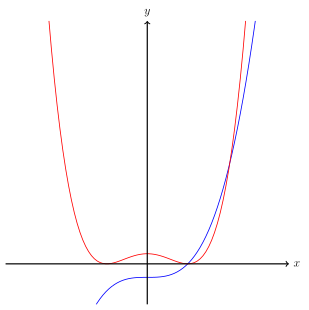
- In the case \(a=1\), show that \(b\) satisfies \[ 3b^3 -b^2-7b -7 =0\,. \] Show further, with the help of a sketch, that there is only one (real) value of \(b\) that satisfies this equation and that it lies between \(2\) and \(3\).
- Show that \(3p^2 + q^2 = 3p^2q\), where \(p=b+a\) and \(q=b-a\), and express \(p^2\) in terms of \(q\). Deduce that \(1< b-a\le\frac43\).
Solution:
- \(\,\) \begin{align*} && \int_0^b x^2 \d x &= \left ( \int_0^b x \d x \right)^2 \\ \Rightarrow && \frac{b^3}{3} &= \left ( \frac{b^2}{2} \right)^2 \\ \Rightarrow && b &= \frac{4}{3} \end{align*}
- \(\,\)
\begin{align*}
&& \int_1^b x^2 \d x &= \left ( \int_1^b x \d x \right)^2 \\
\Rightarrow && \frac{b^3}{3} - \frac{1}{3} &= \left ( \frac{b^2}{2} - \frac{1}{2} \right)^2 \\
\Rightarrow && 4(b^3 - 1) &= 3(b^2-1)^2 \\
\Rightarrow && 4(b^3-1) &= 3(b^4-2b^2+1) \\
\Rightarrow && 0 &= 3b^4-4b^3-6b^2+7 \\
&&&= (b-1)(3b^3-b^2-7b-7) \\
\Rightarrow && 0 &= 3b^3-b^2-7b-7
\end{align*}
Let \(f(x) = 3x^3-x^2-7x-7\) then \(f(2) = 3 \cdot 8 - 4 - 14 - 7 = -1 < 0\), \(f(3) = 3 \cdot 27 - 9 - 21 - 7 = 44 > 0\) therefore the root must lie between \(2\) and \(3\).
- \(,\) \begin{align*} && \int_a^b x^2 \d x &= \left ( \int_a^b x \d x \right)^2 \\ \Rightarrow && \frac{b^3}{3} - \frac{a^3}{3} &= \left ( \frac{b^2}{2} - \frac{a^2}{2} \right)^2 \\ \Rightarrow && 4(b^3 - a^3) &= 3(b^2-a^2)^2 \\ \Rightarrow && 4(b^2+ab+a^2) &= 3(b-a)(b+a)^2 \\ \Rightarrow && 4 \left ( \left ( \frac{p+q}{2}\right)^2+\left ( \frac{p+q}{2}\right)\left ( \frac{p-q}{2}\right)+\left ( \frac{p-q}{2}\right)^2\right) &= 3qp^2 \\ \Rightarrow && 3p^2 + q^2 &= 3qp^2 \\ \Rightarrow && 3p^2(q-1) &= q^2 \\ \Rightarrow && p^2 &= \frac{q^2}{3(q-1)} \\ \Rightarrow && 1 &\leq \frac{1}{3(q-1)} \\ \Rightarrow && 3(q-1) &\leq 1 \\ \Rightarrow && q & \leq \frac{4}{3} \\ \end{align*}
2011 Paper 3 Q6
The definite integrals \(T\), \(U\), \(V\) and \(X\) are defined by \begin{align*} T&= \int_{\frac13}^{\frac12} \frac{{\rm artanh}\, t}t \,\d t\,, & U&= \int _{\ln 2 }^{\ln 3 } \frac{u}{2\sinh u}\, \d u \,, \\[3mm] V&= - \int_{\frac13}^{\frac12} \frac{\ln v}{1-v^2} \,\d v \,, & X&= \int _{\frac12\ln2}^{\frac12\ln3} \ln ({\coth x})\, \d x\,. \end{align*} Show, without evaluating any of them, that \(T\), \(U\), \(V\) and \(X\) are all equal.
Solution: \begin{align*} && T &= \int_{\frac13}^{\frac12} \frac{{\rm artanh}\, t}t \,\d t \\ && &=\int_{\frac13}^{\frac12} \frac{1}{2t}\ln \left ( \frac{1+t}{1-t} \right) \,\d t \\ u = \tfrac{1+t}{1-t}, t= \tfrac{u-1}{u+1}, \d t = \tfrac{2}{(u+1)^2} \d t &&&= \int_{u=2}^{u=3} \frac{1}{2t} \ln u \frac{2}{(u+1)^2} \d u \\ &&&= \int_2^3 \frac{u+1}{u-1} \ln u \frac{1}{(u+1)^2} \d u \\ &&&= \int_2^3 \frac{1}{u^2-1} \ln u \d u \end{align*} \begin{align*} && U&= \int _{\ln 2 }^{\ln 3 } \frac{u}{2\sinh u}\, \d u \\ v = e^u, \d v = e^u \d u &&&= \int_{v=2}^{v=3} \frac{\ln v}{v - \frac{1}{v}} \frac{1}{v} \d v \\ &&&= \int_2^3 \frac{1}{v^2-1} \ln v \d v \end{align*} \begin{align*} &&V &= - \int_{\frac13}^{\frac12} \frac{\ln v}{1-v^2} \,\d v \\ u = \tfrac1v, \d u = -\tfrac1{v^2} \d v &&&= -\int_{u=3}^{u=2} \frac{-\ln u}{1 - \frac{1}{u^2}} \frac{-1}{u^2} \d u \\ &&&= -\int_3^2 \frac{\ln u}{u^2-1} \d u \\ &&&= \int_2^3 \frac{1}{u^2-1} \ln u \d u \end{align*} \begin{align*} &&X&= \int _{\frac12\ln2}^{\frac12\ln3} \ln ({\coth x})\, \d x \\ u = \coth x, \d u =(1-u^2) \d x &&&= \int_{u = 3}^{u=2} \ln u \frac{1}{1-u^2} \d u \\ &&&= \int_2^3 \frac{\ln u}{u^2-1} \d u \end{align*} Therefore all integrals are equal to the same integral, namely \(\displaystyle \int_2^3 \frac{\ln u}{u^2-1} \d u\)
2007 Paper 3 Q7
The functions \(\s(x)\) (\(0\le x<1\)) and \(t(x)\) (\(x\ge0\)), and the real number \(p\), are defined by \[ \s(x) = \int_0^x \frac 1 {\sqrt{1-u^2}}\, \d u\;, \ \ \ \ t(x) = \int_0^x \frac 1 {1+u^2}\, \d u\;, \ \ \ \ p= 2 \int_0^\infty \frac 1 {1+u^2}\, \d u \;. \] For this question, do not evaluate any of the above integrals explicitly in terms of inverse trigonometric functions or the number \(\pi\).
- Use the substitution \(u=v^{-1}\) to show that \(\displaystyle t(x) =\int_{1/x}^\infty\frac 1 {1+v^2}\, \d v \, \). Hence evaluate \(t(1/x) + t(x)\) in terms of \(p\) and deduce that \(2t(1)= \frac12 p\,\).
- Let \(y=\dfrac{u}{\sqrt{1+u^2}}\). Express \(u\) in terms of \(y\), and show that \(\displaystyle \frac{\d u}{\d y} = \frac 1 {\sqrt{(1-y^2)^3}}\). By making a substitution in the integral for \(t(x)\), show that \[ t(x) = \s\left(\frac{x}{\sqrt{1+x^2}}\right)\!. \] Deduce that \(\s\big(\frac1{\sqrt2}\big) =\frac1 4 p\,\).
- Let \(z= \dfrac{u+ \frac1{\sqrt3}}{1-\frac 1{\sqrt3}u}\,\). Show that \(\displaystyle t(\tfrac1{\sqrt3}) = \int_{\frac1{\sqrt3}}^{\sqrt3} \frac1 {1+z^2} \,\d z\;, \) and hence that \(3t(\frac1{\sqrt3}) = \frac12 p\,\).
Solution:
- \begin{align*} && t(x) &= \int_0^x \frac{1}{1+u^2} \d u \\ u = v^{-1}, \d u = -v^{-2} \d v&&&= \int_{v = \infty}^{v = 1/x} \frac{1}{1+v^{-2}} \frac{-1}{v^2} \d v \\ &&&= \int_{1/x}^\infty \frac{1}{1+v^2} \d v \\ \\ \Rightarrow && t(x) + t(1/x) &= \int_0^x \frac{1}{1+u^2} \d u + \int_0^{1/x} \frac{1}{1+u^2} \d u \\ &&&= \int_{1/x}^{\infty} \frac{1}{1+u^2} \d u + \int_0^{1/x} \frac{1}{1+u^2} \d u \\ &&&= \int_0^{\infty} \frac{1}{1+u^2} \d u \\ &&&= \frac12 p \\ \\ \Rightarrow && t(1) +t(1/1) = 2t(1) &= \frac12 p \end{align*}
- \(\,\) \begin{align*} && y &= \frac{u}{\sqrt{1+u^2}} \\ \Rightarrow && y^2 &= \frac{u^2}{1+u^2} \\ &&&= 1-\frac{1}{1+u^2} \\ \Rightarrow && 1+u^2 &= \frac{1}{1-y^2} \\ \Rightarrow && u &= \frac{y}{\sqrt{1-y^2}} \\ \\ && \frac{\d u}{\d y} &= \frac{\sqrt{1-y^2} + y^2(1-y^2)^{-1/2}}{1-y^2} \\ &&&= \frac{1}{(1-y^2)^{3/2}} \\ \\ && t(x) &= \int_0^x \frac{1}{1+u^2} \d u \\ &&&= \int_0^{y = x/\sqrt{1+x^2}} \frac{1}{1 + \frac{y^2}{1-y^2}} \frac{1}{(1-y^2)^{3/2}} \d y \\ &&&= \int_0^{x/\sqrt{1+x^2}} \frac{1-y^2}{(1-y^2)^{3/2}} \d y \\ &&&= \int_0^{x/\sqrt{1+x^2}} \frac{1}{(1-y^2)^{1/2}} \d y \\ &&&= s\left ( \frac{x}{\sqrt{1+x^2}} \right) \\ \\ \Rightarrow && s\left ( \frac{1}{\sqrt{2}} \right) &= t(1) = \frac14p \end{align*}
- \(\,\) \begin{align*} && z &= \frac{u + \frac1{\sqrt{3}}}{1- \frac{1}{\sqrt{3}} u}\\ \Rightarrow && z - \frac{z}{\sqrt{3}}u &= u + \frac{1}{\sqrt{3}} \\ \Rightarrow && u &= \frac{z-\frac{1}{\sqrt{3}}}{1 + \frac{z}{\sqrt{3}}} \\ \\ \Rightarrow && \frac{\d u}{\d z} &= \frac{\sqrt{3}(\sqrt{3}+z ) -(\sqrt{3}z-1)}{\left (\sqrt{3}+z \right)^2} \\ &&&= \frac{4}{(\sqrt{3}+z)^2} \\ \\ \Rightarrow && t \left ( \frac{1}{\sqrt{3}} \right) &= \int_0^{1/\sqrt{3}} \frac{1}{1+u^2} \d u \\ &&&= \int_{z=1/\sqrt{3}}^{z=\sqrt{3}} \frac{1}{1 + \left ( \frac{\sqrt{3}z-1}{\sqrt{3}+z}\right)^2} \frac{4}{(\sqrt{3}+z)^2} \d z\\ &&&= \int_{1/\sqrt{3}}^{\sqrt{3}} \frac{4}{(\sqrt{3}+z)^2+(\sqrt{3}z-1)^2} \d z \\ &&&= \int_{1/\sqrt{3}}^{\sqrt{3}} \frac{4}{4+4z^2} \d z \\ &&&= \int_{1/\sqrt{3}}^{\sqrt{3}} \frac{1}{1+z^2} \d z \end{align*} Notice that \(t(1/\sqrt{3})+t(\sqrt{3}) = \frac12p\) and also notice that \(t(1/\sqrt{3}) + t(1/\sqrt{3}) =t(\sqrt{3})\) so \(3t(1/\sqrt{3}) = \frac12p\)
1992 Paper 1 Q3
Evaluate
- \({\displaystyle \int_{-\pi}^{\pi}\left|\sin x\right|\,\mathrm{d}x,}\)
- \({\displaystyle \int_{-\pi}^{\pi}\sin\left|x\right|\,\mathrm{d}x},\)
- \({\displaystyle \int_{-\pi}^{\pi}x\sin x\,\mathrm{d}x},\)
- \({\displaystyle \int_{-\pi}^{\pi}x^{10}\sin x\,\mathrm{d}x.}\)
Solution:
- \begin{align*} \int_{-\pi}^\pi |\sin x | \d x &= \int_{-\pi}^{0} - \sin x \d x + \int_0^\pi \sin x \d x \\ &= \left [\cos x \right]_{-\pi}^{0} +[-\cos x]_0^{\pi} \\ &= 1-(-1)+(1)-(-1) \\ &= 4 \end{align*}
- \begin{align*} \int_{-\pi}^\pi \sin | x | \d x &= \int_{-\pi}^0 - \sin x \d x + \int_0^\pi \sin x \d x \\ &= 4 \end{align*}
- \begin{align*} \int_{-\pi}^\pi x \sin x \d x &= \left [ -x \cos x \right]_{-\pi}^\pi + \int_{-\pi}^{\pi} \cos x \d x \\ &= \pi -(-\pi) + \left [\sin x \right]_{-\pi}^\pi \\ &= 2\pi \end{align*}
- \begin{align*} \int_{-\pi}^{\pi} x^{10} \sin x \d x &\underbrace{=}_{x^{10}\sin x \text{ is odd}} 0 \end{align*}
1991 Paper 3 Q7
- Prove that \[ \int_{0}^{\frac{1}{2}\pi}\ln(\sin x)\,\mathrm{d}x=\int_{0}^{\frac{1}{2}\pi}\ln(\cos x)\,\mathrm{d}x=\tfrac{1}{2}\int_{0}^{\frac{1}{2}\pi}\ln(\sin2x)\,\mathrm{d}x-\tfrac{1}{4}\pi\ln2 \] and \[ \int_{0}^{\frac{1}{2}\pi}\ln(\sin2x)\,\mathrm{d}x=\tfrac{1}{2}\int_{0}^{\pi}\ln(\sin x)\,\mathrm{d}x=\int_{0}^{\frac{1}{2}\pi}\ln(\sin x)\,\mathrm{d}x. \] Hence, or otherwise, evaluate \({\displaystyle \int_{0}^{\frac{1}{2}\pi}\ln(\sin x)\,\mathrm{d}x.}\) You may assume that all the integrals converge.
- Given that \(\ln u< u\) for \(u\geqslant1\) deduce that \[ \tfrac{1}{2}\ln x < \sqrt{x}\qquad\mbox{ for }\quad x\geqslant1. \] Deduce that \(\dfrac{\ln x}{x}\rightarrow0\) as \(x\rightarrow\infty\) and that \(x\ln x\rightarrow0\) as \(x\rightarrow0\) through positive values.
- Using the results of parts (i) and (ii), or otherwise, evaluate \({\displaystyle \int_{0}^{\frac{1}{2}\pi}x\cot x\,\mathrm{d}x.}\)
Solution:
- \begin{align*} u = \frac{\pi}{2} - x :&& \int_0^{\tfrac12 \pi} \ln (\sin x) \d x &= \int_{\frac12\pi}^0 \ln (\cos u) (- 1)\d u \\ &&&= \int_0^{\frac12 \pi} \ln (\cos x) \d x \\ \Rightarrow && 2 \int_0^{\tfrac12 \pi} \ln (\sin x) \d x &= \int_0^{\tfrac12 \pi} \ln (\sin x) \d x +\int_0^{\tfrac12 \pi} \ln (\cos x) \d x \\ &&&= \int_0^{\tfrac12 \pi}\left (\ln (\sin x)+ \ln (\cos x) \right) \d x \\ &&&= \int_0^{\frac12 \pi} \ln \left (\frac12 \sin 2x \right) \d x \\ &&&= \int_0^{\frac12 \pi} \left ( \ln \left (\sin 2x \right) - \ln 2 \right)\d x \\ &&&= \int_0^{\frac12 \pi} \ln \left (\sin 2x \right)\d x - \frac{\pi}{2} \ln 2\\ \Rightarrow && \int_0^{\tfrac12 \pi} \ln (\sin x) \d x &= \frac12 \int_0^{\frac12 \pi} \ln \left (\sin 2x \right)\d x - \frac{\pi}{4} \ln 2 \end{align*} \begin{align*} u = 2x, \d u = 2 \d x && \int_0^{\frac12 \pi} \ln \left (\sin 2x \right)\d x &= \int_0^{\pi} \ln (\sin u) \frac12 \d u \\ &&&= \frac12 \int_0^{\pi} \ln (\sin u) \d u \\ &&&=\frac12 \left ( \int_0^{\pi/2} \ln (\sin u) \d u + \int_{\pi/2}^{\pi} \ln (\sin u) \d u \right)\\ &&&= \int_0^{\pi/2} \ln (\sin u) \d u \\ \Rightarrow && I &= \frac12 I - \frac14 \pi \ln 2 \\ \Rightarrow && I &= -\frac12 \pi \ln 2 \end{align*}
- \begin{align*} && \ln u &< u & \quad (u \geq 1)\\ \underbrace{\Rightarrow}_{u = \sqrt{x}} && \ln \sqrt{x} &< \sqrt{x} \\ \Rightarrow && \frac12 \ln x &< \sqrt{x} \\ \Rightarrow && \frac{\ln x}{x} &< \frac{2\sqrt{x}}{x} \\ &&&= \frac{2}{\sqrt{x}} \\ &&&\to 0 & (x \to \infty) \\ && x \ln x &= \frac{\ln 1/y}{y} \\ &&&= -\frac{\ln y}{y} \\ &&&\to 0 & (y \to \infty, x \to 0) \end{align*}
- \begin{align*} \int_{0}^{\frac{1}{2}\pi}x\cot x\,\mathrm{d}x &= \left [ x \ln(\sin x) \right]_0^{\pi/2} - \int_0^{\pi/2} \ln (\sin x) \d x \\ &= \left ( \frac{\pi}{2} \ln 1 - \lim_{x \to 0} x \ln (\sin x) \right) - \left ( -\frac12 \pi \ln 2 \right) \\ &= \frac12 \pi \ln 2 \end{align*}