Problems
Filters
21 problems found
2025 Paper 2 Q1
The function \(\mathrm{Min}\) is defined as \[ \mathrm{Min}(a, b) = \begin{cases} a & \text{if } a \leq b \\ b & \text{if } a > b \end{cases} \]
- Sketch the graph \(y = \mathrm{Min}(x^2, 2x)\).
- Solve the equation \(2\mathrm{Min}(x^2, 2x) = 5x - 3\).
- Solve the equation \(\mathrm{Min}(x^2, 2x) + \mathrm{Min}(x^3, 4x) = mx\) in the cases \(m = 2\) and \(m = 6\).
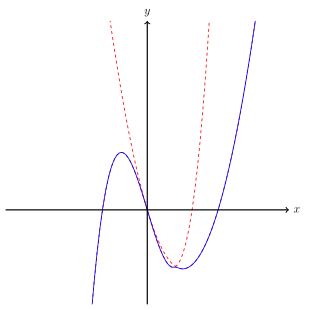
- Show that \((1, -3)\) is a local maximum point on the curve \(y = 2\mathrm{Min}(x^2, x^3) - 5x\) and find the other three local maxima and minima on this curve. Sketch the curve.
Solution:
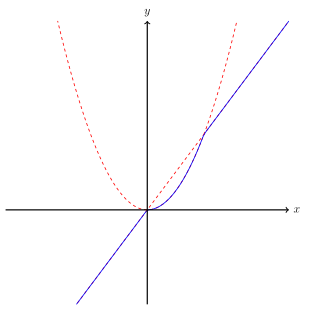
- \(2 \textrm{Min}(x^2,2x) = 5x-3\) tells us either \(2x^2 = 5x-3 \Rightarrow 2x^2 - 5x +3 = 0 \Rightarrow (2x-3)(x-1) \Rightarrow x = 1, \frac32\) and \(0 \leq x \leq 2\) or \(4x = 5x-3 \Rightarrow x= 3\) and \(x < 0\) or \(2 > x\), therefore our solutions are \(x = 1, \frac32, 3\)
- We have different cases based on \(x\) vs \(-2, 0, 2\), ie Case \(x \leq -2\): \begin{align*} && mx &= \mathrm{Min}(x^2, 2x) + \mathrm{Min}(x^3, 4x) \\ &&&= 2x + x^3 \end{align*} So \(2x = 2x + x^3 \Rightarrow x^3 = 0\), but \(x \leq -2\) so no solutions. or \(6x = 2x + x^3 \Rightarrow 0 = x(x^2-4) \Rightarrow x = 0, 2, -2\) so \(x = -2\). Case \(-2 < x \leq 0\): \begin{align*} && mx &= \mathrm{Min}(x^2, 2x) + \mathrm{Min}(x^3, 4x) \\ &&&= 2x + 4x \end{align*} So \(2x = 2x + 4x\) ie \(x = 0\) which is valid. Or \(6x = 2x + 4x\) ie valid for all values in \(-2 \leq x \leq 0\) Case \(0 < x \leq 2\): \begin{align*} && mx &= \mathrm{Min}(x^2, 2x) + \mathrm{Min}(x^3, 4x) \\ &&&= x^2 + x^3 \end{align*} So \(2x = x^2 + x^3 \Rightarrow 0 = x(x^2+x-2) = x(x-1)(x+2)\) so \(x = 0, 1, -2\), but the range means \(x = 0\) or \(x = 1\) Or \(6x = x^2 + x^3 \Rightarrow 0 = x(x^2+x-6) = x(x-2)(x+3)\) so \(x = 0, 2, -3\), but the range means \(x = 0\) or \(x = 2\) Case \(2 \leq x \): \begin{align*} && mx &= \mathrm{Min}(x^2, 2x) + \mathrm{Min}(x^3, 4x) \\ &&&=2x + 4x \end{align*} So \(2x = 2x + 4x \Rightarrow x = 0\) so no solutions. Or \(6x = 2x + 4x\) so a range of solutions. Therefore the final solutions for \(m = 2\) are \(x = 0, x = 1\) and for \(m = 2\) are \(x \in [-2,0] \cup [2, \infty)\)
- \(\mathrm{Min}(x^2, x^3)\) switches when \(x = 1\), so we must consider both limits:
\begin{align*}
&& \frac{\d y}{\d x}\vert_{x > 1} &= 4x - 5 \\
\\
&& \frac{\d y}{\d x}\vert_{x < 1} &= 6x^2 - 5 \\
\end{align*}
so when \(x = 1\) the sign of the derivative changes from positive to negative, hence a local maximum.
The other local maxima and minima will be when \(x = \frac54\) or \(x = \pm \sqrt{5/6}\)
2019 Paper 2 Q1
Let \(f(x) = (x-p)g(x)\), where g is a polynomial. Show that the tangent to the curve \(y = f(x)\) at the point with \(x = a\), where \(a \neq p\), passes through the point \((p, 0)\) if and only if \(g'(a) = 0\). The curve \(C\) has equation $$y = A(x - p)(x - q)(x - r),$$ where \(p\), \(q\) and \(r\) are constants with \(p < q < r\), and \(A\) is a non-zero constant.
- The tangent to \(C\) at the point with \(x = a\), where \(a \neq p\), passes through the point \((p, 0)\). Show that \(2a = q + r\) and find an expression for the gradient of this tangent in terms of \(A\), \(q\) and \(r\).
- The tangent to \(C\) at the point with \(x = c\), where \(c \neq r\), passes through the point \((r, 0)\). Show that this tangent is parallel to the tangent in part (i) if and only if the tangent to \(C\) at the point with \(x = q\) does not meet the curve again.
Solution: The tangent to the curve \(y = f(x)\) at \(x = a\) has the equation \(\frac{y-f(a)}{x-a} = f'(a) = g(a)+(a-p)g'(a)\). This passes through \((p,0)\) iff \begin{align*} && \frac{-f(a)}{p-a} &= g(a)+(a-p)g'(a) \\ \Leftrightarrow && -f(a) &= (p-a)g(a) -(a-p)^2g'(a) \\ \Leftrightarrow && -f(a) &= -f(a) -(a-p)^2g'(a) \\ \Leftrightarrow && 0 &= g'(a) \\ \end{align*}
- In this case \(g(x) = A(x-q)(x-r) = A(x^2-(q+r)x+qr)\) and so we must have that \(g'(a) = 0\), ie \(A(2a-(q+r)) = 0 \Rightarrow 2a = q+r\) The gradient is \(g(a) +(a-p)g'(a) = g(a) = A(a-q)(a-r)\)
- By the same reasoning, but with \(g(x) = A(x-p)(x-q)\) we have the gradient is \(A(c-p)(c-r)\). This is parallel iff \begin{align*} && (c-p)(c-r) &= (a-q)(a-r) \end{align*} The tangent at \(x = q\) is \(\frac{y-0}{x-q} = A(q-p)(q-r)\) or \( y = A(q-p)(q-r)(x-q)\)
2015 Paper 3 Q6
- Let \(w\) and \(z\) be complex numbers, and let \(u= w+z\) and \(v=w^2+z^2\). Prove that \(w\) and \(z\) are real if and only if \(u\) and \(v\) are real and \(u^2\le2v\).
- The complex numbers \(u\), \(w\) and \(z\) satisfy the equations \begin{align*} w+z-u&=0 \\ w^2+z^2 -u^2 &= - \tfrac 23 \\ w^3+z^3 -\lambda u &= -\lambda\, \end{align*} where \(\lambda \) is a positive real number. Show that for all values of \(\lambda\) except one (which you should find) there are three possible values of \(u\), all real. Are \(w\) and \(z\) necessarily real? Give a proof or counterexample.
Solution:
- Notice that \(u^2 = v+2wz\), so \(w,z\) are roots of the quadratic \(t^2 -ut+\frac{u^2-v}{2}\). Therefore they are both real if \(u^2 \geq 2(u^2-v) \Rightarrow 2v \geq u^2\).
- \begin{align*} && w+z &= u \\ && w^2+z^2 &= u^2 - \tfrac23 \\ && w^3+z^3 &= \lambda(u-1) \\ \\ && wz &= \frac{u^2 - (u^2-\tfrac23)}{2} = \tfrac13\\ \\ && (w+z)(w^2+z^2) &= w^3+z^3+wz(w+z) \\ &&u(u^2-\tfrac23)&= \lambda(u-1)+\frac13u \\ \Rightarrow && u^3-u&= \lambda (u-1) \\ \Rightarrow && 0 &= (u-1)(u(u+1) - \lambda) \\ \Rightarrow && 0 &= (u-1)(u^2+u - \lambda) \end{align*} Therefore there will be at most 3 values for \(u\), unless \(1\) is a root of \(u^2+u-\lambda\), ie \(\lambda = 2\). Suppose \(u = 1\), then we have: \(w+z = 1, wz = 1/3 \Rightarrow w,z = \frac{-1 \pm \sqrt{-1/3}}{2}\) which are clearly complex.
2014 Paper 1 Q5
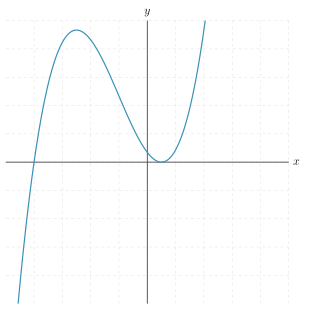
- Let \(f(x) = (x+2a)^3 -27 a^2 x\), where \(a\ge 0\). By sketching \(f(x)\), show that \(f(x)\ge 0\) for \(x \ge0\).
- Use part (i) to find the greatest value of \(xy^2\) in the region of the \(x\)-\(y\) plane given by \(x\ge0\), \(y\ge0\) and \(x+2y\le 3\,\). For what values of \(x\) and \(y\) is this greatest value achieved?
- Use part (i) to show that \((p+q+r)^3 \ge 27pqr\) for any non-negative numbers \(p\), \(q\) and \(r\). If \((p+q+r)^3 = 27pqr\), what relationship must \(p\), \(q\) and \(r\) satisfy?
Solution:
- Note that \(f(x) = (x+2a)^3 - 27a^2x\) so \(f'(x) = 3(x+2a)^2-27a^2 = 3x^2+12ax-15a^2 = (x-a)(3x+15a)\) so the turning points are at \(x = a, x = -5a\). But \(f(a) = 0\), so the curve just touches the \(x\)-axis. Note also that \(f(0) = 8a^3 \geq 0\) so:
- \(\,\) \begin{align*} && 0 &\leq (x+2y)^3 - 27y^2 x \\ &&& \leq 3^3 - 27 y^2 x \\ &&&= 27(1-y^2x) \\ \Rightarrow && xy^2 &\leq1 \end{align*} with equality when \(x = y = 1\)
- Notice that \begin{align*} && 0 &\leq (p+q+r)^3 - 27\left (\frac{q+r}{2}\right)^2 p \\ \Rightarrow && (p+q+r)^3 &\geq 27\left (\frac{q+r}{2}\right)^2 p \\ &&&\underbrace{\geq}_{AM-GM} 27\left (\sqrt{qr}\right)^2 p \\ &&&= 27pqr \end{align*} Equality can only hold if \(p = \frac{q+r}{2}\), but by symmetry we must also have \(q = \frac{r+p}{2}, r = \frac{p+q}{2}\) ie \(p = q = r\). And indeed equality does hold in this case.
2013 Paper 2 Q3
- Given that the cubic equation \(x^3+3ax^2 + 3bx +c=0\) has three distinct real roots and \(c<0\), show with the help of sketches that either exactly one of the roots is positive or all three of the roots are positive.
- Given that the equation \(x^3 +3ax^2+3bx+c=0\) has three distinct real positive roots show that \begin{equation*} a^2>b>0, \ \ \ \ a<0, \ \ \ \ c<0\,. \tag{\(*\)} \end{equation*} [Hint: Consider the turning points.]
- Given that the equation \(x^3 +3ax^2+3bx+c=0\) has three distinct real roots and that \begin{equation*} ab<0, \ \ \ \ c>0\,, \end{equation*} determine, with the help of sketches, the signs of the roots.
- Show by means of an explicit example (giving values for \(a\), \(b\) and \(c\)) that it is possible for the conditions (\(*\)) to be satisfied even though the corresponding cubic equation has only one real root.
Solution:
- First notice that this cubic has leading first term \(1\) and three real roots, so it must have the shape:
With the \(x\)-axis running somewhere between the dashed lines. Since \(c < 0\), the \(y\)-axis must meet the curve below the \(x\)-axis, ie somewhere on the blue section of this curve:
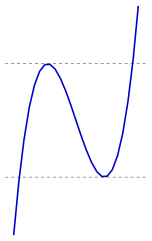 Therefore there will be either \(1\) (if it meets it in the \(\cup\) area) or \(3\) (if it meets it on the far left) positive roots.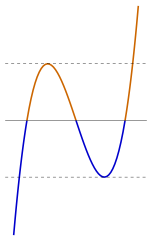
- First notice that if \(c > 0\) we cannot have three positive real roots since the function would need to pass \(0\) between \(0\) and \(-\infty\). Secondly, notice both turning points must be larger than zero, ie \begin{align*} && 0 &= 3x^2 + 6ax + 3b \\ \Leftrightarrow && 0 &= (x+a)^2 + b - a^2 \end{align*} has both roots larger than zero, (and it needs to have two roots, so \(a^2 > b\) and \(-a > 0\), ie \(a < 0\). If \(b < 0\), then just looking at \(x^2+2ax+b\) we can see that it is \(<0\) at \(0\) and one of the roots will be negative, therefore \(c < 0\), \(a^2 > b > 0\) and \(a < 0\)
- Since \(c > 0\) we can see that at least one root is negative.
ie the \(y\)-axis passes through an orange section of this curve. What now matters is where the larger turning point is. Considering \(x^2 + 2ax + b\), we notice that \(ab < 0\) means that \((x-\alpha)(x-\beta)\) we must have \((\alpha + \beta)\alpha \beta > 0\) which isn't possible if both roots are negative. Therefore the \(y\)-axis passes through the orange \(\cap\) and there are \(2\) positive real roots.
- If we take \(a = 1, b = -1, c = 1\) then we have \(x^3 + 3x^2-3x+1\). This has turning points when \(x^2+2x-1 = 0\), ie \(x = -1 \pm \sqrt{2}\) Notice that \begin{align*} && y(-1\pm \sqrt2) &= (-1 \pm \sqrt{2})^3 + 3(-1 \pm \sqrt{2})^2-3(-1 \pm \sqrt{2}) + 1 \\ &&&= (-1\pm \sqrt{2}) \cdot (3 \mp 2\sqrt2) + 3(3 \mp \sqrt2) -3(-1\pm \sqrt2) + 1 \\ &&&= (-7 \pm 5 \sqrt2) + (9 \mp 3\sqrt2) +(3 \mp 3\sqrt2) + 1 \\ &&&= 24 \mp 16\sqrt2 = 8(3 \mp 2 \sqrt2) >0 \end{align*} ie both turning points are above zero and hence only one real root
2011 Paper 1 Q8
- The numbers \(m\) and \(n\) satisfy
\[
m^3=n^3+n^2+1\,.
\tag{\(*\)}
\]
- Show that \(m > n\). Show also that \(m < n+1\) if and only if \(2n^2+3n > 0\,\). Deduce that \(n < m < n+1\) unless \(-\frac32 \le n \le 0\,\).
- Hence show that the only solutions of \((*)\) for which both \(m\) and \(n\) are integers are \((m,n) = (1,0)\) and \((m,n)= (1,-1)\).
- Find all integer solutions of the equation \[ p^3=q^3+2q^2-1\,. \]
2010 Paper 2 Q2
Prove that \[ \cos 3x = 4 \cos^3 x - 3 \cos x \,. \] Find and prove a similar result for \(\sin 3x\) in terms of \(\sin x\).
- Let \[ {\rm I}(\alpha) = \int_0^\alpha \big(7\sin x - 8 \sin^3 x\big) \d x\,. \] Show that \[ {\rm I}(\alpha) = -\tfrac 8 3 c^3 + c +\tfrac5 3\,, \] where \(c = \cos \alpha\). Write down one value of \(c\) for which \({\rm I}(\alpha) =0\).
- Useless Eustace believes that \[ \int \sin^n x \, \d x =\dfrac {\sin^{n+1}x}{n+1}\, \] for \(n=1, \ 2, \ 3, \ldots\, \). Show that Eustace would obtain the correct value of \({\rm I}(\beta)\,\), where \(\cos \beta= -\frac16\). Find all values of \(\alpha\) for which he would obtain the correct value of \({\rm I}(\alpha)\).
Solution: \begin{align*} \cos 3x &\equiv \cos (2x + x) \\ &\equiv \cos 2x \cos x - \sin 2x \sin x \\ &\equiv (2\cos^2 x - 1) \cos x - 2 \sin x \cos x \sin x \\ &\equiv 2 \cos^3 x - \cos x - 2\cos x (\sin^2 x) \\ &\equiv 2 \cos^3 x - \cos x - 2\cos x (1- \cos^2 x) \\ &\equiv 4\cos^3 x - 3\cos x \end{align*} Similarly, \begin{align*} \sin 3x &\equiv \sin (2x + x) \\ &\equiv \sin 2x \cos x + \cos 2x \sin x \\ &\equiv 2 \sin x \cos x \cos x + (1-2\sin^2 x) \sin x \\ &\equiv 2 \sin x (1-\sin^2 x) + \sin x - 2 \sin^3 x \\ &\equiv 3 \sin x -4 \sin ^3 x \end{align*}
- \begin{align*} I(\alpha) &= \int_0^{\alpha} (7 \sin x - 8 \sin^3 x) \d x \\ &= \int_0^{\alpha} (7 \sin x - (6\sin x-2 \sin 3x) ) \d x \\ &= \int_0^{\alpha} (\sin x +2 \sin 3x ) \d x \\ &= -\cos \alpha - \frac23 \cos 3\alpha +1+\frac23 \\ &= -c - \frac23 (4c^3-3c) + \frac53 \\ &= -\frac83 c^3 +c + \frac53 \end{align*} as required. When \(c = -1\) this value is \(0\). Eustace will obtain the value \(\frac{7}{2} \sin^2 \beta - 2 \sin^4 \beta = \frac72 (1-\cos^2 \beta) - 2(1-\cos^2 \beta)^2 = \frac32 + \frac12\cos^2 \beta -2\cos^4 \beta\) So if \(\cos \beta = -\frac16\) he will obtain \(\frac32 + \frac{1}{2\cdot36} - \frac{2}{6^4}\) and he should obtain \(\frac{8}{3} \frac{1}{6^3} - \frac{1}{6} + \frac{5}{3}\) which are equal. We want to find all roots of: \begin{align*} && \frac32 + \frac12 c^2 - 2c^4 &= -\frac83 c^3+ c + \frac53 \\ \Rightarrow && 0 &=2c^4-\frac83c^3-\frac12 c^2+c +\frac{1}{6} \\ &&&= 12c^4-16c^3-3c^2+6c+1\\ &&&= (6c+1)(2c^3-3c^2+1) \\ &&&= (6c+1)(2c+1)(c-1)^2 \end{align*} Therefore \(\cos \alpha = - \frac16, -\frac12, 1\) will give the correct answers.
2009 Paper 3 Q5
The numbers \(x\), \(y\) and \(z\) satisfy \begin{align*} x+y+z&= 1\\ x^2+y^2+z^2&=2\\ x^3+y^3+z^3&=3\,. \end{align*} Show that \[ yz+zx+xy=-\frac12 \,.\] Show also that \(x^2y+x^2z+y^2z+y^2x+z^2x+z^2y=-1\,\), and hence that \[ xyz=\frac16 \,.\] Let \(S_n=x^n+y^n+z^n\,\). Use the above results to find numbers \(a\), \(b\) and \(c\) such that the relation \[ S_{n+1}=aS_{n}+bS_{n-1}+cS_{n-2}\,, \] holds for all \(n\).
Solution: \begin{align*} && (x+y+z)^2 &= x^2 + y^2 + z^2 + 2(xy+yz+zx) \\ \Rightarrow && 1^2 &= 2 + 2(xy+yz+zx) \\ \Rightarrow && xy+yz+zx &= -\frac12 \end{align*} \begin{align*} && 1 \cdot 2 &= (x+y+z)(x^2+y^2+z^2) \\ &&&= x^3 + y^3 + z^3 + x^2y+x^2z+y^2z+y^2x+z^2x+z^2y \\ &&&= 3 + x^2y+x^2z+y^2z+y^2x+z^2x+z^2y\\ \Rightarrow && -1 &= x^2y+x^2z+y^2z+y^2x+z^2x+z^2y \end{align*} \begin{align*} && (x+y+z)^3 &= x^3 + y^3 + z^3 + \\ &&&\quad \quad 3xy^2 + 3xz^2 + \cdots + 3zx^2 + 3zy^2 + \\ &&&\quad \quad \quad 6xyz \\ \Rightarrow && 1 &= 3 + 3(-1) + 6xyz \\ \Rightarrow && xyz &= \frac16 \end{align*} Since we have \(f(t) = (t-x)(t-y)(t-z) = t^3-t^2-\frac12 t - \frac16\) is zero for \(x,y,z\) we can notice that: \(t^{n+1} = t^n +\frac12 t^{n-1} + \frac16 t^{n-2}\) is also true for \(x,y,z\) (by multiplying by \(t^{n-2}\). Therefore: \(S_{n+1} = S_n + \frac12 S_{n-1} + \frac16 S_{n-2}\)
2008 Paper 2 Q3
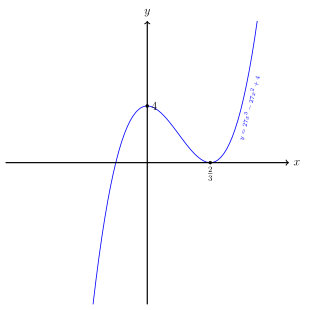
- Find the coordinates of the turning points of the curve \(y=27x^3-27x^2+4\). Sketch the curve and deduce that \(x^2(1-x)\le 4/27\) for all \(x\ge0\,\). Given that each of the numbers \(a\), \(b\) and \(c\) lies between \(0\) and \(1\), prove by contradiction that at least one of the numbers \(bc(1-a)\), \(ca(1-b)\) and \(ab(1-c)\) is less than or equal to \(4/27\).
- Given that each of the numbers \(p\) and \(q\) lies between \(0\) and \(1\), prove that at least one of the numbers \(p(1-q)\) and \(q(1-p)\) is less than or equal to \(1/4\).
Solution:
- \(\,\)
\begin{align*}
&& y & = 27x^3 - 27x^2 + 4 \\
\Rightarrow && \frac{\d y}{\d x} &= 81x^2 - 54x \\
\Rightarrow && x &= 0, \frac23 \\
\Rightarrow && (x,y) &= (0, 4), \left (\frac23, 0 \right)
\end{align*}
Since \(f(x) \geq 0\) for \(x \geq 0\) we must have \(27x^2(1-x) \leq 4 \Rightarrow x^2(1-x) \leq \frac{4}{27}\) Suppose for contradiction that \(bc(1-a) > \frac{4}{27}, ca(1-b) > \frac{4}{27}, ab(1-c) > \frac{4}{27}\) then taking the product we see \begin{align*} && \left ( \frac{4}{27} \right)^3 &< bc(1-a) \cdot ca(1-b) \cdot ab(1-c) \\ &&&= a^2(1-c) \cdot b^2(1-b) \cdot c^2(1-c) \leq \left ( \frac{4}{27}\right)^3 \end{align*} which is a contradiction.
- Notice that \(f(x) = x(1-x)\) has a turning point at \((\frac12, \frac14)\), and so \(f(x) \leq \frac14\). Suppose for contradiction that both \(p(1-q)\) and \(q(1-p)\) are larger than \(1/4\) \begin{align*} && \left ( \frac14 \right)^2 &< p(1-q) \cdot q(1-p) \\ &&&= p(1-p) \cdot q(1-q) \\ &&&\leq \left ( \frac14 \right)^2 \end{align*} which is a contradiction.
2007 Paper 1 Q8
A curve is given by the equation \[ y = ax^3 - 6ax^2+ \left( 12a + 12 \right)x - \left( 8a + 16 \right)\,, \tag{\(*\)} \] where \(a\) is a real number. Show that this curve touches the curve with equation \[ y=x^3 \tag{\(**\)} \] at \(\left( 2 \, , \, 8 \right)\). Determine the coordinates of any other point of intersection of the two curves.
- Sketch on the same axes the curves \((*)\) and \((**)\) when \(a = 2\).
- Sketch on the same axes the curves \((*)\) and \((**)\) when \(a = 1\).
- Sketch on the same axes the curves \((*)\) and \((**)\) when \(a = -2\).
Solution: \begin{align*} && y &= ax^3 - 6ax^2+ \left( 12a + 12 \right)x - \left( 8a + 16 \right) \\ && y(2) &= 8a-24a+24a+24-8a-16 \\ &&&= 8 \\ && y'(x) &= 3ax^2-12ax+(12a+12) \\ && y'(0) &= 12a-24a+12a+12 \\ &&&= 12 \end{align*} Therefore since our curve has the same value and gradient at \((2,8)\) as \(y = x^3\) they must touch at this point. Therefore \begin{align*} && ax^3 - 6ax^2+ \left( 12a + 12 \right)x - \left( 8a + 16 \right) - x^3 &= (x-2)^2((a-1)x-(2a+4)) \end{align*} Therefore if \(a \neq 1\), they touch again when \(x = \frac{2a+4}{a-1}\).


2007 Paper 2 Q2
A curve has equation \(y=2x^3-bx^2+cx\). It has a maximum point at \((p,m)\) and a minimum point at \((q,n)\) where \(p>0\) and \(n>0\). Let \(R\) be the region enclosed by the curve, the line \(x=p\) and the line \(y=n\).
- Express \(b\) and \(c\) in terms of \(p\) and \(q\).
- Sketch the curve. Mark on your sketch the point of inflection and shade the region \(R\). Describe the symmetry of the curve.
- Show that \(m-n=(q-p)^3\).
- Show that the area of \(R\) is \(\frac12 (q-p)^4\).
Solution:
- \(\,\) \begin{align*} && y &= 2x^3-bx^2+cx \\ \Rightarrow && y' &= 6x^2-2bx+c \end{align*} We must have \(p, q\) are the roots of this equation, ie \(\frac13b = p+q, \frac16c = pq\)
- The point of inflection will be at \(\frac{b}6\)
The graph will have rotational symmetry of \(180^{\circ}\) about the point of inflection.

- \begin{align*} && m-n &= 2(p^3-q^3)-b(p^2-q^2)+c(p-q) \\ &&&= (p-q)(2(p^2+qp+q^2)-b(p+q)+c) \\ &&&= (p-q)(2(p^2+qp+q^2)-3(p+q)^2+6pq) \\ &&&= (p-q)(-p^2-q^2+2pq) \\ &&&= (q-p)^3 \end{align*}
- The area of \(R\) is \begin{align*} A &= \frac12 bh \\ &= \frac12 (q-p)(m-n) = \frac12(q-p)^4 \end{align*} as required.
2006 Paper 1 Q3
In this question \(b\), \(c\), \(p\) and \(q\) are real numbers.
- By considering the graph \(y=x^2 + bx + c\) show that \(c < 0\) is a sufficient condition for the equation \(\displaystyle x^2 + bx + c = 0\) to have distinct real roots. Determine whether \(c < 0\) is a necessary condition for the equation to have distinct real roots.
- Determine necessary and sufficient conditions for the equation \(\displaystyle x^2 + bx + c = 0\) to have distinct positive real roots.
- What can be deduced about the number and the nature of the roots of the equation \(x^3 + px + q = 0\) if \(p>0\) and \(q<0\)? What can be deduced if \(p<0\,\) and \(q<0\)? You should consider the different cases that arise according to the value of \(4p^3+ 27q^2\,\).
Solution:
- Since \(y(0) < 0\) and \(y(\pm \infty) > 0\) we must cross the axis twice. Therefore there are two distinct real roots. It is not necessary, for example \((x-2)(x-3)\) has distinct real roots by the constant term is \(6 > 0\)

- For \(x^2+bx+c=0\) to have distinct, positive real roots we need \(\Delta > 0\) and \(\frac{-b -\sqrt{\Delta}}{2a} > 0\) where \(\Delta = b^2-4ac\), ie \(b < 0\) and \(b^2 > \Delta = b^2-4ac\) or \(4ac > 0\). Therefore we need \(b^2-4ac > 0, b < 0, 4ac > 0\)
- Since \(q < 0\) at least one of the roots is positive. The gradient is \(3x^2+p > 0\) therefore there is exactly one positive root. If \(p < 0\) then there are turning points when \(3x^2+p = 0\) ie \(x = \pm \sqrt{\frac{-p}{3}}\). If the first turning point is above the \(x\)-axis then there will be 3 roots. If it is on the \(x\)-axis then 2, otherwise only 1. \begin{align*} y &= \left (-\sqrt{\frac{-p}{3}}\right)^3 + p\left (-\sqrt{\frac{-p}{3}}\right)+q \\ &= \sqrt{\frac{-p}{3}} \left (p - \frac{p}{3} \right) + q \\ &= \frac{2}{3} \sqrt{\frac{-p}{3}}p +q \\ \end{align*} Therefore it is positive if \(-\frac{4}{27}p^3 >q^2\) ie if \(4p^3+27q^2 < 0\)
2003 Paper 3 Q5
Find the coordinates of the turning point on the curve \(y = x^2 - 2bx + c\,\). Sketch the curve in the case that the equation \(x^2 - 2bx + c=0\) has two distinct real roots. Use your sketch to determine necessary and sufficient conditions on \(b\) and \(c\) for the equation \(x^2 - 2bx + c = 0\) to have two distinct real roots. Determine necessary and sufficient conditions on \(b\) and \(c\) for this equation to have two distinct positive roots. Find the coordinates of the turning points on the curve \(y = x^3 - 3b^2x + c\) (with \(b>0\)) and hence determine necessary and sufficient conditions on \(b\) and \(c\) for the equation \(x^3 - 3b^2x + c = 0\) to have three distinct real roots. Determine necessary and sufficient conditions on \(a\,\), \(b\) and \(c\) for the equation \(\l x - a \r^3 - 3b^2 \l x - a \r + c = 0\) to have three distinct positive roots. Show that the equation \(2x^3 - 9x^2 + 7x - 1 = 0\) has three distinct positive roots.
Solution: \begin{align*} y &= x^2-2bx+c \\ &= (x-b)^2+c-b^2 \end{align*} Therefore the turning point is at \((b,c-b^2)\)


2002 Paper 3 Q4
Show that if \(x\) and \(y\) are positive and \(x^3 + x^2 = y^3 - y^2\) then \(x < y\,\). Show further that if \(0 < x \le y - 1\), then \(x^3 + x^2 < y^3 - y^2\). Prove that there does not exist a pair of {\sl positive} integers such that the difference of their cubes is equal to the sum of their squares. Find all the pairs of integers such that the difference of their cubes is equal to the sum of their squares.
2001 Paper 1 Q3
Sketch, without calculating the stationary points, the graph of the function \(\f(x)\) given by \[ \f(x) = (x-p)(x-q)(x-r)\;, \] where \(p < q < r\). By considering the quadratic equation \(\f'(x)=0\), or otherwise, show that \[ (p+q+r)^2 > 3(qr+rp+pq)\;. \] By considering \((x^2+gx+h)(x-k)\), or otherwise, show that \(g^2>4h\,\) is a sufficient condition but not a necessary condition for the inequality \[ (g-k)^2>3(h-gk) \] to hold.
Solution:
