Problems
Filters
8 problems found
2022 Paper 3 Q7
Let \(\mathbf{n}\) be a vector of unit length in three dimensions. For each vector \(\mathbf{r}\), \(\mathrm{f}(\mathbf{r})\) is defined by \[ \mathrm{f}(\mathbf{r}) = \mathbf{n} \times \mathbf{r}\,. \]
- Given that \[ \mathbf{n} = \begin{pmatrix} a \\ b \\ c \end{pmatrix} \quad \text{and} \quad \mathbf{r} = \begin{pmatrix} x \\ y \\ z \end{pmatrix}, \] show that the \(x\)-component of \(\mathrm{f}(\mathrm{f}(\mathbf{r}))\) is \(-x(b^2+c^2)+aby+acz\). Show further that \[ \mathrm{f}(\mathrm{f}(\mathbf{r})) = (\mathbf{n}.\mathbf{r})\mathbf{n} - \mathbf{r}\,. \] Explain, by means of a diagram, how \(\mathrm{f}(\mathrm{f}(\mathbf{r}))\) is related to \(\mathbf{n}\) and \(\mathbf{r}\).
- Let \(R\) be the point with position vector \(\mathbf{r}\) and \(P\) be the point with position vector \(\mathrm{g}(\mathbf{r})\), where \(\mathrm{g}\) is defined by \[ \mathrm{g}(\mathbf{s}) = \mathbf{s} + \sin\theta\,\mathrm{f}(\mathbf{s}) + (1-\cos\theta)\,\mathrm{f}(\mathrm{f}(\mathbf{s}))\,. \] By considering \(\mathrm{g}(\mathbf{n})\) and \(\mathrm{g}(\mathbf{r})\) when \(\mathbf{r}\) is perpendicular to \(\mathbf{n}\), state, with justification, the geometric transformation which maps \(R\) onto \(P\).
- Let \(R\) be the point with position vector \(\mathbf{r}\) and \(Q\) be the point with position vector \(\mathrm{h}(\mathbf{r})\), where \(\mathrm{h}\) is defined by \[ \mathrm{h}(\mathbf{s}) = -\mathbf{s} - 2\,\mathrm{f}(\mathrm{f}(\mathbf{s}))\,. \] State, with justification, the geometric transformation which maps \(R\) onto \(Q\).
2019 Paper 3 Q8
A pyramid has a horizontal rectangular base \(ABCD\) and its vertex \(V\) is vertically above the centre of the base. The acute angle between the face \(AVB\) and the base is \(\alpha\), the acute angle between the face \(BVC\) and the base is \(\beta\) and the obtuse angle between the faces \(AVB\) and \(BVC\) is \(\pi - \theta\).
- The edges \(AB\) and \(BC\) are parallel to the unit vectors \(\mathbf{i}\) and \(\mathbf{j}\), respectively, and the unit vector \(\mathbf{k}\) is vertical. Find a unit vector that is perpendicular to the face \(AVB\). Show that $$\cos \theta = \cos \alpha \cos \beta.$$
- The edge \(BV\) makes an angle \(\phi\) with the base. Show that $$\cot^2 \phi = \cot^2 \alpha + \cot^2 \beta.$$ Show also that $$\cos^2 \phi = \frac{\cos^2 \alpha + \cos^2 \beta - 2 \cos^2 \theta}{1 - \cos^2 \theta} \geq \frac{2 \cos \theta - 2 \cos^2 \theta}{1 - \cos^2 \theta}$$ and deduce that \(\phi < \theta\).
Solution:
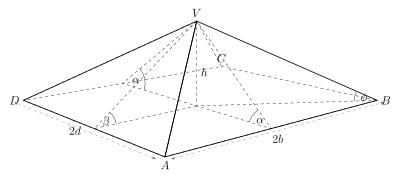
- Let \(A = (0,0,0)\) and then \(B = 22b \mathbf{i}, D = 2d\mathbf{j}, C = 2b\mathbf{i}+2d\mathbf{j}\) and \(V = b \mathbf{i} + d\mathbf{j} + h\mathbf{k}\) We also have \begin{align*} && \tan \alpha &= \frac{h}{d}\\ && \tan \beta &= \frac{d}{b} \\ && \vec{AV} \times \vec{VB} &= \begin{pmatrix} b \\ d \\ h \end{pmatrix} \times \begin{pmatrix} -b \\ d \\ h \end{pmatrix} \\ &&&= \begin{pmatrix} 0 \\ -2bh \\ 2db \end{pmatrix} \\ &&&= 2b \begin{pmatrix} 0 \\ -d \tan \alpha \\ d \end{pmatrix} \\ &&&= k \begin{pmatrix} 0 \\ - \sin \alpha \\ \cos \alpha \end{pmatrix} \end{align*} similarly for the vector perpendicular to the other face it must be \(\begin{pmatrix}-\sin \beta \\ 0 \\ \cos \beta \end{pmatrix}\) Looking at the angle between these perpendicular (to find the angles between the faces we see: \begin{align*} \begin{pmatrix} 0 \\ - \sin \alpha \\ \cos \alpha \end{pmatrix} \cdot \begin{pmatrix}-\sin \beta \\ 0 \\ \cos \beta \end{pmatrix} &= \cos \alpha \cos \beta \end{align*} But this is also \(\pi -\) the angle between the planes, ie \(\cos \theta = \cos \alpha \cos \beta\)
- \(\,\) \begin{align*} && \cot^2 \phi &= \frac{b^2+d^2}{h^2} \\ && \cot^2 \alpha &= \frac{d^2}{h^2} \\ && \cot^2 \beta &= \frac{b^2}{h^2} \\ \Rightarrow && cot^2 \phi &= \cot^2 \beta+\cot^2 \alpha \end{align*} \begin{align*} && \cos^2 \phi &= \frac{b^2+d^2}{b^2+d^2+h^2} \\ && \cos^2 \alpha &= \frac{d^2}{d^2+h^2} \\ && \cos^2 \beta &= \frac{b^2}{b^2+h^2} \\ && \frac{\cos^2 \alpha + \cos^2 \beta - 2 \cos^2 \theta}{1-\cos^2 \theta} &= \frac{\frac{d^2}{d^2+h^2}+\frac{b^2}{b^2+h^2}-2\cdot \frac{d^2}{d^2+h^2} \cdot \frac{b^2}{b^2+h^2}}{1 - \frac{d^2}{d^2+h^2} \cdot\frac{b^2}{b^2+h^2}} \\ &&&= \frac{d^2(b^2+h^2)+b^2(d^2+h^2)-2d^2b^2}{(d^2+h^2)(b^2+h^2)-d^2b^2} \\ &&&= \frac{h^2(b^2+d^2)}{h^2(b^2+d^2+h^2)} \\ &&&= \frac{b^2+d^2}{b^2+d^2+h^2} \\ &&&= \cos^2\phi \end{align*} Also notice that \begin{align*} && \cos^2 \alpha + \cos^2 \beta &\underbrace{\geq}_{AM-GM} 2 \cos \alpha \cos \beta \\ &&&= 2 \cos \theta \\ \Rightarrow && \frac{\cos^2 \alpha + \cos^2 \beta - 2 \cos^2 \theta}{1-\cos^2 \theta} &\geq \frac{2 \cos \theta - 2\cos^2 \theta}{1-\cos^2 \theta} \\ &&&= \frac{2\cos \theta}{1+\cos \theta} = \cos \theta \frac{2}{1+\cos \theta} \\ &&&> \cos^2 \theta \\ \Rightarrow && \phi &< \theta \end{align*}
1995 Paper 3 Q8
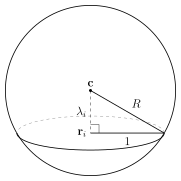
A plane \(\pi\) in 3-dimensional space is given by the vector equation \(\mathbf{r}\cdot\mathbf{n}=p,\) where \(\mathbf{n}\) is a unit vector and \(p\) is a non-negative real number. If \(\mathbf{x}\) is the position vector of a general point \(X\), find the equation of the normal to \(\pi\) through \(X\) and the perpendicular distance of \(X\) from \(\pi\). The unit circles \(C_{i},\) \(i=1,2,\) with centres \(\mathbf{r}_{i},\) lie in the planes \(\pi_{i}\) given by \(\mathbf{r}\cdot\mathbf{n}_{i}=p_{i},\) where the \(\mathbf{n}_{i}\) are unit vectors, and \(p_{i}\) are non-negative real numbers. Prove that there is a sphere whose surface contains both circles only if there is a real number \(\lambda\) such that \[ \mathbf{r}_{1}+\lambda\mathbf{n}_{1}=\mathbf{r}_{2}\pm\lambda\mathbf{n}_{2}. \] Hence, or otherwise, deduce the necessary conditions that \[ (\mathbf{r}_{1}-\mathbf{r}_{2})\cdot(\mathbf{n}_{1}\times\mathbf{n}_{2})=0 \] and that \[ (p_{1}-\mathbf{n}_{1}\cdot\mathbf{r}_{2})^{2}=(p_{2}-\mathbf{n}_{2}\cdot\mathbf{r}_{1})^{2}. \] Interpret each of these two conditions geometrically.
Solution: The equation of the normal to \(\pi\) through \(X\) is \(\mathbf{x} + \lambda \mathbf{n}\). The distance is \(|\mathbf{x}\cdot \mathbf{n}-p|\) We know that the centre of the sphere must lie above the centre of the circle following the normal, ie \(\mathbf{c} = \mathbf{r}_1+\lambda_1 \mathbf{n}_1 = \mathbf{r}_2+\lambda_2 \mathbf{n}_2\)
1993 Paper 2 Q4
Two non-parallel lines in 3-dimensional space are given by \(\mathbf{r}=\mathbf{p}_{1}+t_{1}\mathbf{m}_{1}\) and \(\mathbf{r}=\mathbf{p}_{2}+t_{2}\mathbf{m}_{2}\) respectively, where \(\mathbf{m}_{1}\) and \(\mathbf{m}_{2}\) are unit vectors. Explain by means of a sketch why the shortest distance between the two lines is \[ \frac{\left|(\mathbf{p}_{1}-\mathbf{p}_{2})\cdot(\mathbf{m}_{1}\times\mathbf{m}_{2})\right|}{\left|(\mathbf{m}_{1}\times\mathbf{m}_{2})\right|}. \]
- Find the shortest distance between the lines in the case \[ \mathbf{p}_{1}=(2,1,-1)\qquad\mathbf{p}_{2}=(1,0,-2)\qquad\mathbf{m}_{1}=\tfrac{1}{5}(4,3,0)\qquad\mathbf{m}_{2}=\tfrac{1}{\sqrt{10}}(0,-3,1). \]
- Two aircraft, \(A_{1}\) and \(A_{2},\) are flying in the directions given by the unit vectors \(\mathbf{m}_{1}\) and \(\mathbf{m}_{2}\) at constant speeds \(v_{1}\) and \(v_{2}.\) At time \(t=0\) they pass the points \(\mathbf{p}_{1}\) and \(\mathbf{p}_{2}\), respectively. If \(d\) is the shortest distance between the two aircraft during the flight, show that \[ d^{2}=\frac{\left|\mathbf{p}_{1}-\mathbf{p}_{2}\right|^{2}\left|v_{1}\mathbf{m}_{1}-v_{2}\mathbf{m}_{2}\right|^{2}-[(\mathbf{p}_{1}-\mathbf{p}_{2})\cdot(v_{1}\mathbf{m}_{1}-v_{2}\mathbf{m}_{2})]^{2}}{\left|v_{1}\mathbf{m}_{1}-v_{2}\mathbf{m}_{2}\right|^{2}}. \]
- Suppose that \(v_{1}\) is fixed. The pilot of \(A_{2}\) has chosen \(v_{2}\) so that \(A_{2}\) comes as close as possible to \(A_{1}.\) How close is that, if \(\mathbf{p}_{1},\mathbf{p}_{2},\mathbf{m}_{1}\) and \(\mathbf{m}_{2}\) are as in (i)?
1992 Paper 2 Q9
Let \(\mathbf{a},\mathbf{b}\) and \(\mathbf{c}\) be the position vectors of points \(A,B\) and \(C\) in three-dimensional space. Suppose that \(A,B,C\) and the origin \(O\) are not all in the same plane. Describe the locus of the point whose position vector \(\mathbf{r}\) is given by \[ \mathbf{r}=(1-\lambda-\mu)\mathbf{a}+\lambda\mathbf{b}+\mu\mathbf{c}, \] where \(\lambda\) and \(\mu\) are scalar parameters. By writing this equation in the form \(\mathbf{r}\cdot\mathbf{n}=p\) for a suitable vector \(\mathbf{n}\) and scalar \(p\), show that \[ -(\lambda+\mu)\mathbf{a}\cdot(\mathbf{b}\times\mathbf{c})+\lambda\mathbf{b}\cdot(\mathbf{c}\times\mathbf{a})+\mu\mathbf{c}\cdot(\mathbf{a}\times\mathbf{b})=0 \] for all scalars \(\lambda,\mu.\) Deduce that \[ \mathbf{a}\cdot(\mathbf{b}\times\mathbf{c})=\mathbf{b}\cdot(\mathbf{c}\times\mathbf{a})=\mathbf{c}\cdot(\mathbf{a}\times\mathbf{b}). \] Say briefly what happens if \(A,B,C\) and \(O\) are all in the same plane.
Solution: \(\mathbf{r}=(1-\lambda-\mu)\mathbf{a}+\lambda\mathbf{b}+\mu\mathbf{c} = \mathbf{a} + \lambda(\mathbf{b}-\mathbf{a})+\mu(\mathbf{c}-\mathbf{a})\) Therefore it is the plane through \(\mathbf{a}\) with direction vectors \(\mathbf{b}-\mathbf{a}\) and \(\mathbf{c}-\mathbf{a}\), ie it is the plane through \(\mathbf{a},\mathbf{b},\mathbf{c}\). The normal to this plane will be \((\mathbf{b}-\mathbf{a} ) \times (\mathbf{c}-\mathbf{a}) = \mathbf{b}\times \mathbf{c}-\mathbf{a} \times \mathbf{c}-\mathbf{b}\times \mathbf{a}\), so we must have: \begin{align*} && \mathbf{r} \cdot \left (\mathbf{b}\times \mathbf{c}-\mathbf{a} \times \mathbf{c}-\mathbf{b}\times \mathbf{a} \right) &= \mathbf{a} \cdot \left (\mathbf{b}\times \mathbf{c}-\mathbf{a} \times \mathbf{c}-\mathbf{b}\times \mathbf{a} \right) \\ &&&= \mathbf{a} \cdot (\mathbf{b}\times \mathbf{c}) \end{align*} Therefore, \begin{align*} && \mathbf{a} \cdot (\mathbf{b}\times \mathbf{c}) &= \mathbf{r} \cdot \left (\mathbf{b}\times \mathbf{c}-\mathbf{a} \times \mathbf{c}-\mathbf{b}\times \mathbf{a} \right) \\ &&&= \left ( (1-\lambda-\mu)\mathbf{a}+\lambda\mathbf{b}+\mu\mathbf{c} \right)\cdot \left (\mathbf{b}\times \mathbf{c}-\mathbf{a} \times \mathbf{c}-\mathbf{b}\times \mathbf{a} \right) \\ &&&= (1-\lambda- \mu) \mathbf{a}\cdot (\mathbf{b} \times \mathbf{c})-\lambda \mathbf{b}\cdot(\mathbf{a} \times \mathbf{c})-\mu \mathbf{c}\cdot(\mathbf{b} \times \mathbf{a}) \\ \Rightarrow && 0 &= (-\lambda- \mu) \mathbf{a}\cdot (\mathbf{b} \times \mathbf{c})-\lambda \mathbf{b}\cdot(\mathbf{a} \times \mathbf{c})-\mu \mathbf{c}\cdot(\mathbf{b} \times \mathbf{a}) \\ &&&= -(\lambda+ \mu) \mathbf{a}\cdot (\mathbf{b} \times \mathbf{c})+\lambda \mathbf{b}\cdot(\mathbf{c} \times \mathbf{a})+\mu \mathbf{c}\cdot(\mathbf{a} \times \mathbf{b}) \\ \end{align*} The result follows from setting \(\mu = 0, \lambda = 1\) and \(\mu = 1, \lambda = 0\). If they all lie in the same plane then the plane described is through the origin, and those values are all the same, but equal to \(0\).
1990 Paper 3 Q14
The edges \(OA,OB,OC\) of a rigid cube are taken as coordinate axes and \(O',A',B',C'\) are the vertices diagonally opposite \(O,A,B,C,\) respectively. The four forces acting on the cube are \[ \begin{pmatrix}\alpha\\ \beta\\ \gamma \end{pmatrix}\mbox{ at }O\ (0,0,0),\ \begin{pmatrix}\lambda\\ 0\\ 1 \end{pmatrix}\mbox{ at }O'\ (a,a,a),\ \begin{pmatrix}-1\\ 0\\ 2 \end{pmatrix}\mbox{ at }B\ (0,a,0),\ \mbox{ and }\begin{pmatrix}1\\ \mu\\ \nu \end{pmatrix}\mbox{ at }B'\ (a,0,a). \] The moment of the system about \(O\) is zero: find \(\lambda,\mu\) and \(\nu\).
- Given that \(\alpha=\beta=\gamma=0,\) find the system consisting of a single force at \(B\) together with a couple which is equivalent to the given system.
- Given that \(\alpha=2,\beta=3\) and \(\gamma=2,\) find the equation of the locus about each point of which the moment of the system is zero. Find the number of units of work done on the cube when it moves (without rotation) a distance in the direction of this line under the action of the given forces only.
Solution: \begin{align*} &&\mathbf{M} &= \begin{pmatrix}\lambda \\ 0\\ 1 \end{pmatrix} \times \begin{pmatrix}a\\ a \\ a \end{pmatrix} + \begin{pmatrix}-1\\ 0\\ 2 \end{pmatrix} \times \begin{pmatrix} 0 \\ a \\ 0 \end{pmatrix} + \begin{pmatrix}1\\ \mu\\ \nu \end{pmatrix} \times \begin{pmatrix} a \\ 0 \\ a \end{pmatrix} \\ &&&= \begin{pmatrix} -a \\ -a(\lambda -1) \\ \lambda a \end{pmatrix} + \begin{pmatrix} -2a \\ 0 \\ -a \end{pmatrix} + \begin{pmatrix} \mu a \\ -a(1-\nu) \\ -a \mu \end{pmatrix} \\ &&&=a \begin{pmatrix} \mu - 3 \\ \nu - \lambda \\ \lambda-1-\mu \end{pmatrix} \\ \Rightarrow && \mu &= 3, \lambda = 4, \nu = 4 \end{align*}
- To find the force we add all vectors: \begin{align*} \mathbf{F} &= \begin{pmatrix}\lambda \\ 0\\ 1 \end{pmatrix} + \begin{pmatrix}-1\\ 0\\ 2 \end{pmatrix} + \begin{pmatrix}1\\ \mu\\ \nu \end{pmatrix} \\ &= \begin{pmatrix}4\\ 0\\ 1 \end{pmatrix} + \begin{pmatrix}-1\\ 0\\ 2 \end{pmatrix} + \begin{pmatrix}1\\ 3 \\ 4 \end{pmatrix} \\ &= \begin{pmatrix} 4 \\ 3 \\ 7 \end{pmatrix} \end{align*} Since the moment about \(O\) is \(0\), we have the moment about \(B\) is: \begin{align*} \mathbf{M} &= \begin{pmatrix} 0 \\ a \\ 0 \end{pmatrix} \times \begin{pmatrix} 4 \\ 3 \\ 7\end{pmatrix} \\ &= \begin{pmatrix} 7a \\ 0 \\ -4a\end{pmatrix} \end{align*}
- \begin{align*} \mathbf{0} &= \mathbf{r} \times \begin{pmatrix} 4 + 2 \\ 3+3 \\ 7+2 \end{pmatrix} \\ &= \mathbf{r} \times \begin{pmatrix} 6 \\ 6 \\ 9 \end{pmatrix} \\ \end{align*} Therefore \(\mathbf{r} = t\begin{pmatrix} 2 \\ 2 \\ 3 \end{pmatrix}\) (ie a line) \begin{align*} \text{Work done} &= \text{Force} \cdot \text{distance} \end{align*} Since they are parallel, it's just the magnitude of the force, which is \(3\sqrt{2^2+2^2+3^2} = 3\sqrt{17}\)
1989 Paper 3 Q2
The points \(A,B\) and \(C\) lie on the surface of the ground, which is an inclined plane. The point \(B\) is 100m due north of \(A,\) and \(C\) is 60m due east of \(B\). The vertical displacements from \(A\) to \(B,\) and from \(B\) to \(C\), are each 5m downwards. A plane coal seam lies below the surface and is to be located by making vertical bore-holes at \(A,B\) and \(C\). The bore-holes strike the coal seam at 95m, 45m and 76m below \(A,B\) and \(C\) respectively. Show that the coal seam is inclined at \(\cos^{-1}(\frac{4}{5})\) to the horizontal. The coal seam comes to the surface along a line. Find the bearing of this line.
Solution: Set up a coordinate system so that \(x\) is E-W, \(y\) is N-S and \(z\) is the vertical direction. Also assume \(B\) is the origin, then, \(A = \begin{pmatrix} 0 \\ -100 \\ 5\end{pmatrix}, B = \begin{pmatrix} 0 \\ 0 \\ 0\end{pmatrix}, C= \begin{pmatrix} 60 \\ 0\\ -5\end{pmatrix},\). The coal seam has points: \(\begin{pmatrix} 0 \\ -100 \\ -90\end{pmatrix}, \begin{pmatrix} 0 \\ 0 \\ -45\end{pmatrix}, \begin{pmatrix} 60 \\ 0\\ -81\end{pmatrix},\) Therefore we can find the normal to the coal seam: \begin{align*} \mathbf{n} &= \left (\begin{pmatrix} 0 \\ -100 \\ -90\end{pmatrix} - \begin{pmatrix} 0 \\ 0 \\ -45\end{pmatrix}\right ) \times \left ( \begin{pmatrix} 60 \\ 0\\ -81\end{pmatrix} - \begin{pmatrix} 0 \\ 0 \\ -45\end{pmatrix}\right ) \\ &= \begin{pmatrix} 0 \\ - 100 \\ -45\end{pmatrix} \times \begin{pmatrix} 60 \\ 0 \\ -36\end{pmatrix} \\ &= \begin{pmatrix} 3600 \\ -60 \cdot 45 \\ 60 \cdot 100 \end{pmatrix} \\ &= 300\begin{pmatrix} 12 \\ -9 \\ 20\end{pmatrix} \end{align*} To measure the incline \(\theta\) to the horizontal we can take a dot with \(\hat{\mathbf{k}}\), to see: \begin{align*} \cos \theta &= \frac{20}{\sqrt{12^2+(-9)^2+20^2} \sqrt{1^2+0^2+0^2}} \\ &= \frac{20}{25} \\ &= \frac{4}{5} \end{align*} Therefore the angle is \(\cos^{-1} \tfrac 45\) The equation of the seam is \(12x - 9y + 20z = -900\). The equation of the surface is \(5x + 3y + 60z = 0\) We can compute the direction of the overlap again with a cross product: \begin{align*} \mathbf{d} &= \begin{pmatrix} 12 \\ -9 \\ 20\end{pmatrix} \times \begin{pmatrix} 5 \\ 3 \\ 60\end{pmatrix} \\ &= \begin{pmatrix} -600 \\ -620 \\ 81 \end{pmatrix} \end{align*} To get the bearing of this vector we just need to look at the \(x\) and \(y\) components, so it will be \(\tan^{-1} \frac{600}{620} = \tan^{-1} \frac{30}{31}\)
1988 Paper 2 Q10
The surface \(S\) in 3-dimensional space is described by the equation \[ \mathbf{a}\cdot\mathbf{r}+ar=a^{2}, \] where \(\mathbf{r}\) is the position vector with respect to the origin \(O\), \(\mathbf{a}(\neq\mathbf{0})\) is the position vector of a fixed point, \(r=\left|\mathbf{r}\right|\) and \(a=\left|\mathbf{a}\right|.\) Show, with the aid of a diagram, that \(S\) is the locus of points which are equidistant from the origin \(O\) and the plane \(\mathbf{r}\cdot\mathbf{a}=a^{2}.\) The point \(P\), with position vector \(\mathbf{p},\) lies in \(S\), and the line joining \(P\) to \(O\) meets \(S\) again at \(Q\). Find the position vector of \(Q\). The line through \(O\) orthogonal to \(\mathbf{p}\) and \(\mathbf{a}\) meets \(S\) at \(T\) and \(T'\). Show that the position vectors of \(T\) and \(T'\) are \[ \pm\frac{1}{\sqrt{2ap-a^{2}}}\mathbf{a}\times\mathbf{p}, \] where \(p=\left|\mathbf{p}\right|.\) Show that the area of the triangle \(PQT\) is \[ \frac{ap^{2}}{2p-a}. \]
Solution: The plane is the same as the plane \((\mathbf{r} - \mathbf{a}) \cdot \mathbf{a} = 0\), ie the plane through \(\mathbf{a}\) whose normal is parallel to \(\mathbf{a}\) The distance from \(\mathbf{r}\) to the plane therefore is \(\lambda\) where \(\mathbf{r}+\lambda \frac{1}{a}\mathbf{a}\) must be on the plane, ie \((\mathbf{r}+\frac{\lambda}{a} \mathbf{a} - \mathbf{a})\cdot \mathbf{a} = 0 \Rightarrow \lambda = \frac{a^2-\mathbf{a} \cdot \mathbf{r}}{a}\) But if \(\mathbf{a} \cdot \mathbf{r} = a^2 - ar\) then \(\lambda = r\), ie the distance to the plane is the same as the distance to the origin. \(\mathbf{q} = k \mathbf{p}\) and so \(\mathbf{a} \cdot k \mathbf{p} + a |k|p = a^2\) if \(k > 0\) we will find \(k = 1\) the position vector we already know about, therefore suppose \(k < 0\) so: \begin{align*} && \mathbf{a} \cdot k \mathbf{p} - ka p &= a^2 \\ \Rightarrow && k(a^2-ap)-kap &= a^2 \\ \Rightarrow && k(a^2-2ap) &= a^2 \\ \Rightarrow && k &= \frac{a^2}{a^2-2ap} \end{align*} Therefore \(\mathbf{q} = \frac{a^2}{a^2-2ap} \mathbf{p}\) The line through \(O\) orthogonal to \(\mathbf{p}\) and \(\mathbf{a}\) will be parallel to \(\mathbf{a} \times \mathbf{p}\). Therefore we should consider points of the from \(s \mathbf{a} \times \mathbf{p}\) on the surface \(S\). \begin{align*} && s\mathbf{a} \cdot ( \mathbf{a} \times \mathbf{p}) + sa^2p |\sin \theta| &= a^2 \end{align*} The angle between \(\cos \theta = \frac{\mathbf{a} \cdot \mathbf{p}}{ap} = \frac{a^2-ap}{ap} \Rightarrow |\sin \theta| = \sqrt{1-\frac{(a-p)^2}{p^2}} = \frac{1}{p} \sqrt{2ap-a^2}\) Therefore \(sa^2 \sqrt{2ap-a^2} = a^2 \Rightarrow s = \frac{1}{\sqrt{2ap-a^2}}\) and so the points are as required. Noting that \(|\mathbf{p} \times \mathbf{t}| = |\frac{1}{p \sin \theta}\mathbf{p} \times (\mathbf{p} \times \mathbf{a}) | = |\frac{1}{p \sin \theta}p^2a \sin \theta | = pa\) The area of triangle \(PQT\) is : \begin{align*} \frac12 | (\mathbf{p} - \mathbf{t}) \times (\mathbf{q} - \mathbf{t}) | &= \frac12 |\mathbf{p} \times \mathbf{q} - \mathbf{t} \times \mathbf{q} - \mathbf{p} \times \mathbf{t} - \mathbf{t} \times \mathbf{t}| \\ &= \frac12 |\mathbf{t} \times (\mathbf{p} - \mathbf{q})| \\ &= \frac12 \cdot (1 - \frac{a^2}{a^2-2ap})| \mathbf{t} \times \mathbf{p}| \\ &= \frac12 \frac{2ap}{a^2-2ap} \cdot ap \\ &= \frac{ap^2}{a^2-ap} \end{align*}