Problems
Filters
5 problems found
2015 Paper 2 Q10
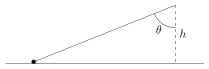
A particle of mass \(m\) is pulled along the floor of a room in a straight line by a light string which is pulled at constant speed \(V\) through a hole in the ceiling. The floor is smooth and horizontal, and the height of the room is \(h\). Find, in terms of \(V\) and \(\theta\), the speed of the particle when the string makes an angle of \(\theta\) with the vertical (and the particle is still in contact with the floor). Find also the acceleration, in terms of \(V\), \(h\) and \(\theta\). Find the tension in the string and hence show that the particle will leave the floor when \[ \tan^4\theta = \frac{V^2}{gh}\,. \]
Solution:
2014 Paper 2 Q11
A small smooth ring \(R\) of mass \(m\) is free to slide on a fixed smooth horizontal rail. A light inextensible string of length~\(L\) is attached to one end,~\(O\), of the rail. The string passes through the ring, and a particle~\(P\) of mass~\(km\) (where \(k>0\)) is attached to its other end; this part of the string hangs at an acute angle \(\alpha\) to the vertical and it is given that \(\alpha\) is constant in the motion. Let \(x\) be the distance between \(O\) and the ring. Taking the \(y\)-axis to be vertically upwards, write down the Cartesian coordinates of~\(P\) relative to~\(O\) in terms of \(x\), \(L\) and~\(\alpha\).
- By considering the vertical component of the equation of motion of \(P\), show that \[ km\ddot x \cos\alpha = T \cos\alpha - kmg\,, \] where \(T\) is the tension in the string. Obtain two similar equations relating to the horizontal components of the equations of motion of \(P\) and \(R\).
- Show that \(\dfrac {\sin\alpha}{(1-\sin\alpha)^2_{\vphantom|}} = k\), and deduce, by means of a sketch or otherwise, that motion with \(\alpha\) constant is possible for all values of~\(k\).
- Show that \(\ddot x = -g\tan\alpha\,\).
2007 Paper 3 Q9
Two small beads, \(A\) and \(B\), each of mass \(m\), are threaded on a smooth horizontal circular hoop of radius \(a\) and centre \(O\). The angle \(\theta\) is the acute angle determined by \(2\theta = \angle AOB\). The beads are connected by a light straight spring. The energy stored in the spring is \[ mk^2 a^2(\theta - \alpha)^2, \] where \(k\) and \(\alpha\) are constants satisfying \(k>0\) and \(\frac \pi 4< \alpha<\frac\pi2\). The spring is held in compression with \(\theta =\beta\) and then released. Find the period of oscillations in the two cases that arise according to the value of \(\beta\) and state the value of \(\beta\) for which oscillations do not occur.
1997 Paper 3 Q11
\(\,\)
1988 Paper 3 Q14
A small heavy bead can slide smoothly in a vertical plane on a fixed wire with equation \[ y=x-\frac{x^{2}}{4a}, \] where the \(y\)-axis points vertically upwards and \(a\) is a positive constant. The bead is projected from the origin with initial speed \(V\) along the wire.
- Show that for a suitable value of \(V\), to be determined, a motion is possible throughout which the bead exerts no pressure on the wire.
- Show that \(\theta,\) the angle between the particle's velocity at time \(t\) and the \(x\)-axis, satisfies \[ \frac{4a^{2}\dot{\theta}^{2}}{\cos^{6}\theta}+2ga(1-\tan^{2}\theta)=V^{2}. \]
Solution:
- The condition that the bead exerts no pressure on the wire is equivalent to the condition that the wire exerts no force on the bead. (Newton's Third Law). This is equivalent to the bead being projected under gravity. Notice that the initial projection is at \(45^{\circ}\) since \(\frac{dy}{dx}|_{x=0} = 1\). The position of the particle (under gravity) at time \(t\) is \(x = \frac{1}{\sqrt{2}}Vt\) and \(y = \frac{1}{\sqrt{2}}Vt - \frac12 gt^2 = x - \frac{1}{2}g \frac{2x^2}{V^2} = x - \frac{g}{V^2}x^2\). Therefore they follow the same trajectory if \(\frac{g}{V^2} = \frac{1}{4a} \Leftrightarrow V = 2\sqrt{ag}\)
- First note that the wire does no work as it is perpendicular to the velocity, so it is fine to use conservation of momentum. If we take our \(0\) GPE level to be be \(x = 0\), then we notice the initial energy is \(\frac12mV^2\). Secondly, notice that \(\tan \theta = \frac{\d y}{\d x} = 1- \frac{x}{2a} \Rightarrow x = 2a - 2a \tan \theta\) \begin{align*} y &= 2a(1-\tan \theta) - \frac{4a^2(1-\tan \theta)^2}{4a}\\ &= (1-\tan \theta)(2a-a(1-\tan \theta)) \\ &= a(1-\tan \theta)(1+\tan \theta) \\ &= a(1-\tan^2 \theta) \end{align*} GPE \(mga(1-\tan^2 \theta)\). To calculate the kinetic energy, notice that \(\dot{x} = v \cos \theta \dot{\theta}\) and \(\dot{x} = -2a\sec^2 \theta\dot{\theta} \Rightarrow v = -\frac{2a\dot{\theta} }{\cos^{3} \theta}\). Therefore, energy at time \(t\) is: \begin{align*} && \frac12 m V^2 &= \frac12 m \l - \frac{2a\dot{\theta}}{\cos^3 \theta} \r^2 + mga(1-\tan^2 \theta) \\ \Rightarrow && V^2 &= \frac{4a^2\dot{\theta}^2}{\cos^6 \theta} + 2ag(1-\tan^2 \theta) \end{align*}