Problems

Filters
Clear Filters

4 problems found

2018 Paper 3 Q10
D: 1700.0 B: 1484.0

A uniform disc with centre \(O\) and radius \(a\) is suspended from a point \(A\) on its circumference, so that it can swing freely about a horizontal axis \(L\) through \(A\). The plane of the disc is perpendicular to \(L\). A particle \(P\) is attached to a point on the circumference of the disc. The mass of the disc is \(M\) and the mass of the particle is \(m\). In equilibrium, the disc hangs with \(OP\) horizontal, and the angle between \(AO\) and the downward vertical through \(A\) is \(\beta\). Find \(\sin\beta\) in terms of \(M\) and \(m\) and show that \[ \frac{AP}{a} = \sqrt{\frac{2M}{M+m}} \,. \] The disc is rotated about \(L\) and then released. At later time \(t\), the angle between \(OP\) and the horizontal is \(\theta\); when \(P\) is higher than \(O\), \(\theta\) is positive and when \(P\) is lower than \(O\), \(\theta\) is negative. Show that \[ \tfrac12 I \dot\theta^2 + (1-\sin\beta)ma^2 \dot \theta^2 + (m+M)g a\cos\beta \, (1- \cos\theta) \] is constant during the motion, where \(I\) is the moment of inertia of the disc about \(L\). Given that \(m= \frac 32 M\) and that \(I=\frac32Ma^2\), show that the period of small oscillations is \[ 3\pi \sqrt{\frac {3a}{5g}} \,. \]


Solution:
TikZ diagram
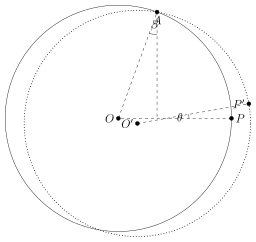
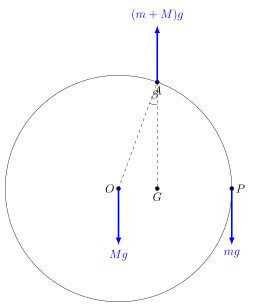
First, notice that the centre of mass will lie directly below \(A\) and will be \(\frac{m}{M+m}\) of the way between \(O\) and \(P\). Therefore \(\sin \beta = \frac{m}{M+m}\). The cosine rule states that: \begin{align*} && AP^2 &= a^2 + a^2 - 2a^2 \cos \angle AOP \\ \Rightarrow && \frac{AP^2}{a^2} &= 2 - 2 \sin \beta \\ &&&= \frac{2M+2m-2m}{M+m} \\ &&&= \frac{2M}{M+m} \\ \Rightarrow && \frac{AP}{a} &= \sqrt{\frac{2M}{M+m}} \end{align*}
TikZ diagram
Considering conservation of energy, we have: Rotational kinetic energy for the disc: \(\frac12 I \dot{\theta}^2\) Kinetic energy for the particle: \(\frac12 m (\dot{\theta} \sqrt{2-2\sin \beta} a)^2 = (1- \sin \beta)ma^2 \dot{\theta}^2\)
TikZ diagram
GPE: The important thing is the vertical location of \(G\). The triangle \(OAG\) will still have angle \(\beta\) at \(A\). The vertical height below is: \(\cos \theta \cdot AG = \cos \theta a \cos \beta\). The distance from when \(\theta = 0\) will be \(a \cos \beta (1- \cos \theta)\) and so the GPE will be \((M+m)ga \cos \beta ( 1- \cos \theta)\) we can therefore say by conservation of energy: \[ \frac12 I \dot{\theta}^2 + (1- \sin \beta)ma^2 \dot{\theta}^2+(M+m)ga \cos \beta ( 1- \cos \theta) \] is constant. Suppose \(m = \frac32 M\) and \(I = \frac32 Ma^2\) then differentiating the constant wrt to \(\theta\) gives \(\sin \beta = \frac{m}{M+m} = \frac{3}{5}, \cos \beta = \frac45\) \begin{align*} && 0 &= \frac12 \frac32 M a^2 \cdot 2 \dot{\theta}\ddot{\theta} + (1- \sin \beta)\frac32M a^2 2 \dot{\theta}\ddot{\theta} + (M+\frac32M) ga \cos \beta \sin \theta \cdot \dot{\theta} \\ \Rightarrow && 0 &= \frac32 \ddot{\theta} + 3(1-\sin \beta) \ddot{\theta} + \frac{5}{2}\frac{g}{a} \cos \beta \sin \theta \\ &&&= (\frac32 + \frac65) \ddot{\theta} + \frac{2g}{a} \sin \theta \\ &&&= \frac{27}{10} \ddot{\theta} + \frac{2g}{a} \sin \theta \end{align*} If \(\theta\) is small, we can approximate this by: \(\frac{27}{10} \ddot{\theta} + \frac{2g}{a} \theta = 0\) which will have period \(\displaystyle 2 \pi \sqrt{\frac{27a}{10\cdot2 g}} = 2 \pi \sqrt{\frac{3a}{5g}}\) as required.

1998 Paper 3 Q9
D: 1700.0 B: 1484.0

A uniform right circular cone of mass \(m\) has base of radius \(a\) and perpendicular height \(h\) from base to apex. Show that its moment of inertia about its axis is \({3\over 10} ma^2\), and calculate its moment of inertia about an axis through its apex parallel to its base. \newline[{\em Any theorems used should be stated clearly.}] The cone is now suspended from its apex and allowed to perform small oscillations. Show that their period is $$ 2\pi\sqrt{ 4h^2 + a^2\over 5gh} \,. $$ \newline[{\em You may assume that the centre of mass of the cone is a distance \({3\over 4}h\) from its apex.}]

1997 Paper 3 Q11
D: 1700.0 B: 1500.0

\(\,\)

\psset{xunit=1.0cm,yunit=1.0cm,algebraic=true,dotstyle=o,dotsize=3pt 0,linewidth=0.5pt,arrowsize=3pt 2,arrowinset=0.25} \begin{pspicture*}(-1.14,-1.32)(3.52,3.04) \psline(-0.92,2.74)(-0.06,-0.6) \psline(-0.06,-0.6)(2.66,-0.6) \psline(2.66,-0.6)(3.38,2.74) \psline[linewidth=0.1pt,linestyle=dashed,dash=2pt 2pt](1.22,-0.6)(1.22,2.74) \psline(3.07,2.11)(1.22,-0.6) \psline{<->}(1.37,-0.6)(3.17,1.99) \psline{<->}(1.06,-0.6)(1.05,1.76) \psdots[dotstyle=*](1.22,1.86) \rput[tl](0.88,2.2){\(\mathrm{G}\)} \rput[tl](0.73,0.6){\(h\)} \pscustom{\parametricplot{0.9714278016111888}{1.5707963267948966}{0.83*cos(t)+1.22|0.83*sin(t)+-0.6}\lineto(1.22,-0.6)\closepath} \rput[tl](2.36,0.54){\(l\)} \rput[tl](1.46,0.7){\(\beta \)} \rput[tl](1.15,-0.69){\(O\)} \begin{scriptsize} \psdots[dotsize=10pt 0,dotstyle=*](3.07,2.11) \end{scriptsize} \end{pspicture*} \par
A heavy symmetrical bell and clapper can both swung freely in a vertical plane about a point \(O\) on a horizontal beam at the apex of the bell. The mass of the bell is \(M\) and its moment of inertia about the beam is \(Mk^{2}\). Its centre of mass, \(G\), is a distance \(h\) from \(O\). The clapper may be regarded as a small heavy ball on a light rod of length \(l\). Initially the bell is held with its axis vertical and its mouth above the beam. The clapper ball rests against the side of the bell, with the rod making an angle \(\beta\) with the axis. The bell is then released. Show that, at the moment when the clapper and bell separate, the clapper rod makes an angle \(\alpha\) with the upwards vertical, where \[ \cot\alpha=\cot\beta-\frac{k^{2}}{hl}\mathrm{cosec}\beta. \]

1995 Paper 3 Q9
D: 1700.0 B: 1470.3

A thin circular disc of mass \(m\), radius \(r\) and with its centre of mass at its centre \(C\) can rotate freely in a vertical plane about a fixed horizontal axis through a point \(O\) of its circumference. A particle \(P\), also of mass \(m,\) is attached to the circumference of the disc so that the angle \(OCP\) is \(2\alpha,\) where \(\alpha\leqslant\pi/2\).

  1. In the position of stable equilibrium \(OC\) makes an angle \(\beta\) with the vertical. Prove that \[ \tan\beta=\frac{\sin2\alpha}{2-\cos2\alpha}. \]
  2. The density of the disc at a point distant \(x\) from \(C\) is \(\rho x/r.\) Show that its moment of inertia about the horizontal axis through \(O\) is \(8mr^{2}/5\).
  3. The mid-point of \(CP\) is \(Q\). The disc is held at rest with \(OQ\) horizontal and \(C\) lower than \(P\) and it is then released. Show that the speed \(v\) with which \(C\) is moving when \(P\) passes vertically below \(O\) is given by \[ v^{2}=\frac{15gr\sin\alpha}{2(2+5\sin^{2}\alpha)}. \] Find the maximum value of \(v^{2}\) as \(\alpha\) is varied.