Problems
Filters
5 problems found
2007 Paper 2 Q10
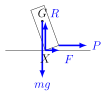
A solid figure is composed of a uniform solid cylinder of density \(\rho\) and a uniform solid hemisphere of density \(3\rho\). The cylinder has circular cross-section, with radius \(r\), and height \(3r\), and the hemisphere has radius \(r\). The flat face of the hemisphere is joined to one end of the cylinder, so that their centres coincide. The figure is held in equilibrium by a force \(P\) so that one point of its flat base is in contact with a rough horizontal plane and its base is inclined at an angle \(\alpha\) to the horizontal. The force \(P\) is horizontal and acts through the highest point of the base. The coefficient of friction between the solid and the plane is \(\mu\). Show that \[\mu \ge \left\vert \tfrac98 -\tfrac12 \cot\alpha\right\vert\,. \]
Solution: The centre of mass of the sphere will be at \((0, \frac{3}{2}r)\) and the centre of mass of the hemisphere will be at \((0, 3r + \frac38r)\), their masses will be \(3\pi r^3 \cdot \rho \) and \(\frac23 \pi r^3 \cdot 3\rho \), meaning the center of mass will be \(\frac{\frac92r + \frac{27}{8} \cdot 2r}{3 + 2} = \frac{45/4}{5}r = \frac{9}{4}r\) above the center of the base.
2003 Paper 1 Q10
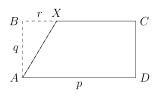
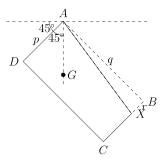
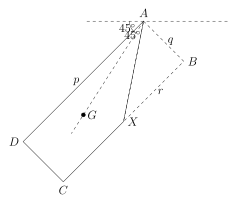
\(ABCD\) is a uniform rectangular lamina and \(X\) is a point on \(BC\,\). The lengths of \(AD\), \(AB\) and \(BX\) are \(p\,\), \(q\) and \(r\) respectively. The triangle \(ABX\) is cut off the lamina. Let \((a,b)\) be the position of the centre of gravity of the lamina, where the axes are such that the coordinates of \(A\,\), \(D\) and \(C\) are \((0,0)\,\), \((p,0)\) and \((p,q)\) respectively. Derive equations for \(a\) and \(b\) in terms of \(p\,\), \(q\) and \(r\,\). When the resulting trapezium is freely suspended from the point \(A\,\), the side \(AD\) is inclined at \(45^\circ\) below the horizontal. Show that \(\displaystyle r = q - \sqrt{q^2 - 3pq + 3p^2}\,\). You should justify carefully the choice of sign in front of the square root.
Solution:
1996 Paper 2 Q9
A child's toy consists of a solid cone of height \(\lambda a\) and a solid hemisphere of radius \(a\), made out of the same uniform material and fastened together so that their plane faces coincide. (Thus the diameter of the hemisphere is equal to that of the base of the cone.) Show that if \(\lambda < \sqrt{3}\) the toy will always move to an upright position if placed with the surface of the hemisphere on a horizontal table, but that if \(\lambda > \sqrt{3}\) the toy may overbalance. Show, however, that if the toy is placed with the surface of the cone touching the table it will remain there whatever the value of \(\lambda\). [The centre of gravity of a uniform solid cone of height \(h\) is a height \(h/4\) above its base. The centre of gravity of a uniform solid hemisphere of radius \(a\) is at distance \(3a/8\) from the centre of its base.]
Solution:


1993 Paper 1 Q11
A piece of uniform wire is bent into three sides of a square \(ABCD\) so that the side \(AD\) is missing. Show that if it is first hung up by the point \(A\) and then by the point \(B\) then the angle between the two directions of \(BC\) is \(\tan^{-1}18.\)
Solution:

1988 Paper 1 Q11
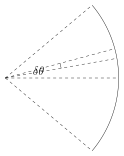
Derive a formula for the position of the centre of mass of a uniform circular arc of radius \(r\) which subtends an angle \(2\theta\) at the centre.

Solution: